What is the Best Literary Film Adaptation of the Last 50 Years?
The Bracket You Didn’t Know You Needed
If you’re a Lit Hub reader, there’s a good chance you have a few opinions about literary adaptations. Some are great. Many are bad. Others are frankly offensive (Ghibli’s Earthsea, I’m looking at you). A few are even better than the books they’re based on.
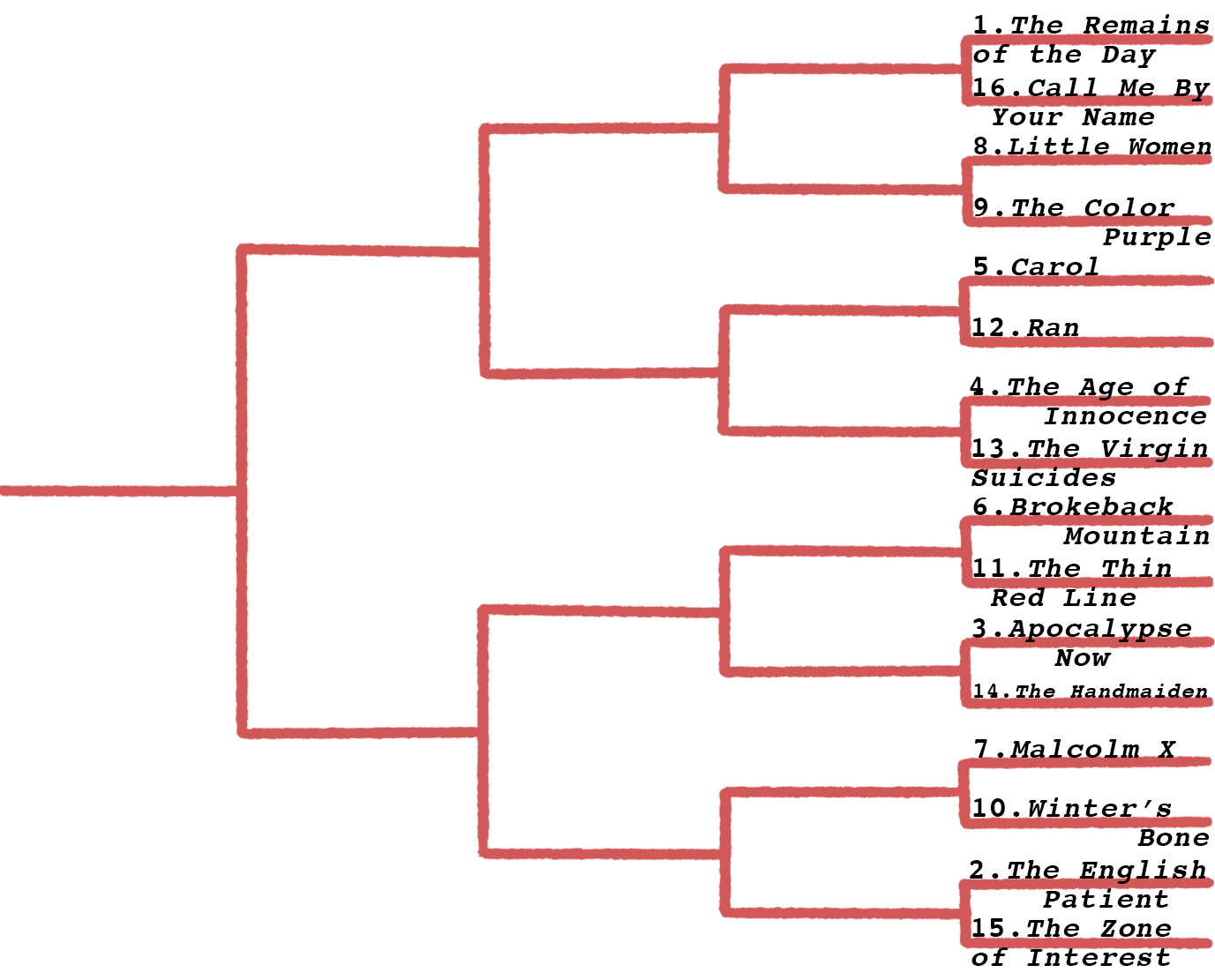
A great adaptation can redeem a flawed novel, cast new light on a favorite one, or introduce us to something new. It can also be simply pleasurable, and sometimes that’s enough. But which adaptation is best? To try and figure it out, we’ve compiled a list of 64 of our favorite adaptations* from the last 50 years (don’t worry, Old Hollywood-heads, the pre-1976 bracket is coming) but we need your help.
Voting is now open for our Best Contemporary Literary Film Adaptations Bracket. We’ve got faithful adaptations, wild reimaginings, and everything in between. We’ve got meta-adaptations, thematic adaptations, and tonal adaptations. We’ve got movies based on novels, short stories, and one ancient epic poem. And we have The Lord of the Rings, of course.
*Obligatory disclaimer: As always, the initial draft picks are based on the taste, interests, opinions, and sometimes the whims of the Literary Hub staff. If your favorite movie is not here, we are sorry. Also, you’re probably wrong.
So without further ado: cue the projectionist and roll that bracket:
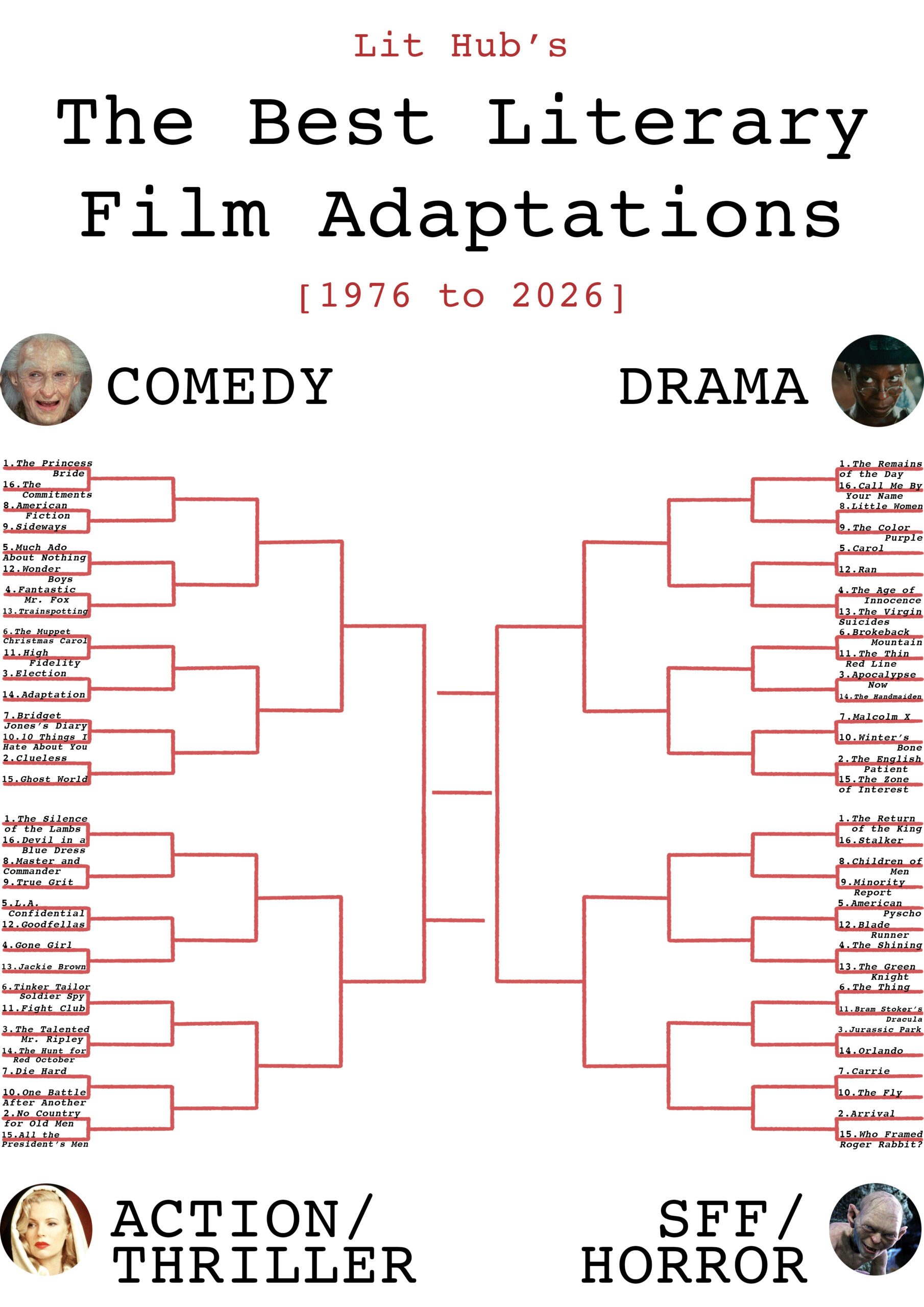
[Click image to enlarge and zoom]
*
INSTRUCTIONS:
We’re looking for the best contemporary film based on a book, short story, or play. In some cases we considered the difficulty and/or finesse of the adaptation itself, but mostly the question at hand is an easy one: Which movie, given the options, do you like best? That’s what you should vote for.
We’ve sorted our top 64 choices into four genre categories: Comedy, Drama, Action & Thriller, and Sci-Fi, Fantasy & Horror. Normal bracket rules apply, because sports. Each quadrant’s winner will face off on Friday, before the final head-to-head on Monday, April 20th to crown our winner.
*
VOTING SCHEDULE:
➤ Round of 64: Voting open Monday, April 13th from 10:00 AM – 7:00 PM EDT
Round of 32: Voting open Tuesday, April 14th from 10:00 AM – 7:00 PM EDT
Round of 16: Voting open Wednesday, April 15th from 10:00 AM – 7:00 PM EDT
The Quarterfinals : Voting open Thursday April 16th from 10:00 AM – 7:00 PM EDT
The Semifinals: Voting open Friday, April 17th from 10:00 AM, until Sunday April 19th at 7:00 PM EDT
The Finals: Voting open Monday, April 20th from 10:00 AM – 7:00 PM EDT
And the winner will be announced on Tuesday, April 21st!
*
HOW TO VOTE:
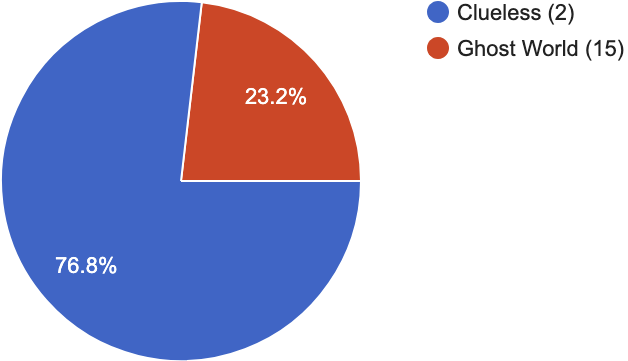
We’ve got handy voting forms embedded below. Simply select which movie you think should advance, and we’ll tabulate the votes at the end of each day.
*
And now, your feature presentation…

*
MATCHUP:
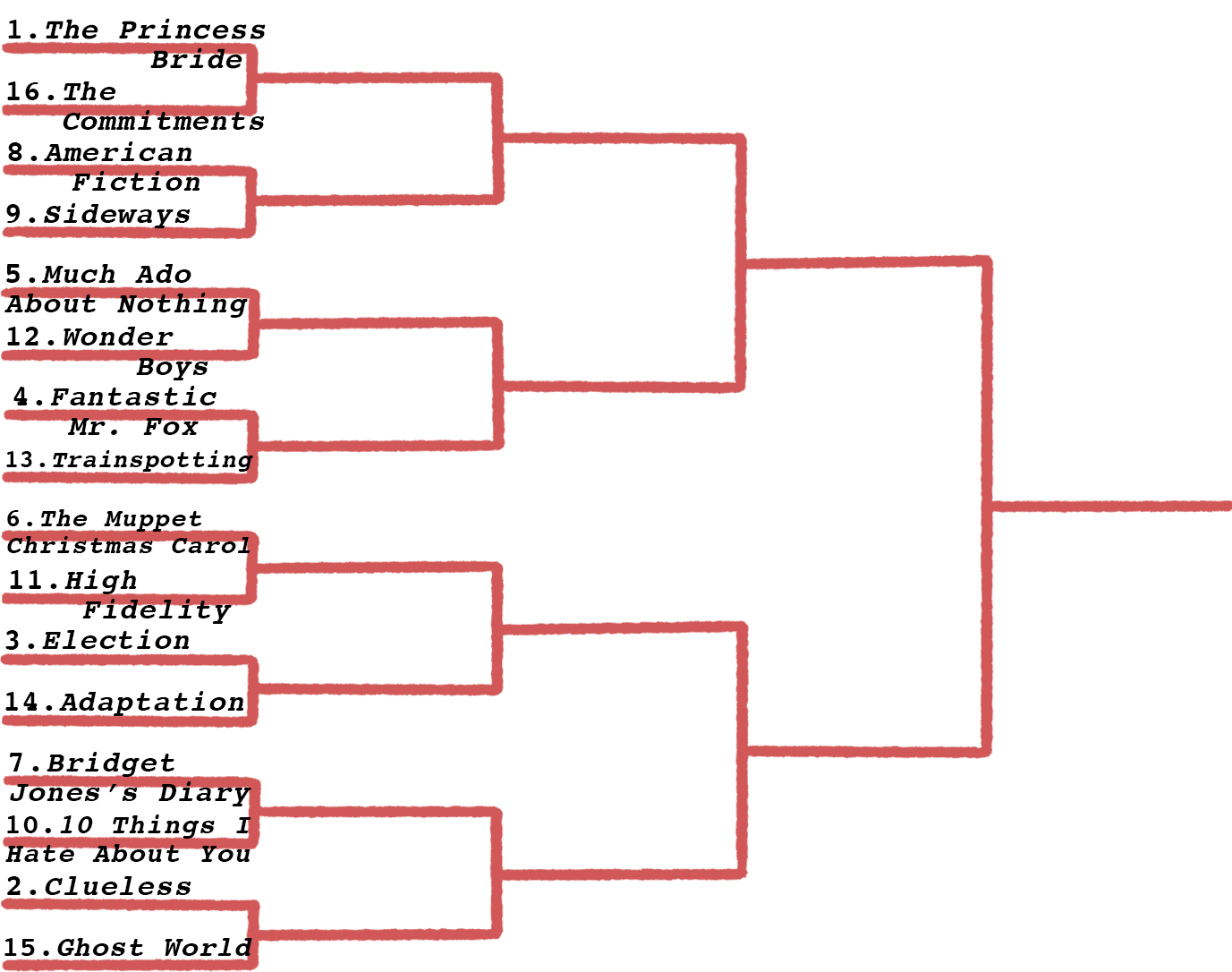
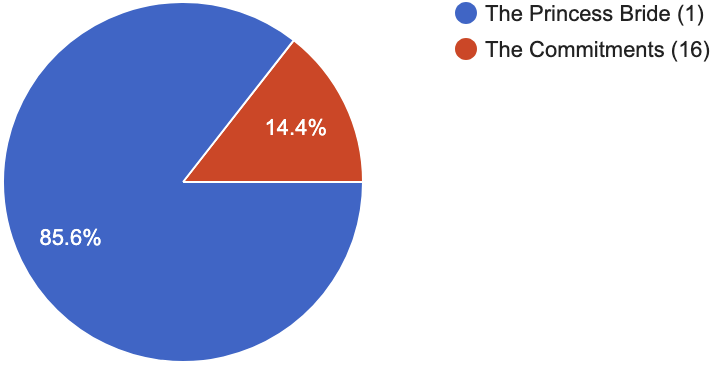
The Princess Bride (1) vs. The Commitments (16)
******************************************
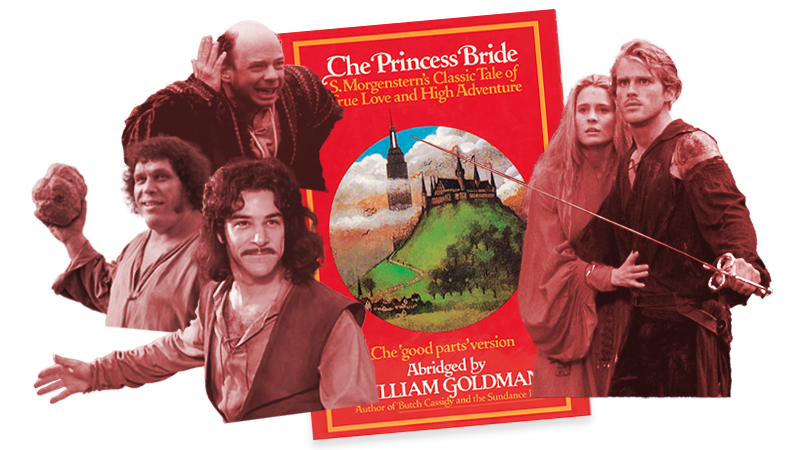 The Princess Bride
dir. Rob Reiner, 1987
Based on William Goldman’s The Princess Bride (1973)
Sub-genres: Your Bisexual Awakening • Cult Movies of Unusual Resonance(s) • Endlessly Quotable • Peak Patinkin
There are few films with a higher delight-to-runtime ratio than The Princess Bride. Its particular alchemy of postmodern irreverence and slapstick buffoonery has made it an enduring cult classic despite its initially underwhelming box office returns. Of course, it benefits from being adapted by Goldman himself—not so often is the author of the source text also an Academy Award-winning screenwriter—and from the fact that it was a particular passion project for Reiner, whose father had given him the book, and who was determined to adapt it despite the fact that Hollywood considered it unadaptable.
“When I first met Bill Goldman to talk about this,” Reiner remembered, “he said, ‘This is my favorite thing I’ve ever written, and I want this on my tombstone. And what are you going to do with it?’” Well, we all know the answer to that. –Emily Temple, Managing Editor
 See also:
What Makes The Princess Bride Such a Great Movie • How Loving The Princess Bride Led Me to Buddhism
••••••••••vs••••••••••
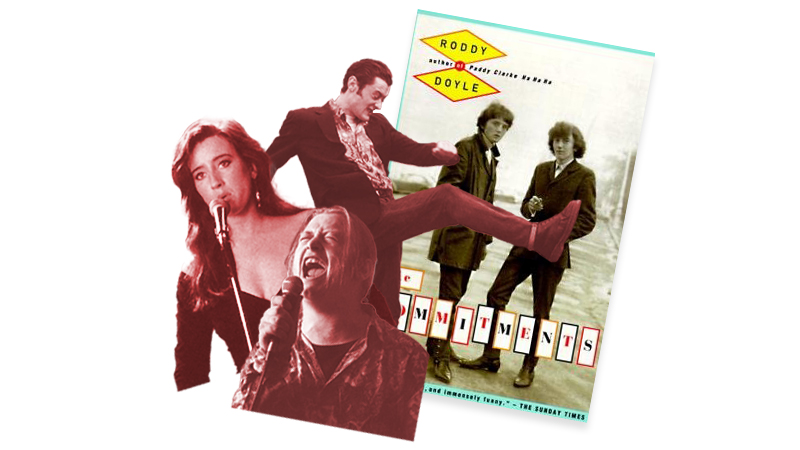 The Commitments
dir. Alan Parker, 1991
Based on Roddy Doyle’s The Commitments (1987)
Sub-genres: The Doyle-iverse • Great Nicknames • Cultural Exchanges • Great Moments in UK Up-Yours, Reverse-V Signs
It’s the tunes for me. Because the minute I was asked to imagine “Dublin Soul,” I needed to hear it. The 1991 adaptation of Roddy Doyle’s novel follows a bunch of working class Irish heroes in somewhat-unlikely-thrall to Otis Redding. The movie’s own soul hinges on lengthy, stirring performances from the band. With special props to the mad frontman, Deco (Andrew Strong). –Brittany Allen, Staff Writer
 See also:
Reading at Full Volume: Seven Books That Feature Rock Music • On the Rise and Fall of Fictional Rock Stars
*
MATCHUP:
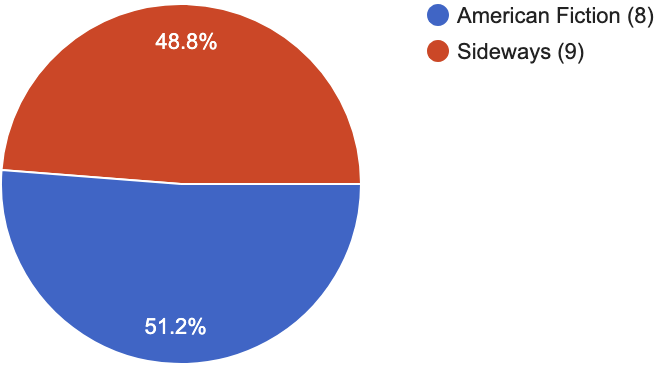
American Fiction (8) vs. Sideways (9)
******************************************
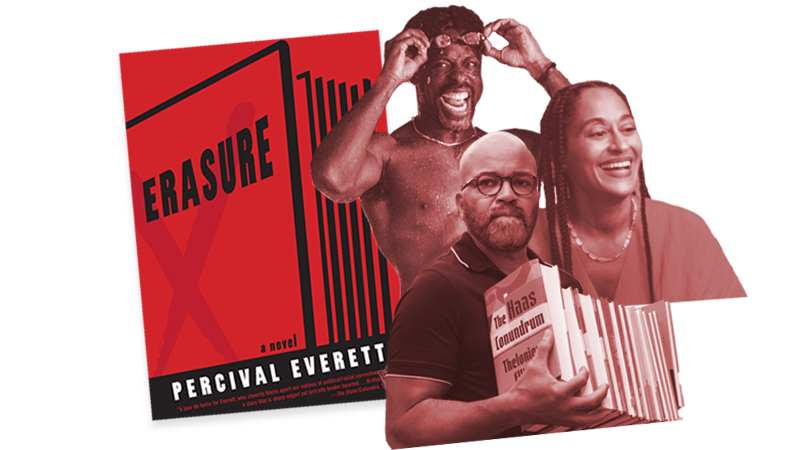 American Fiction
dir. Cord Jefferson, 2023
Based on Percival Everett’s Erasure (2001)
Sub-genres: Satire On Satire • Academics vs. Hollywood • I’m Laughing But I’m Angry
Satire hinges on the specifics. The details need to be both plausible but still legible as comedy, otherwise the jokes will read as hamfisted, or won’t land at all. Erasure is full of those great details, from the book titles (Chaldean Oracles and We’s Lives In Da Ghetto) to the character names (Monk Ellison and Wiley Valdespino)—they just sound right. The escalation of the satire is excellent too, especially as Monk’s attempts to sabotage himself are repeatedly embraced by publishers and Hollywood. The film has to lose some of Everett’s great formal satire on page, of everything from academic articles to C.V.s, but more than makes up for it with excellent acting and direction. What makes Everett such an excellent satirist and Jefferson such an excellent director is that they give each character enough humanity and justification to never be fully right or wrong. In the end, who’s really in on the joke? –James Folta, Staff Writer
 See also:
More Than a Satire: American Fiction is a Poignant Reflection on Existence • Taking Center Stage: Eight Novels That Celebrate Black Performance • Neither Plot Nor Character, But… Something Else? Ten Novels with Mind-Blowing Structures • One great short story to read today: Percival Everett’s “The Appropriation of Cultures” • Renaissance of the Weird: Experimental Fiction as the New American Normal • How Black Writers Capture the Comedy and Dark Absurdity of Life in America • Jacinda Townsend and James Bernard Short on American Fiction
••••••••••vs••••••••••
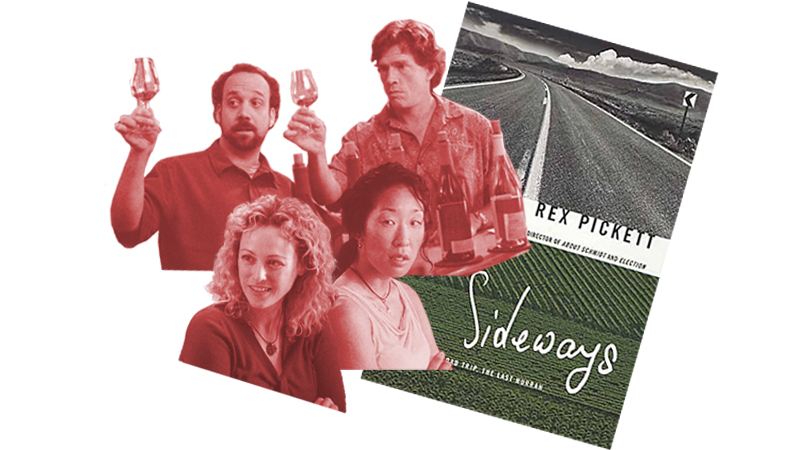 Sideways
dir. Alexander Payne, 2004
Based on Rex Pickett’s Sideways (2004)
Sub-genres: Gen X Canon • Ruinous For Merlot’s Reputation • Horrible Road Trips • Broken Noses on Film
Sideways miraculously is able to simultaneously make fun of wine snobs and celebrate wine snobbery. Payne is very good at this empathetic satire (see Election below), and the fact that every wine person I know has huge opinions on this movie is a great sign that this film is doing something right. The central cast of Giamatti, Church, Madsen, and Oh are stellar, different flavors of lost soul and each painted so specifically. Giamatti’s character’s introduction as the thwarted intellectual is wonderful—the early moment where he’s doing the Times crossword as he drives is such a perfect detail. And every time he describes his novel, I die a new death. This movie will make you want a glass of wine, and then make you want to never, ever drink again. –JF
 See also:
8 Novels for the Literate Oenophile • What’s It Really Like to Have Your Book Made Into a Movie?
*
MATCHUP:
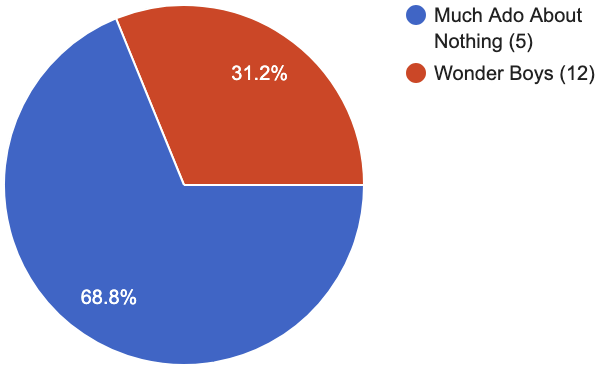
Much Ado About Nothing (5) vs. Wonder Boys (12)
******************************************
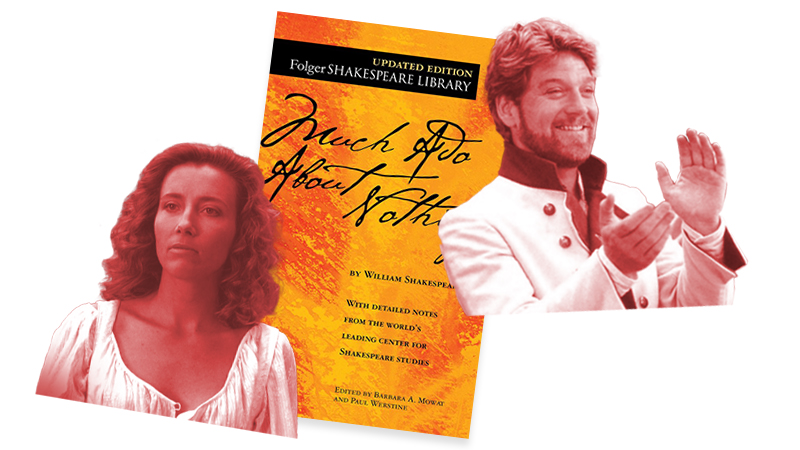 Much Ado About Nothing
dir. Kenneth Branagh, 1993
Based on William Shakespeare’s Much Ado About Nothing (1600)
Sub-genres: Ye Olde Jokes • Ample Bosoms • Eating His Heart in the Marketplace • By Shakespeare Nerds, For Shakespeare Nerds
There’s a never-ending set of Shakespeare adaptations out there but there’s something simply perfect about Kenneth Branagh’s crack at Much Ado, one of the best plays in the canon. Branagh can get self-indulgent in his later work, but this one zips along like the frothy comedy it is, with absolutely radiant turns from Branagh and Emma Thompson and Denzel Washington and Imelda Staunton and, yes, even the much-maligned Keanu Reeves, who brings a particularly human darkness to the too-often-too-cartoonish Don John. Everybody seems to be having a damn good time, it’s all very ’90s, I wish more adaptations would have fun like this one does. –Drew Broussard, Podcast Editor
 See also:
The Best 90s Screen Adaptations of Shakespeare, Ranked • Black Lives Matter in the Public Theater’s Much Ado About Nothing
••••••••••vs••••••••••
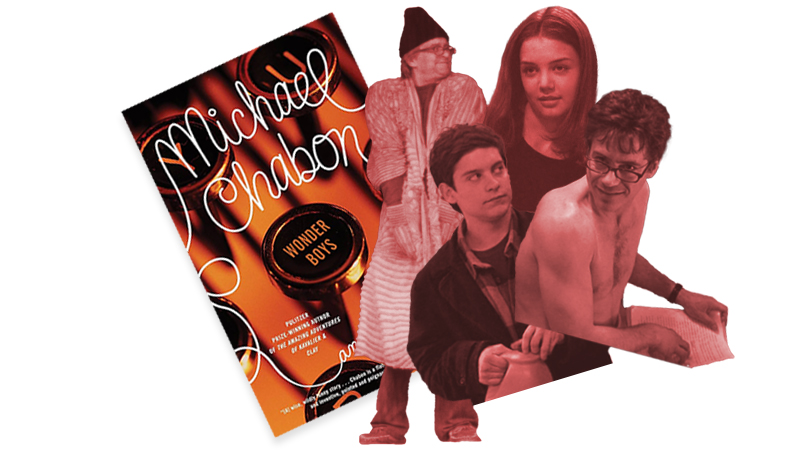 Wonder Boys
dir. Curtis Hanson, 2000
Based on Michael Chabon’s Wonder Boys (1995)
Sub-genres: Accurate Depictions of Writers • The Pink Bathrobe • Literary Festivals on Screen • Campus Hijinks
Screenwriter Steve Kloves showed a knack for drawing strange love triangles with his debut, The Fabulous Baker Boys. Here, he pulls a similar feat on Michael Chabon’s dark night of the soul, bringing charisma and nuance to the world of voices outside of Professor Grady Tripp’s blockhead. Also? We get peak “freak era” Tobey Maguire, playing the creepy genius from your last workshop. Gosh, sometimes I wish that spider never bit him… –BA
 See also:
In Praise of Wonder Boys (Both the Book AND the Movie) • Is Wonder Boys the Best-Ever Onscreen Depiction of a Writer? • Remembering Rip Torn’s “I . . . am a writer” speech from Wonder Boys • The 20 Best Campus Novels, Ranked • 50 Fictional Writers, Ranked
*
MATCHUP:
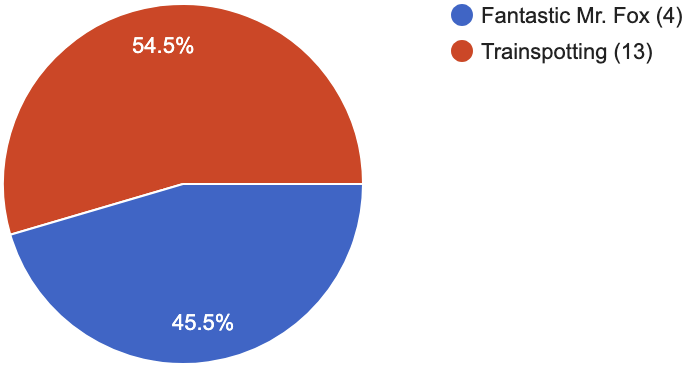
Fantastic Mr. Fox (4) vs. Trainspotting (13)
******************************************
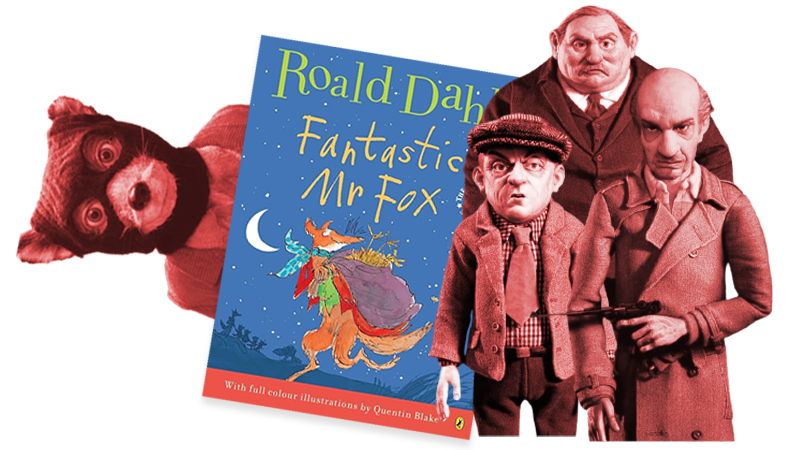 Fantastic Mr. Fox
dir. Wes Anderson, 2009
Based on Roald Dahl’s Fantastic Mr. Fox (1970)
Sub-genres: What the Cuss? • Discount Bandit Hats • Pure Wild Animal Craziness
Wes Anderson gets a lot of credit for doing a lot of things well, but I’m always most impressed by how funny his movies are—Fantastic Mr. Fox in particular. Anderson’s dry, deadpan humor is a perfect match for Roald Dahl’s dark whimsy. The movie also strikes that Dahl-ian balance of having a kid-friendly tone with adult-leaning themes. Don’t let the perfect autumnal color palette fool you: this movie has high stakes. A fox-man gets his tail shot off! Animals fight each other tooth and claw! A family’s home is destroyed! There’s murder and rabies and sharp teeth and catchy songs. But there’s also forest creatures wearing sweaters and apples with sparkles on them. Fantastic Mr. Fox pulls off a complicated balancing act and still manages to go down as easy as a glass of Farmer Bean’s cider. –McKayla Coyle, Publishing Coordinator
 See also:
When Roald Dahl’s Editor Decided He Was Too Much of a Prick To Publish • The Reading Lists Hidden Inside 12 Great Books
••••••••••vs••••••••••
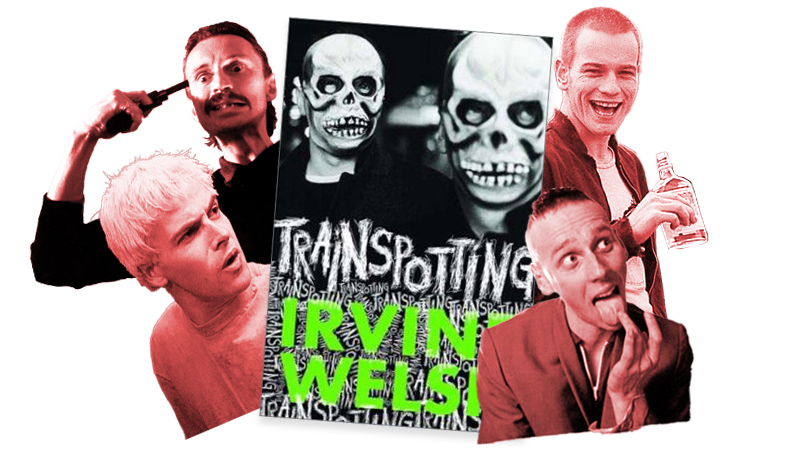 Trainspotting
dir. Danny Boyle, 1996
Based on Irvine Welsh’s Trainspotting (1993)
Sub-genres: Great Nicknames • Hard Not To Mimic The Accents • The Music Is Doing Some Heavy Lifting
A brutal movie that is funnier than it needs to be, thanks in large part to Danny Boyle’s expressive, exuberant style that effectively dramatizes the caterwauling lives of Edinburgh addicts. The score of pop tunes adds a lot of dynamism to the scenes—there are a few songs that I now primarily associate with this movie, for good or ill. The balancing act of both the film and Irvine Welsh’s book is impressive. This is an unsparing portrait of addiction, but isn’t afraid to show moments of joy or tenderness, or what’s cool and interesting in this particular youth culture. The lack of simple, after-school-special moralizing of course scandalized all the right people: credit to Boyle and Welsh for freaking out Bob Dole, whose hand-wringing helped the film break out. –JF
 See also:
Irvine Welsh Comes to America • Ten Great Books With Their Own Languages
*
MATCHUP:
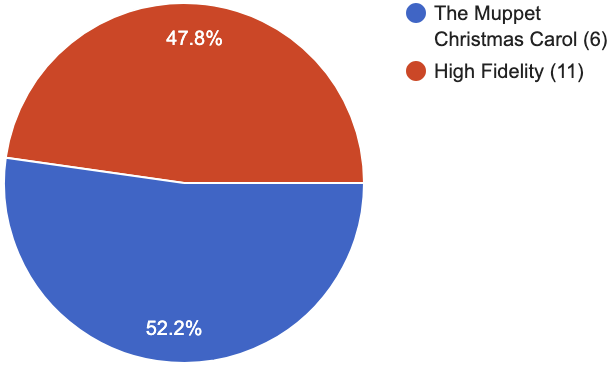
The Muppet Christmas Carol (6) vs. High Fidelity (11)
******************************************
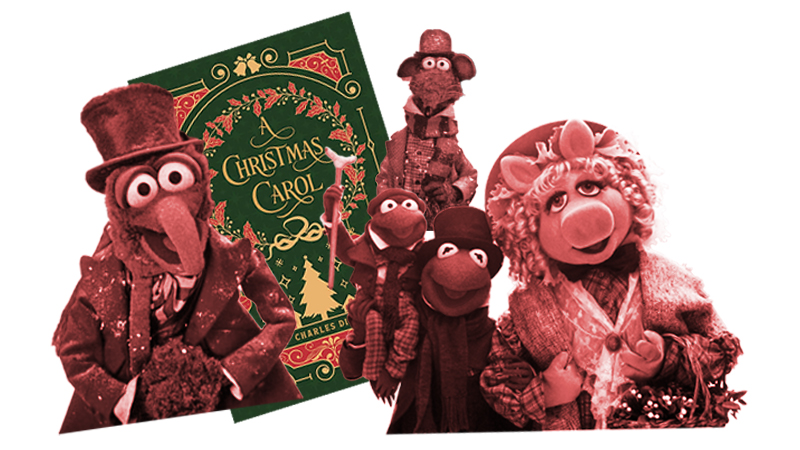 The Muppet Christmas Carol
dir. Brian Henson, 1992
Based on Charles Dickens’s A Christmas Carol (1843)
Sub-genres: Everybody Loves Muppets
Dickens’s novella forever changed the way people related to Christmas, and it’s fitting that the Henson adaptation did the same thing for Millennials’ relationship to the holiday. Real fans never get sick of telling everyone in earshot that Michael Caine only agreed to be in the movie if he could play it as straight as Shakespeare. –JF
 See also:
21 Movies You Should Watch This Holiday Season • A brief literary history of The Muppet Show • Did Bob Cratchit really make more than an American on minimum wage? • The Wizardry of Boz: A Brief History of Charles Dickens on Screen • Charles Dickens partied HARD after finishing A Christmas Carol in just six weeks. • On Dickens’s Demons and Weird Relationship with Christmas
••••••••••vs••••••••••
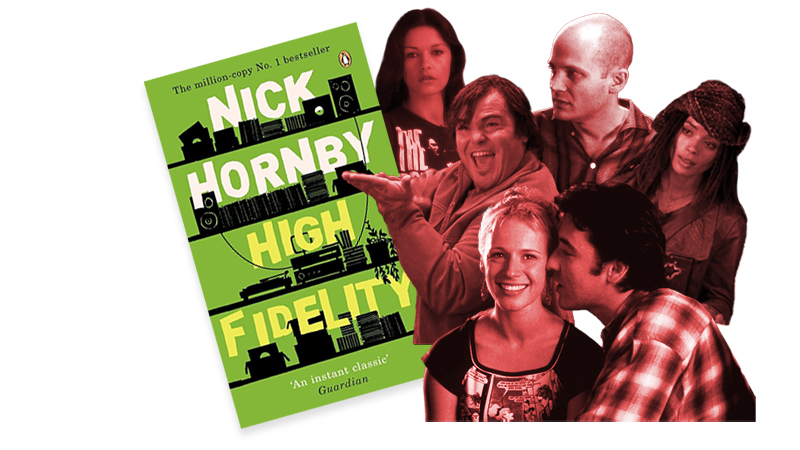 High Fidelity
dir. Stephen Frears, 2000
Based on Nick Hornby’s High Fidelity (1995)
Sub-genres: The Gen X Canon • Music Is My Life • The Original Eras Tour • Make More Mixtapes
Music nerd Rob Gordon is Cusack at his most Cusack-y—always a treat—but this movie is most memorable for the great visual gags and side characters as we time-travel through Rob’s past. His coworkers, friends, and exes are each so specific and heightened, and the star of the movie is of course Jack Black as the manic nerd Barry, who steals every scene he’s in.
High Fidelity distills adolescence down to its core tent poles of crushes and music. It’s sweet and funny, but for the love of God do not go to this movie for relationship tips. –JF
 See also:
On the Absolute Chaos of Modern Dating: A Reading List • Nick Hornby: The Older You Get, the Less Time You Have for Bad Books • The Living Authors with the Most Film Adaptations
*
MATCHUP:
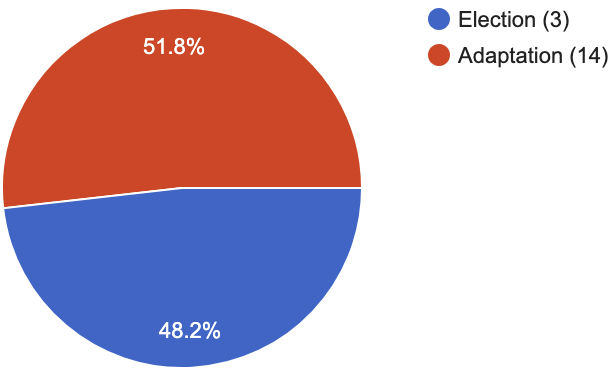
Election (3) vs. Adaptation (14)
******************************************
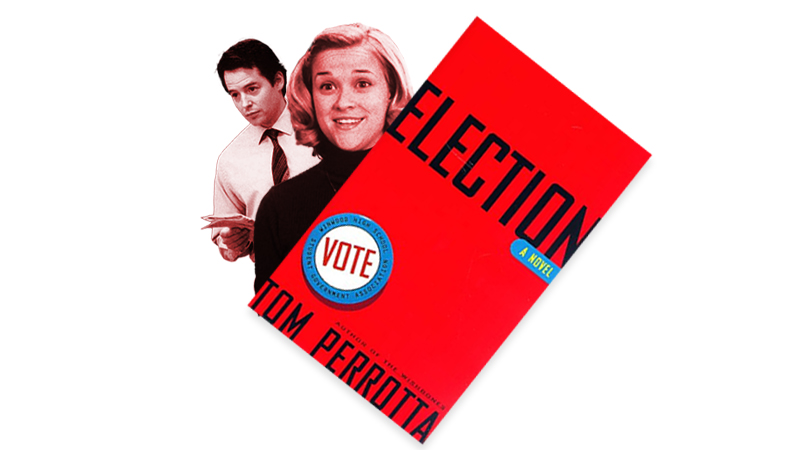 Election
dir. Alexander Payne, 1999
Based on Tom Perrotta’s Election (1998)
Sub-genres: Not How I Remember High School • A Different Ending Than The Book • Hey Teacher, Leave Those Kids Alone
I believe Alexander Payne to be a wizard of tone, and for proof I submit his sophomore film. Election is a ruthless, high-wire satire with its skeptical spectacles trained on authority itself. The Perrotta novel is a wisecracking romp; the film adaptation is transcendent. It’s all in the way the camera collects indignities—from Mr. McCallister’s beestung eye to Tracy’s frozen face in Social Studies. IMHO, this film ran so Mean Girls, another swell adaptation lampooning hierarchy, could trot. –BA
 See also:
Tom Perrotta on the Suburban Novel • The Author of Election on the Election • Revisiting Tracy Flick 30 Years Later: Tom Perrotta Talks to Emma Straub • Tom Perrotta on How to Keep a Story’s Momentum Going
••••••••••vs••••••••••
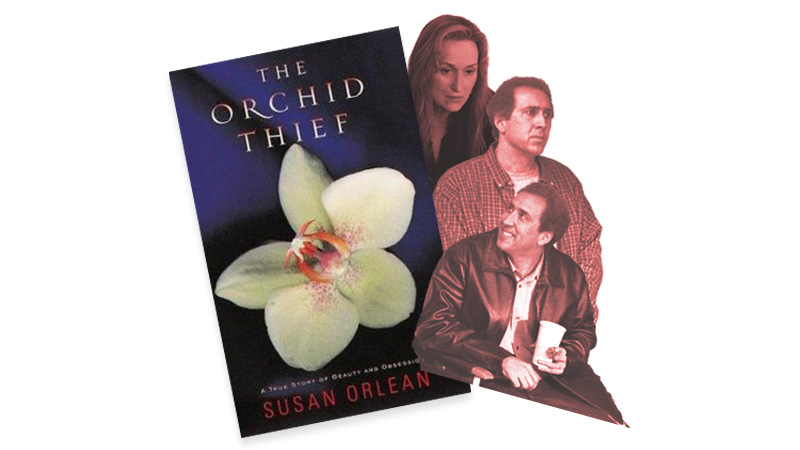 Adaptation
dir. Spike Jonze, 2002
Based on Susan Orlean’s The Orchid Thief (1998)
Sub-genres: Nick Cage Doing His Thing • Writers on Writers • Tonal Adaptations
For my money, this meta fever dream starring not one but TWO Nicholases Cage may be the most interesting adaptation in this whole bracket. Just for being so crooked and inventive. Charlie Kaufman and Spike Jonze don’t exactly dramatize the content of Susan Orlean’s The Orchid Thief, but they do take a crucial seed-theme. This is a film about what it’s like to fall in love with a weird, specific subject, and then struggle to articulate why. I.e., the writing process. –BA
 See also:
13 Adaptations Better Than the Books They’re Based On • Trouble for Your Thoughts: On Reported Creative Nonfiction • Susan Orlean Is a Really Serious Chicken Lady • Susan Orlean: “In the End, What Matters is Noticing.”
*
MATCHUP:
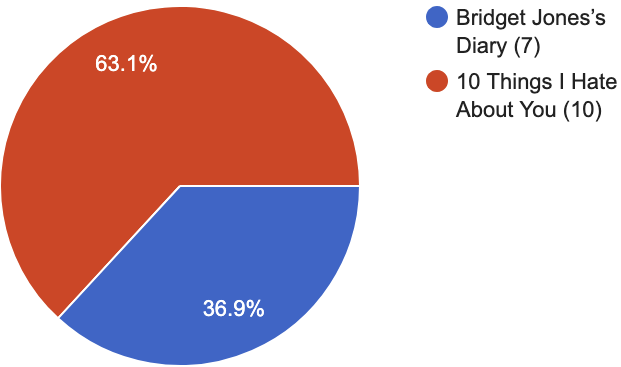
Bridget Jones’s Diary (7) vs. 10 Things I Hate About You (10)
******************************************
 Bridget Jones’s Diary
dir. Sharon Maguire, 2001
Based on Helen Fielding’s Bridget Jones’s Diary (1996)
Sub-genres: Perfect Rom-Coms with Regrettable Body Dysmorphia • Hugh Grant’s Loveable Cads • Flex-mas Classics • Ugly Sweaters
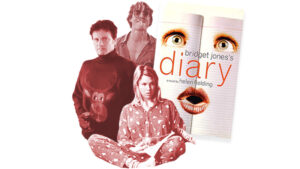
In order to make a great rom-com, you have to have both deep affection for and a great sense of humor about the genre. The 2001 adaptation about one of the great romantic-comedy novels, Bridget Jones’ Diary, evidences both. Its screenplay was a collaboration between the book’s author, Helen Fielding, rom-com master Richard Curtis (though the less said about Love, Actually the better), and Andrew Davies, who previously adapted Pride and Prejudice in the iconic BBC miniseries. Add to that casting the actual Mr. Darcy from said miniseries, Colin Firth, as Mark Darcy? Now that’s how you pay tribute to Jane Austen. –Jessie Gaynor, Senior Editor
 See also:
Was Bridget Jones’s Diary the First Internet Novel? • Helen Fielding on Bridget Jones and the Subtle Art of Diary Keeping • Unsurprisingly, the early coverage of Bridget Jones’s Diary does not hold up. • Intimacy and Manipulation: A Reading List of Fictional Diaries • Every one of Bridget Jones’s boyfriends, ranked. • These are the most popular romantic novels from each of the last six decades.
••••••••••vs••••••••••
 10 Things I Hate About You
dir. Gil Junger, 1999
Based on William Shakespeare’s The Taming of the Shrew (c. 1592)
Sub-genres: Witty Remarks • Not Another Teen Remake • Heath Ledger
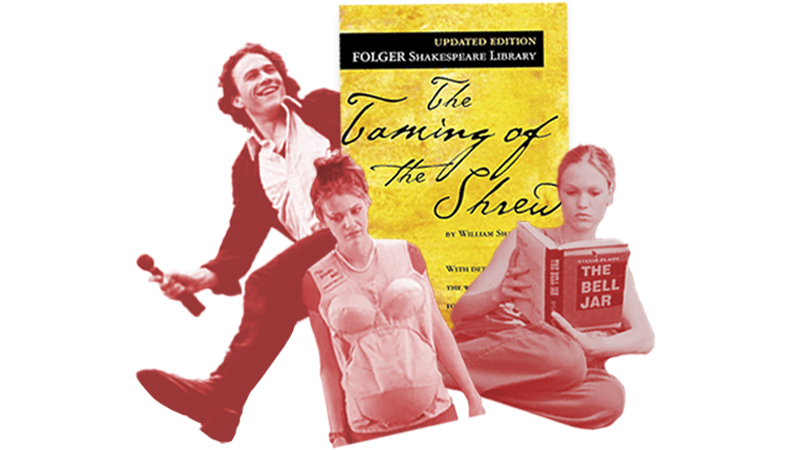
Ah, the ‘90s, when Hollywood went nuts mining classic literature to make teen movies. There were hits and there were misses, but one of the best was Karen McCullah Lutz and Kirsten Smith’s clever transformation of The Taming of the Shrew, which retains many of the play’s concerns (How should a woman be? What is the difference between how we present and who we are? What is love worth, no like literally, in dollars?) and has enough wordplay to thrill the Bard himself, but makes it all deliciously modern (and makes these answers to those questions much more palatable). Plus, it’s stuffed with Millennial culture royalty: Heath Ledger, Julia Stiles, Joseph Gordon-Levitt, Alex Mack Larisa Oleynik, Gabrielle Union, David Krumholtz. A classic. –ET
 See also:
The Life-Changing Magic of 10 Things I Hate About You • The Best 90s Screen Adaptations of Shakespeare, Ranked • What to read next based on your favorite teen comedy. • 50 Fictional Writers, Ranked
*
MATCHUP:
Clueless (2) vs. Ghost World (15)
******************************************
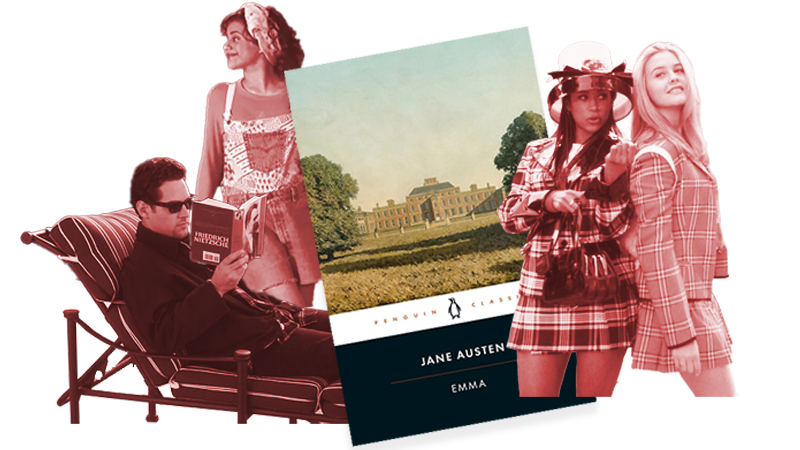 Clueless
dir. Amy Heckerling, 1995
Based on Jane Austen’s Emma (1815)
Sub-genres: Slang Machine • You’re a Virgin Who Can’t Drive • Just Don’t Ask What Happened to Dionne
The best adaptation of the best Jane Austen novel (see below) manages to recreate the classic novel in all of its minute social dramas, while making the story feel entirely original in its vision and aesthetic. Austen’s restrained and polished Regency Era is culturally converted to the splashy, enviable world of Beverly Hills in the ’90s: mini skirts, baggy pants, flip phones, convertibles, and all. Cher, our stand-in for Emma Woodhouse, is the it-girl at the center of it all, confident and unflappable in her place in the hierarchy—but with a hint of narcissism that gives her a preening over-confidence in her capabilities. Or as our own Brittany Allen put it, “Cher was as vibrant as she was delulu.” Love, friendship, confidence: all of it can come crashing down far too easily—but oh so enjoyably. –Julia Hass, Book Marks Associate Editor
 See also:
Actually, Emma is the Best Jane Austen Novel • On Jane Austen and The Lovable Unlikability of Emma Woodhouse • The Magic of a Slow-Burn Romance • Why Jane Austen Adaptations Just Keep Coming—And We Keep Watching • Did Jane Austen Invent the Wellness Guy? • Jane Austen’s Emma Was Basically Torn Apart in Workshop
••••••••••vs••••••••••
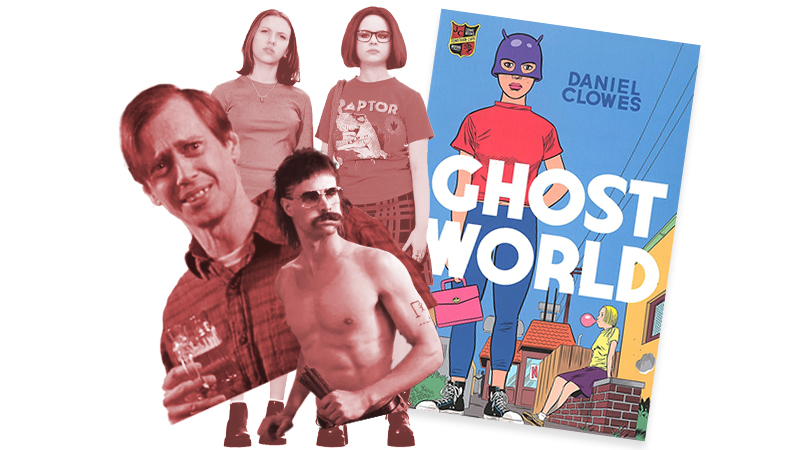 Ghost World
dir. Terry Zwigoff, 2001
Based on Daniel Clowes’s Ghost World (1997)
Sub-genres: Why You Did That to Your Hair • Indie Sleaze • The Nerds Are Sad
A special feat, I think, to take a graphic novel into live action airspace. Something could easily be lost in the move from 2D world into the tactile. We might go too cartoon-y, or not cartoon-y enough. Or the human actors could fail to live up to their illustrated avatars.
Thank heaven, then, for Terry Zwigoff’s Ghost World, which captures all the dour hijinks and cold freakery of its source text on an all-too-IRL plane. This film is perfectly calibrated and colorized. The saddies of Enid’s notebook all a little uncanny, as in any good comic, yet terribly human in their tragedies. (Seymour!!!) –BA
 See also:
Seven Novels That Explore Friendship In All Its Messy, Complex Beauty • Terrible Writing By Great Writers
* * *

*
MATCHUP:
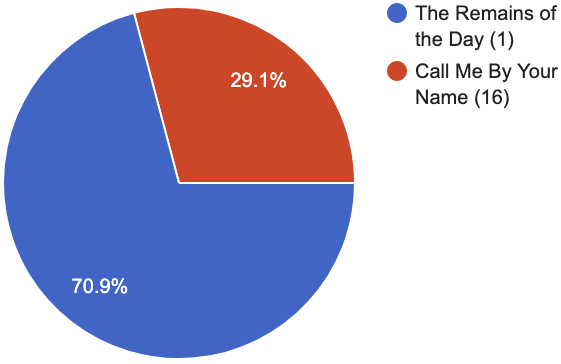
The Remains of the Day (1) vs. Call Me By Your Name (16)
******************************************
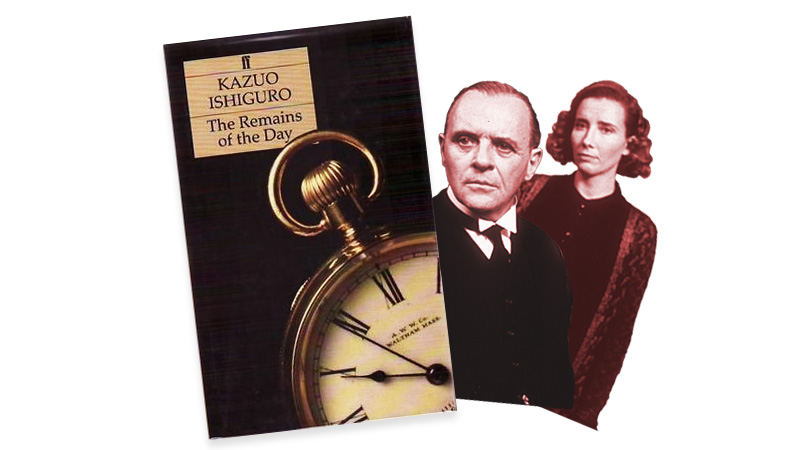 The Remains of the Day
dir. James Ivory, 1993
Based on Kazuo Ishiguro’s The Remains of the Day (1989)
Sub-genres: Antifa • Unrequited Love • Very British Contemplation • Fighting And Flirting With A Coworker
Ishiguro’s subtle, introspective novel seems impossible to translate onto the screen, but with Anthony Hopkins and Emma Thompson anything is possible. This was originally supposed to be a Harold Pinter script directed by Mike Nichols, which is quite the hypothetical to imagine, but director James Ivory and rewrites by the Booker and Oscar winner Ruth Prawer Jhabvala are a lateral move at absolute worst.
The film is a quiet yearning romance alongside an interrogation of Nazi appeasement, class, and duty. It does a lot, quietly and patiently. Each emotional beat arrives with soft footsteps, and is all the more affecting for it. A beautiful film and one that feels like a novel on the screen, which is why it takes our top dramatic seed. –JF
 See also:
Romance Finely Aged: On the Unique Dynamic of Older Couples • Kazuo Ishiguro: ‘Write What You Know’ is the Stupidest Thing I’ve Ever Heard • 9 Novels in Which Houses Have a Life of Their Own • Sweet (But Not Too Sweet): 6 Essential Literary Love Stories • 10 Books for Being Alone • In Praise of the Unhappy Happy Ending
••••••••••vs••••••••••
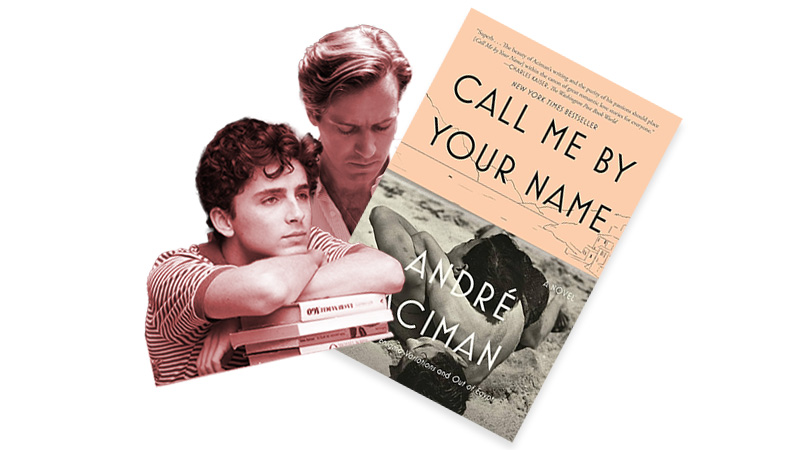 Call Me By Your Name
dir. Luca Guadagnino, 2017
Based on André Aciman’s Call Me By Your Name (2007)
Sub-genres: Peach Choreo • Crying to Sufjan • Don’t Ask About the Cannibalism
Guadagnino’s sexy, dreamy, sad boi film is good on its own merits, depending on your current tolerance for its leads, but its brilliance is really in the adaptation. As I’ve written elsewhere, the novel relies heavily on a textured interiority—the narration of a teenage boy named Elio, who falls in hopeless love with his father’s grad student—which would seem to be not easily translatable to film. Voices never carry the way you think they will. But Guadagnino manages it in a rather ecstatic fashion: he takes the chaotic, obsessive narration, and he inverts it. That is, mostly he turns it into silence. It’s almost like someone read the book and painted a picture of it. –ET
 See also:
Call Me By Your Name is an Object Lesson in Adapting Interiority • André Aciman Finds His Way Back to His Famous Lovers • André Aciman on Displacement, Family and the Struggle to Find Home In the Eternal City • Sweet (But Not Too Sweet): 6 Essential Literary Love Stories
*
MATCHUP:
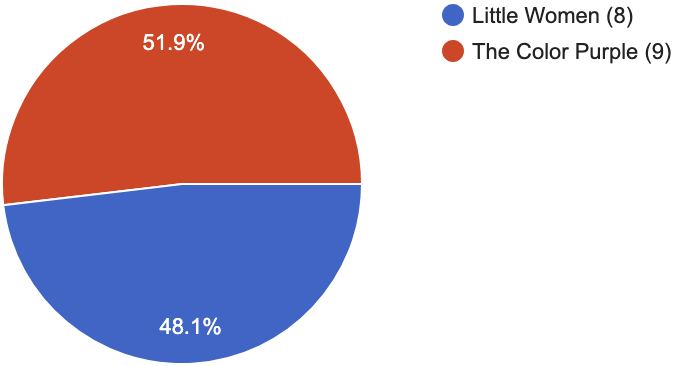
Little Women (8) vs. The Color Purple (9)
******************************************
 Little Women
dir. Gillian Armstrong, 1994
Based on Louisa May Alcott’s Little Women (1868)
Sub-genres: Love Jo All Your Days • True To The Novel • I Guess This Is Growing Up
I love Greta Gerwig, but there’s just something so cozy about Gillian Armstrong’s take on the March girls. And for a story in thrall to the wonder years, I would think coziness is the point. The bits after Beth’s death hit especially hard once we’ve sung all those carols around the piano, and hurled snowballs over a Christmas-y Thomas Newman soundtrack. Final snaps must be given to Claire Danes, who brought such tenderness to the easily undersold Beth. And of course the unruly Winona, a perfect Jo. –BA
 See also:
Nonfiction That Rivals Little Women: The Forgotten Essays of Louisa May Alcott • Parts of a Whole: Ann Napolitano on Reaching for the Vivacity and Connection of Little Women • The Enduring Appeal of Fictional Sisters: A Reading List • How Would the Sisters of Little Women Experience the World Today? • The Ubiquity of Little Women: 11 Books Inspired by the March Family • Walking Through the House Where Louisa May Alcott Wrote Little Women • Jenny Zhang on Reading Little Women and Wanting to Be Like Jo March • Louisa May Alcott’s Letter of Advice to a Young Writer • Why Don’t More Boys Read Little Women? • Rereading Little Women in its 150th Anniversary Year • Louisa May Alcott: A Difficult Woman Who Got Things Done • Why We Do Need Another Adaptation of Little Women
••••••••••vs••••••••••
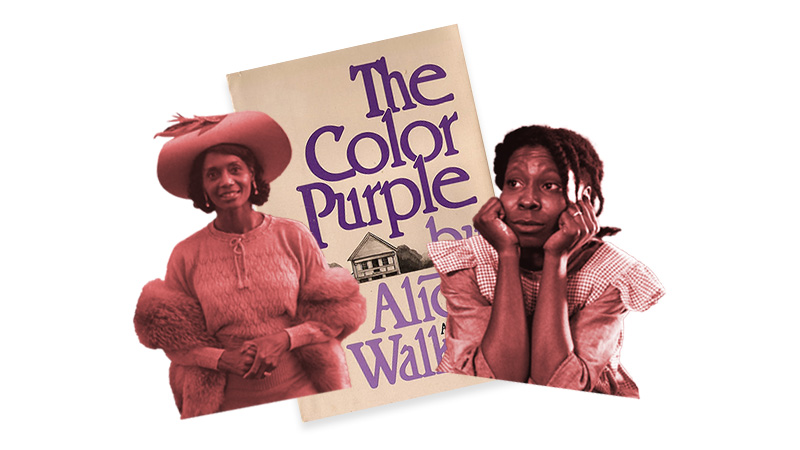 The Color Purple
dir. Steven Spielberg, 1985
Based on Alice Walker’s The Color Purple (1982)
Sub-genres: Spielberg Gets Serious • Oprah’s Acting Debut • Robbed At The Oscars
I have a preference for the book here, but the adaptation of The Color Purple retains much of what makes the book so moving. Spielberg was an odd choice to direct, especially since he’d only done summer blockbusters up to this point and because Walker was reluctant to hand her book over for adaptation at all (she was apparently swayed by ET—relatable!). But Spielberg is a pro, and handles the material well (with the exception of downplaying the lesbian aspects of the story) and the cast delivers career high performances. And a Quincy Jones score? Amazing. –JF
 See also:
Friend, Foe, Family, Stranger: Fourteen Books on Black Motherhood by Black Daughters • In Praise of Problematic Women: A Reading List of “Bad” Mothers • Ten LGBTQ+ Authors on the Books That Taught Them • “Who Are Your People?” A Reading List of Strong, Spirited Southern Ladies • Why Queer Stories Deserve Happy Endings • Making a Way Out of No Way: Celebrating the Power of Black Female Relationships in Literature • The Color Purple and the Language of Healing from Trauma • Intimacy and Manipulation: A Reading List of Fictional Diaries • The Meaningful Mundane:6 Classic Books That Depict Black Girlhood • From Gatsby to Giovanni’s Room, the Stories Behind 5 American Classics
*
MATCHUP:
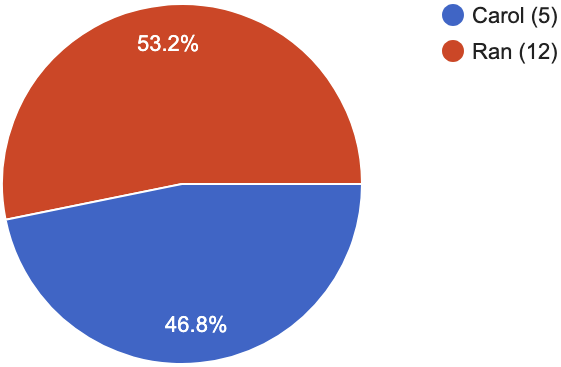
Carol (5) vs. Ran (12)
******************************************
 Carol
Carol
dir. Todd Haynes, 2015
Based on Patricia Highsmith’s The Price of Salt (1952)
Sub-genres: Harold, They’re Lesbians • Technically a Christmas Movie • Flung Out of Space
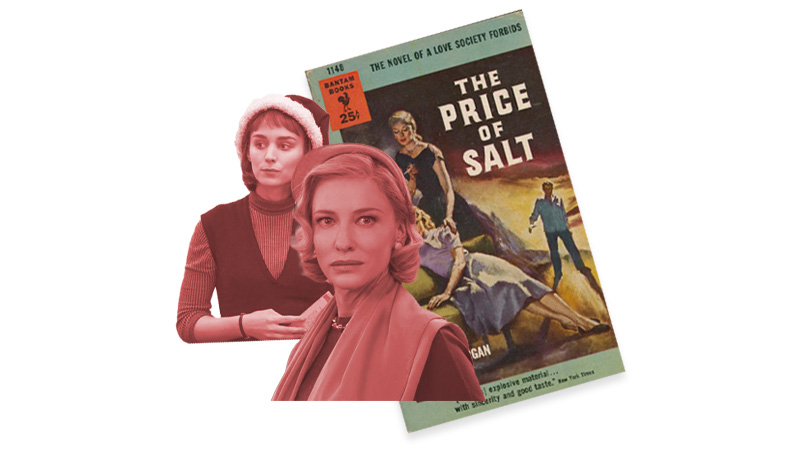
A true labor of love by one of New Queer Cinema’s most notable directors, Carol adapts a novel that stands out among other pieces of mid-century lesbian pulp for its happy(ish) ending. Beyond that, it’s a coming of age story. It’s a story about motherhood. It’s an exploration of the relationships between love and obsession, oppression and surveillance. On film, the romance between Carol and Therese is captured with a quiet boldness in imagery inspired by the works of Edward Hopper and Vivian Maier, often rendered dreamy through windows streaked by rain or clouded with cigarette smoke. In a world that refuses them refuge, Carol constructs small, intimate spaces hidden in plain sight, not only reflecting the effects of social and political realities, but also cinematically reproducing the sensory experience of love. As Therese wonders in the novel, “Why did people talk of heaven?” –Oliver Scialdone, Community Editor
 See also:
A Secret Literary Love Hidden in the Margins of The Price of Salt • On Patricia Highsmith and the Horror—and Revelation—of Obsession • 10 Queer Books For People With Mommy Issues • A Literary Dictionary of the Mothers Who Leave • What Age-Gap Relationships Reveal About Power, Sex, Love, and Desire
••••••••••vs••••••••••
 Ran
Ran
dir. Akira Kurosawa, 1985
Based on William Shakespeare’s King Lear (1605)
Sub-genres: Shakespeare Abroad • Moody Men • Swordplay
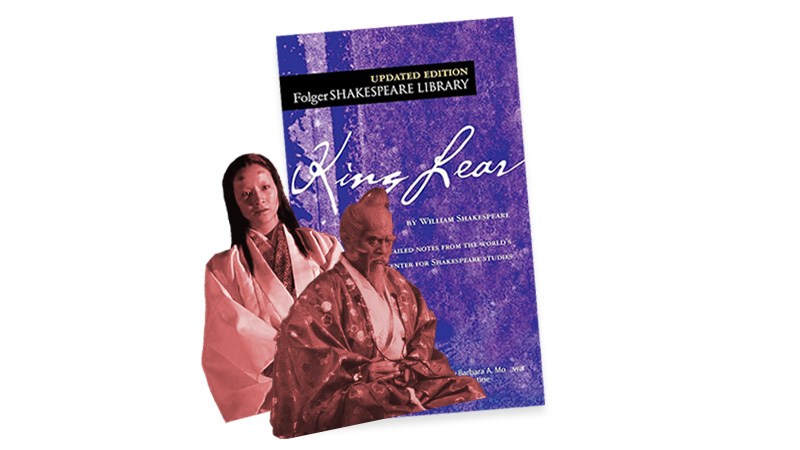
Kurosawa is one of the great directors of Shakespeare, and this adaptation is one of the best. It would be his last epic film, and he pulls out all the stops with the locations, cinematography, and battle sequences. Not surprisingly, it was one of the most expensive films made in Japan at the time.
What I love about this adaptation is how much it diverges from the play. The script began as a story of a 16th century warlord and his three sons—Kurosawa only added elements of Lear later on, alongside other references and inspirations. The result is a not a true restaging of Shakespeare, but Ran is also not divergent enough to be merely “inspired by.” Kurosawa shifts Shakespeare’s plot and the themes just enough, which makes for a fascinating companion and foil. –JF
 See also:
In Praise of Remixing Shakespeare • Tyranny as Tragedy: On King Lear, Maoist China and the Unpredictable Nature of Power • How Did Shakespeare Kill (And Heal) His Characters?
*
MATCHUP:
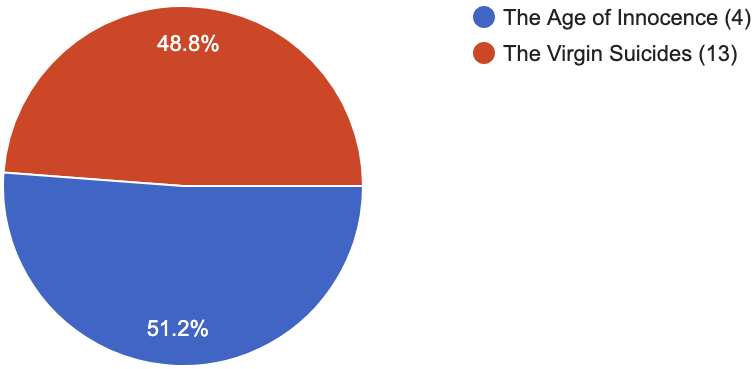
The Age of Innocence (4) vs. The Virgin Suicides (13)
******************************************
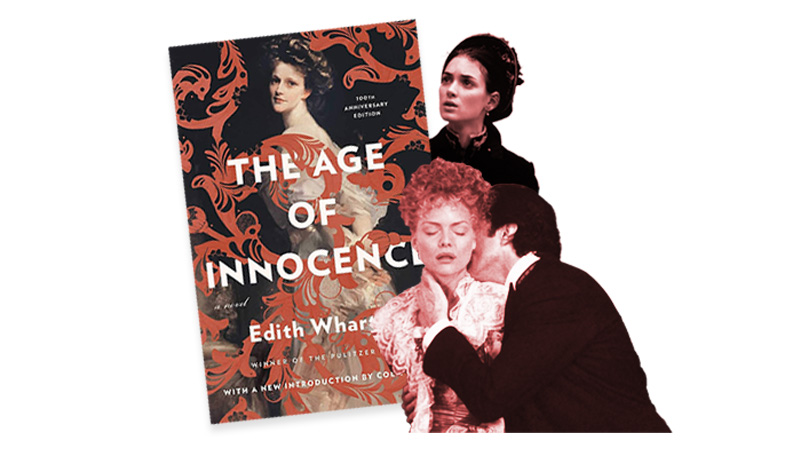 The Age of Innocence
dir. Martin Scorsese, 1993
Based on Edith Wharton’s The Age of Innocence (1920)
Sub-genres: Lingering Gazes • Society Is The Real Villain • Infidelity Is Wrong… Unless?
There’s a lot of yearning here in the drama section, much of it British. But to pair my soft boy heart with my NYC pride for a moment: we can yearn with the best of them over here in New York, as Edith Wharton proves in her top notch romance about flawed, stifled people finding and losing each other. Fellow New Yorker Martin Scorsese’s take is wistful and tender, and I think this movie is a thematic skeleton key for the rest of his oeuvre. Class and society constrain all, and Age of Innocence traps its characters in their gauzy and ornate world. We see insert shots of all the luxe, representative objects, and Scorsese’s shots (the spotlighting in the opera box, my heart!) are a perfect match to Wharton’s prose. What performances! What direction! And that nearly unbearable ending! Scorsese’s not just a mob movie guy, he really can do it all. –JF
 See also:
30 Years Later, The Age of Innocence Remains Scorsese’s Most Subtle Deconstruction of Misogyny • What Do We Do with The Age of Innocence in 2020? • The Memories of Streets: A Reading List of NYC Books That Capture the City’s Many Sides • “The Future Belonged to the Showy and the Promiscuous.” How Edith Wharton Foresaw the 21st Century • Edith Wharton on How to Write a Vivid First Line • Some Things You May Not Have Known About Edith Wharton’s Dog Obsession • The Secret Love of Edith Wharton’s Life • Does Edith Wharton Hate Us?
••••••••••vs••••••••••
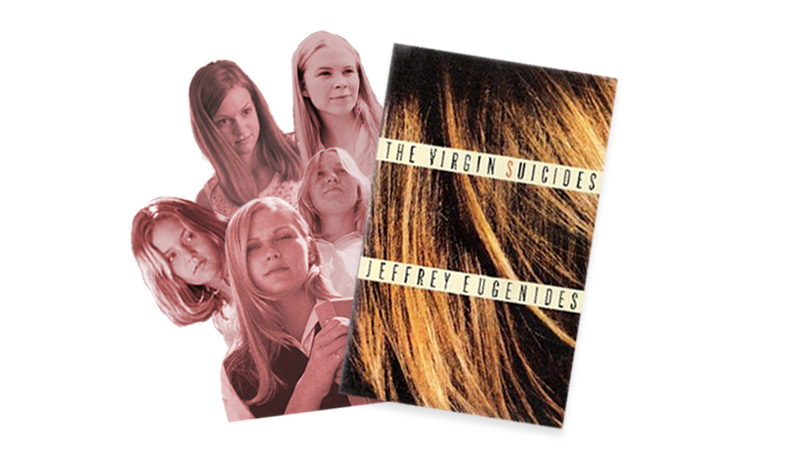 The Virgin Suicides
dir. Sofia Coppola, 1999
Based on Jeffrey Eugenides’s The Virgin Suicides (1993)
Sub-genres: The Vibes Though • Couldn’t Do It Without the Soundtrack • The Power of Angst
Sofia Coppola’s directorial debut is a stylized, gauzy, claustrophobic confection that firmly established her personal aesthetic and has influenced representations of suburban girlhood ever since. It is a deft adaptation of a novel that could have been easily mishandled—the Greek chorus-style narration, the delicate subject matter, the dark humor—but Coppola was a true fan.
“I really didn’t know I wanted to be a director until I read The Virgin Suicides and saw so clearly how it had to be done,” Coppola has said. (Luckily she had a few connections in the business.) “I immediately saw the central story as being about what distance and time and memory do to you, and about the extraordinary power of the unfathomable.”
Coppola also understood something that is at the core of the book: that the Lisbon girls don’t exist, or at least not as the narrator(s) imagine them. They can’t exist—they are girls made myth, and so can only be destroyed. –ET
 See also:
Does The Virgin Suicides Hold Up 25 Years Later? • Unrequited Love and Unmet Obsession: A Reading List
*
MATCHUP:
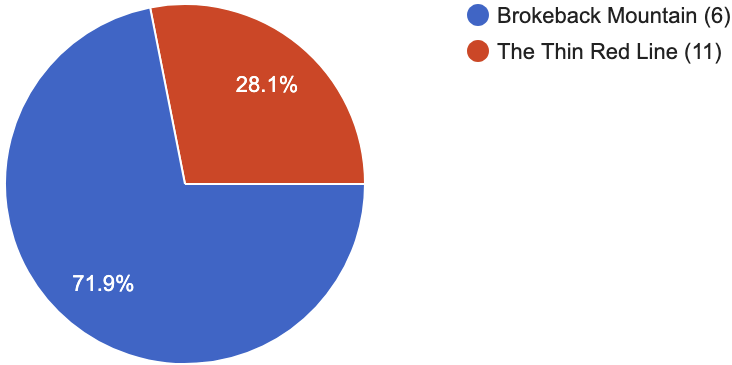
Brokeback Mountain (6) vs. The Thin Red Line (11)
******************************************
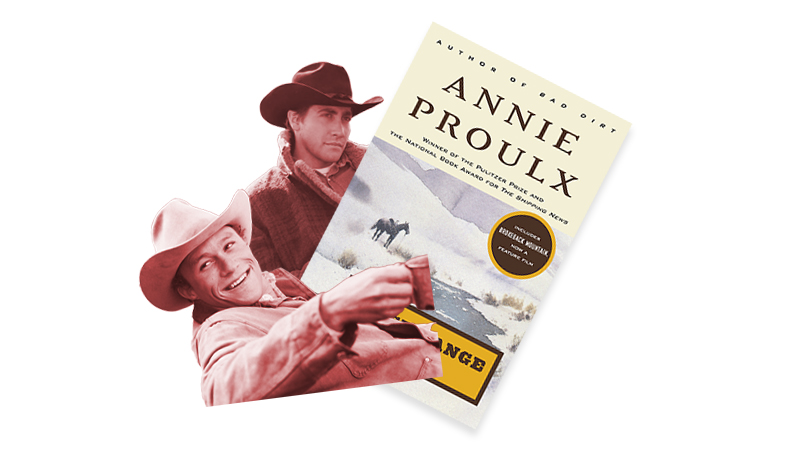 Brokeback Mountain
dir. Ang Lee, 2005
Based on Annie Proulx’s “Brokeback Mountain” (1997)
Sub-genres: Iconic Lines • Home (In Your Arms) On The Range • Just Let The Boys Kiss
One of the few short story adaptations on our list, Brokeback Mountain makes a feature out of fewer than 3,000 words by paying deep attention to the characters and the nuances in Proulx’s story. (Interestingly, Proulx has said she regrets publishing the story because of all of the wild fan fiction rewrites she gets in the mail. Leave Annie alone!)
Brokeback Mountain looks great—cinematographer Rodrigo Prieto Stambaugh knocks it out of the park. (Look him up on IMDB, he’s shot so many gorgeous movies.) And of course, our sweet, repressed boys steal the show. Heath Ledger, Jake Gyllenhaal, and Michelle Williams are all passionately restrained, which has led to endless debates about the characters’ “true” sexuality.
My hot take? The line “I wish I knew how to quit you” lands harder on the page than on the screen. –JF
 See also:
On the Outsize Power of the Short Story (AKA the Genre of “High Genius”) • On Reimagining the Limitless Potential of the Literary Western • 43 of the Most Iconic Short Stories in the English Language • Where Are All the Rural Gay Poets? • Billy-Ray Belcourt Wants a Whole Literature of Queer Indigenous Possibility • Thomas McGuane on Not Living the Writer’s Life
••••••••••vs••••••••••
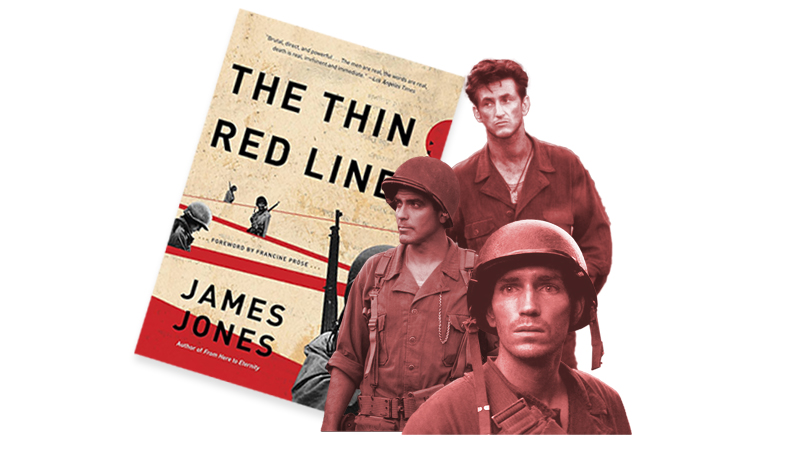 The Thin Red Line
dir. Terrence Malick, 1998
Based on James Jones’s The Thin Red Line (1962)
Sub-genres: Everyone Gets A Monologue • Trench Philosophy • Every Male Actor Gets A Role
WWII movies are a hard genre to stand out in, but Malick succeeds through introspection, inspired by the novel’s study of character amidst brutal chaos. There are lots of guys to keep track of over the course of a very long runtime, but each soldier is specific and mostly manages to avoid the war movie tropes. The result is a wider portrait, as is usually the case with Malick. The Thin Red Line is a rich, tonal tapestry.
Malick immerses us in the often gorgeous nature of this battlefield, including many small shots of animals in and around the fighting. There’s particular attention to the geography of the hill being fought over, and how intimate of a relationship the infantrymen have with this land. There’s an ever present sense of the air moving, seen in the grass swaying and the smoke drifting. –JF
 See also:
How From Here to Eternity Contradicted Post-War America’s Wholesome Notions • 50 Years Later, Terrence Malick’s Badlands Remains a Pure Encapsulation of American Violence
*
MATCHUP:
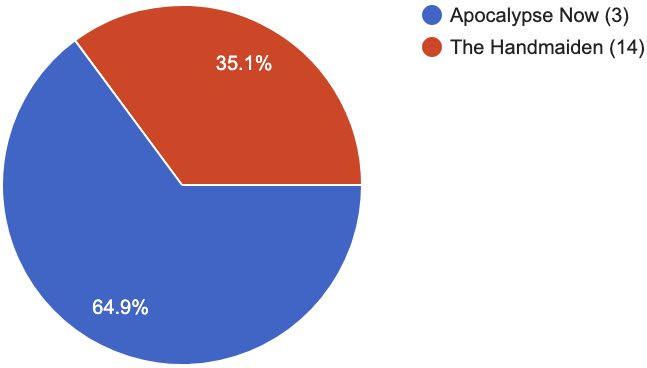
Apocalypse Now (3) vs. The Handmaiden (14)
******************************************
 Apocalypse Now
dir. Francis Ford Coppola, 1979
Based on Joseph Conrad’s Heart of Darkness (1899) and Michael Herr’s Dispatches (1977)
Sub-genres: Almost Directed By George Lucas?! • T.S. Eliot Quotes • Big Music Choices
Perhaps the best Vietnam War movie ever made. A savvy translation from the source material by Francis Ford Coppola and right-wing crank John Milius, Apocalypse Now shifts Conrad’s tale of depravity set amidst Belgian colonial horrors to a tale of depravity set amidst American imperial horrors in Vietnam and Cambodia.
An elite soldier with a fraying mind is sent deep into a wartime nightmare, and the sweaty performances, bold musical choices, and beautiful cinematography take us there. And every film nerd knows that the production’s depravity and delirium almost surpasses the film’s—Apocalypse Now’s Wikipedia page is as wild as the film itself. –JF
 See also:
What Really Went on Between Francis Ford Coppola and Martin Sheen During the Filming of Apocalypse Now? • “Invasion is a Structure Not an Event.” On Settler Colonialism and Joseph Conrad’s Heart of Darkness • On the Jealous Rivalry Between Nicolas Cage and His Uncle, Francis Ford Coppola • 19th-Century Blues: When Science Killed God and Made Some Englishmen Sad • The Editor Who Pulled Joseph Conrad from the Slush Pile • How Heart of Darkness Revealed the Horror of Congo’s Rubber Trade
••••••••••vs••••••••••
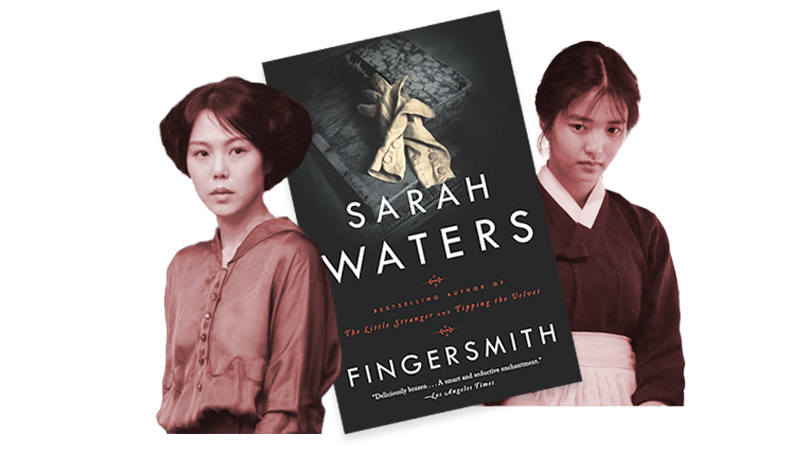 The Handmaiden
dir. Park Chan-wook, 2016
Based on Sarah Waters’s Fingersmith (2002)
Sub-genres: They Fixed It! • Metaphorical Molluscs • Wheels Within Wheels
Park Chan-wook manages to both honor and improve upon his source material in this out-of-the-box adaptation, which transposes the action from Victorian England to 1930s colonial Korea, and, honestly, fixes the third act. As an adaptation, it is a kind of wish fulfillment (no spoilers here, but you’ll know why if you’ve read the book), and is also bonkers gorgeous and, at times, quite terrifying. A feminist re-imagining of a feminist novel, complete with sinister octopus. –ET
 See also:
13 Adaptations Better Than the Books They’re Based On • Love and Struggle Throughout the Ages: A Reading List of Queer Historical Fiction • 10 Contemporary “Dickensian” Novels
*
MATCHUP:
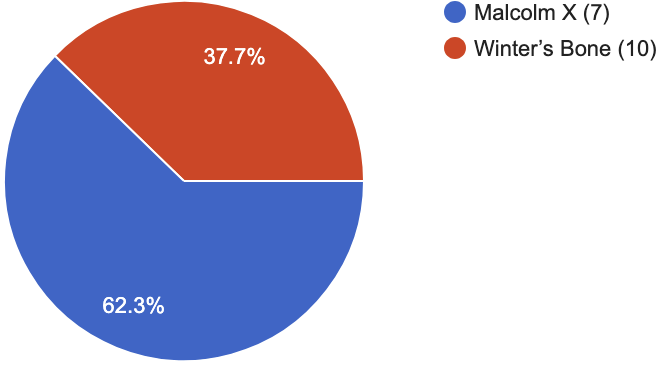
Malcolm X (7) vs. Winter’s Bone (10)
******************************************
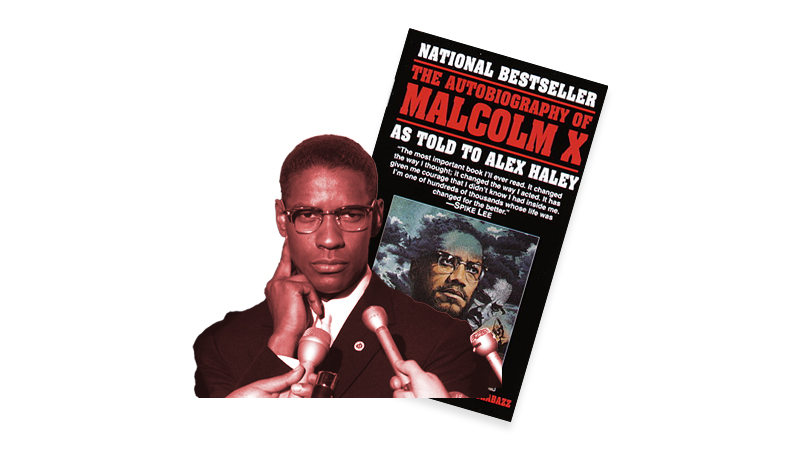 Malcolm X
dir. Spike Lee, 1992
Based on Alex Haley’s The Autobiography of Malcolm X (1965)
Sub-genres: Radical Films • Big Book & Big Movie • Amazing Cameos
Thanks to the maximalist Spike Lee, this sprawling biopic replicates the 500-page scope of its source material. We follow the man born Malcolm Little from point of origin to mission fulfillment; from Omaha to Harlem to Mecca, plus many stations in between. The film structure is ambitious because its subject was. You reach the credits appropriately floored by what Malcolm X (i.e., Denzel, giving a tour de force performance) managed to accomplish in such a short time. –BA
 See also:
How the Mothers of MLK, Malcolm X, and James Baldwin Shaped America • Naming the Unnamed: On the Many Uses of the Letter X • On the Self-Education of Frederick Douglass, Malcolm X, and the Insatiable Quest for Literacy • How to Understand the 1960s in 11 Books • Fatima Bhutto on Channeling the Fearlessness of Malcolm X • How Two of America’s Biggest Columnists Reacted to the Assassination of Malcolm X • The Invention of Mid-Century Cool • Falling in Love with Malcolm X—and His Mastery of Metaphor
••••••••••vs••••••••••
 Winter’s Bone
dir. Debra Granik, 2010
Based on Daniel Woodrell’s Winter’s Bone (2010)
Sub-genres: Coming Of Age Goes Wrong • Cold, Cold, Cold • A Different Kind of Hunger Games
This is a bleak movie, based on a bleak book, but manages to avoid easy tropes and stereotypes. I could easily imagine this as an overly simplistic crime thriller, but the direction and performances are nuanced and engaging. This is also one of the first movies I remember seeing Jennifer Lawrence in, and she plays Ree Dolly as remarkably composed despite the violent and desperate circumstances she ends up in. It gives the movie a bit of hope amidst the heart-pounding danger. –JF
 See also:
40 Writer’s Writers Whomst Readers Should Read • On the Genius of Daniel Woodrell, the “Battle-Hardened Bard of Meth Country”
*
MATCHUP:
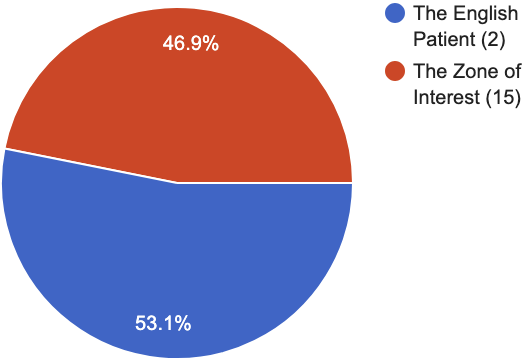
The English Patient (2) vs. The Zone of Interest (15)
******************************************
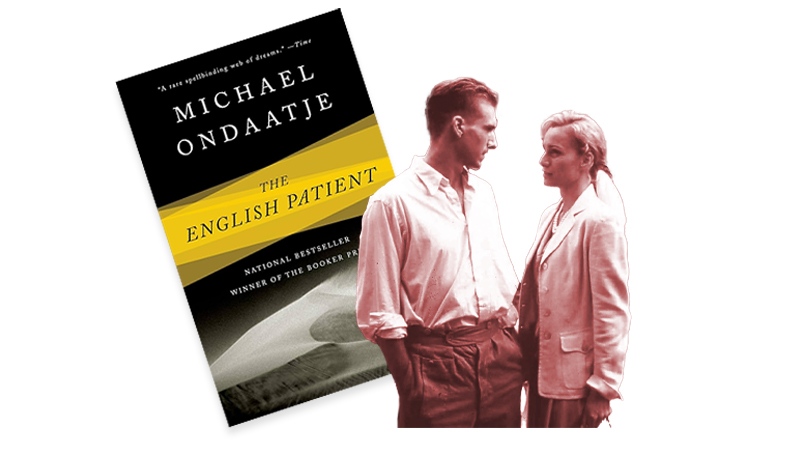 The English Patient
dir. Anthony Minghella, 1996
Based on Michael Ondaatje’s The English Patient (1992)
Sub-genres: So Many Awards • Sexy Archaeology • Biplanes
I got an undergraduate degree in archaeology and a lot of my peers cited Indiana Jones or The Mummy as the source of their interest in the field, but I distinctly remember one person saying they were inspired by The English Patient. And they’re not wrong—the movie certainly made archaeology seem like it would involve a lot more falling in love in beautiful caves.
This movie yearns, oh how it yearns. It’s the careful pacing, and the movement through time that builds the feeling, and allows The English Patient to maintain the careful attention of the novel, not easy to pull off with so much fighting going on. Minghella and a stellar cast never lose the tenderness amidst the epic sweep of a world war. –JF
 See also:
So, is the The English Patient good or what? • Michael Ondaatje’s Golden Man Booker Speech is Really Great • Telling Everything All at Once: A Conversation with Michael Ondaatje • Michael Ondaatje on the Books He Loves to Reread
••••••••••vs••••••••••
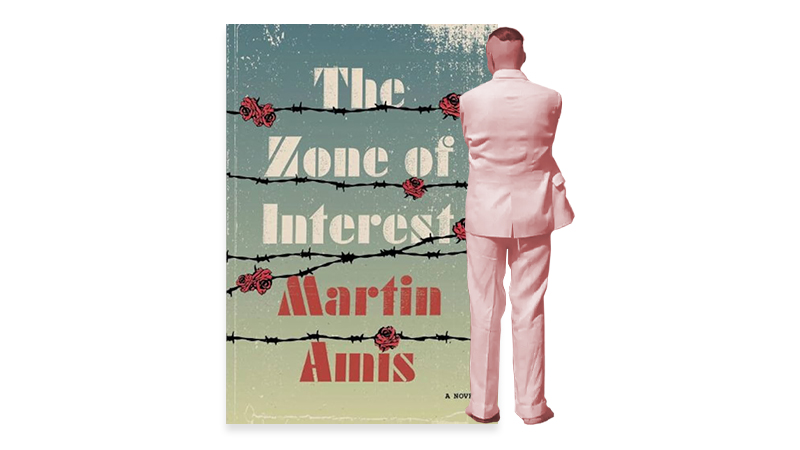 The Zone of Interest
dir. Jonathan Glazer, 2023
Based on Martin Amis’s The Zone of Interest (2014)
Sub-genres: Antifa • History’s Horrors • Frighteningly Relevant
A dark and unsparing story that isn’t afraid to break the fouth wall and draw explicit connections to our terrifying present day. This is based on Amis’s most brutal novel, and honors the text with an artsier approach. The production of this movie is fascinating too, much of it filmed with stationary cameras that allow the actors to dwell in the scenes, and the performances feel lived in, terrifyingly real. Glaser’s direction, and in particular the vivid use of sound, draw horrifying juxtapositions between domestic tranquility and genocide. –JF
 See also:
Clinging to an Ardent Hope: Eli Zuzovsky on Film, Selfhood, and Being an Israeli Writer Today
* * *

*
MATCHUP:
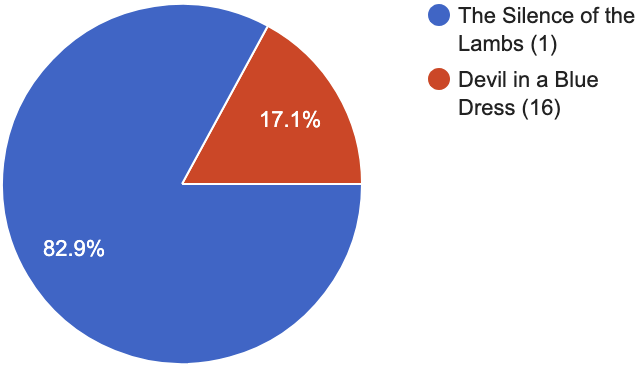
The Silence of the Lambs (1) vs. Devil in a Blue Dress (16)
******************************************
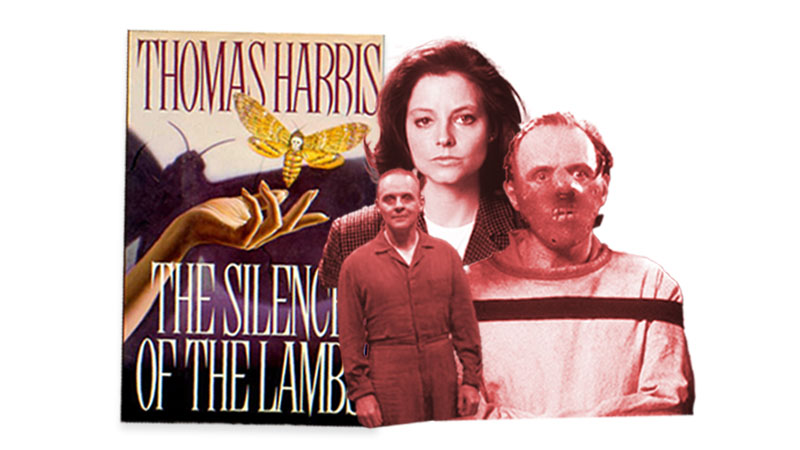 The Silence of the Lambs
dir. Jonathan Demme, 1991
Based on Thomas Harris’s The Silence of the Lambs (1988)
Sub-genres: Ruined Both Chianti AND Fava Beans • And the Song “American Girl” • Still Worth It, Though
Jonathan Demme’s adaptation starts out tense (dreary woods and Howard Shore strings from the jump) and tightens the screws, with surgical precision, to an almost unbearable tautness—culminating in one of the great payoffs in film history. And, of course, the repartee (if slightly mismatched) between Jodie Foster and Anthony Hopkins is a skin-crawling delight. –JG
 See also:
40 of the Best Villains in Literature • On the Women Lucky Enough to Survive Horror Films
••••••••••vs••••••••••
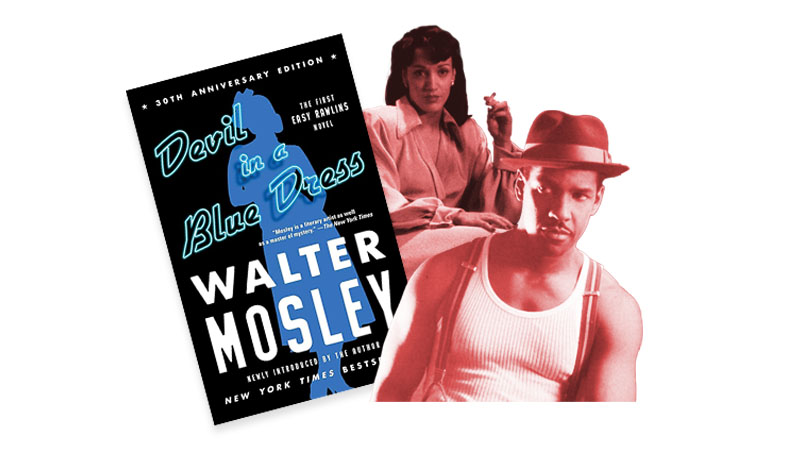 Devil in a Blue Dress
dir. Carl Franklin, 1995
Based on Walter Mosley’s Devil in a Blue Dress (1990)
Sub-genres: It Goes Higher Than You Could Ever Imagine • Denzel’s Cool Mustache • L.A. At Night
This neo-noir, based on Walter Mosley’s debut, is incredibly stylish. The ear for dialogue that makes Mosley’s writing so distinct is a natural fit for the screen, and it comes to life with an excellent cast led by Denzel Washington at the height of his powers as Easy Rawlins. As in all truly great noirs, Easy is a cork adrift in larger social and political forces, and Denzel is just as good at being shocked as he is at being forceful and charismatic. Plus everyone looks cool as hell in all the moody nighttime fog, which is exactly what you want visually from an L.A. crime story. –JF
 See also:
Walter Mosley on Devil in a Blue Dress, Thirty Years Later • Walter Mosley on Learning to Love Rewriting • Walter Mosley: When I’m Telling a Story I Imagine the Eavesdropper Over My Shoulder
*
MATCHUP:
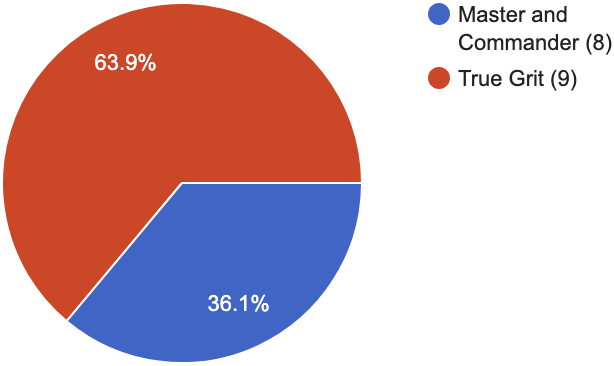
Master and Commander (8) vs. True Grit (9)
******************************************
 Master and Commander
dir. Peter Weir, 2003
Based on Patrick O’Brian’s Master and Commander (1969)
Sub-genres: Oceans Are Now Battlefields • The Boyfriend Canon • Codependent Male Friendship
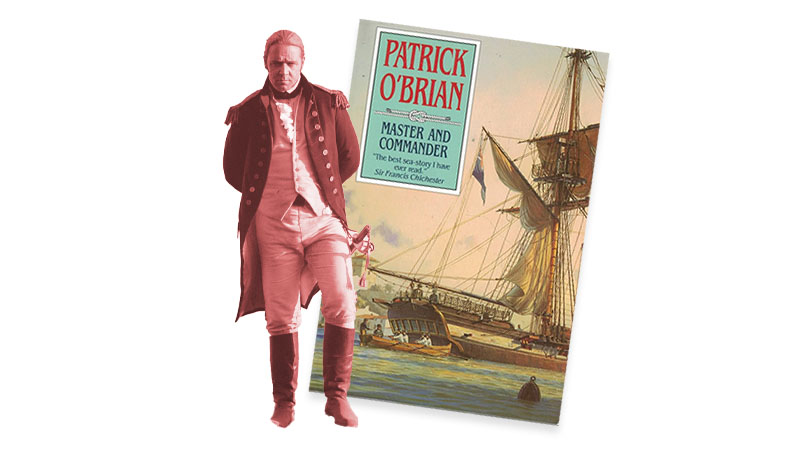
Men froth at the mouth about this movie—it’s the only thing we think about more than the Roman Empire. The opening title card became a classic boy-meme and the 4K release that came out 20+ years after the film’s release sold out instantly and spawned a cutthroat secondary market. This reaction isn’t all that surprising when O’Brian’s books have been inspiring the same dorky devotion since the ‘60s. But believe the hype: both the books and the film are very worth it. The movie is gorgeous, thrilling, and very fun, anchored by Crowe and Bettany’s performances, which capture all of the love and devotion between Aubrey and Maturin. –JF
 See also:
Actually, Master and Commander is a Domestic Fantasy About a Codependent Life Partnership!
••••••••••vs••••••••••
 True Grit
dir. Joel Coen and Ethan Coen, 2010
Based on Charles Portis’s True Grit (1968)
Sub-genres: “La-Beef” • Forceful Narrators • Great Nicknames
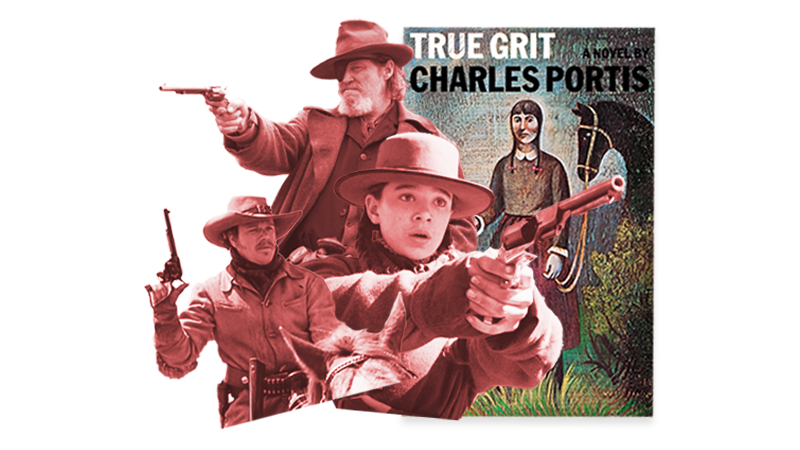
I’m glad that it was the Coen’s who adapted this novel by one of America’s funniest writers. The three men share sensibilities: Portis and the Coens all love a freaky little tertiary character, an idiosyncratic turn of phrase, and a manically driven main character. Unlike the John Wayne adaptation from the ‘60s, the Coens honor what makes Portis’s novel memorable: Mattie Ross and her highly opinionated narration. Hailee Steinfeld is great in the role, and all the more impressive that it’s her first film. True Grit is a movie that meets the almost impossibly bar the novel sets. –JF
 See also:
A Close Reading of True Grit’s Perfect First Paragraph • He Got Away With Everything: Reading True Grit After the Reelection of Donald Trump • The Paradox of the Contemporary Southern Writer • Bud Smith on the Quintessential “Road Trip” Novel • Eric Puchner: How to Be Funny When Writing a Novel • The 10 Best Literary Film Adaptations of the Decade
*
MATCHUP:
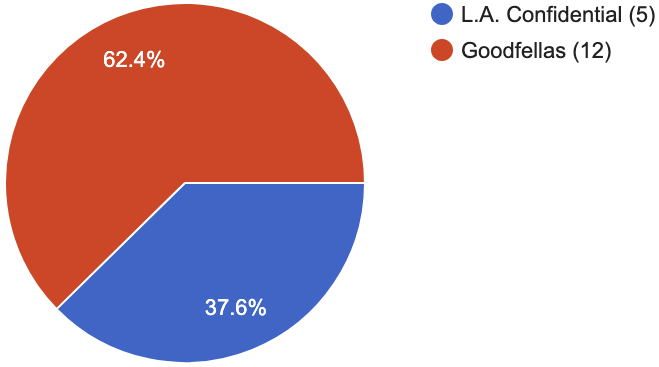
L.A. Confidential (5) vs. Goodfellas (12)
******************************************
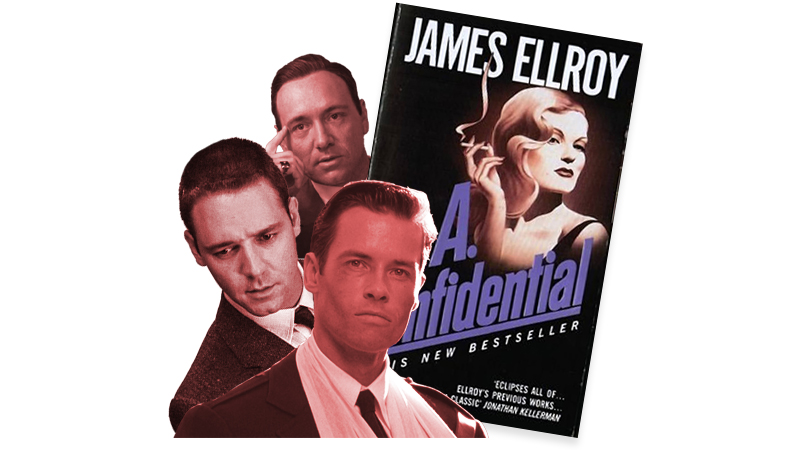 L.A. Confidential
dir. Curtis Hanson, 1997
Based on James Ellroy’s L.A. Confidential (1990)
Sub-genres: From The Twisted Mind of James Ellroy • Corruption • “It Goes All The Way To The Top!”
Coming out on the tail-end of the neo-noir revival that kicked off in the ‘70s, this adaptation has everything you want from a story of L.A. corruption and malice. The twisted cynicism and cruel violence of James Ellroy is hard to replicate on the screen, but L.A. Confidential’s taut pace and manic density feels like it gets close. And every character seems dangerously teetering on a knife’s edge of something unredeemable, a hallmark of Ellroy’s hyperventilating plots. –JF
 See also:
Ten Books Where the Setting Is a Character • James Ellroy Reveals the Real Reason He Writes
••••••••••vs••••••••••
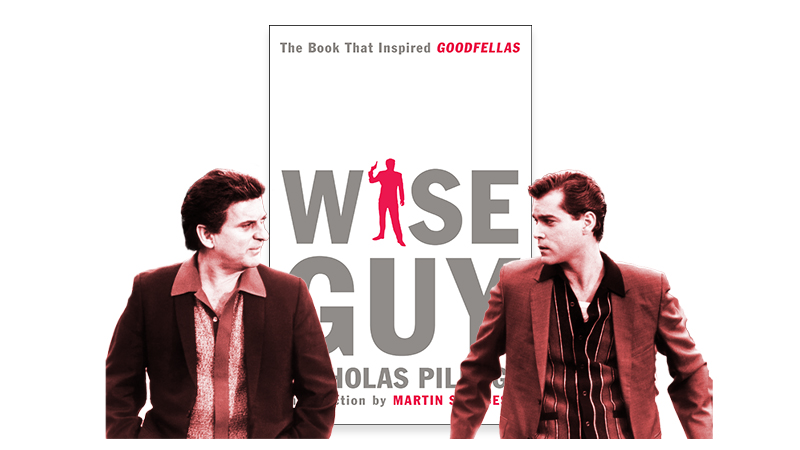 Goodfellas
dir. Martin Scorsese, 1990
Based on Nicolas Pileggi’s Wiseguy (1985)
Sub-genres: Great Narration • Iconic Garlic Slicing On Film • So Much Cocaine
What makes Goodfellas the perfect adaptation is its style, and how perfectly suited that style is to the content. On the page, ex-gangster Henry Hill’s story is exciting enough. But it’s Scorcese’s zooming, coked-out sensibility—as felt in sweaty close-ups, indelible needle drops, and brash voice over—that brings our unreliable narrator(s) to life. The scene on the stand, when Hill breaks the fourth wall? Because at this point in the narrative, Henry feels he can break anything!? Is inspired medium translation. No small wonder that Scorcese self-cannibalized the move in several subsequent projects. –BA
 See also:
Thirty Years Later, Is Goodfellas The Greatest Mob Movie Ever Made?
*
MATCHUP:
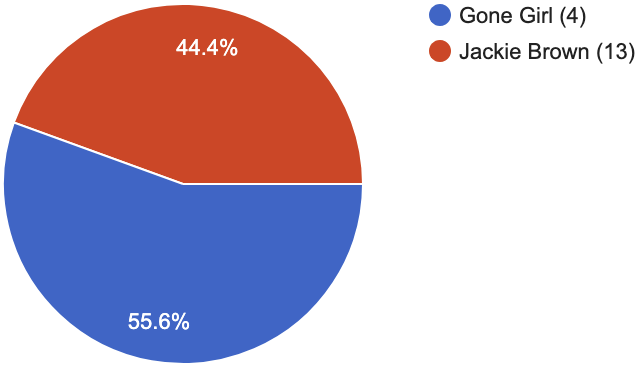
Gone Girl (4) vs. Jackie Brown (13)
******************************************
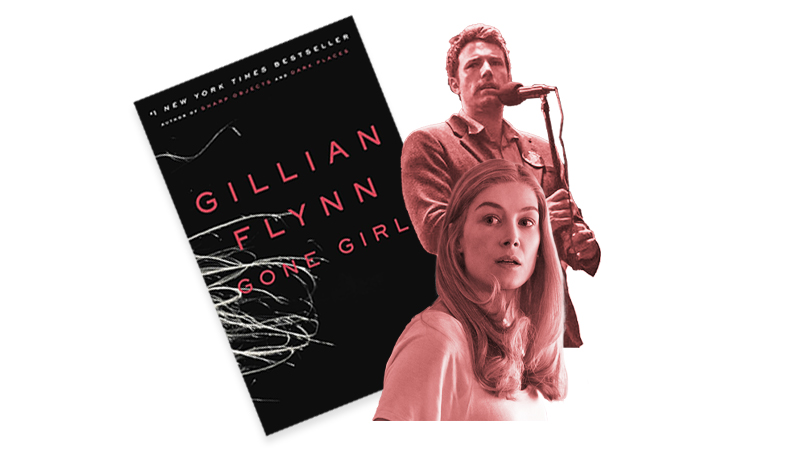 Gone Girl
dir. David Fincher, 2014
Based on Gillian Flynn’s Gone Girl (2012)
Sub-genres: Revenge Served Cool • Writers Behaving Badly • Spitting In Mountain Dew
Look, nothing’s ever going to hit quite like that on-page twist—but damn if David Fincher doesn’t almost pull it off. An absolutely feral Rosamund Pike, Ben Affleck at his most charming and hateful (this is up there with Ned in Shakespeare in Love for top Affleck roles), a thoroughly creepy Neil Patrick Harris, and about a thousand other killer performances against the haunting Trent Reznor/Atticus Ross score are frankly hypnotizing. Even if you know the twists, the movie still convinces you that you might not. This movie also helps me explain to people why I think the Macbeths are the most mature, loving couple in all of Shakespeare. –DB
 See also:
30 of the Worst Couples in Literature • On the Feminine Urge to Murder • Why the Rise of Morally Gray Women In Fiction Is Good For All of Us
••••••••••vs••••••••••
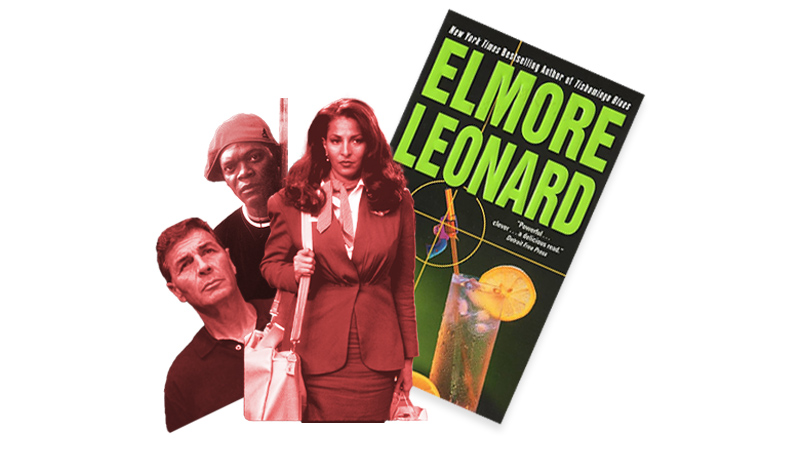 Jackie Brown
dir. Quentin Tarantino, 1997
Based on Elmore Leonard’s Rum Punch (1992)
Sub-genres: Neo-Blaxploitation • Swapping And Reswapping Bags of Cash • Inventive Adaptations
Note to the engineers: there should be a sub-category in this bracket for adaptations that hinge on impeccable soundtracks—though honestly, such a sub-category would undersell Jackie B. My parents had this (perfect) CD on in the car for most of 1998, but the real case for Jackie rests on casting. The elegantly sly Pam Grier, a long-time blaxploitation heroine, is reinvented in this lively caper as a con artist on a relatable mission: to retire. The rest of the cast is a winky murderer’s row of genre veterans, who all bring earnest cheek to their assignments. –BA
 See also:
Quentin Tarantino’s list of his favorite books may (or may not) surprise you.
*
MATCHUP:
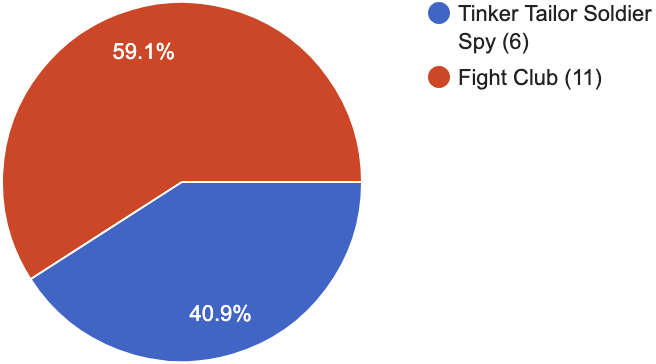
Tinker Tailor Soldier Spy (6) vs. Fight Club (11)
******************************************
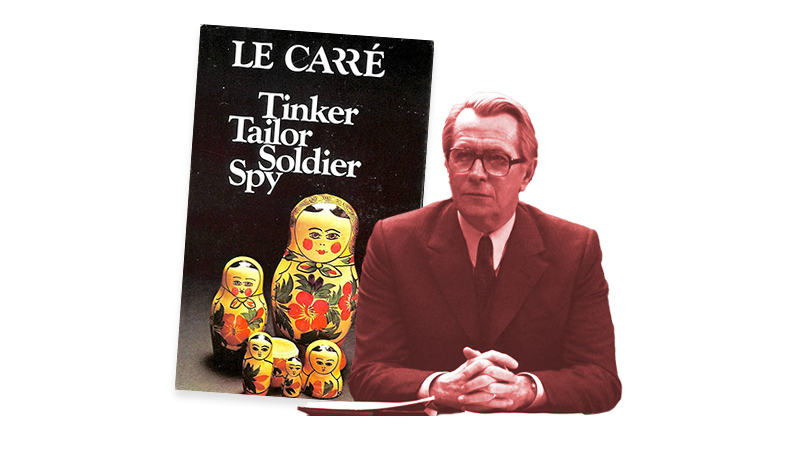 Tinker Tailor Soldier Spy
dir. Thomas Alfredson, 2011
Based on John le Carré’s Tinker Tailor Soldier Spy (1974)
Sub-genres: One Kind of Oldman Spy • The Circus • The Boyfriend Canon • Spies With Ennui • The Many Accents of The Cold War
Le Carré is one of the most adapted authors ever, and TTSS is one of the greatest adaptations of his work. The cast is a murderers row of British actors, and the twisting plot of the novel is full of introspection and doubt, which makes for a tight 127 minutes of shocking revelations told through stern and troubled looks. Beautifully performed, this Cold War espionage plot is really about what conflict and hyperviligence does to someone. Betrayal, and the thin rewards of life dedicated to a shadow conflict on nebulous grounds, is corrosive. Le Carré’s Circus is a sad lot of devoted and heartbroken men, who cannot ask each other for the help they so desperately need. –JF
 See also:
“The Anti-James Bond.” Read This Early Review of Tinker, Tailor, Soldier, Spy • A Writer For Our Time: Why John le Carré’s Work Remains More Essential Than Ever • How Four Literary Icons Chose the Pen Names That Made Them Famous • Spying is Lying: How David Cornwell Became John Le Carré • The Lit Hub Staff’s Favorite Villains: James Folta on John le Carré’s Karla • Look inside the gorgeous English cottage where John Le Carré wrote Tinker Tailor Soldier Spy •
••••••••••vs••••••••••
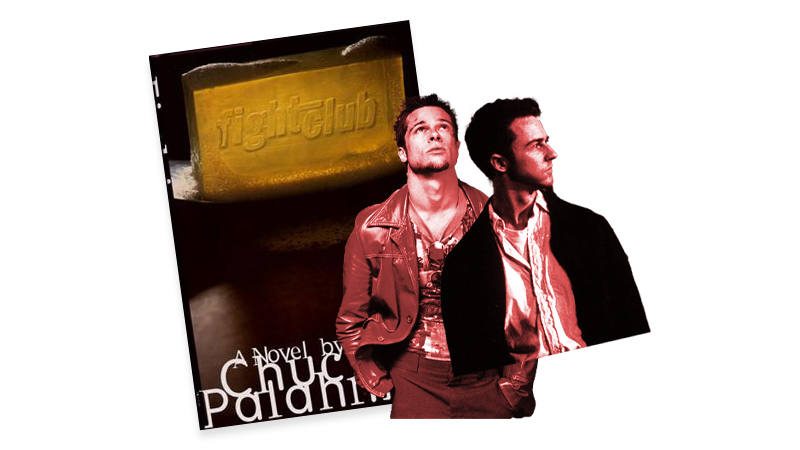 Fight Club
dir. David Fincher, 1999
Based on Chuck Palahniuk’s Fight Club (1996)
Sub-genres: The Boyfriend Canon • Where Is My Mind • Dudes Being Dudes
I don’t love all of the changes made to Chuck Palahniuk’s incendiary debut, but it almost doesn’t matter. Ed Norton and Brad Pitt are grimy and beautiful (and don’t get me started about Helena Bonham Carter) and any movie that features Jared Leto getting his ass kicked is worth the candle. Fight Club has always been misunderstood—by readers, viewers, cultural commentators—but I think Fincher manages to get his licks in about capitalism almost as good as Palahniuk does in the novel. And if the ending is a cop-out, well, who hasn’t said, “You met me at a very strange time in my life” to the person they’re dating? –DB
 See also:
Everyone Misunderstands the Point of Fight Club • Behind the Scenes of David Fincher’s Fight Club
*
MATCHUP:
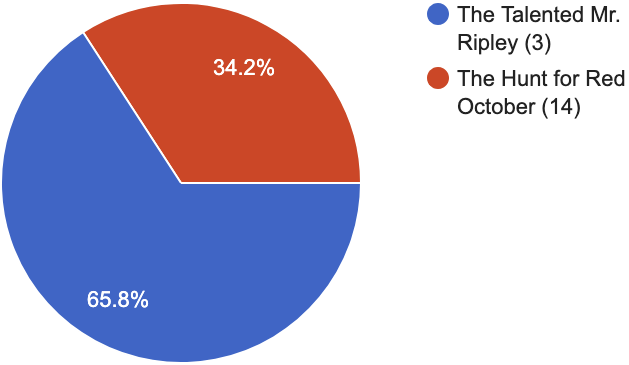
The Talented Mr. Ripley (3) vs. The Hunt for Red October (14)
******************************************
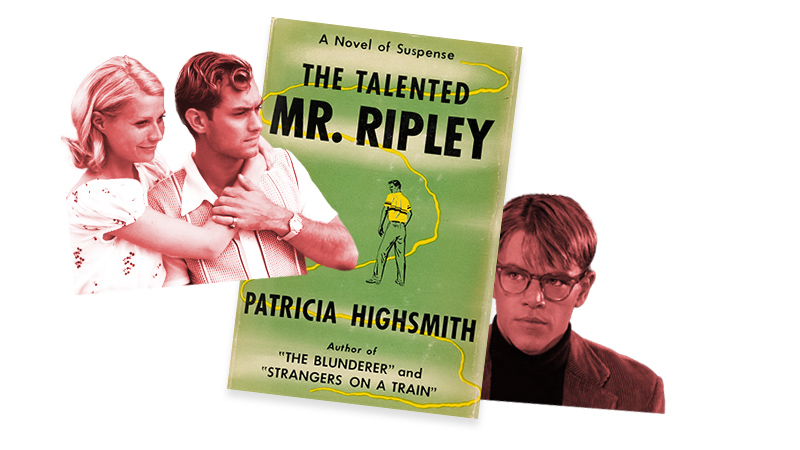 The Talented Mr. Ripley
dir. Anthony Mingella, 1999
Based on Patricia Highsmith’s The Talented Mr. Ripley (1995)
Sub-genres: Beautiful People Doing Murders • Creating Text from Subtext • Boats are Dangerous
Matt Damon has never been more convincing than in his turn as Tom Ripley in Minghella’s unsettling and intoxicating adaptation of Highsmith’s complex thriller, but it’s Philip Seymour Hoffman who really steals the show, even against Jude Law, Gwyneth Paltrow, and Cate Blanchett as the invented but excellent Meredith. The warmth of the film—shot on location in Positano, Italy—only adds to its creeping, sexy menace. Is it better than the book? Not quite, but it makes an excellent companion piece. –ET
 See also:
A Close-Reading of The Talented Mr. Ripley as Coming of Age Story • I think about this tiny detail from The Talented Mr. Ripley all the time. • The Lit Hub Staff’s Favorite Villains: Dwyer Murphy on Patricia Highsmith’s Tom Ripley. • All Our Monstrous Fantasies: A Reading List • Let Them Be Morally Flawed: In Defense of Queer Villains in Stories
••••••••••vs••••••••••
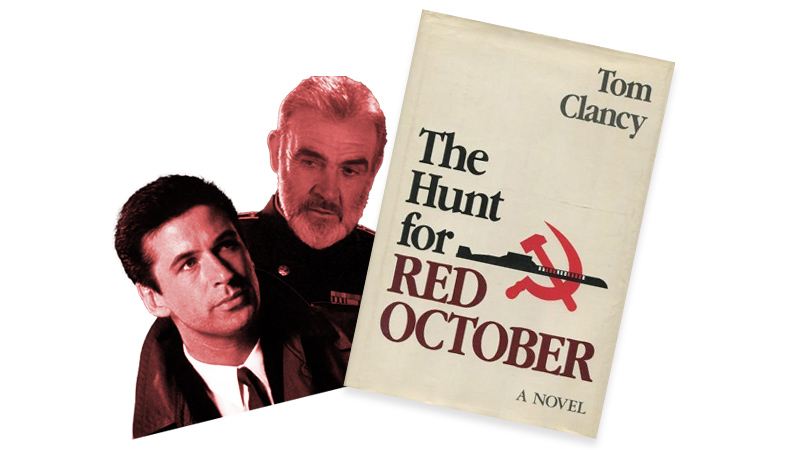 The Hunt for Red October
dir. John McTiernan, 1990
Based on Tom Clancy’s The Hunt for Red October (1984)
Sub-genres: Under The Sea • The Many Accents of The Cold War • Hot Naval Nerds • Stirring Renditions of The Soviet Anthem • Poor Sam Neil’s Montana Dreams
Like all the great Cold War thrillers, this movie is successful because of its novelistic attention to the people caught in the conflict. Incredible displays of competence and poise under pressure hold the film’s plot, but Red October’s leading men are thoughtful and introspective in the quiet moments, which feels atypical for the genre. But at the end of the day it’s also just a cool as hell sub movie with amazing ambiance, heightened set-ups, and torpedoes criss-crossing all over the place.
This book and movie also have one of my favorite Clancy Facts, which is that Tom revealed a top secret, silent navigation technology that caused a minor stir in the world of military-industrial-complex boat guys. That’s the power of novels. –JF
 See also:
Here are the Biggest Fiction Bestsellers of the Last 100 Years
*
MATCHUP:
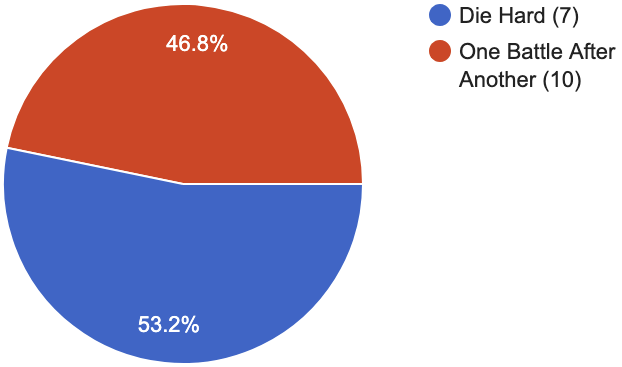
Die Hard (7) vs. One Battle After Another (10)
******************************************
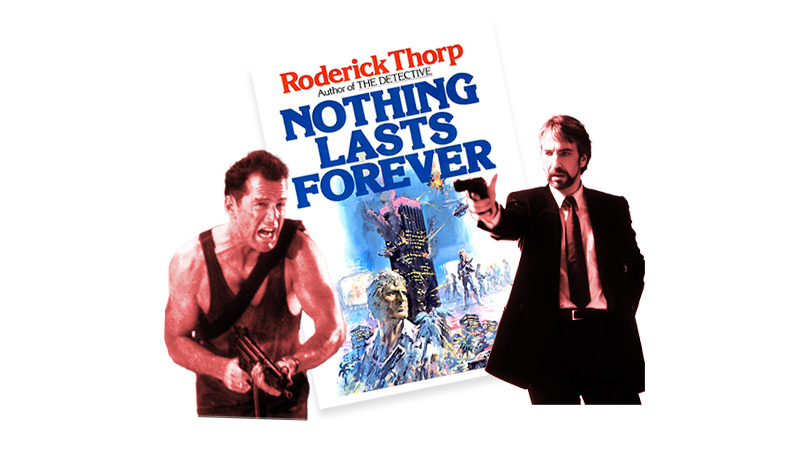 Die Hard
dir. John McTiernan, 1988
Based on Roderick Thorp’s Nothing Lasts Forever (1979)
Sub-genres: But Is It a Christmas Movie? • Better Than the Book • The Watch is a Metaphor, You See • Yippie-ki-yay
An action movie about a cop at a Christmas party that turned out way, way better than it needed to be, thanks to Bruce Willis, the always-excellent Alan Rickman, superb pacing, and most of all, a strong sense of humor. Is it essentially an anti-feminist parable? Possibly! But you’d hardly notice because of all the fun you’re having. –ET
 See also:
On the Literary Roots of Die Hard • 21 Movies You Should Watch This Holiday Season • 13 Adaptations Better Than the Books They’re Based On
••••••••••vs••••••••••
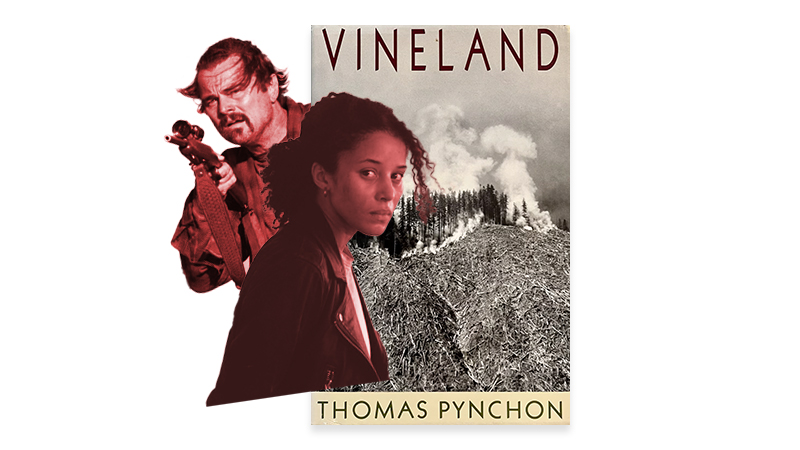 One Battle After Another
dir. Paul Thomas Anderson, 2025
Based on Thomas Pynchon’s Vineland (1990)
Sub-genres: Viva La Revolución • Very Loose Adaptations • A Few Small Beers
The most recent film to make our cut, and one of the most interesting adaptations from page to screen in years. Vineland is wildly different—set in a different decade and full of Pynchon’s typically batty rocket-flights of fancy—but PTA finds a thread of resonant plot and character that feels true to the source material and ripped from our very dark headlines. Great performances (Benicio del Toro, my king) and great editing makes OBAA the best of the recent films taking on This Moment Of Ours, more successful than the snotty Eddington or the loopy Bugonia. —JF
 See also:
Thomas Pynchon Has Been Warning Us About American Fascism the Whole Time • Why Thomas Pynchon’s Vineland—a Disappointment When It Was Published—is the Novel We Need Right Now • In Line With All the Pynchon Fans at the Midnight Release of Shadow Ticket • Ana Gavrilovska on Pynchon’s Prescient Technofascism
*
MATCHUP:
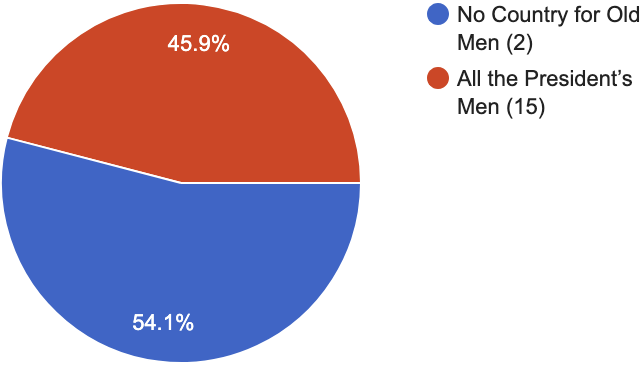
No Country for Old Men (2) vs. All the President’s Men (15)
******************************************
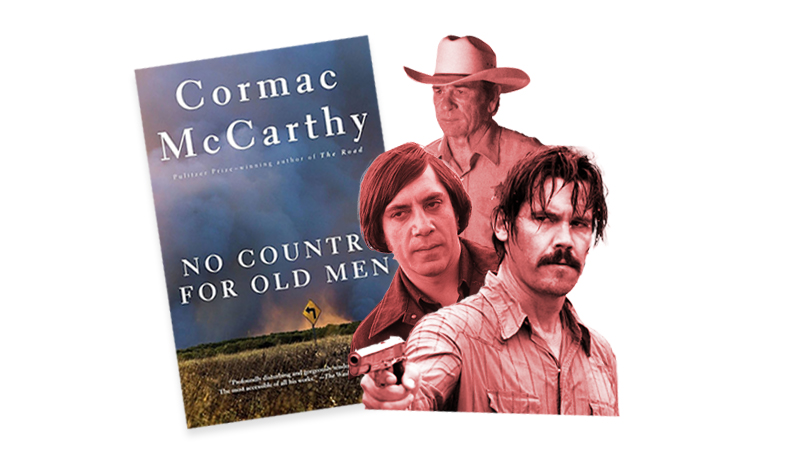 No Country for Old Men
dir. Joel Coen and Ethan Coen, 2007
Based on Cormac McCarthy’s No Country for Old Men (2005)
Sub-genres: Extra Villainous Villains • Contemplating The Nature of Evil • Hats
It’s sometimes shocking to think that No Country beat out two other similarly spectacular adaptations (There Will Be Blood, a very loose adaptation of Upton Sinclair’s Oil!, and Atonement) for the 2007 Academy Award for Best Picture. I probably watch those other films more often than I do No Country and yet I do think No Country is also the better adaptation. It gave us, of course, Javier Bardem’s most riveting performance as the classically-McCarthy-ian villain Anton Chigurh, but the thing that seals the deal for me is the ending, which somehow brings the true existentialist poetry of McCarthy’s writing to life in the simple delivery of Tommy Lee Jones and the steady camerawork of the Coen Brothers. A true masterpiece. –DB
 See also:
Remembering Cormac McCarthy • JD Vance Quoted One of Cormac McCarthy’s Most Evil Characters to Make Some Asinine Point • The 30 Best Diner Scenes in Crime Movies, Ranked
••••••••••vs••••••••••
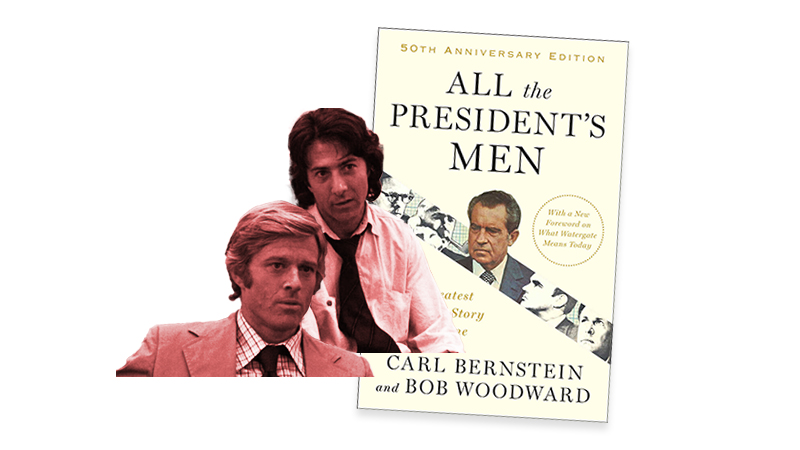 All the President’s Men
dir. Alan J. Pakula, 1976
Based on Carl Bernstein and Bob Woodward’s All the President’s Men (1974)
Sub-genres: Hot Reporters • Shoe Leather • The Lost World of Print Media
I’ve been on the record in the pages (“pages”) of Lit Hub that this is my least favorite of Pakula’s paranoia trilogy, but that’s like getting the bronze at the Olympics—you’re still way, way better than the average. ATPM is exellent: the amazing performances, the tense conversations, and the ringing phones, crumbling paper, and scritching pencils of The Post‘s busy news room (RIP, good Post). It’s a thrilling movie about the mechanics of reporting out a news story that manages to keep the suspense high, even though we know how it ends.
This is a hard one to rewatch in 2026, though, since the world of the 1970s, with its robust, respected media and politicians that can feel shame, feel so utterly foreign. –JF
 See also:
All the President’s Shakespeare • Bigger Than Watergate? 10 Essential Books About Our Future Past
* * *
*
MATCHUP:
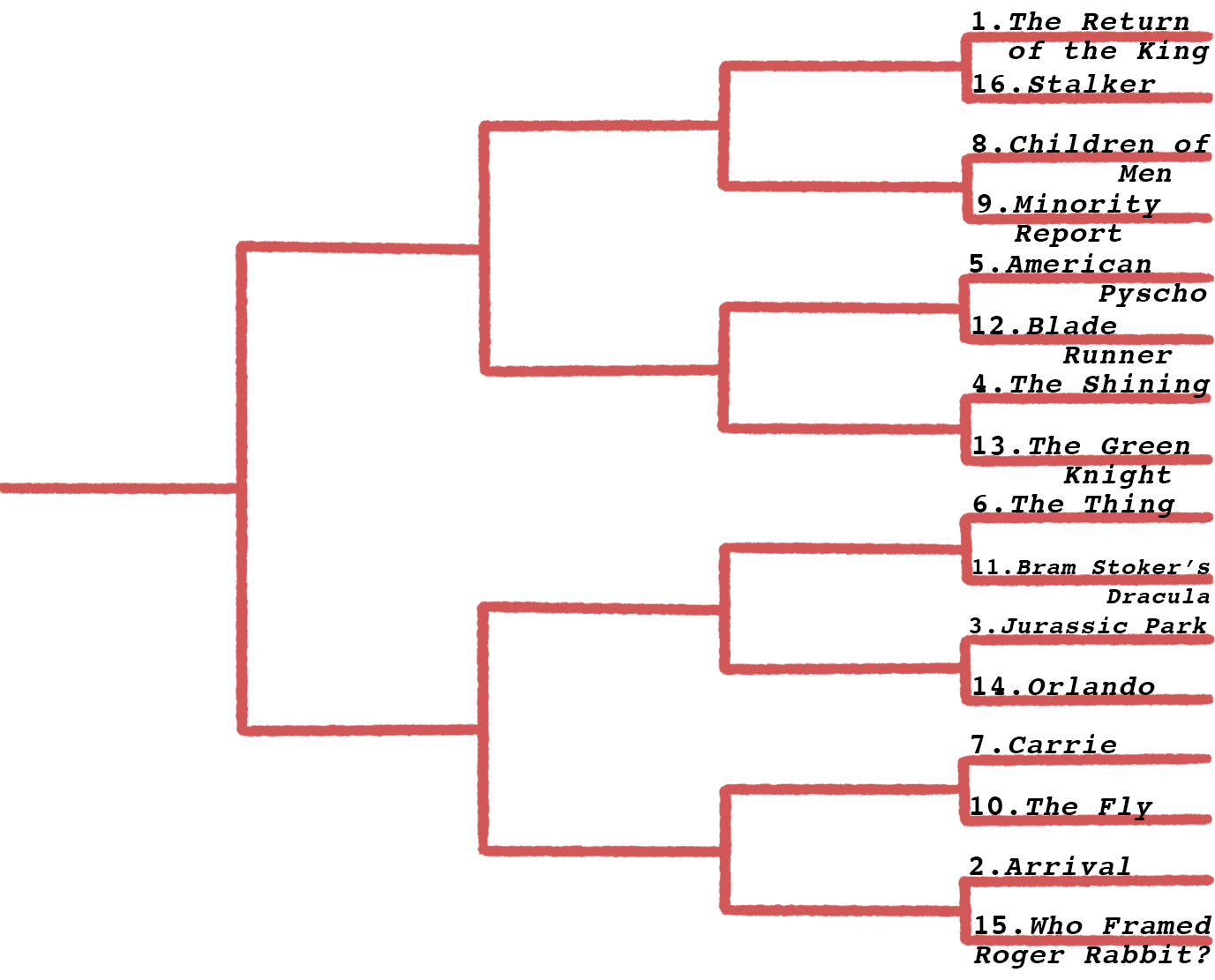
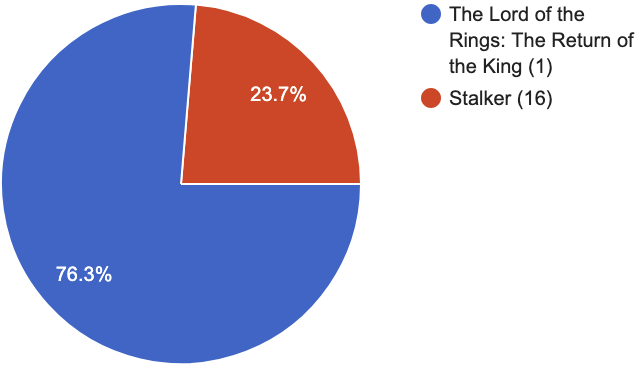
The Lord of the Rings: The Return of the King (1) vs. Stalker (16)
******************************************
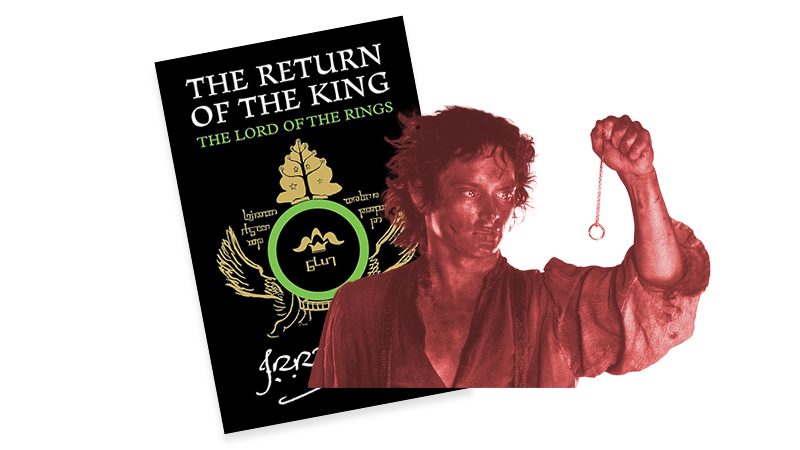 The Lord of the Rings: The Return of the King
dir. Peter Jackson, 2003
Based on J.R.R. Tolkien’s The Return of the King (1955)
Sub-genres: Extended Edition or Die • Movies That Make Me Cry For Over One Full Hour • Sam Gamgee You Will Always Be Famous
The Lord of the Rings movies are some of the best films—let alone the best adaptations—ever made. What Jackson (and his co-writers Phillipa Boyens and Fran Walsh) manage to do with Return of the King is uphold the world and themes of the book while also clarifying the message and emotional stakes of the original text. They’re talented editors as much as they’re talented adaptors. There is a deep care and respect in every choice made, and no change is made lightly, no cut is made thoughtlessly. Like Tolkien’s novel, this movie is a masterwork of craft. Unlike Tolkien’s novel, we get to see many different crafts succeed at once: writing, editing, directing, costuming, acting, designing, and more. I could talk about this movie for a very long time, but instead I’ll just say: it’s probably been too long since you watched it. Throw it on and have a good 4+ hour cry. –MC
 See also:
The Literary Power of Hobbits: How JRR Tolkien Shaped Modern Fantasy • Did Tolkien Write The Lord of the Rings Because He Was Avoiding His Academic Work? • Is The Lord of the Rings a Work of Modernism? • On the time J.R.R. Tolkien refused to work with Nazi-leaning publishers • Imaginary Histories: How Tolkien’s Fascination with Language Shaped His Literary World • Why We Feel So Compelled to Make Maps of Fictional Worlds
••••••••••vs••••••••••
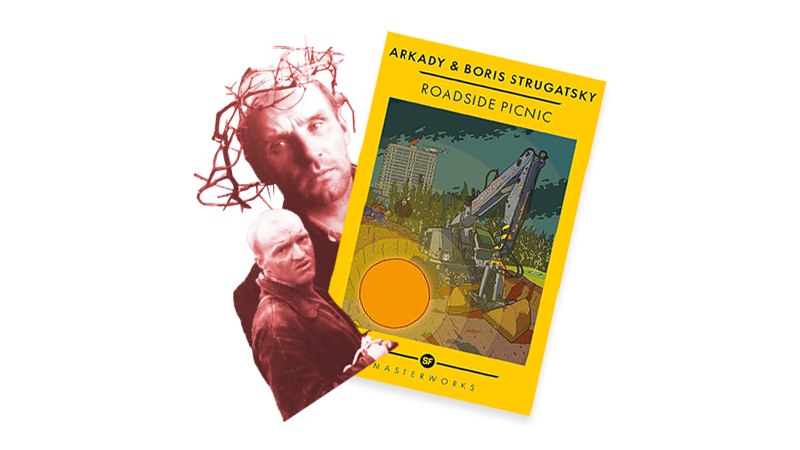 Stalker
dir. Andrei Tarkovsky, 1979
Based on Arkady and Boris Strugatsky’s Roadside Picnic (1972)
Sub-genres: Soviet Sci Fi • Strange Vacations • Lots of Allegory
Stalker is a journey. The Zone that the tourists enter, guided by the titular Stalker, is mysterious and beautiful, which Tarkovsky starkly juxtaposes against the dystopia of the rest of the world. This can be read as a reflection on any number of late-era Soviet anxieties or encounters with the outside world. But Stalker is above all a philosophical, nearly religious movie about consciousness, love, and hope. The room at the center of The Zone starts to feel like some gnostic state of being that we’re all seeking, groping tenderly ahead of ourselves for danger with small bolts tied to cloth. –JF
 See also:
How Andrei Tarkovsky Taught Me to Write About the American West
*
MATCHUP:
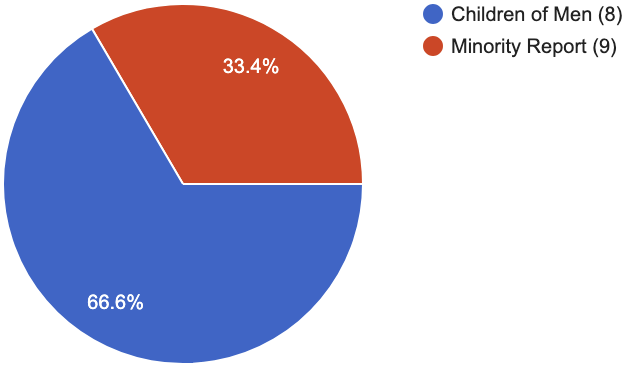
Children of Men (8) vs. Minority Report (9)
******************************************
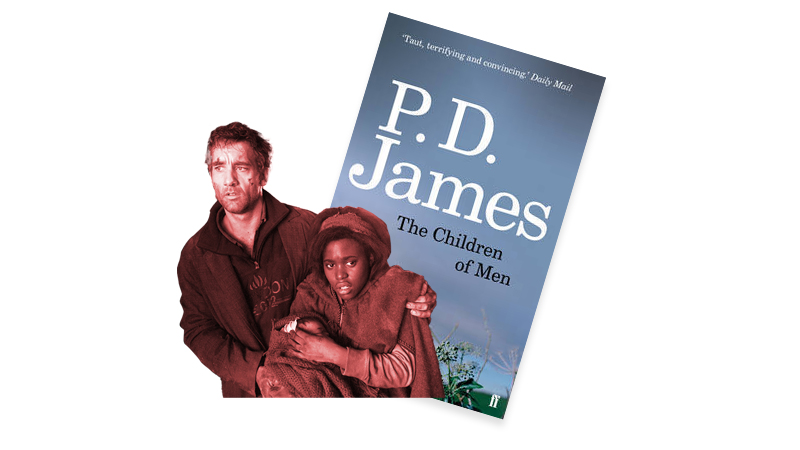 Children of Men
dir. Alfonso Cuarón, 2006
Based on PD James’s The Children of Men (1992)
Sub-genres: The Only Living Boy • Stoner Michael Caine • One Shot Hall of Fame • Too Prescient
There was a great tweet from back in the day that wondered if in Children of Men, maybe the rest of the world was still normal and only Britain was like that. It’s a joke that doesn’t strike me as so absurd anymore, from the vantage point of a country that is inflicting a lot of pain on others and on itself, for really no reason at all.
Children of Men is prescient in this and a lot of other ways, but most of all it’s a well-made, thoughtful action movie. Cuarón is a great director, and the speculative plot is complicated by a tired hero, played by the moody and reluctant Clive Owen. In the two decades since its release, I find this movie most memorable for its vivid texture, of life during a violent apocalypse-in-process. –JF
 See also:
22 (More) Adaptations Better Than the Books They’re Based On • Speculative Journeys: Sci-Fi for People Who Don’t Really Like Sci-Fi • Writing the Anxiety of Parenthood on the Precipice of Apocalypse
••••••••••vs••••••••••
 Minority Report
dir. Steven Spielberg, 2002
Based on Philip K. Dick’s The Minority Report (1956)
Sub-genres: Big Ol’ Touch Screens • Eyeball Surgery • Those Pre-Cog Goo Vats Look Pretty Relaxing
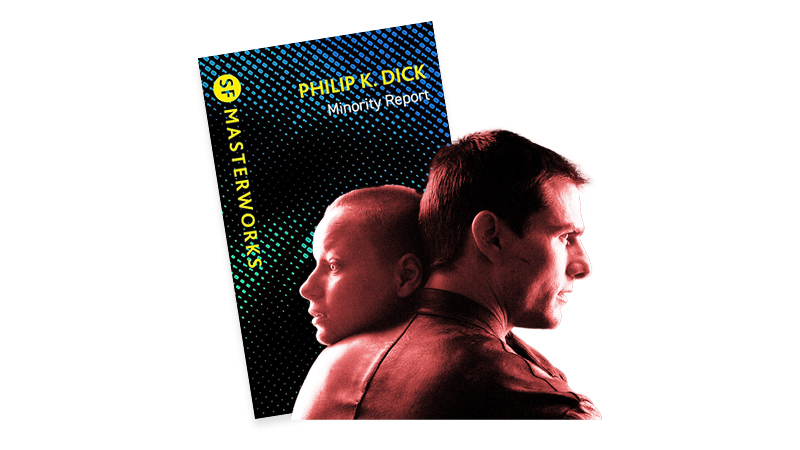
Adapting Philip K. Dick always requires focusing and pruning, and Spielberg does it right: Minority Report is incredibly tight and propulsive, delivering a ton of high concept exposition and plot twists without feeling too ham-fisted or corny. And it’s remarkable how well it all hangs together, given all the big world-building swings: the clairvoyant pre-cogs floating in tanks and spitting out engraved prediction balls, the giant touch screens and their power gloves, Colin Farrell forever wearing pin-stripes. A lot of Minority Report‘s speculations have come true—of course the Justice Department will supercharge profiling through an expensive and untested tech solution—but the detail that sticks with me most is the Gap store retinal-scanning Cruise and yelling past purchases back at him. It’s a throwaway joke that isn’t as funny 20 years later. –JF
 See also:
43 of the Most Iconic Short Stories in the English Language • Jonathan Lethem on Revisiting Old Short Stories While Writing New Ones • We have a dangerous blur: Philip K. Dick’s cult essay about false realities is as relevant as ever.
*
MATCHUP:
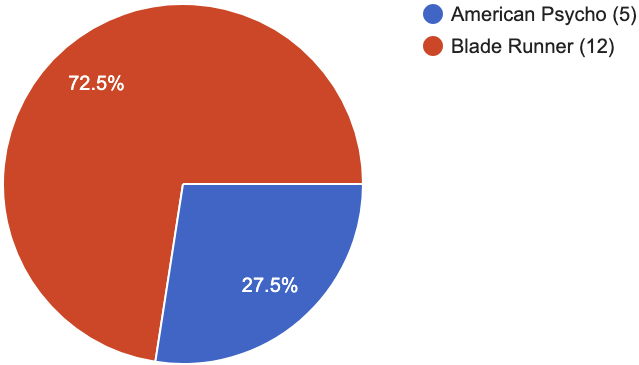
American Psycho (5) vs. Blade Runner (12)
******************************************
 American Psycho
dir. Mary Harron, 2000
Based on Bret Easton Ellis’s American Psycho (1991)
Sub-genres: Morning Routines • Exhibit A In The Media Literacy Crisis • Hot Takes on Fonts
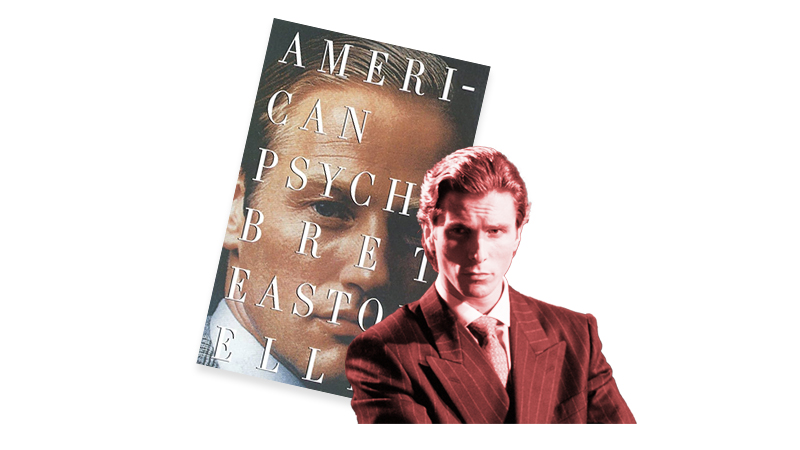
Picking up from the book’s breathless lists of detail and brands, there’s so much texture on screen in American Psycho. It forms a thick crust of aesthetics that insulate the characters from self-reflection. Those vibe-y details are also easy to clip for a fan cam, and seem to distract many of today’s weirdest guys from being able to see the film’s satirical barbs. I would think it’s pretty clear what this movie is up to: Christian Bale is intensely creepy as a dead-eyed finance bro and director Mary Harron brutally dramatizes his descents into depravity. The book has a bit more shocking violence than we see in the film perhaps, but I don’t see how the point of American Psycho could be more direct. I can’t fault the movie for the misreadings of the populace, but it certainly makes me feel some kind of way that Patrick Bateman has so many fans these days. –JF
 See also:
On the Decision to Make Patrick Bateman a Serial Killer • How Donald Trump Brought the “Bateman Doctrine” to the World • Our favorite Literary Twitter moments: Drew Broussard on “come over at do bring coke now” • 40 of the Best Villains in Literature • Nine of the Most Violent Works of Literary Fiction • 40 of the Creepiest Book Covers of All Time • A Brief Survey of the Great American Novel(s)
••••••••••vs••••••••••
 Blade Runner
dir. Ridley Scott, 1982
Based on Philip K. Dick’s Do Androids Dream of Electric Sheep? (1968)
Sub-genres: The Boyfriend Canon • More Human Than Human • “Computer, Enhance” • They Fixed It
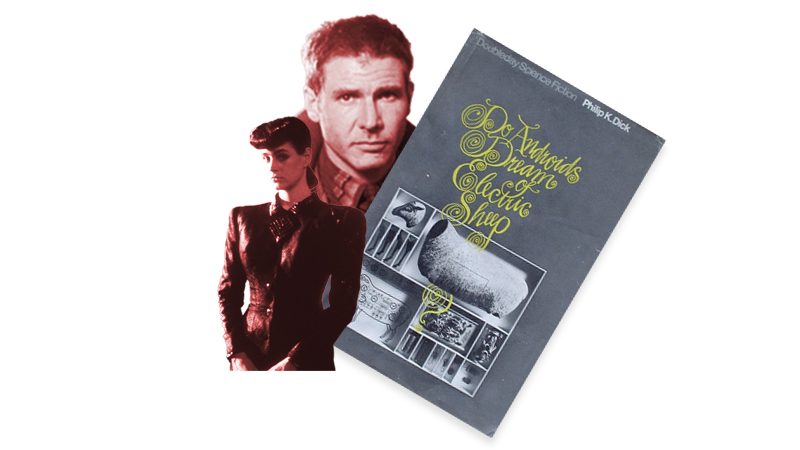
This iconic adaptation smoothed out a lot of the tangles in Dick’s novel, but it didn’t arrive perfect. A weird monologue was removed from the theatrical cut, and there have been a number subsequent re-edits and updates of the film since then. But despite all the recuts, Blade Runner has remained popular because of the questions it raises about humanity, labor, and class, alongside great performances and a rich and gritty vision of the future. There’s a lot to like aestethically: blinking machines, Harrison Ford, robots, Sean Young, Edward James Olmos in a flying cop car, dumpling carts on rainy L.A. streets, and Vangelis’s eerie synths. Plus that Rutger Hauer “tears in the rain” monologue? It’s like the film bro pledge of allegiance. –JF
 See also:
Storytelling Tips from the Writer of Blade Runner • Bad Old Ideas in a Brave New World • Following the “Mom Rule.” On Writing Sci-Fi My Mother Could Get Behind
*
MATCHUP:
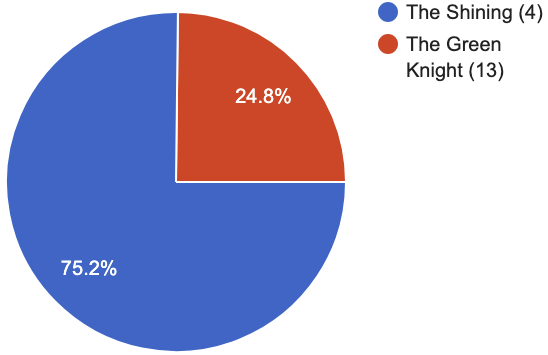
The Shining (4) vs. The Green Knight (13)
******************************************
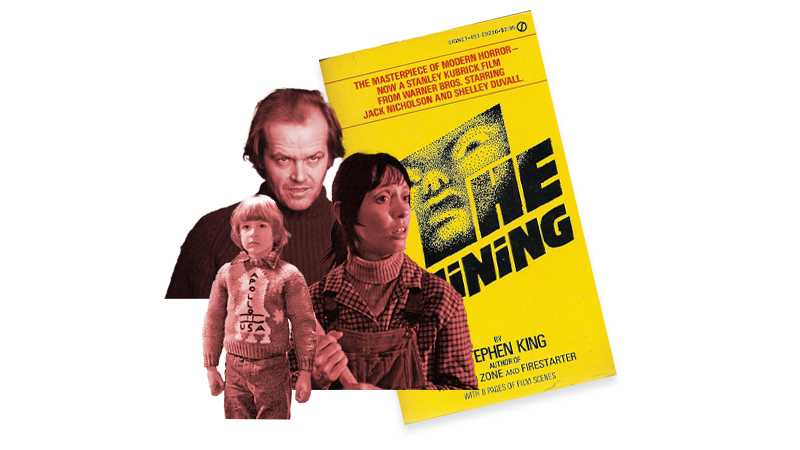 The Shining
dir. Stanley Kubrick, 1980
Based on Stephen King’s The Shining (1977)
Sub-genres: Accurate Depictions of Writers • Famous Axes Of Cinema • Imagine The Trip Advisor Reviews
Here’s the thing: is this a great adaptation of the Stephen King novel The Shining? Not really. We all know how much King hates this version (so much so that he made his own! Which was worse, if more faithful!), but it’s like how Throne of Blood is probably the best cinematic Macbeth: Kubrick took the elements he liked, ditched the rest, and turned in one of the great horror films of all time. It doesn’t matter that we lose the psychological nuance of the novel or even that Jack Torrance is already well and truly haunted before he gets to the hotel—because Jack Nicholson’s performance gets at the core of the fear that’s animating King’s novel, just from a different direction. In King’s book, the hotel is evil; in Kubrick’s film, there’s plenty of human villainy to go around. Both are scary, both are exceptional. Perhaps that’s all a good adaptation needs to do. –DB
 See also:
Jack Torrance and Me: On Writing and Self-Loathing in The Shining • How Stanley Kubrick Brought Stephen King’s The Shining to the Big Screen • Bestsellers to Blockbusters: Stephen King Reflects on the Adaptations of His Work
••••••••••vs••••••••••
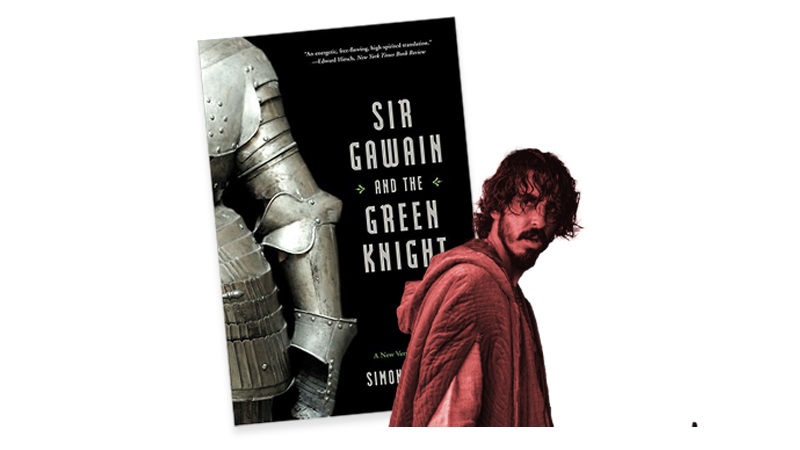 The Green Knight
dir. David Lowery, 2021
Based on The Pearl Poet’s Sir Gawain and the Green Knight (c. 14th century)
Sub-genres: English Prof Watches Forbidden Planet • Dev Patel’s Cape • Christmas Movies • Truth Or Dare Gone Horribly Wrong
Lowery’s Arthurian-saga-on-drugs takes a rich text and makes it even richer, or at least much nicer to look at (thanks in large part to cinematographer Andrew Droz Palermo). Rather than replicate the plot—more or less a morality play—too closely, he adapts the poem’s essential underpinnings, its language of wildness, resulting in a thrillingly impressionistic, mysterious, and chaotic ode to uncertainty. This is an ambiguous art film that asks more questions than it answers, radical in its refusal to pander, deeply satisfying to anyone who can pay attention long enough to really see it. –ET
 See also:
The Green Knight Unmakes a Classic—to Unsettling and Glorious Effect • David Lowery on the Strange, Arduous Journey of Adapting The Green Knight for Film • Five Medieval Tales That Should Immediately Be Made Into Movies
*
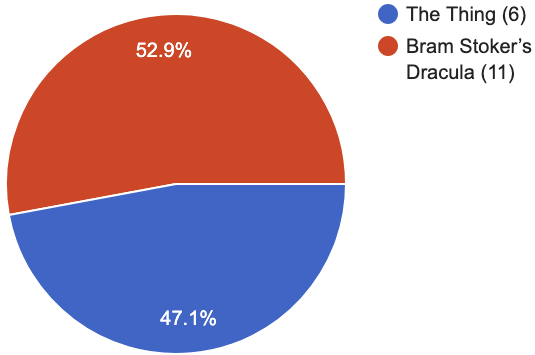
MATCHUP:
The Thing (6) vs. Bram Stoker’s Dracula (11)
******************************************
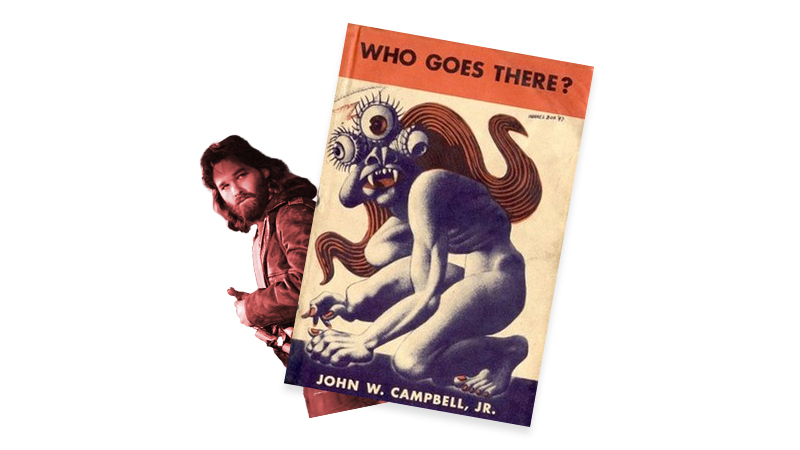 The Thing
dir. John Carpenter, 1982
Based on John W. Campbell Jr.’s Who Goes There? (1938)
Sub-genres: MacReady’s Hat • Movies With Tons of Fan Theories • J&B Scotch • Never Trust Your Coworkers
This is my favorite of John Carpenter’s movies, and one of my favorite movies of all time. The 1938 novella it’s based on ran in Astounding Science Fiction and is a classic “stuck inside with a monster” horror set-up. It’s a little corny by today’s standards, and Carpenter wisely brings it up to date with more cursing and nastier (prosthetic) creatures. But he also has a keen eye for the emotional stakes, and matches the scientific fear of an alien creature with the corrosive distrust that infects the doomed men, a la Treasure of the Sierra Madre. Carpenter’s genius as a director lies in knowing that the gut-level blood and guts scares are just as affecting as the icy realization that you can’t trust anyone. –JF
 See also:
What Teaching Shakespeare Taught Me About Writing Horror
••••••••••vs••••••••••
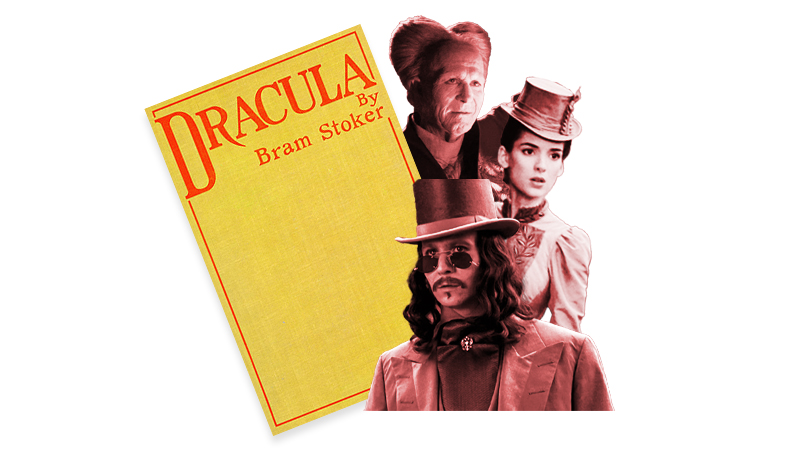 Bram Stoker’s Dracula
dir. Francis Ford Coppola, 1992
Based on Bram Stoker’s Dracula (1897)
Sub-genres: Making Dracula Sexy Again • Heart Hair • Steampunk Realness
Bram Stoker’s Dracula is one of those movies that turns me into an old-timey film guy who shouts, “What a picture!” at the screen. It’s a gorgeous movie, with ambitious in-camera effects, sumptuous and intricate costumes, and lush, colorful cinematography—Coppola’s take on Dracula has influenced every vampire film since. (Notably, Coppola foregrounds the sexual subtexts in Stoker. The best read on this topic comes from my friend Luke, who identified that Keanu Reeve’s Harker is the only character who doesn’t seem to understand horniness, a tension which dooms him.) –JF
 See also:
The 52 Best Draculas, Ranked • On the Victorian Science and Prejudices Behind Bram Stoker’s Dracula • On Dracula‘s Lost Icelandic Sister Text • This is the weird horror novel that outsold Dracula in 1897 • Charles Band on Shooting Inside His Own Castle and Borrowing a Costume from Bram Stoker’s Dracula
*
MATCHUP:
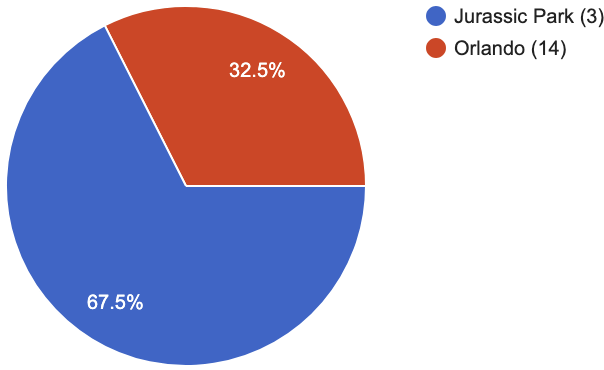
Jurassic Park (3) vs. Orlando (14)
******************************************
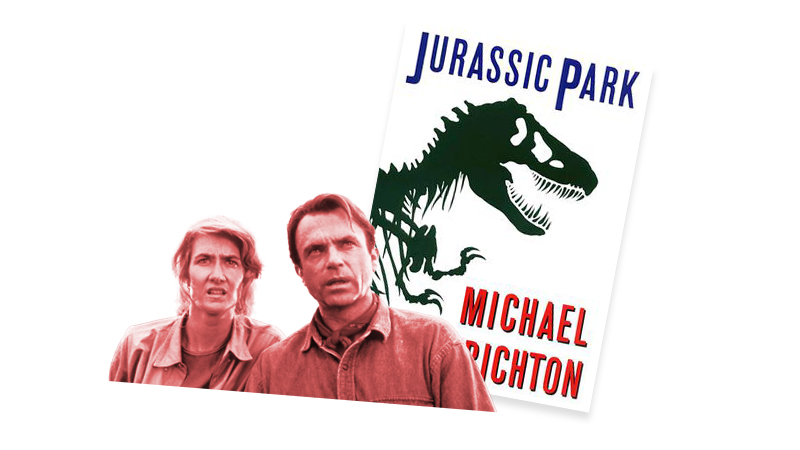 Jurassic Park
dir. Steven Spielberg, 1993
Based on Michael Crichton’s Jurassic Park (1990)
Sub-genres: Preoccupied Scientists • Clever Girls • The Most Blockbuster of The Summer Blockbusters
You can hear the sweeping John Williams right now, I’m sure, a sign of how indelible this movie has become. Jurassic Park is a classic, full of great performances, endlessly quotable lines, and all those dinosaurs moving in herds. It’s quintessentially summer. It’s so good that even the atrocious sequels can’t take the shine off of it.
One thing I’ve always wondered is that if Jurassic Park were real, would the park have the equivalent of annoying Disney Adults, whose entire personalities revolve around the dinos? It’s just one of the reasons I’m glad this is fiction. –JF
 See also:
The 25 Most Iconic Book Covers in History • 40 of the Best Villains in Literature • The Scariest, Creepiest, and Most Frightening Animals in Fiction
••••••••••vs••••••••••
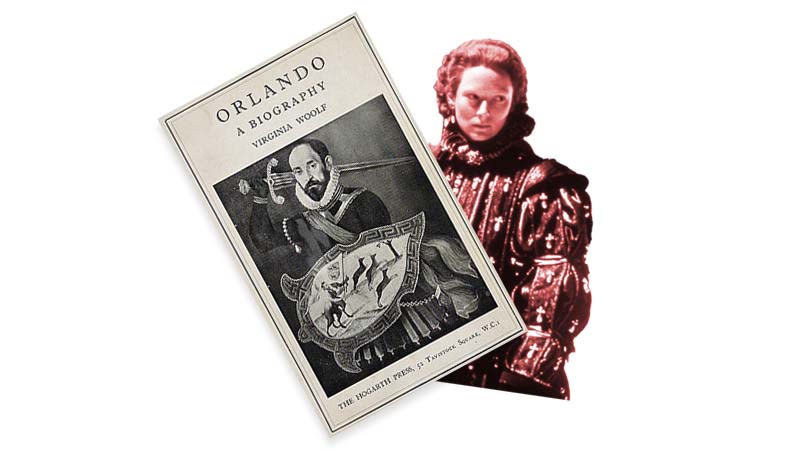 Orlando
dir. Sally Potter, 1992
Based on Virginia Woolf’s Orlando (1928)
Sub-genres: Tilda Time Travel • Costumes! • Breaking the Fourth Wall • Their Old Website Is Still Up
This is one of the most ambitious and interesting adaptations on this bracket, pairing well with other slant takes like Adaptation and Ran. Woolf’s classic feminist satire, a centuries-spanning ode to her friend and lover Vita Sackville-West, is a tough book to try and bring to the screen, but the attempt is dazzling. The sets, costumes, and plot that rollicks through time is never boring, and the movie is funnier than you might expect. And the film’s considerations of gender, performance, and power are impressively confident and ahead of its time. Orlando doesn’t completely work on its own outside of the context of Woolf’s novel, I think, but as a companion? It’s excellent. –JF
 See also:
On Orlando, and Virginia Woolf’s Defiance of Time • How Virginia Woolf’s Time-Traveling Androgynous Hero Became Shorthand for Fashion’s Genderless Future
*
MATCHUP:
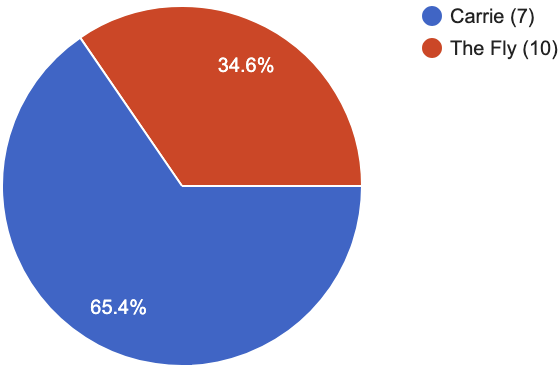
Carrie (7) vs. The Fly (10)
******************************************
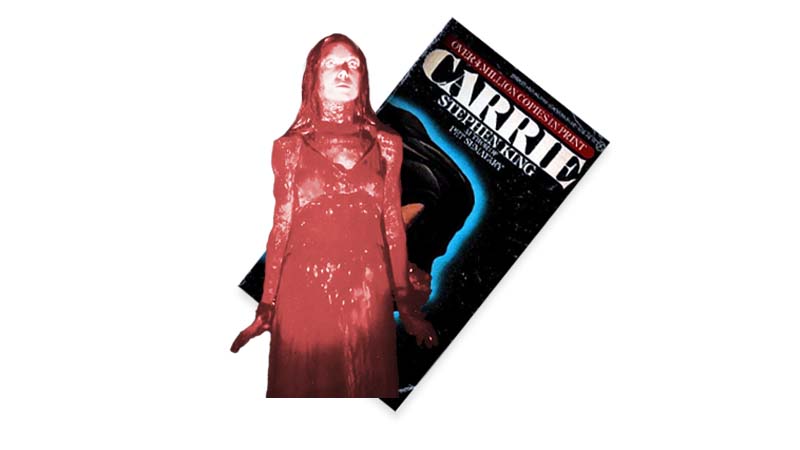 Carrie
dir. Brian De Palma, 1976
Based on Stephen King’s Carrie (1974)
Sub-genres: Bad Prom Dates • They Fixed It • The Stephen King Cinematic Universe
A wildly influential film that spins high school revenge fantasy into a dizzyingly gory spectacle. The final sequence is pure American Giallo (complimentary): the bullies’ comeuppance is delivered with flying knives, a fire hose turned into a spitting cobra, and microphone electrocution. Sissy Spacek keeps the cast on track, and I think De Palma has a better handle on the story’s themes and anxieties than King does. De Palma gets the pain of youth on a more nuanced level, and smartly dials back the violent scale of the ending to put the focus closer to home. –JF
 See also:
The Most-Rejected Books of All Time • The Living Authors with the Most Film Adaptations • Girls, Interrupted: A Reading List of Female Madness • Stephen King: Master of Almost All the Genres Except “Literary”
••••••••••vs••••••••••
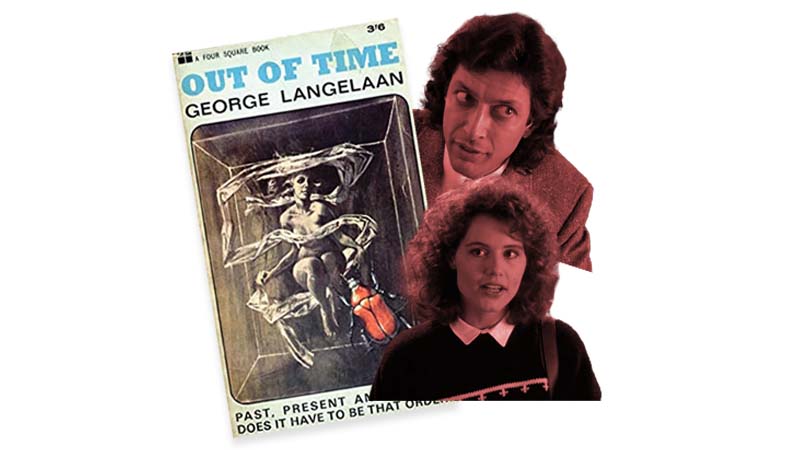 The Fly
dir. David Cronenberg, 1986
Based on George Langelaan’s “The Fly” (1957)
Sub-genres: Bad Science • Goldblum’s Body Hair • Terrifying Rubber Monsters
A grotesque masterpiece, and not for the faint of heart. Jeff Goldblum is perfect as the lanky mad scientist doing nude experiments in his warehouse lab, and his wide-eyed transformation into the horny, sugar-hungry man-fly underlines the weird anxieties that Cronenberg always brings to body horror. And I love Geena Davis in this—she has that B-movie scream queen skill of making each new freak-out seem distinct. Her character being a journalist is a good reminder that no matter how bad media seems to be doing these days, at least you’re not dating a source who’s turning into a fly-man. –JF
 See also:
On Horror Fiction and The “Ick” Factor • Corporeal Punishment: On Body Horror, That Most Human of Stories
*
MATCHUP:
Arrival (2) vs. Who Framed Roger Rabbit? (15)
******************************************
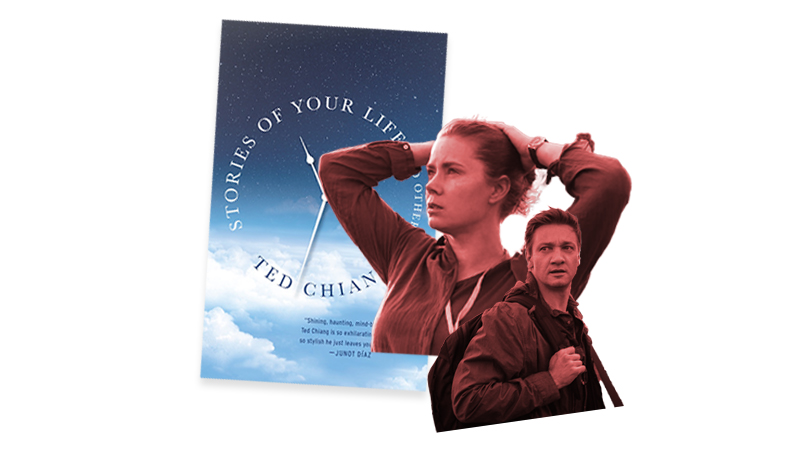 Arrival
dir. Denis Villeneuve, 2016
Based on Ted Chiang’s “Story of Your Life” (1998)
Sub-genres: What Even Is Time, Man? • Jeremy Renner Loves A Helicopter • Word Nerds On Film • Aliens That Make You Cry
As Lit Hub editor emeritus Aaron Robertson put it: “What if language was the key to knowledge, not only about your neighbor, but about strangers and yourself as well? By the end of Arrival, the Denis Villeneuve film based on Ted Chiang’s 1998 short story, “Story of Your Life,” the viewer understands this as the movie’s central question. Linguist Louise Banks (played by the ever-reliable Amy Adams) and physicist Ian Donnelly (Jeremy Renner) are called by the US Army to help study one of twelve extraterrestrial spacecrafts that have positioned themselves in scattered locations around the world. What Banks and Donnelly discover aboard the craft are two amorphous alien specimens, which they call “heptapods,” that communicate using a complicated system of logograms, or written characters that represent a word or phrase. This straightforward set-up lays the groundwork for a moving, and often anxiety-inducing, investigation of language, empathy, and miscommunication. Arrival’s surprising endgame cemented it as one of the most heartfelt movies of the last decade. The film’s meditative aesthetic is also boosted by a rather primal, ruminative score by the late, great Icelandic composer Jóhann Jóhannsson.” –ET
 See also:
Ted Chiang on Arrival, the Boredom of Moviemaking, and The Princess Bride • Why Arrival Looks So Different After COVID-19 • Ted Chiang on Superintelligence and Its Discontents in J.D. Beresford’s Innovative Work of Early 20th-Century Science Fiction
••••••••••vs••••••••••
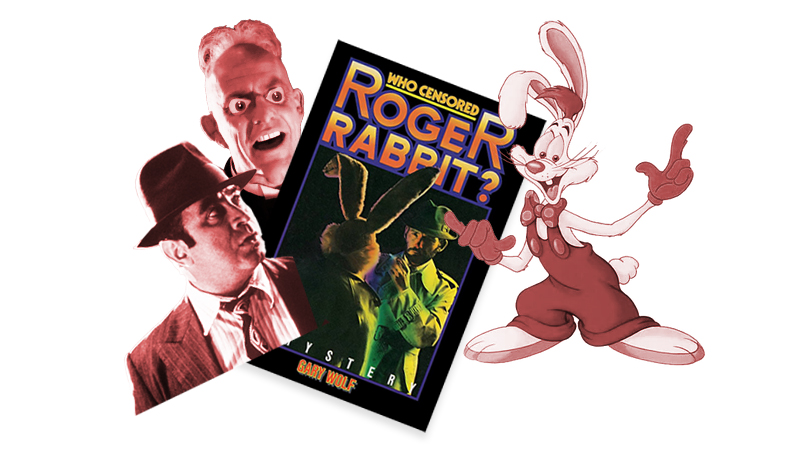 Who Framed Roger Rabbit?
dir. Robert Zemeckis, 1988
Based on Gary K. Wolf’s Who Censored Roger Rabbit? (1981)
Sub-genres: Bob Hoskins Resisting Silliness for as Long as Humanly Possible • Patty-Cake Erotica • Capitalism Is Bad
I admit I have never read the source material for this one, so I can only speak to the film itself, which I loved before I had any point of reference for film noir (or, you know, evil conglomerates threatening to wipe out a people in service of “progress”). Bob Hoskins’ Eddie Valiant is convincingly hard-boiled, even faced with the goofiest shit imaginable (and convincingly AH-OOO-GA for Jessica Rabbit, but who among us, etc., etc.), and while I won’t spoil the villain (other than capitalism), suffice it to say that “the dip” still haunts the nightmares of many an elder Millennial/young Gen-Xer. –JG
 See also:
On Class, Capitalism and Urban Planning in Who Framed Roger Rabbit?
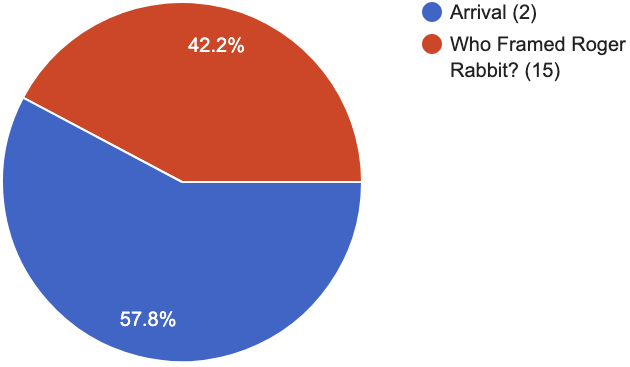
Happy voting! We’ll see you tomorrow for the results!