What is the Best Literary Film Adaptation of the Last 50 Years?
Day Three
The King is Dead, But the Yearning is Eternal
It’s day three and only 16 films are left after voting yesterday. I always forget that running these brackets is an experience in daily heartbreak, as every morning, more of my favorites get knocked out. Yesterday, Bram Stoker’s Dracula, Ran, Die Hard, 10 Things I Hate About You, and American Fiction all failed to advance, but they’re still perfect in my eyes.
A consolation is that yesterday’s final vote tallies were closer than I expected, and a few were very close: Trainspotting just barely lost to Much Ado About Nothing, and Blade Runner beat The Shining by a mere 5 votes.
By the way: Carrie also failed to graduate to the round of 16, which means that the Stephen King adaptations have been completely eliminated from competition. Ouch.
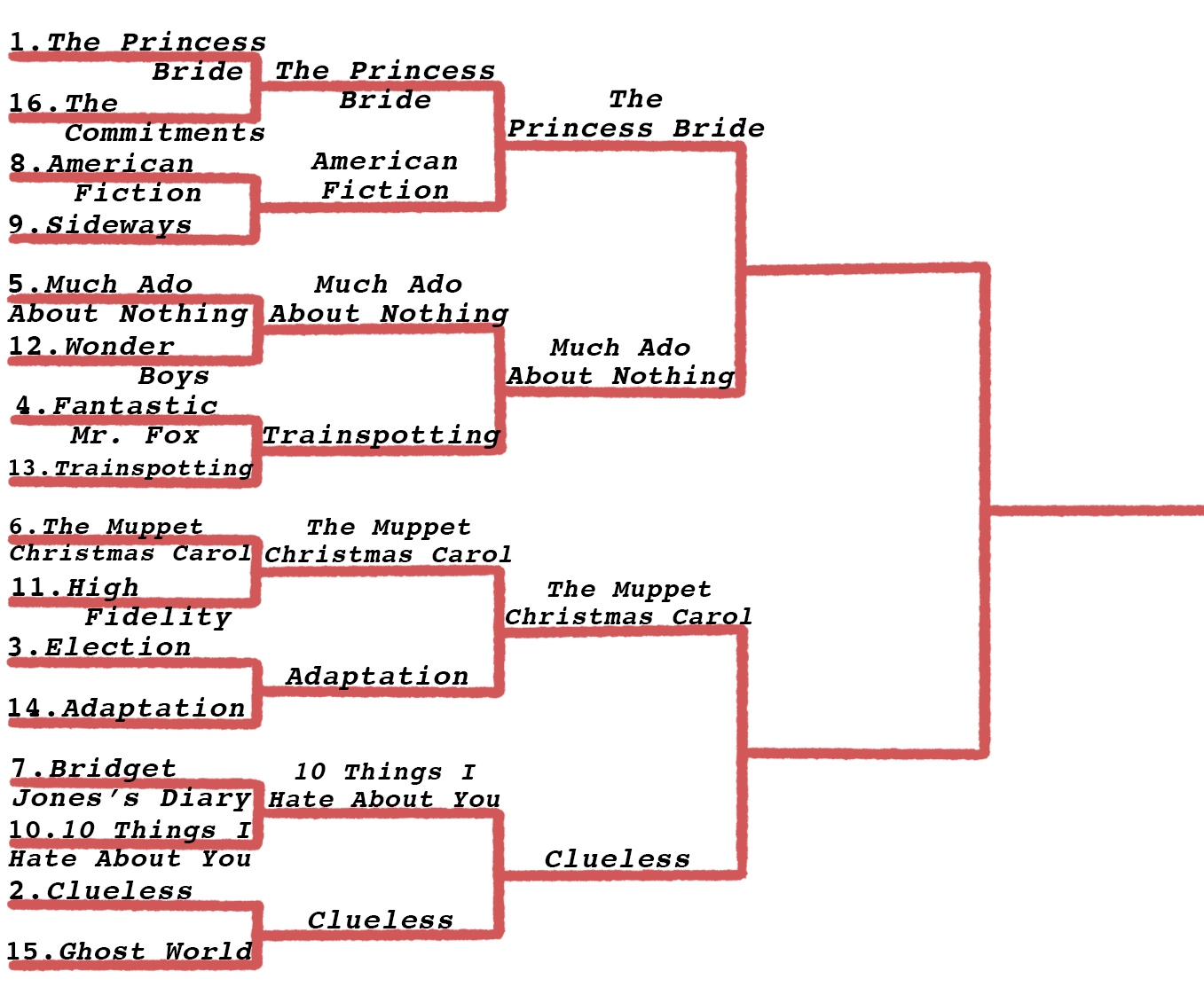
Anyway, today has some big pairings. The Muppet Christmas Carol vs. Clueless is going to be a tough one for me. They’re well matched: Two movies with great joke writing, memorable characters, and a tongue-in-cheek but deeply emotional approach to adaptation. This vote will probably come down to how I’m feeling about Rizzo the Rat vs. Paul Rudd at the moment of clickage.
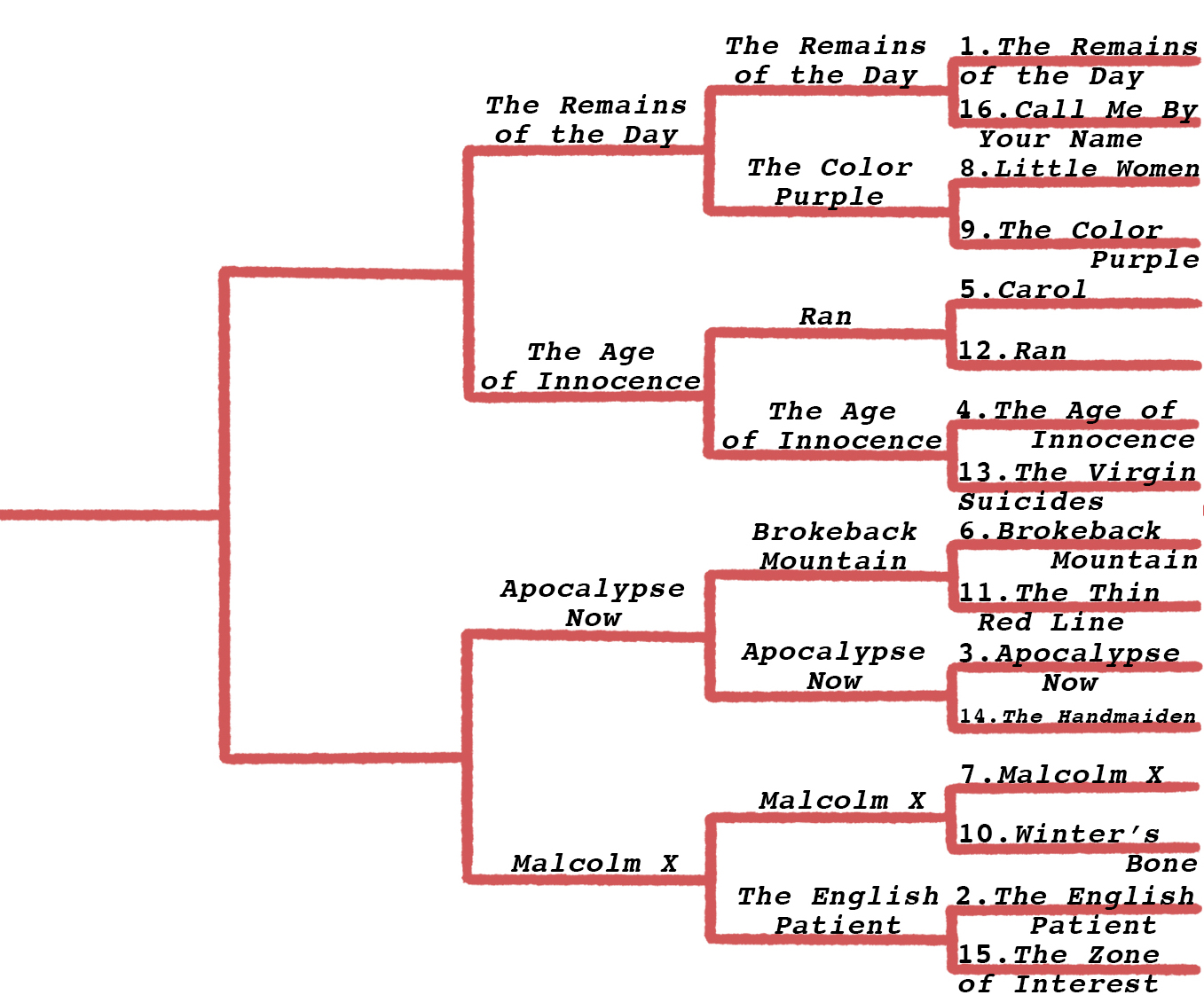
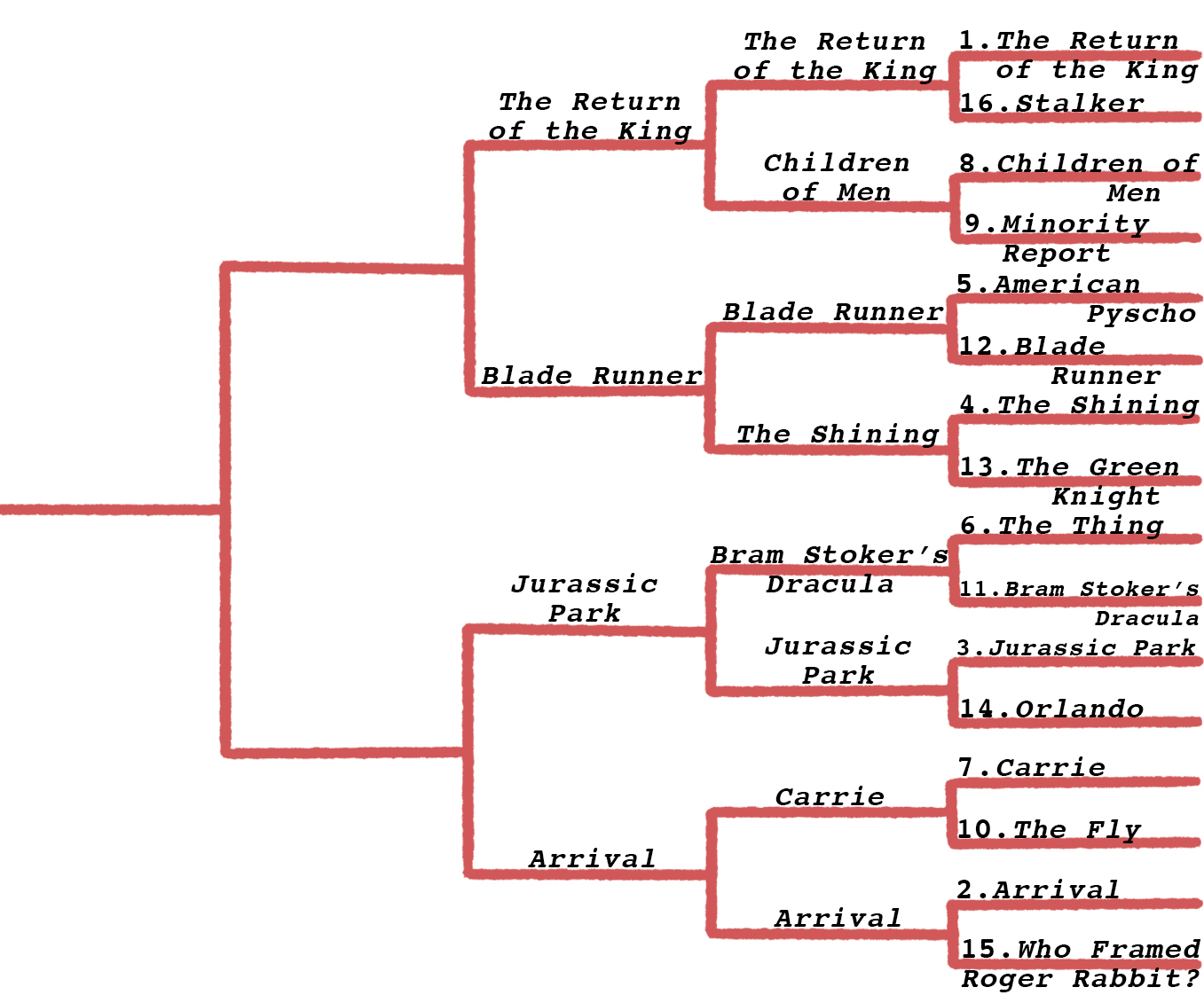
The SFF/Horror quadrant remains chaotic, featuring high fantasy versus hard sci-fi and dinosaurs versus aliens (otherwise known as the 10-year-old’s dilemma). And the Drama corner is very interesting this round, headlined by a big yearn-off between The Remains of the Day and The Age of Innocence. I’m still pulling for The Age of Innocence to make the finals, but The Remains of the Day might be the one to knock it out.
Overall, it’s an embarrassment of riches in the round of 16. But one of the hazards of bracketeering, it turns out, is being reminded of all the adaptations we didn’t include, which is growing my to-watch list to dangerous lengths. Speaking of, if you’d like to take a peek at the Lit Hub staff’s personal favorite adaptations, and what we’re watching next, you can do that on our Letterboxd page.
But without further ado, let’s vote.
–James Folta
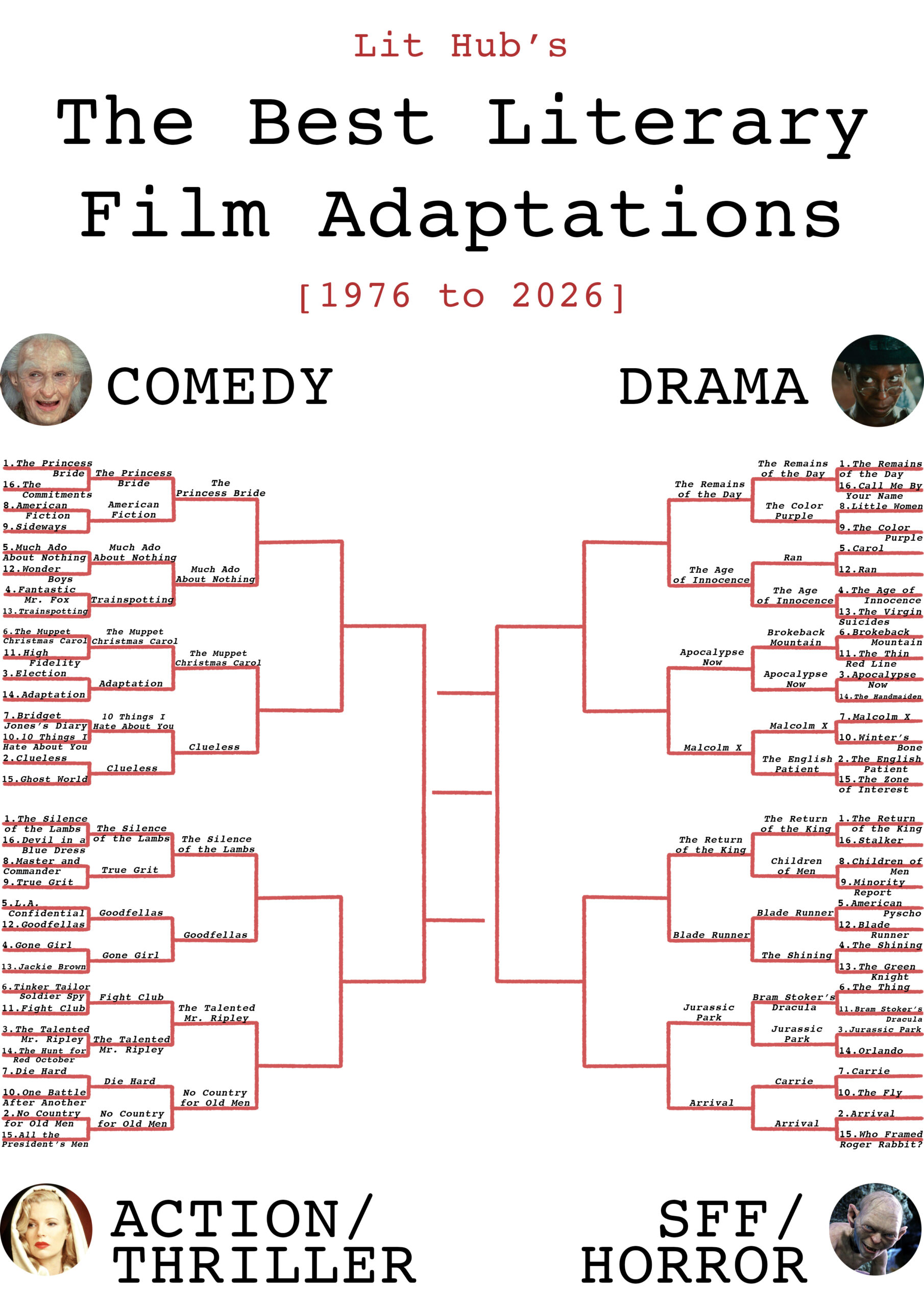
[Click image to enlarge and zoom]
*
INSTRUCTIONS:
We’re looking for the best contemporary film based on a book, short story, or play. In some cases we considered the difficulty and/or finesse of the adaptation itself, but mostly the question at hand is an easy one: Which movie, given the options, do you like best? That’s what you should vote for.
We’ve sorted our top 64 choices into four genre categories: Comedy, Drama, Action & Thriller, and Sci-Fi, Fantasy & Horror. Normal bracket rules apply, because sports. Each quadrant’s winner will face off on Friday, before the final head-to-head on Monday, April 20th to crown our winner.
*
VOTING SCHEDULE:
Round of 64: Voting open now until tonight at 7:00 PM EDT (See the results)
Round of 32: Voting open Tuesday, April 14th from 10:00 AM – 7:00 PM EDT (See the results)
Round of 16: Voting open Wednesday, April 15th from 10:00 AM – 7:00 PM EDT
The Quarterfinals : Voting open Thursday April 16th from 10:00 AM – 7:00 PM EDT
The Semifinals: Voting open Friday, April 17th from 10:00 AM, until Sunday April 19th at 7:00 PM EDT
The Finals: Voting open Monday, April 20th from 10:00 AM – 7:00 PM EDT
And the winner will be announced on Tuesday, April 21st!
*
HOW TO VOTE:
We’ve got handy voting forms embedded below. Simply select which movie you think should advance, and we’ll tabulate the votes at the end of each day.
*
And now, your feature presentation…

*
MATCHUP:
The Princess Bride (1) vs. Much Ado About Nothing (5)
******************************************
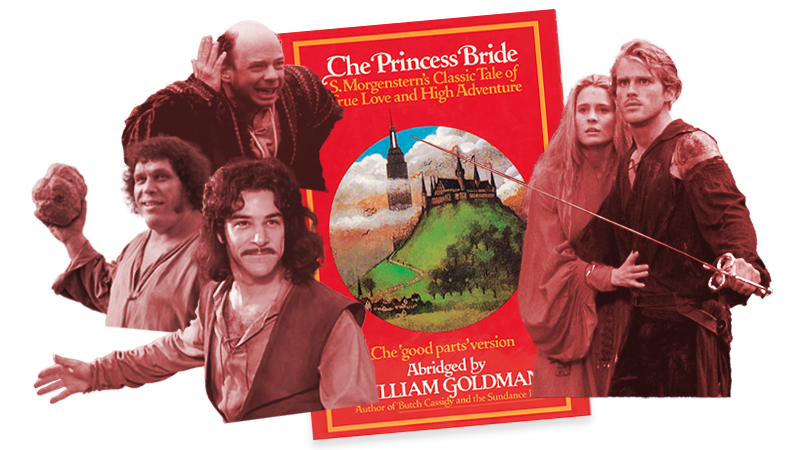 The Princess Bride
dir. Rob Reiner, 1987
Based on William Goldman’s The Princess Bride (1973)
Sub-genres: Your Bisexual Awakening • Cult Movies of Unusual Resonance(s) • Endlessly Quotable • Peak Patinkin
There are few films with a higher delight-to-runtime ratio than The Princess Bride. Its particular alchemy of postmodern irreverence and slapstick buffoonery has made it an enduring cult classic despite its initially underwhelming box office returns. Of course, it benefits from being adapted by Goldman himself—not so often is the author of the source text also an Academy Award-winning screenwriter—and from the fact that it was a particular passion project for Reiner, whose father had given him the book, and who was determined to adapt it despite the fact that Hollywood considered it unadaptable.
“When I first met Bill Goldman to talk about this,” Reiner remembered, “he said, ‘This is my favorite thing I’ve ever written, and I want this on my tombstone. And what are you going to do with it?’” Well, we all know the answer to that. –Emily Temple, Managing Editor
 See also:
What Makes The Princess Bride Such a Great Movie • How Loving The Princess Bride Led Me to Buddhism
••••••••••vs••••••••••
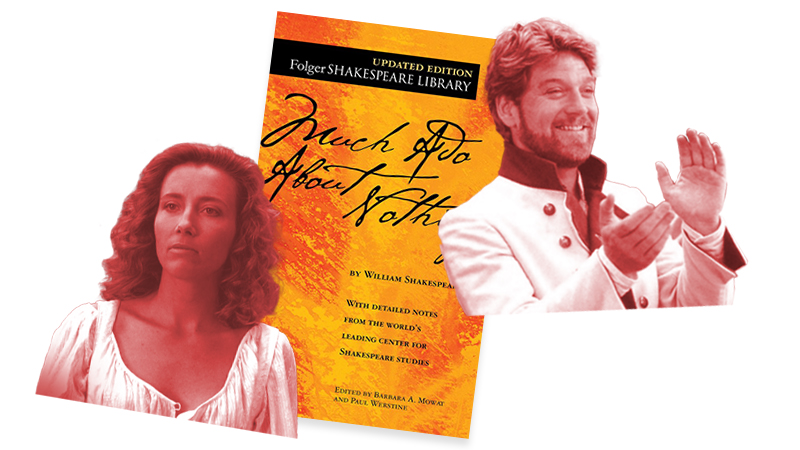 Much Ado About Nothing
dir. Kenneth Branagh, 1993
Based on William Shakespeare’s Much Ado About Nothing (1600)
Sub-genres: Ye Olde Jokes • Ample Bosoms • Eating His Heart in the Marketplace • By Shakespeare Nerds, For Shakespeare Nerds
There’s a never-ending set of Shakespeare adaptations out there but there’s something simply perfect about Kenneth Branagh’s crack at Much Ado, one of the best plays in the canon. Branagh can get self-indulgent in his later work, but this one zips along like the frothy comedy it is, with absolutely radiant turns from Branagh and Emma Thompson and Denzel Washington and Imelda Staunton and, yes, even the much-maligned Keanu Reeves, who brings a particularly human darkness to the too-often-too-cartoonish Don John. Everybody seems to be having a damn good time, it’s all very ’90s, I wish more adaptations would have fun like this one does. –Drew Broussard, Podcast Editor
 See also:
The Best 90s Screen Adaptations of Shakespeare, Ranked • Black Lives Matter in the Public Theater’s Much Ado About Nothing
*
MATCHUP:
The Muppet Christmas Carol (6) vs. Clueless (2)
******************************************
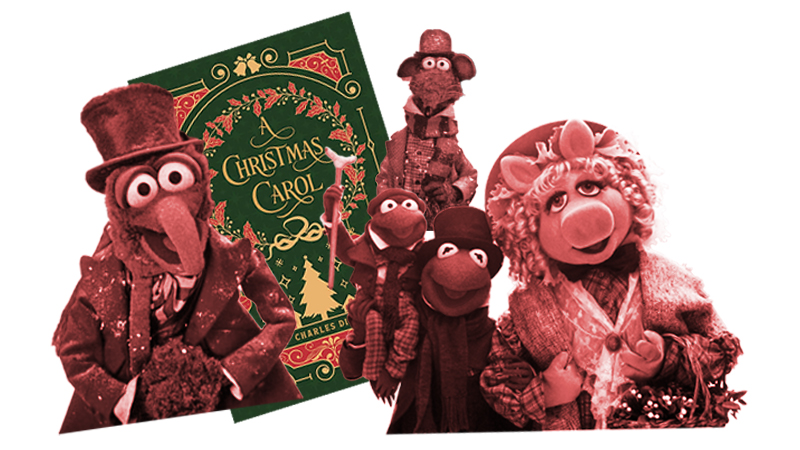 The Muppet Christmas Carol
dir. Brian Henson, 1992
Based on Charles Dickens’s A Christmas Carol (1843)
Sub-genres: Everybody Loves Muppets
Dickens’s novella forever changed the way people related to Christmas, and it’s fitting that the Henson adaptation did the same thing for Millennials’ relationship to the holiday. Real fans never get sick of telling everyone in earshot that Michael Caine only agreed to be in the movie if he could play it as straight as Shakespeare. –JF
 See also:
21 Movies You Should Watch This Holiday Season • A brief literary history of The Muppet Show • Did Bob Cratchit really make more than an American on minimum wage? • The Wizardry of Boz: A Brief History of Charles Dickens on Screen • Charles Dickens partied HARD after finishing A Christmas Carol in just six weeks. • On Dickens’s Demons and Weird Relationship with Christmas
••••••••••vs••••••••••
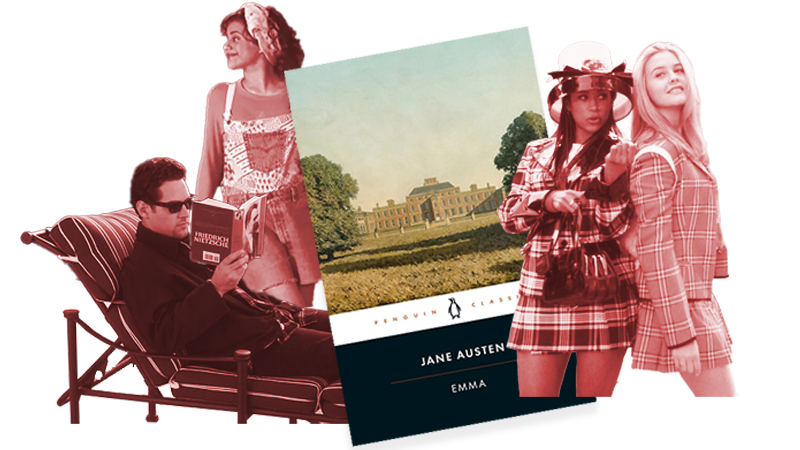 Clueless
dir. Amy Heckerling, 1995
Based on Jane Austen’s Emma (1815)
Sub-genres: Slang Machine • You’re a Virgin Who Can’t Drive • Just Don’t Ask What Happened to Dionne
The best adaptation of the best Jane Austen novel (see below) manages to recreate the classic novel in all of its minute social dramas, while making the story feel entirely original in its vision and aesthetic. Austen’s restrained and polished Regency Era is culturally converted to the splashy, enviable world of Beverly Hills in the ’90s: mini skirts, baggy pants, flip phones, convertibles, and all. Cher, our stand-in for Emma Woodhouse, is the it-girl at the center of it all, confident and unflappable in her place in the hierarchy—but with a hint of narcissism that gives her a preening over-confidence in her capabilities. Or as our own Brittany Allen put it, “Cher was as vibrant as she was delulu.” Love, friendship, confidence: all of it can come crashing down far too easily—but oh so enjoyably. –Julia Hass, Book Marks Associate Editor
 See also:
Actually, Emma is the Best Jane Austen Novel • On Jane Austen and The Lovable Unlikability of Emma Woodhouse • The Magic of a Slow-Burn Romance • Why Jane Austen Adaptations Just Keep Coming—And We Keep Watching • Did Jane Austen Invent the Wellness Guy? • Jane Austen’s Emma Was Basically Torn Apart in Workshop
* * *

*
MATCHUP:
The Remains of the Day (1) vs. The Age of Innocence (4)
******************************************
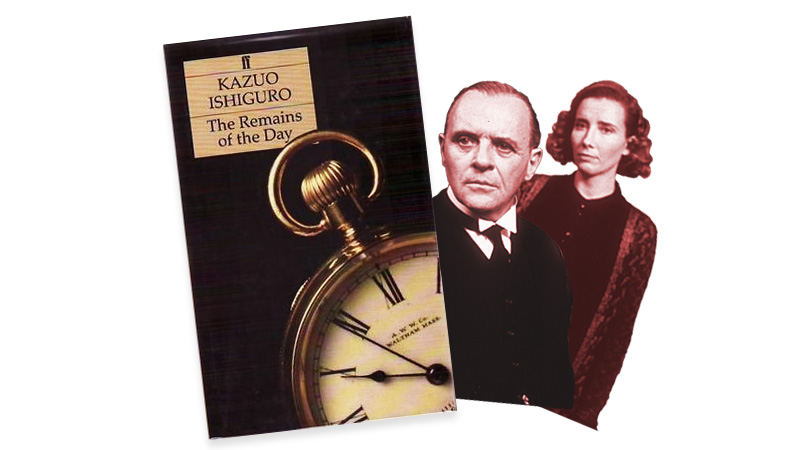 The Remains of the Day
dir. James Ivory, 1993
Based on Kazuo Ishiguro’s The Remains of the Day (1989)
Sub-genres: Antifa • Unrequited Love • Very British Contemplation • Fighting And Flirting With A Coworker
Ishiguro’s subtle, introspective novel seems impossible to translate onto the screen, but with Anthony Hopkins and Emma Thompson anything is possible. This was originally supposed to be a Harold Pinter script directed by Mike Nichols, which is quite the hypothetical to imagine, but director James Ivory and rewrites by the Booker and Oscar winner Ruth Prawer Jhabvala are a lateral move at absolute worst.
The film is a quiet yearning romance alongside an interrogation of Nazi appeasement, class, and duty. It does a lot, quietly and patiently. Each emotional beat arrives with soft footsteps, and is all the more affecting for it. A beautiful film and one that feels like a novel on the screen, which is why it takes our top dramatic seed. –JF
 See also:
Romance Finely Aged: On the Unique Dynamic of Older Couples • Kazuo Ishiguro: ‘Write What You Know’ is the Stupidest Thing I’ve Ever Heard • 9 Novels in Which Houses Have a Life of Their Own • Sweet (But Not Too Sweet): 6 Essential Literary Love Stories • 10 Books for Being Alone • In Praise of the Unhappy Happy Ending
••••••••••vs••••••••••
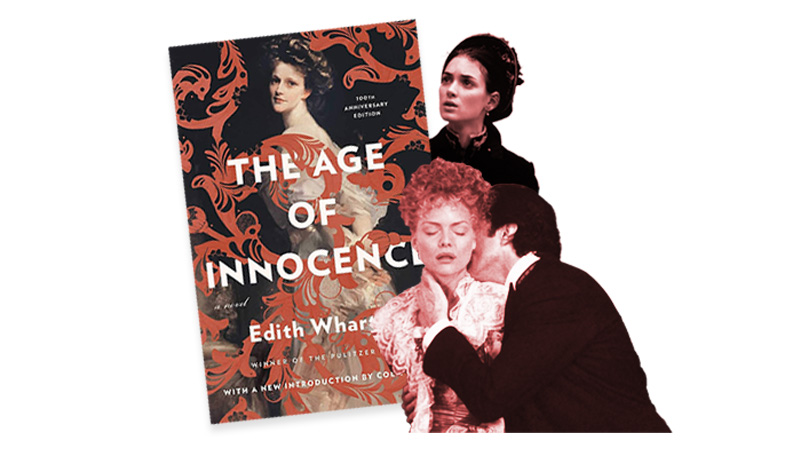 The Age of Innocence
dir. Martin Scorsese, 1993
Based on Edith Wharton’s The Age of Innocence (1920)
Sub-genres: Lingering Gazes • Society Is The Real Villain • Infidelity Is Wrong… Unless?
There’s a lot of yearning here in the drama section, much of it British. But to pair my soft boy heart with my NYC pride for a moment: we can yearn with the best of them over here in New York, as Edith Wharton proves in her top notch romance about flawed, stifled people finding and losing each other. Fellow New Yorker Martin Scorsese’s take is wistful and tender, and I think this movie is a thematic skeleton key for the rest of his oeuvre. Class and society constrain all, and Age of Innocence traps its characters in their gauzy and ornate world. We see insert shots of all the luxe, representative objects, and Scorsese’s shots (the spotlighting in the opera box, my heart!) are a perfect match to Wharton’s prose. What performances! What direction! And that nearly unbearable ending! Scorsese’s not just a mob movie guy, he really can do it all. –JF
 See also:
30 Years Later, The Age of Innocence Remains Scorsese’s Most Subtle Deconstruction of Misogyny • What Do We Do with The Age of Innocence in 2020? • The Memories of Streets: A Reading List of NYC Books That Capture the City’s Many Sides • “The Future Belonged to the Showy and the Promiscuous.” How Edith Wharton Foresaw the 21st Century • Edith Wharton on How to Write a Vivid First Line • Some Things You May Not Have Known About Edith Wharton’s Dog Obsession • The Secret Love of Edith Wharton’s Life • Does Edith Wharton Hate Us?
*
MATCHUP:
Apocalypse Now (3) vs. Malcolm X (7)
******************************************
 Apocalypse Now
dir. Francis Ford Coppola, 1979
Based on Joseph Conrad’s Heart of Darkness (1899) and Michael Herr’s Dispatches (1977)
Sub-genres: Almost Directed By George Lucas?! • T.S. Eliot Quotes • Big Music Choices
Perhaps the best Vietnam War movie ever made. A savvy translation from the source material by Francis Ford Coppola and right-wing crank John Milius, Apocalypse Now shifts Conrad’s tale of depravity set amidst Belgian colonial horrors to a tale of depravity set amidst American imperial horrors in Vietnam and Cambodia.
An elite soldier with a fraying mind is sent deep into a wartime nightmare, and the sweaty performances, bold musical choices, and beautiful cinematography take us there. And every film nerd knows that the production’s depravity and delirium almost surpasses the film’s—Apocalypse Now’s Wikipedia page is as wild as the film itself. –JF
 See also:
What Really Went on Between Francis Ford Coppola and Martin Sheen During the Filming of Apocalypse Now? • “Invasion is a Structure Not an Event.” On Settler Colonialism and Joseph Conrad’s Heart of Darkness • On the Jealous Rivalry Between Nicolas Cage and His Uncle, Francis Ford Coppola • 19th-Century Blues: When Science Killed God and Made Some Englishmen Sad • The Editor Who Pulled Joseph Conrad from the Slush Pile • How Heart of Darkness Revealed the Horror of Congo’s Rubber Trade
••••••••••vs••••••••••
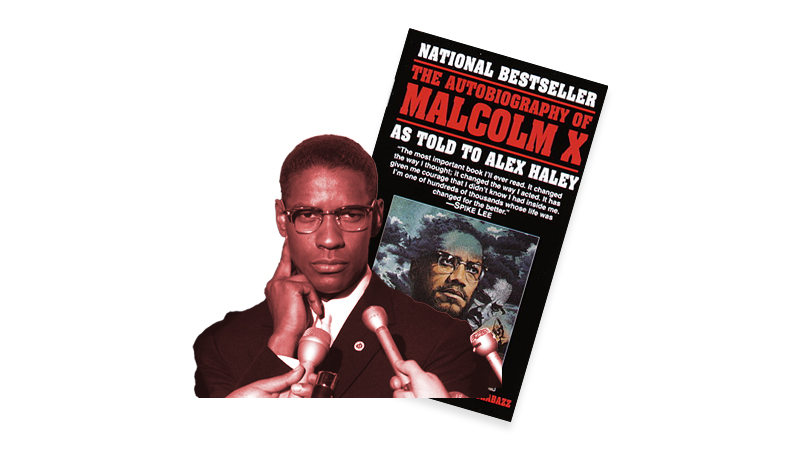 Malcolm X
dir. Spike Lee, 1992
Based on Alex Haley’s The Autobiography of Malcolm X (1965)
Sub-genres: Radical Films • Big Book & Big Movie • Amazing Cameos
Thanks to the maximalist Spike Lee, this sprawling biopic replicates the 500-page scope of its source material. We follow the man born Malcolm Little from point of origin to mission fulfillment; from Omaha to Harlem to Mecca, plus many stations in between. The film structure is ambitious because its subject was. You reach the credits appropriately floored by what Malcolm X (i.e., Denzel, giving a tour de force performance) managed to accomplish in such a short time. –BA
 See also:
How the Mothers of MLK, Malcolm X, and James Baldwin Shaped America • Naming the Unnamed: On the Many Uses of the Letter X • On the Self-Education of Frederick Douglass, Malcolm X, and the Insatiable Quest for Literacy • How to Understand the 1960s in 11 Books • Fatima Bhutto on Channeling the Fearlessness of Malcolm X • How Two of America’s Biggest Columnists Reacted to the Assassination of Malcolm X • The Invention of Mid-Century Cool • Falling in Love with Malcolm X—and His Mastery of Metaphor
* * *
*
MATCHUP:
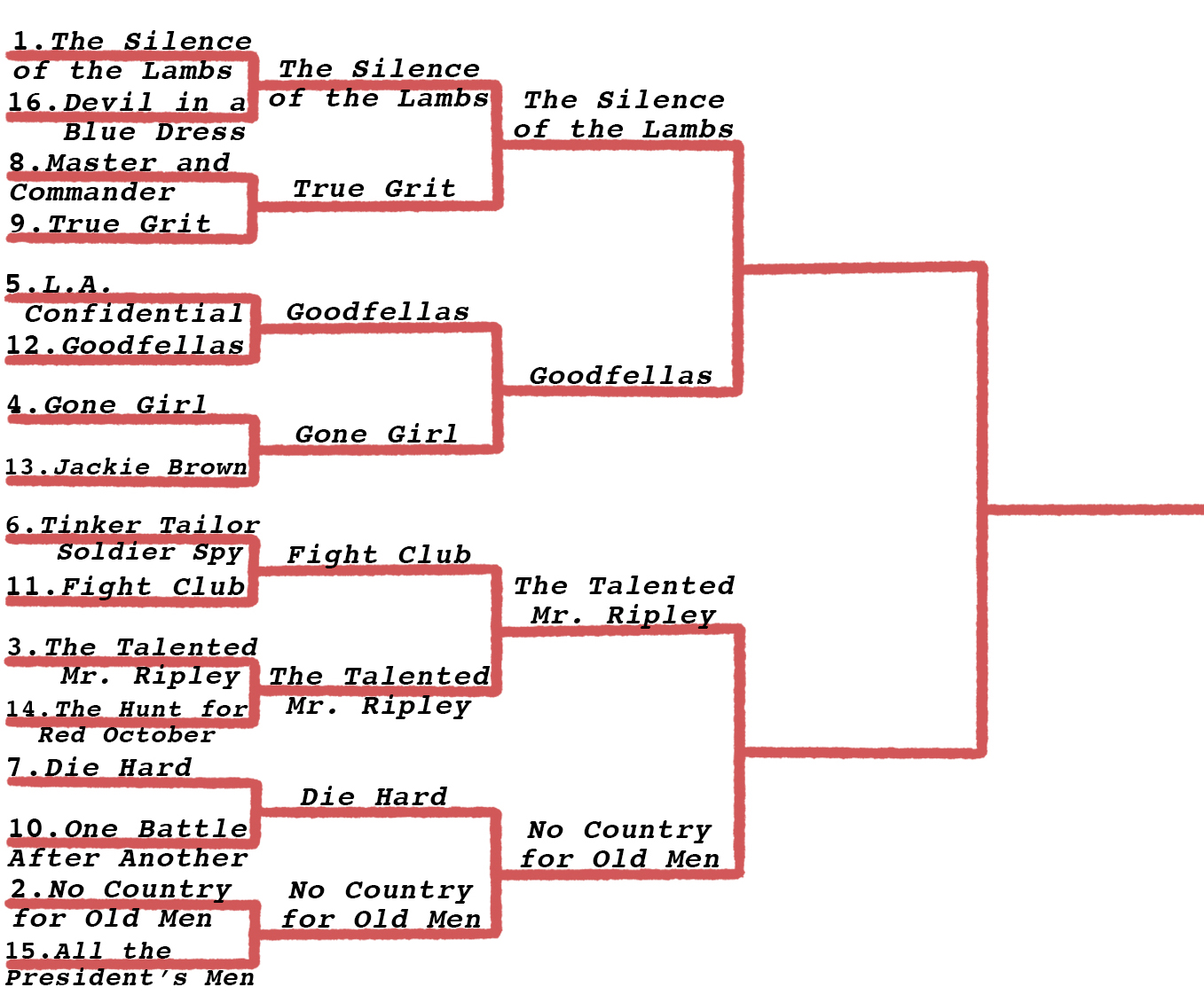
The Silence of the Lambs (1) vs. Goodfellas (12)
******************************************
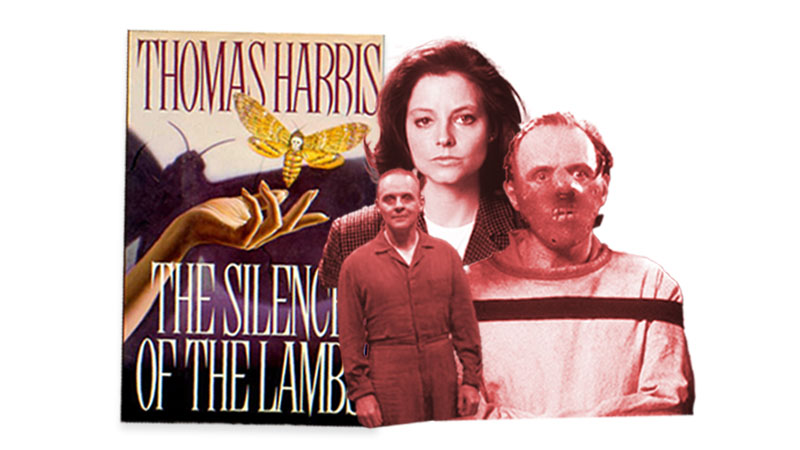 The Silence of the Lambs
dir. Jonathan Demme, 1991
Based on Thomas Harris’s The Silence of the Lambs (1988)
Sub-genres: Ruined Both Chianti AND Fava Beans • And the Song “American Girl” • Still Worth It, Though
Jonathan Demme’s adaptation starts out tense (dreary woods and Howard Shore strings from the jump) and tightens the screws, with surgical precision, to an almost unbearable tautness—culminating in one of the great payoffs in film history. And, of course, the repartee (if slightly mismatched) between Jodie Foster and Anthony Hopkins is a skin-crawling delight. –JG
 See also:
40 of the Best Villains in Literature • On the Women Lucky Enough to Survive Horror Films
••••••••••vs••••••••••
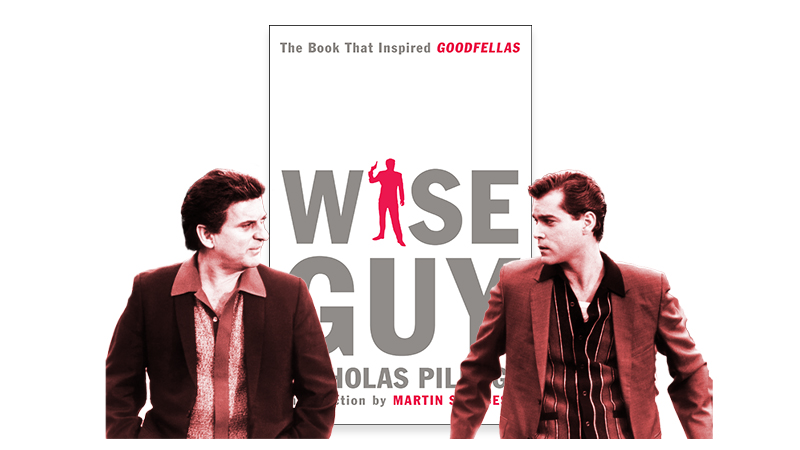 Goodfellas
dir. Martin Scorsese, 1990
Based on Nicolas Pileggi’s Wiseguy (1985)
Sub-genres: Great Narration • Iconic Garlic Slicing On Film • So Much Cocaine
What makes Goodfellas the perfect adaptation is its style, and how perfectly suited that style is to the content. On the page, ex-gangster Henry Hill’s story is exciting enough. But it’s Scorcese’s zooming, coked-out sensibility—as felt in sweaty close-ups, indelible needle drops, and brash voice over—that brings our unreliable narrator(s) to life. The scene on the stand, when Hill breaks the fourth wall? Because at this point in the narrative, Henry feels he can break anything!? Is inspired medium translation. No small wonder that Scorcese self-cannibalized the move in several subsequent projects. –BA
 See also:
Thirty Years Later, Is Goodfellas The Greatest Mob Movie Ever Made?
*
MATCHUP:
The Talented Mr. Ripley (3) vs. No Country for Old Men (2)
******************************************
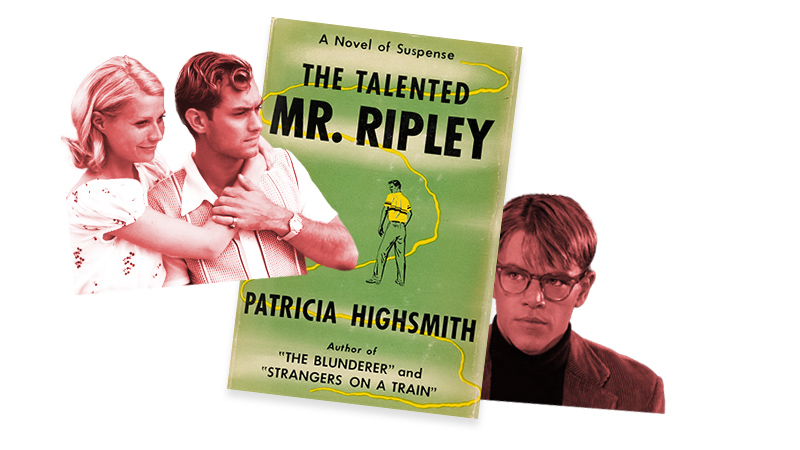 The Talented Mr. Ripley
dir. Anthony Mingella, 1999
Based on Patricia Highsmith’s The Talented Mr. Ripley (1995)
Sub-genres: Beautiful People Doing Murders • Creating Text from Subtext • Boats are Dangerous
Matt Damon has never been more convincing than in his turn as Tom Ripley in Minghella’s unsettling and intoxicating adaptation of Highsmith’s complex thriller, but it’s Philip Seymour Hoffman who really steals the show, even against Jude Law, Gwyneth Paltrow, and Cate Blanchett as the invented but excellent Meredith. The warmth of the film—shot on location in Positano, Italy—only adds to its creeping, sexy menace. Is it better than the book? Not quite, but it makes an excellent companion piece. –ET
 See also:
A Close-Reading of The Talented Mr. Ripley as Coming of Age Story • I think about this tiny detail from The Talented Mr. Ripley all the time. • The Lit Hub Staff’s Favorite Villains: Dwyer Murphy on Patricia Highsmith’s Tom Ripley. • All Our Monstrous Fantasies: A Reading List • Let Them Be Morally Flawed: In Defense of Queer Villains in Stories
••••••••••vs••••••••••
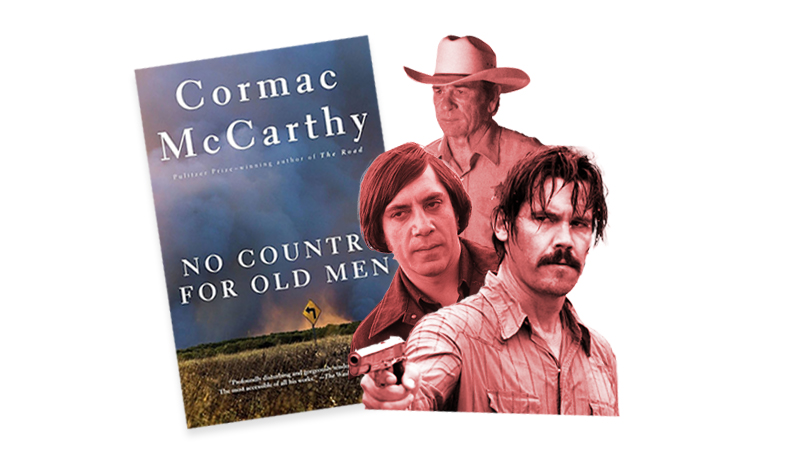 No Country for Old Men
dir. Joel Coen and Ethan Coen, 2007
Based on Cormac McCarthy’s No Country for Old Men (2005)
Sub-genres: Extra Villainous Villains • Contemplating The Nature of Evil • Hats
It’s sometimes shocking to think that No Country beat out two other similarly spectacular adaptations (There Will Be Blood, a very loose adaptation of Upton Sinclair’s Oil!, and Atonement) for the 2007 Academy Award for Best Picture. I probably watch those other films more often than I do No Country and yet I do think No Country is also the better adaptation. It gave us, of course, Javier Bardem’s most riveting performance as the classically-McCarthy-ian villain Anton Chigurh, but the thing that seals the deal for me is the ending, which somehow brings the true existentialist poetry of McCarthy’s writing to life in the simple delivery of Tommy Lee Jones and the steady camerawork of the Coen Brothers. A true masterpiece. –DB
 See also:
Remembering Cormac McCarthy • JD Vance Quoted One of Cormac McCarthy’s Most Evil Characters to Make Some Asinine Point • The 30 Best Diner Scenes in Crime Movies, Ranked
* * *
*
MATCHUP:
The Lord of the Rings: The Return of the King (1) vs. Blade Runner (12)
******************************************
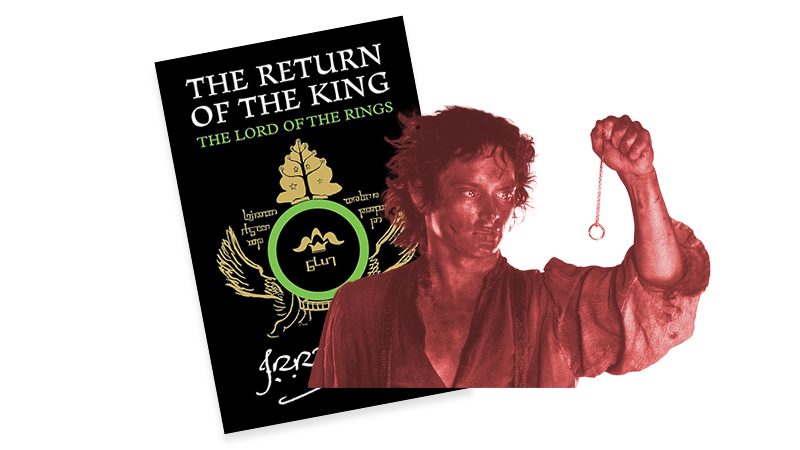 The Lord of the Rings: The Return of the King
dir. Peter Jackson, 2003
Based on J.R.R. Tolkien’s The Return of the King (1955)
Sub-genres: Extended Edition or Die • Movies That Make Me Cry For Over One Full Hour • Sam Gamgee You Will Always Be Famous
The Lord of the Rings movies are some of the best films—let alone the best adaptations—ever made. What Jackson (and his co-writers Phillipa Boyens and Fran Walsh) manage to do with Return of the King is uphold the world and themes of the book while also clarifying the message and emotional stakes of the original text. They’re talented editors as much as they’re talented adaptors. There is a deep care and respect in every choice made, and no change is made lightly, no cut is made thoughtlessly. Like Tolkien’s novel, this movie is a masterwork of craft. Unlike Tolkien’s novel, we get to see many different crafts succeed at once: writing, editing, directing, costuming, acting, designing, and more. I could talk about this movie for a very long time, but instead I’ll just say: it’s probably been too long since you watched it. Throw it on and have a good 4+ hour cry. –MC
 See also:
The Literary Power of Hobbits: How JRR Tolkien Shaped Modern Fantasy • Did Tolkien Write The Lord of the Rings Because He Was Avoiding His Academic Work? • Is The Lord of the Rings a Work of Modernism? • On the time J.R.R. Tolkien refused to work with Nazi-leaning publishers • Imaginary Histories: How Tolkien’s Fascination with Language Shaped His Literary World • Why We Feel So Compelled to Make Maps of Fictional Worlds
••••••••••vs••••••••••
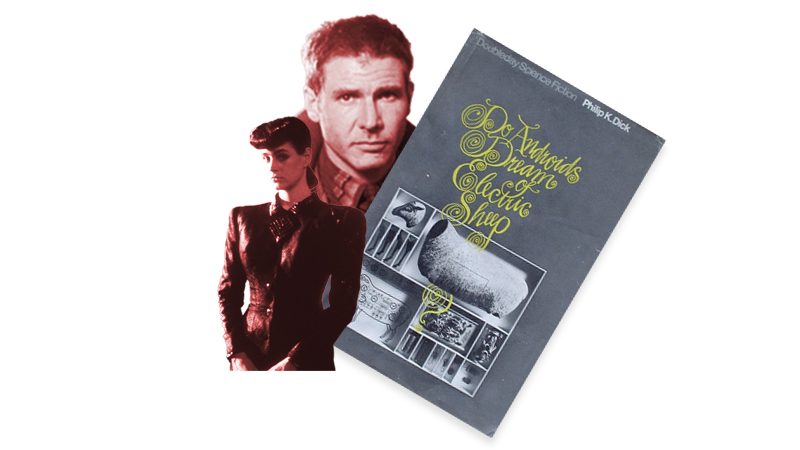 Blade Runner
dir. Ridley Scott, 1982
Based on Philip K. Dick’s Do Androids Dream of Electric Sheep? (1968)
Sub-genres: The Boyfriend Canon • More Human Than Human • “Computer, Enhance” • They Fixed It
This iconic adaptation smoothed out a lot of the tangles in Dick’s novel, but it didn’t arrive perfect. A weird monologue was removed from the theatrical cut, and there have been a number subsequent re-edits and updates of the film since then. But despite all the recuts, Blade Runner has remained popular because of the questions it raises about humanity, labor, and class, alongside great performances and a rich and gritty vision of the future. There’s a lot to like aestethically: blinking machines, Harrison Ford, robots, Sean Young, Edward James Olmos in a flying cop car, dumpling carts on rainy L.A. streets, and Vangelis’s eerie synths. Plus that Rutger Hauer “tears in the rain” monologue? It’s like the film bro pledge of allegiance. –JF
 See also:
Storytelling Tips from the Writer of Blade Runner • Bad Old Ideas in a Brave New World • Following the “Mom Rule.” On Writing Sci-Fi My Mother Could Get Behind
*
MATCHUP:
Jurassic Park (3) vs. Arrival (2)
******************************************
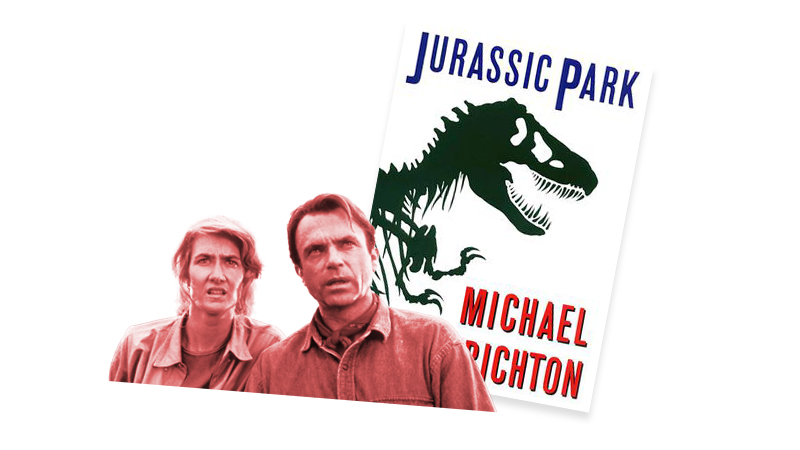 Jurassic Park
dir. Steven Spielberg, 1993
Based on Michael Crichton’s Jurassic Park (1990)
Sub-genres: Preoccupied Scientists • Clever Girls • The Most Blockbuster of The Summer Blockbusters
You can hear the sweeping John Williams right now, I’m sure, a sign of how indelible this movie has become. Jurassic Park is a classic, full of great performances, endlessly quotable lines, and all those dinosaurs moving in herds. It’s quintessentially summer. It’s so good that even the atrocious sequels can’t take the shine off of it.
One thing I’ve always wondered is that if Jurassic Park were real, would the park have the equivalent of annoying Disney Adults, whose entire personalities revolve around the dinos? It’s just one of the reasons I’m glad this is fiction. –JF
 See also:
The 25 Most Iconic Book Covers in History • 40 of the Best Villains in Literature • The Scariest, Creepiest, and Most Frightening Animals in Fiction
••••••••••vs••••••••••
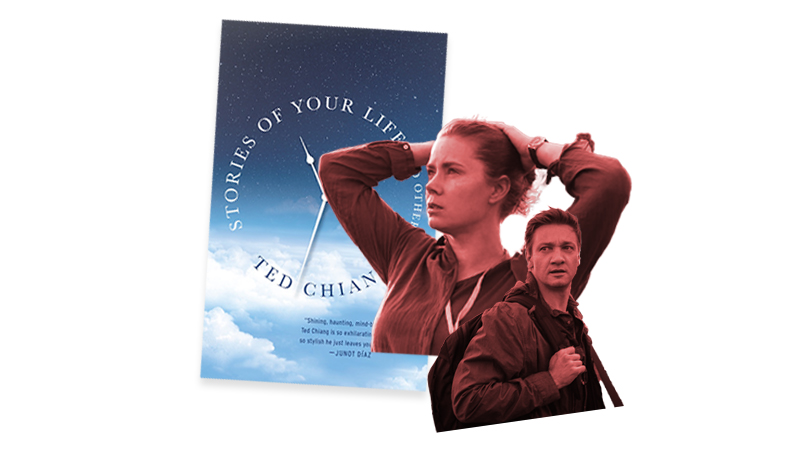 Arrival
dir. Denis Villeneuve, 2016
Based on Ted Chiang’s “Story of Your Life” (1998)
Sub-genres: What Even Is Time, Man? • Jeremy Renner Loves A Helicopter • Word Nerds On Film • Aliens That Make You Cry
As Lit Hub editor emeritus Aaron Robertson put it: “What if language was the key to knowledge, not only about your neighbor, but about strangers and yourself as well? By the end of Arrival, the Denis Villeneuve film based on Ted Chiang’s 1998 short story, “Story of Your Life,” the viewer understands this as the movie’s central question. Linguist Louise Banks (played by the ever-reliable Amy Adams) and physicist Ian Donnelly (Jeremy Renner) are called by the US Army to help study one of twelve extraterrestrial spacecrafts that have positioned themselves in scattered locations around the world. What Banks and Donnelly discover aboard the craft are two amorphous alien specimens, which they call “heptapods,” that communicate using a complicated system of logograms, or written characters that represent a word or phrase. This straightforward set-up lays the groundwork for a moving, and often anxiety-inducing, investigation of language, empathy, and miscommunication. Arrival’s surprising endgame cemented it as one of the most heartfelt movies of the last decade. The film’s meditative aesthetic is also boosted by a rather primal, ruminative score by the late, great Icelandic composer Jóhann Jóhannsson.”
 See also:
Ted Chiang on Arrival, the Boredom of Moviemaking, and The Princess Bride • Why Arrival Looks So Different After COVID-19 • Ted Chiang on Superintelligence and Its Discontents in J.D. Beresford’s Innovative Work of Early 20th-Century Science Fiction
And that’s all for the round of 16! See you tomorrow!