Starting to Write Again After Unimaginable Tragedy
Mai Nguyen: “There’s something about fictionalizing your grief that gives way to joy.”
In 2022, the year my baby died from labor complications, I thought I would never laugh again. That was fine by me. I didn’t want to live in a world where it was possible to laugh after losing your baby.
I did laugh again, of course. Precisely one day after she died.
I was at home, slouched on the sofa under a thick veil of grief. My sister was showing me a video of a presentation she’d put on for work, but in the video she was not talking the way she normally talks. She was using a different voice. A stiff, corporate voice I’d never heard come out of her mouth before. It was bizarre and hilarious. I couldn’t stop laughing.
The laughter was a relief as much as it was a betrayal.
Grieving and laughing may be a contradiction. But so is grieving and living and yet we all do it.
As disturbing as it was, I wasn’t surprised. I am naturally a person who bends towards ease and lightness. I wear a lot of pink. I dance alone in my kitchen to perky pop songs. I am that annoying person that tells you the silver lining. For a long time, I thought sadness was a choice.
I learned the hard way that it’s not. Sadness is a place we all inevitably visit, as Jonny Sun writes in Goodbye, Again, one of the many books I devoured while mourning: “You can’t outrun sadness because sadness is already everywhere. Sadness isn’t the visitor, you are.”
I could laugh, but so what? The grief still ravaged me in the way only grief could. Living got hard. Time slowed down. Home became my enemy—the bassinet, the bouncer, the board books—all reminders of what I’d lost. My days were supposed to be frenetic with feedings and burpings and diaper changes. Instead it was very, very quiet.
During all this, I was editing my debut novel, Sunshine Nails, a multi-narrative story about a dysfunctional Vietnamese family trying to save their nail salon from shutting down. It’s a mostly happy book with a comedic bent. It was a fun book to write, and I wanted my next book to be fun too.
Then time split in two—before my baby died and after my baby died—and I was filled with too much sorrow to write anything remotely fun. I scrapped it.
Like any writer who experiences something traumatic, the natural instinct is to process it through writing. To get it down on paper. To get it out of our system so that it doesn’t fester inside of us and eat us alive.
So, six months after her death, I started writing.
I created a fictional character named Cleo Dang. I gave her all my pain and heartache. I let her rot in bed and cry in the bathtub and drink too much NyQuil. I made her work at a funeral home—the same funeral home where she laid to rest her baby girl—and I put her through hell.
I let her come up for air, too. I gave her a partner who fed her, friends who held her as she cried, and strangers who said all the right things. I gave her a sense of humor, letting her make dark jokes about wanting to go on a John Wick-style murder spree. I even gave her a ridiculous nickname: cứt thối, which is Vietnamese for Smelly Shit.
It surprised me again, the humor. There’s something about fictionalizing your grief that gives way to joy. It gives you distance, perspective. Most of all it gives you the flexibility that grief often does not. Adding a twisted joke here and a poop joke there was the only way I could write this book and not want to die. The only way I could—dare I say—have fun.
I did worry that this might be inappropriate. That having fun was wrong. After all, there is nothing funny about a dead baby. According to the Social Readjustment Rating Scale, which quantifies the magnitude of certain life stressors, child loss is one of the most devastating losses a person can experience.
And yet, I could still laugh. Many parents who’ve lost a child do. Maybe not as frequently as they once did, but they do slowly become capable of it. Grieving and laughing may be a contradiction. But so is grieving and living and yet we all do it.
Though there might not be a happy ending—because grief never ends—there can still be levity.
In Raven Leilani’s essay for n+1, she wrote: “Humor, like grief, like poetry, is occasionally a language of dissonance: dissimilar things side by side reflect back on each other some surprise or shared meaning.”
Grief is absurd in the same way humor is absurd. I think that’s why they go so well together. As writers, we have to trust our audience. Trust them to see the humor as a companion of pain, not an invalidation of it.
My book is still very much a sad book. But sad books need not be torturous books. Though there might not be a happy ending—because grief never ends—there can still be levity.
Another book I read after my baby died was Elizabeth McCracken’s memoir about her stillborn baby, An Exact Replica of a Figment of My Imagination. I found comfort in knowing there was another bereaved mother who found solace in humor: “As for me, I believe that if there’s a God—and I am as neutral on the subject as is possible—then the most basic proof of His existence is black humor. What else explains it, that odd, reliable comfort that billows up at the worst moments, like a beautiful sunset woven out of the smoke over a bombed city.”
When I finished writing my book, Cleo Dang Would Rather Be Dead, I felt profoundly hopeful. I tended to Cleo’s grief like an unruly garden, nurturing it until I could make beauty of it somehow.
Yes, I made her go through hell, but I also pulled her out of it. I gave her community and strength and hope. And in writing all of that, I gave myself hope, too.
__________________________________
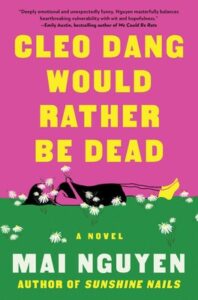
Cleo Dang Would Rather Be Dead by Mai Nguyen is available from Atria Books, an imprint of Simon & Schuster.

Mai Nguyen
Mai Nguyen is a Vietnamese Canadian author whose debut novel, Sunshine Nails, was longlisted for Canada Reads and named one of the best books of 2023 by NPR and CBC. Her journalism has appeared in Wired, The Washington Post, and The Toronto Star. Raised in Halifax, she now lives in Toronto with her husband, daughter, and French bulldog. Cleo Dang Would Rather Be Dead is her second novel.