The story of my grandparents is, I think, one of love and great courage: my grandfather was a Catholic priest, and he stuck it to the ultimate man when he married my grandmother in 1966. To them, however, it was a shameful scandal, one they spent the rest of their lives trying to outrun. Ultimately, they took the details of it to their graves, but what they did divulge provided the bones of my novel.
Writing about family history teaches you the most important lesson you can learn as a writer: humility in the face of your material. What you are handling both does and does not belong to you. If you lift it too far into the light, it could disintegrate. Be gentle. Go easy on the people behind these histories.
Truth be told, I decided to try writing this book when season two of Fleabag swept our screens. When Phoebe Waller-Bridge’s Hot Priest says, of his vestments, “Sometimes I think I’m only in it for the outfits,” the character of my grandfather unlocked for me. It was exactly how I imagined him during the years of his ministry. He would have had, I knew, that same charismatic touch of camp, that quietly acute perception, that habit of drinking gin and tonic from a can. He would have been, as Olivia Coleman’s character says, “very chic.”
My grandfather died when I was six, but even so, writing him into the character of David was comparatively easy. Meanwhile I found my nana, who lived until I was twenty-eight, much tougher to crack—even though that I was intimately involved in her care for her final years.
That act of reconstruction, my attempt to tell the story of how two remarkable people fell in love, is my novel.
Writing about her while she was still alive felt sneaky, underhanded, a stab in the back. I was blocked for a long time as a consequence. More clues about the real-life story kept appearing all the time, too, but they were accidental discoveries, by-products of looking after her. I would be looking for her birth certificate and a love letter would slip out from the binder; I was in the attic, and I found my grandfather’s ordination photos, tied up in purple ribbon.
The motherlode came one day when a sheaf of yellowed typewritten pages slid out of a rotted box file. The pages were covered in both of their handwriting, and I could see the two of them in conversation in the margins. They appeared to be sermons or talks—at least one written by her. They pulled no punches in their critiques of the Church, and they did so wittily, eloquently. I could sense, also, their voices merging into one, the intellectual chemistry between them building to a crescendo.
When I made discoveries like this, it was hard not to let my exhaustion kill my curiosity. I had to make the time to sit up late, reading bit by bit. It was like looking at the ground after a dance and trying to reconstruct the dance from the scuff marks on the boards. That act of reconstruction, my attempt to tell the story of how two remarkable people fell in love, is my novel.
The truth is, you will never know the dance. I found that the writing happened when I gave up on trying to reach the truth through any forensic means. You can look at the floor all you like, but eventually you must join in. If you have to make it up as you go along, so be it. I included several passages from these documents in the text—they were so true to how my grandparents spoke (both what I remembered of him and what I knew of her), and it felt like an appropriate homage.
And yes, I sometimes do believe that I earned the right to tell this story because I cared for my nana in her final years. But it was also a way of finding my way back to my admiration for her, of bringing me back to tenderness. Imagining her as she might have been became a lifeline for me. It helped me remain kind to her on the long path to her death.
A softer way of putting it might be that writing about her and caring for her became inextricably linked. Writing her into the character of Margaret was how I tried to reconcile the person she’d become with the people she used to be — the formidable grandmother, but also the vivacious young woman I imagined.
It is art which shows us the innocent past, despite its knowledge of what is to come.
In addition to the challenge of writing the history of a person I only knew at the end of her life, there was the challenge of writing about a religious tradition that wasn’t mine. The research overwhelmed me: my mother hadn’t been raised Catholic, as a direct consequence of her parents’ departure from the Church, and therefore neither had my siblings and I.
Reading about the history of the Catholicism, I was struck again and again by the vastness of everything I didn’t understand. Xavier Rynne’s series of “Letters from the Vatican” for the New Yorker, written during the Second Vatican Council, proved a lifeline. I tried to read religious novels, including Gilead, but found they presumed knowledge I didn’t have.
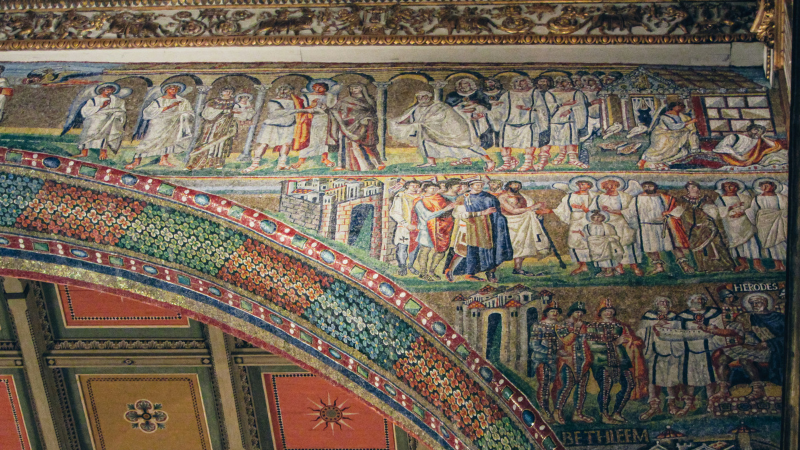
In the end, it was visual culture that helped me write the book. I gave up on trying to get to grips with the sprawling arcane terminology, and I went to Rome. My love of art history, which I’d been lucky enough to study in high school, resurfaced, and I made a dense Google Map with over a hundred pinned churches. I walked everywhere, not once taking public transport. I saw as many Bernini statues as I could, and was stunned by every one. I realized I knew more than I thought I did, from growing up in France, a deeply Catholic country, and being steeped in its aesthetic. Catholic art proved the writing guide I needed, ultimately: its attitude to time, how it looks forward and back, signaling to the future and the past: paintings of the infant Jesus always hold a clue to his future death. It is art which shows us the innocent past, despite its knowledge of what is to come.
And in that way, it taught me how to think about family history: with all I know about how it panned out, in its bittersweet messiness, can I go back, and write them as they might have been, a pair of bright, charismatic people blazing with hope? To do so—and this book is my attempt—would not, could not constitute a betrayal. Wherever my grandparents may be, I hope they see the spirit of admiration in which I tried to tell their story.
__________________________________
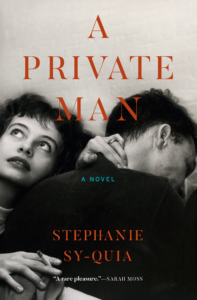
A Private Man by Stephanie Sy-Quia is available from Grove Hardcover.

Stephanie Sy-Quia
Stephanie Sy-Quia was born in California in 1995 and is based in London. Her writing and criticism have been published in The Guardian, The White Review, The Boston Review, Granta, and elsewhere. Her debut poetry collection Amnion, published in the UK by Granta Poetry in 2021, received a Somerset Maugham Award and was a Poetry Book Society Winter Recommendation; was longlisted for the Rathbones Folio and RSL Ondaatje Prizes; and won the Forward Prize for Best First Collection. She is the recipient of an Eric Gregory Award and is a fourth-generation teacher.