Was Emerson the True Father of American Literature?
Bruce Nichols on the American Renaissance of Prose and Poetry in the 1850s
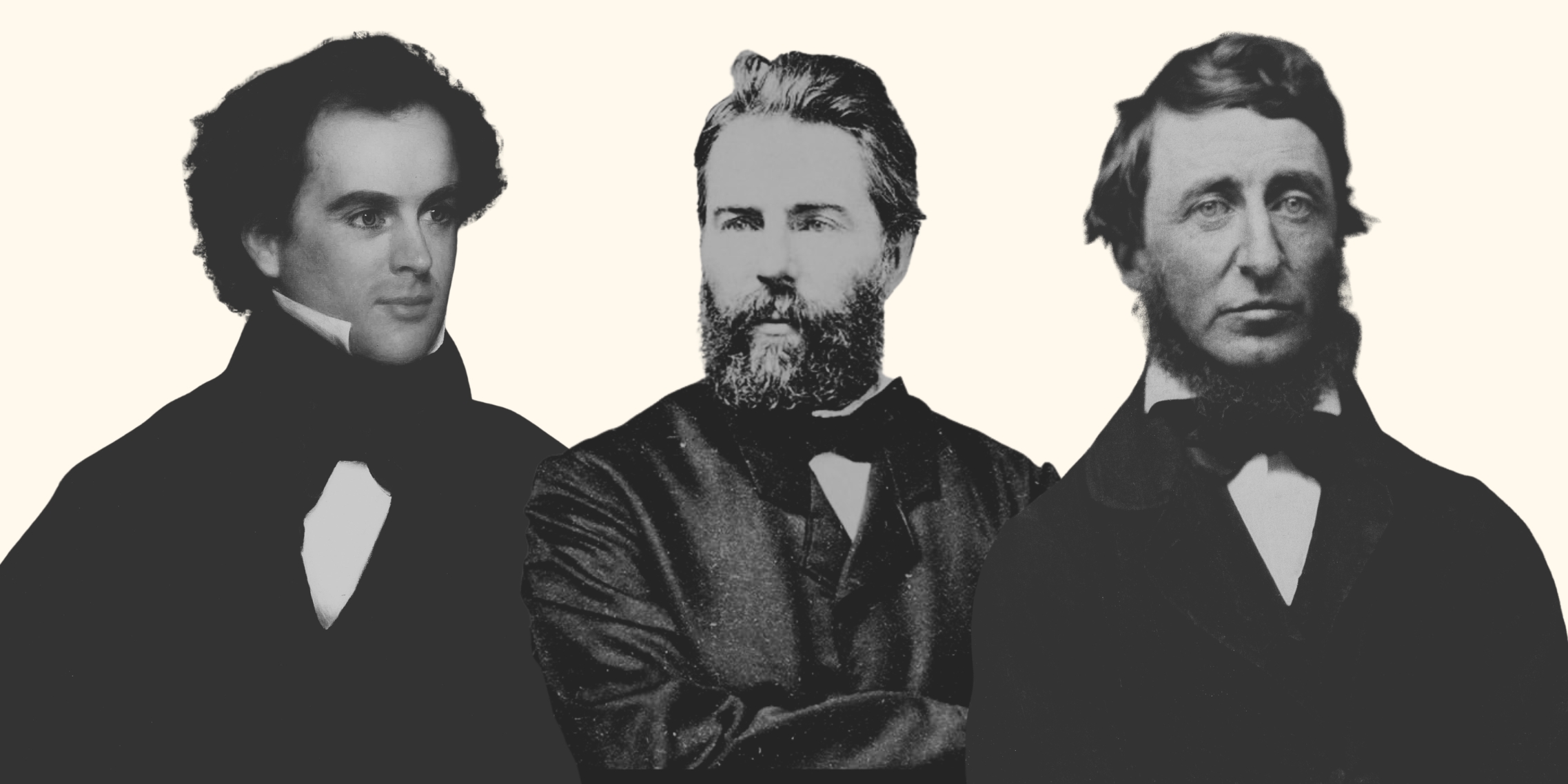
The 1850s have been called the American Renaissance, the decade when distinctive new voices emerged in prose and poetry. The great works were remarkably concentrated: from The Scarlet Letter (1850) to Moby-Dick (1851), to Walden (1854), to Leaves of Grass (1855). In her seminal 1846 essay on American literature in the New York Tribune, Margaret Fuller had called on writers “to develop a genius, wide and full as our rivers, flowery, luxuriant and impassioned as our vast prairies, rooted in strength as the rocks on which the Puritan fathers landed. That such a genius is to rise and work in this hemisphere we are confident; equally so that scarce the first faint streaks of that day’s dawn are yet visible.” That dawn broke just as she vanished into the sea.
Emerson was the wellspring of the Renaissance. Walt Whitman, in 1863, predicted that historians would come to acknowledge Emerson as “the actual beginner of the whole procession” of America’s original poets and writers. Today, scholars of American literature often say the same, but that claim has been largely forgotten outside the academy.
Yet it is the four great books of the 1850s that are an outgrowth from and a response to Emerson, with revealing backstories behind their creation.
The works of the American Renaissance could hardly have been more varied. As the literary critic F. O. Matthiessen described it: “Their tones were sometimes optimistic, sometimes blatantly, even dangerously expansive, sometimes disillusioned, even despairing, but what emerges from the total pattern of their achievement—if we will make the effort to repossess it—is literature for our democracy. In reading the lyric, heroic, and tragic expression of our first great age, we can feel the challenge of our still undiminished resources.”
The authors of The Scarlet Letter, Moby-Dick, Walden, and Leaves of Grass at times embraced, at times resisted Emerson. What they could not do was ignore him. Hawthorne was drawn to Concord even as he satirized it. Melville, reading Emerson’s two essay collections in the 1860s, scribbled a mix of agreement and strong disagreement in their margins.
In the 1850s, all four writers were in their thirties or forties. Each developed a voice, a framing, and a structure that were unique in Anglo-American literature. To be sure, a full accounting of the American Renaissance would include Edgar Allan Poe and Emily Dickinson, two writers who were more distant from Emerson and his circle (though Dickinson did admire his poetry). Poe’s works mostly dated from the 1840s, and Dickinson’s then-unpublished poems are mostly from the 1860s. Yet it is the four great books of the 1850s that are an outgrowth from and a response to Emerson, with revealing backstories behind their creation.
The Scarlet Letter
Nathaniel Hawthorne, on the evidence of his novels, found it difficult to follow Poe’s advice to “cut Mr. Alcott [and] hang (if possible) the editor of The Dial.” He wrote three novels in quick succession in the early 1850s, two of which feature contemporary reformers. The Scarlet Letter is the only one of Hawthorne’s mature novels that avoids any hint of the Newness.
Hawthorne was the opposite of Emerson. His tragic worldview clashed with Emerson’s idealism, which may explain why he so often wrote stories that undercut the best of reformers’ intentions with the flaws of their hearts. In The Scarlet Letter, he turned to the seventeenth-century setting of Puritan Boston. Rather than the strange “moral shapes of men” that he satirized elsewhere, the characters in his great-est book face a rigid and restrictive social order. Their flawed hearts thereby become far more dangerous.
When eighteen-year-old Louisa May Alcott noted that she was reading Hawthorne, she commented that “‘The Scarlet Letter’ is my favorite . . . I fancy ‘lurid’ things, if true and strong also.” Poe’s advice may have been wise: by getting Emerson out of his head, Hawthorne freed himself to write his most enduring work.
The story of how he came to write it is its own tale of desperation. His first two story collections had met positive reviews but only modest sales. In the summer of 1849, his situation worsened: He was fired from his Salem Customs House position. The Democratic Party, led by Lewis Cass (father of the chargé d’affaires to Rome), had been defeated by Zachary Taylor and the Whigs. Patronage positions turned over at many levels, including in Salem.
He learned of his termination in June. (“I am turned out of office! There is no use in lamentation.”) Sophia had saved up some money but not enough to last long. One friend organized contributions from Hawthorne’s admirers and sent a substantial check. Hawthorne wrote in thanks, saying that the letter and check “drew—what my troubles never have—the water to my eyes . . . It is sweet to be remembered and cared for by one’s friends. And it is bitter, nevertheless, to need their support. I am ashamed of it, and I ought to be.”
In Hawthorne’s hour of need, publisher James T. Fields came calling. He was thirty-two years old, the junior partner of William Davis Ticknor who had helped Ticknor and Fields become one of the country’s most prestigious imprints. When he heard that Hawthorne had lost his job, he first tried to convince politician friends to find a new position for him, with no success. He recalled one who dismissed the very idea of having a literary man in public office: “Hawthorne is one of them ’ere visionists, and we don’t want no such a man as him around.”
Next, Fields came to Salem. Fields told Hawthorne he would print two thousand copies “of anything you write.” Hawthorne protested that he had nothing to offer. Spying a bureau with drawers that might con-tain manuscripts, Fields asked again. Finally, he began to leave. “I was hurrying down the stairs when he called after me from the chamber, asking me to stop a moment. Then quickly stepping into the entry with a roll of manuscript in his hands, he said: ‘How in Heaven’s name did you know this thing was there? It is either very good or very bad,—I don’t know which.’ On my way up to Boston I read the germ of ‘The Scarlet Letter’; before I slept that night I wrote him a note all aglow with admiration of the marvelous story he had put into my hands.”
Nonetheless, the novel’s success did not make Hawthorne a rich man.
Hawthorne had intended to use a shorter version of the novel as part of a collection of “Old-Time Legends.” Fields convinced him to expand it and publish it separately. Hawthorne worried that it would be too “somber.” To help lighten it he wrote a lengthy introduction, a framing device of pseudo-nonfiction set in the Custom House. It was a chance for him to satirize his former colleagues ruthlessly. Fields liked the addition, though Hawthorne wondered whether readers would care about his own experiences.
When he finished the novel in February, he reported to a friend that Fields “speaks of it in tremendous terms of approbation; so does Mrs. Hawthorne, to whom I read the conclusion last night. It broke her heart and sent her to bed with a grievous headache—which I look upon as a triumphant success!”
The Scarlet Letter was published in March 1850. Its first printing of 2,500 copies sold out quickly. Another 2,500 were printed one month later, and yet another 1,000 five months after that. At last Hawthorne had a commercial success.
Reviews were mostly very favorable. The Massachusetts Quarterly Review gushed that “in no work has [Hawthorne] presented so clear and perfect an image of himself, as a speculative philosopher, an ethi-cal thinker, a living man.” Some religiously minded reviewers decried the “nauseous” and “debauched” themes and characters. But overall, and over time, The Scarlet Letter was accepted as “the most decisive production of the author and one of the remarkable stories of the age.” Evert Augustus Duyckinck hailed it as an “entire, perfect creation” and gushed, “Our literature has given to the world no truer product of the American soil, though of a peculiar culture, than Nathaniel Haw-thorne.”
Nonetheless, the novel’s success did not make Hawthorne a rich man. A few months after The Scarlet Letter reached stores, a senti-mental novel by Susan Warner, The Wide, Wide World, became one of America’s first true bestsellers. It went through fourteen printings in two years. Louisa’s alter ego in Little Women, Jo March, spends an afternoon “reading and crying over” it. It was just one of many sentimental novels that would turn at least a few American authors into wealthy women. Hawthorne complained bitterly. “America is now wholly given over to a damned mob of scribbling women, and I should have no chance of success while the public taste is occupied with their trash—and should be ashamed of myself if I did succeed.”
He still needed the help of his friends. When one couple offered the Hawthornes use of a cottage on the edge of their property, Tanglewood, in Lenox, Massachusetts, they accepted and moved in March 1850. There Hawthorne would write another success, The House of the Seven Gables.
Gables came out in 1851. His Brook Farm–inspired novel, The Blithedale Romance, followed in 1852, his third novel in three years, leading some biographers to note that his loss of the Customs House job was a great gift to American literature. By 1852, the Hawthornes were back in Concord. They purchased the Alcotts’ Hillside, renaming it the Wayside.
Returning, physically, to the Emerson circle may have been a bad move creatively. Hawthorne would continue to write fiction, including The Marble Faun, which he published in 1860, but just as with The Blithedale Romance, its contemporary setting and characters were not successful.
Melville was a pessimist, and a tragedian.
Emerson never much liked Hawthorne’s fiction. Julian Hawthorne would claim that Emerson “was never able to complete the perusal of any of Hawthorne’s stories.” In one journal entry, Emerson wrote, “Nathaniel Hawthorne’s reputation as a writer is a very pleasing fact, because his writing is not good for anything, and this is a tribute to the man.”
Moby-Dick
Another reason to be grateful for Hawthorne’s job loss and move to Lenox in 1850 is that he soon met a near neighbor: Herman Melville.
Melville was fifteen years younger than Hawthorne. Yet at the age of thirty-one, after spending five years at sea in his early twenties, he had already published five books. His first, Typee: A Peep at Polynesian Life (1846), was supposedly a narrative of four months he spent in the Marquesas Islands in the South Pacific when he jumped ship from a whaling vessel. In truth he had only spent one month there, and he borrowed or plagiarized a good deal of material from other accounts. It was a bestseller in both America and England. Hawthorne reviewed it for the Salem Advertiser, praising its light, vigorous style and its “effective” portrait of island life.
While some critics attacked the book for its apparent embrace of voluptuousness, Hawthorne disagreed: Melville “has that freedom of view—it would be too harsh to call it laxity of principle—which renders him tolerant of codes of morals that may be little in accordance with our own; a spirit proper enough to a young and adventurous sailor.”
It was an auspicious career start for Melville. Yet during his lifetime none of his other eight novels would sell as well. He followed Typee with a sequel, Omoo, loosely based on a brief stay in Tahiti as well as his voyages on a whaling ship; but even more than with Typee, he “altered facts and dates, elaborated events, assimilated foreign materials, invented episodes, and dramatized the printed experiences of others as his own.”
Reviews were again positive, though some critics took issue with the book’s truthfulness, not to mention its Rabelaisian celebration of alcohol. Horace Greeley hailed Melville as “a born genius, with few superiors either as a narrator, a describer, or a humorist.” But he argued that both Typee and Omoo were immoral books. “Not that you can put your finger on a passage positively offensive; but the tone is bad. . . . A penchant for bad liquors is everywhere boldly proclaimed, while a hankering after loose company, not always of the masculine order, is but thinly disguised.”
In 1849 Melville switched to full-on fiction with a romance about an American sailor who abandons his whaling ship to explore the South Pacific. He began Mardi: and a Voyage Thither with an ironic preface:
Not long ago, having published two narratives of voyages in the Pacific, which, in many quarters, were received with incredulity, the thought occurred to me, of indeed writing a romance of Polynesian adventure, and publishing it as such; to see whether the fiction might not, possibly, be received for a verity: in some degree the reverse of my previous experience.
Mardi is a rambling story, and reviewers were not kind. George Ripley, who had taken Margaret Fuller’s position at the New York Tribune, wrote that the “story has no movement, no proportions, no ulti-mate end; and unless it is a huge allegory—bits of which peep out here and there—winding its unwieldy length along, like some monster of the deep, no significance or point.” It did not sell well.
Melville wrote two more sailing novels that blended fiction and nonfiction based on his experiences on a merchant vessel (Redburn) and a man-of-war (White-Jacket), neither of which succeeded. White-Jacket did cause a stir with its discussion of the arbitrary and cruel use of flogging in the US Navy. In four short chapters (out of ninety-three), the book describes an incident of flogging and argues that the captain’s unchallenged authority to order it whenever he wishes, but never be subject to it, is antidemocratic and unconstitutional: “You see a human being, stripped like a slave, scourged worse than a hound. And for what? For things not essentially criminal, but only made so by arbitrary laws.” Melville’s publisher, Harper & Brothers, sent copies to every member of Congress. In September 1850, Congress banned flogging on all US ships.
For his part, Melville published an anonymous two-part rave review of Mosses from an Old Manse in Duyckinck’s The Literary World.
Melville was a pessimist, and a tragedian. In Mardi, a character states that “evil is the chronic malady of the universe.” The author of that line was a natural ally of Nathaniel Hawthorne. Their personalities, like their writing styles, were distinct: Melville had bouts of manic energy during which he could not stop talking. Hawthorne was often silent. Yet they connected on a deep level.
When they first met, on a hiking expedition up Monument Mountain in August 1850, they were with James T. Fields, Oliver Wendell Holmes, publisher Evert Duyckinck, and a few others. As Fields recalled, “We scrambled to the top with great spirit, and when we arrived, Melville, I remember, bestrode a peaked rock, which ran out like a bowsprit, and pulled and hauled imaginary ropes for our deectation.”
After lunching among the rocks and making toasts with “a considerable quantity of Heidsieck” champagne, they took an afternoon hike through the Ice Glen, a ravine with deep ice-filled crevices. “Hawthorne was among the most enterprising of the merry-makers; and being in the dark much of the time, he ventured to call out lustily and pretend that certain destruction was inevitable to all of us.” Fields, overweight, wore shoes that slipped on the rocks. Holmes joked, “Ten per cent more to your authors on your next book, and you’ll have less fat to complain of.”
Three days later Melville visited Hawthorne for more champagne and a walk. Hawthorne invited him to return for a stay of a few days. To prepare, he devoured Melville’s three most recent books, writing to Duyckinck in late August, “I have read Melville’s works with a progressive appreciation of the author. No writer ever put the reality before his reader more unflinchingly than he does in ‘Redburn,’ and ‘White Jacket.’ ‘Mardi’ is a rich book, with depths here and there that compel a man to swim for his life. It is so good that one scarcely pardons the writer for not having brooded long over it, so as to make it a great deal better.”
For his part, Melville published an anonymous two-part rave review of Mosses from an Old Manse in Duyckinck’s The Literary World. He praised Hawthorne’s “humor so spiritually gentle, so high, so deep, and yet so richly relishable, that it were hardly inappropriate in an angel.” He noted “such a depth of tenderness, such a boundless sympathy with all forms of being, such an omnipresent love, that we must needs say that this Hawthorne is here almost alone in his generation,—at least, in the artistic manifestation of these things.” He even compared Hawthorne to Shakespeare: “Now I do not say that Nathaniel of Salem is greater than William of Avon, or as great. But the difference between the two men is by no means immeasurable.”
Melville’s four-day visit began on September 3. Sophia wrote to her mother that “he has very keen perceptive power, but what astonishes me is, that his eyes are not large & deep—He seems to see every thing very accurately, & how he can do so with his small eyes, I cannot tell. . . . When conversing, he is full of gesture & force, & loses himself in his subject—There is no grace nor polish.”
Melville would visit Lenox at least six more times. Hawthorne and his daughter would reciprocate by visiting him in March 1851. The following August, Hawthorne described a chance meeting as he sat reading:
While thus engaged, a cavalier on horseback came along the road, and saluted me in Spanish; to which I replied by touching my hat, and went on with the newspaper. But the cavalier renewing his salutation, I regarded him more attentively, and saw that it was Herman Melville! . . . We all went homeward together, talking as we went. After supper, I put Julian to bed; and Melville and I had a talk about time and eternity, things of this world and of the next, and books, and publishers, and all possible and impossible matters, that lasted pretty deep into the night.
Throughout these months of visits Melville was struggling with the manuscript of Moby-Dick. He was also fretting about his income. He wrote to Hawthorne in June 1851 that “dollars damn me; and the malicious Devil is forever grinning in upon me, holding the door ajar.
Scholars have long wondered what influence, if any, Hawthorne may have had over Melville’s masterpiece.
. . . What I feel most moved to write, that is banned,—it will not pay. Yet, altogether, write the other way I cannot. So the product is a final hash, and all my books are botches.” Later that month he wrote again: “Shall I send you a fin of the Whale by way of a specimen mouthful? The tail is not yet cooked—though the hell-fire in which the whole book is broiled might not unreasonably have cooked it all ere this. This is the book’s motto (the secret one),—Ego non baptiso te in nomine [I baptize thee not in the name of the Father, but the Devil]—but make out the rest yourself.”
Moby-Dick came out in October 1851 in the United Kingdom, and one month later in the United States. Hawthorne wrote to Melville, praising the novel and apparently offering to review it (that letter has not survived). Melville’s response is famous:
Whence come you, Hawthorne? By what right do you drink from my flagon of life? And when I put it to my lips,—lo, they are yours and not mine. I feel that the Godhead is broken up like the bread at the Supper, and that we are the pieces. Hence this infinite fraternity of feeling. Now, sympathizing with the paper, my angel turns over an-other page. You did not care a penny for the book. But, now and then as you read, you understood the pervading thought that impelled the book—and that you praised. Was it not so? You were archangel enough to despise the imperfect body, and embrace the soul.
Scholars have long wondered what influence, if any, Hawthorne may have had over Melville’s masterpiece. We know that the manuscript-in-progress was sitting on a desk, in plain view, during one of Hawthorne’s visits. In Melville’s letters to Hawthorne, he speaks several times of wrestling with the book, and the younger man clearly admired the elder. Surely, he would have paid close attention to any advice Hawthorne might have offered. But on this tantalizing question the record is silent.
Given the gulf between the two men’s styles—Hawthorne’s famous novels are spare and brief, hewing closely to a single theme or question, Melville’s novels are extravagant, lengthy journeys through oceans and subcultures—it is hard to imagine what Hawthorne might have said to Melville that would have changed the course of Moby-Dick. Melville’s book includes lengthy digressions on the typology of whales; the symbolic significance of white; the existing paintings and etchings of whales; and the history of fatal encounters with whales, among other topics. (With tongue in cheek, he defends including that history in order to prove that Moby-Dick is no “monstrous fable, or still worse and more detestable, a hideous and intolerable allegory.”) Would Hawthorne have advised him to trim these side branches?
We will never know. Yet there is one intriguing sign built into Moby-Dick at its start—the book is dedicated to Hawthorne: “In token of my admiration for his genius.” Hawthorne discovered this compliment at a private dinner with Melville at a hotel in Lenox. The two men dined at a table alone, lingering long after all other diners had dispersed. Melville handed Hawthorne an inscribed copy. It moved him profoundly.
The two men’s masterworks have a commonality: They are both tragedies built around the power of a symbol—the scarlet A and the great white whale—that marry allegory to drama. Lewis Mumford, writing about the American Renaissance in The Golden Day, goes so far as to say that “at heart, the American novelists were all transcendental.
The scene was a symbol: they scarcely had the patience to describe it: they were interested in it only because it pointed to something more important.” Melville admired Emerson as “more than a brilliant fellow” but insisted that he did not “oscillate in Emerson’s rainbow.” Neither he nor Hawthorne subscribed to Transcendentalism as a movement. Still, Mumford rightly notes that their famous books are churning with deep meaning beneath their surface symbols. Their characters are trapped—Hawthorne’s by the strict codes of Calvinism, Melville’s by Captain Ahab’s tyranny—but they long for liberation. These are tragic novels about trapped individuals, craving freedom.
Melville was discouraged. He would continue to write in different genres, including poetry and short stories, but he would never enjoy commercial success.
Hawthorne admired his friend’s new novel. In December, from his temporary home in West Newton, Massachusetts, he wrote to Duyckinck, “What a book Melville has written! It gives me an idea of much greater power than his preceding ones.”
The initial reviewers did not agree. The Athenaeum (London) called it “an ill-compounded mixture of romance and matter-of-fact.” That review was widely circulated and quoted in America. Duyckinck himself reviewed the novel in The Literary World in November. Even he offered a very mixed assessment of his friend’s “bulky and multifarious volume,” calling it an “intellectual chowder of romance, philosophy, natural history, fine writing, good feeling, bad sayings,” and noting that the characters and setting are “idealized throughout.”
There were some positive notices, including by Horace Greeley in the New York Tribune: “We think it the best production which has yet come from that seething brain, and in spite of its lawless flights, which put all regular criticism at defiance, it gives us a higher opinion of the author’s originality and power than even the favorite and fragrant first-fruits of his genius, the never-to-be-forgotten Typee.”
Melville was discouraged. He would continue to write in different genres, including poetry and short stories (most famously, “Bartleby the Scrivener”), but he would never enjoy commercial success. Moby-Dick initially sold fewer than four thousand copies, of which six hundred were in the United Kingdom. It was out of print by the time Melville died, in 1891.
One British review of Moby-Dick, reprinted in Harper’s New Monthly Magazine, captured the ultimate significance of the novel:
Want of originality has long been the just and standing reproach to American literature; the best of its writers were but second-hand Englishmen. Of late some have given evidence of originality; not absolute originality, but such genuine outcoming of the American intellect as can be safely called national. Edgar Poe, Nathaniel Hawthorne, Herman Melville are assuredly no British off-shoots; nor is Emerson, the German American that he is! . . . What romance writer can be named with HAWTHORNE? Who knows the horrors of the seas like HERMAN MELVILLE?
The reviewer was right.
__________________________________

From The Emerson Circle: The Concord Radicals Who Reinvented the World by Bruce Nichols. Copyright © 2026. Reprinted by permission of Avid Reader Press, an Imprint of Simon & Schuster, Inc.

Bruce Nichols
Bruce Nichols grew up in a Unitarian household, twenty minutes from Concord, Massachusetts. During an almost forty-year career in publishing, he served as publisher of both Houghton Mifflin Harcourt (HMH) and Little, Brown and Company, the original publishers of Thoreau, Hawthorne, and Louisa May Alcott. At HMH, he regularly reissued Thoreau’s works.