Ayelet Waldman on What Quilting Taught Her About the Creative Process
Combining the Writing Life With the Pursuit of a Beloved Hobby
In a previous life, I was an attorney with too much student debt. I figured if I sacrificed my feminist principles and allowed the men I dated to buy my meals, and otherwise subsisted on packaged noodles, I could in one year, on a corporate lawyer’s salary, pay down the loan sufficiently to at least keep me from having a panic attack every time I opened my bank statement. I bought an unfortunate double-breasted suit at Filene’s Basement, and sat for a dozen interviews with law firms. Every interviewer asked me the same bizarre question: what are your hobbies? They might as well have said, “Tell me what will you miss most when you’re putting in fourteen-hour days beneath the fluorescent lights of our tastefully-decorated offices?”
Still they expected an answer. The first time I was so taken aback that I said, “Uh. I don’t really have any hobbies. I read a lot.” I didn’t get that job. After that I began to say, “Reading is my hobby. Mostly fiction, sometimes memoir. Also, I ski.” I do not ski. My father and brothers, however, were skiers, and I had been schlepped up the bunny slope enough to convincingly fake a conversation about schussing and moguls.
Quilting competes with my writing—there are, after all, only so many hours in a day—but like reading it also complements it.
For most of my life, my free time was spent exclusively reading. I even read when I was not free, hidden in a textbook in school, in a corner of the playground when I was supposed to be watching my children. This single-minded devotion is why I became a writer. I try to write the books I want to read.
Then, a couple of years ago, in a time of anxiety and distress, I began to make quilts. I took up this hobby suddenly and it quickly became all-consuming. I have not given up reading; I listen to audiobooks while I sew, but quilting has transformed my life. I do little other than quilting and writing, sedentary activities that often result in my step counter registering only triple digits. (How, you might wonder, does a person walk a mere 225 steps in an entire day? My bathroom is very close to my sewing room and I don’t like answering my door.)
Quilting competes with my writing—there are, after all, only so many hours in a day—but like reading it also complements it. The activities, though they make use of different parts of the body and brain, and thus trigger different neurological and emotional responses, also have unexpected and interesting parallels.
The most well-known and respected American quilters are a group of women who live in a remote and historically Black community in Alabama. The Gees Bend quilters can be considered the first American abstract artists, and though they did not invent the improvisational quilt (Victorian quilters were obsessed with “crazy quilts” made of scraps of different fabric randomly pieced together), they perfected it. I, on the other hand, loathe improvisation. I plan my quilts carefully. I always use patterns, some of my own making, some made by quilt designers. Before I begin sewing, I know exactly what the final product will look like.
I write similarly. When I start a novel, I always know where I’m going. I do allow myself a certain amount of freedom at the beginning, to capture the all-important voice, what Wayne Booth’s The Rhetoric of Fiction calls the “implied author.” In a first person work, the voice of the narrator is obviously the voice of the main character, but even when writing in the third person, each work has its own tone and style. Sometimes the voice of the novel lands complete in my head; other times I have to work my way to it. As soon as I find the voice, however, I stop and plan out the rest of the story, the same way I plan a quilt. Chapters, like quilt blocks, build on one another. Like a good novel, the best quilts create a feeling of progression and change.
My outlines are not detailed; they are more like roadmaps or what in Hollywood is called a “beat sheet.” I know what will happen next, but not how. Even so, I am always open to diverging from the plan, and the moments of purest delight I experience as a writer occur when I am surprised by a sudden, unexpected twist, as with the ending of my latest novel, A Perfect Hand, which arrived on my imagination’s doorstep like a bouquet of perfect peonies on the first day of spring.
When I quilt, I am a meticulous piecer. I try to achieve precise lines, points and shapes. Similarly, when I write, I try for precision in words, sentences, paragraphs and on. Like a false note on an out-of-tune piano, a clunky verb, a sentence without rhythm, yanks the reader out the flow of the work. Often, even when I don’t know the words, I can feel the rhythm of a sentence. “Da, dada, dadada da da.”
Chapters, like quilt blocks, build on one another. Like a good novel, the best quilts create a feeling of progression and change.
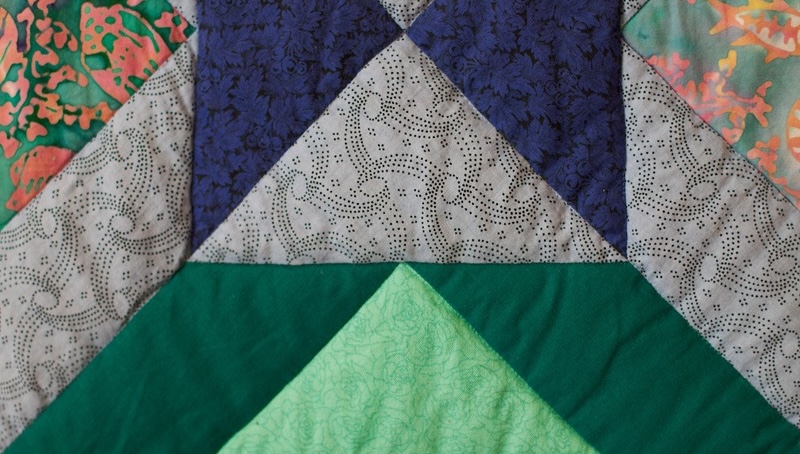
However, no matter how hard I try to achieve precision, I fail as or more often than I succeed. The points of my sawtooth stars get cut off, my quilted circles don’t match. I can’t find the right word to express an emotion, my description of a character is wrong but I can’t figure out how to fix it.
A sewist’s best friend in the seam ripper, and I make sure mine—both literal and figurative—are always sharp. Writing is a process of rewriting. I write as many as nine or ten drafts before my manuscripts are good enough to submit.
Still, I find nothing so painful as rereading my published work. How did I let that sentence stand? Why didn’t I dig deeper for a better metaphor? How did I miss that I used the word “absorb” in two sentences a single paragraph apart? I try to remind myself that writers far more accomplished than I have experienced this same misery. As the poet Paul Valery (or maybe Robert Frost) said, “A work is never finished, only abandoned.” Still, no matter how many times I mutter Voltaire’s maxim,”Le mieux est l’ennemi du bien” (the perfect is the enemy of the good), the imperfections gall.
I do not generally keep my quilts. I give them away as gifts; I donate them to charity; I auction them off for a cause. Similarly, I don’t keep a journal. I write to be read by others, not myself. Perhaps quilting can make me better tolerate my failings as a writer. Once you piece together a quilt top out of cuts of fabric, you add a back and batting, and stitch the “sandwich” together. Then you toss the completed quilt into the washing machine, and miraculously, your errors vanish. They all “quilt out.” Never once has the recipient of one of my quilts ever expressed disappointment at an upside down triangle or a missed stitch. I doubt that the same is true of the readers of my books, but maybe it’s enough for me to pretend that it is.
____________________________
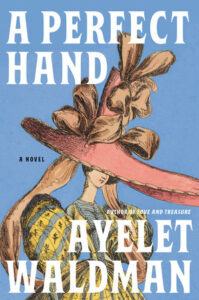
A Perfect Hand by Ayelet Waldman is available from Alfred A. Knofp, an imprint of Knopf Doubleday Publishing Group, a division of Penguin Random House, LLC.

Ayelet Waldman
Ayelet Waldman is the author of A Really Good Day, Love and Treasure, Red Hook Road, Love and Other Impossible Pursuits, Daughter’s Keeper, Bad Mother and the Mommy-Track Mystery series. She co-developed and was an Executive Producer on the Netflix series Unbelievable, which received a Peabody Award and Best Limited Series nominations at the Critics’ Choice Awards, the Golden Globes, and the Primetime Emmys in 2020. Waldman lives in Berkeley, California with her husband Michael Chabon.