The Man Who Reads Books For a Living (One Every Two Days)
You Have Clarke Speicher to Thank (Or Blame) For the
Recent Train Dreams Adaptation
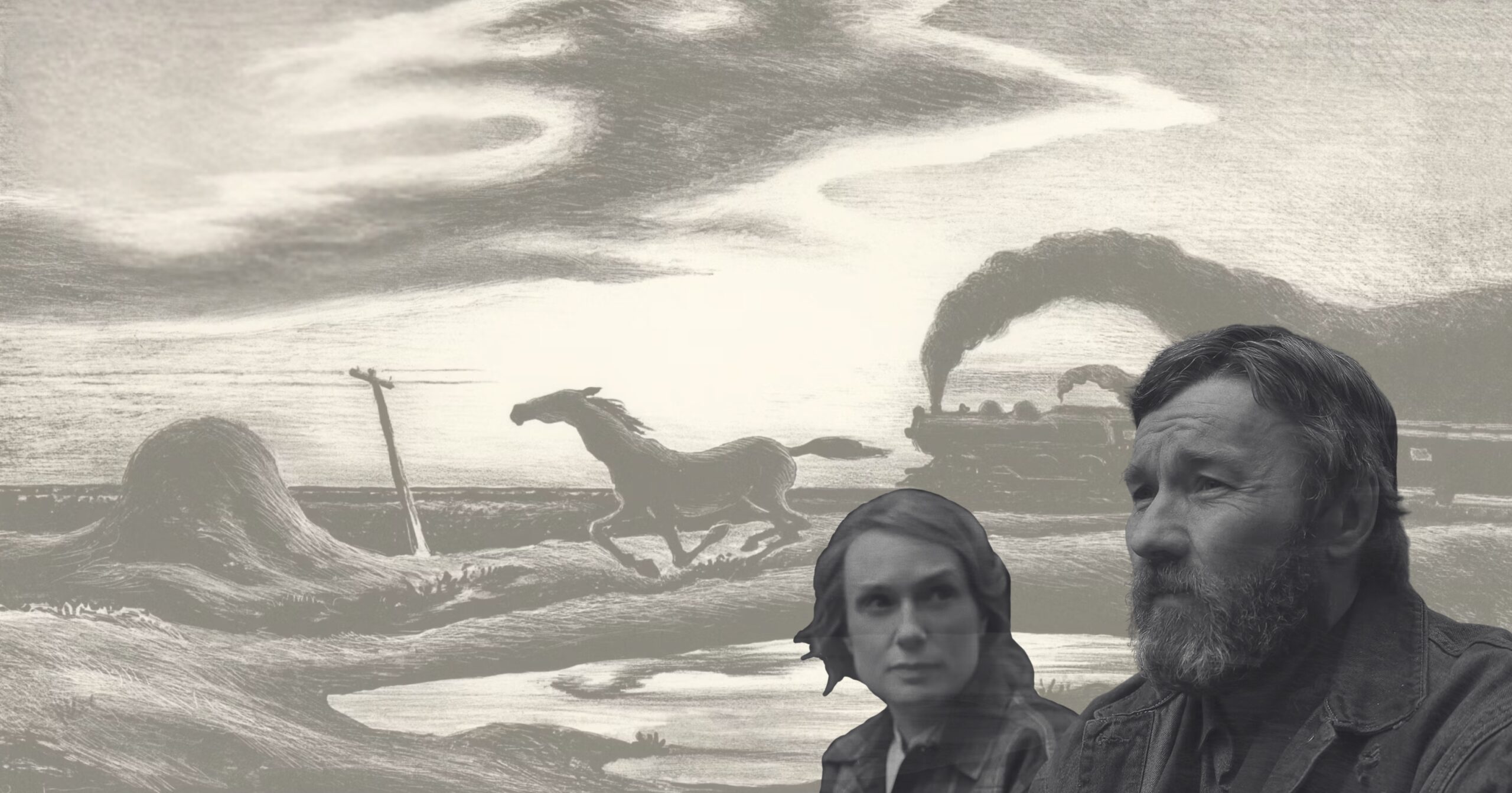
When Clarke Speicher (spike-er) asked how I liked the screen adaptation of Train Dreams, Denis Johnson’s novella following the solitary logger Robert Granier in the early 20th-century American West, he was actually asking whether it measured up to its source material. That is, after all, the question about adaptations. Still, it felt loaded. If it had been anyone else, I would’ve felt at liberty to prattle without worrying whether I’d arrived at any kind of thesis. That I love the book was beside the point. I felt caught out because it was Clarke doing the asking. But he isn’t an author, screenwriter, director, producer, critic, agent, or editor. He isn’t a journalist or influencer.
Clarke is something much more specific and much rarer: a professional book reader who evaluates literature specifically for screen adaptation. So after a few seconds of mealy-mouthed equivocation about Train Dreams, I came to my senses and flipped the question back on him. A few drinks later, we were talking about his profession, how it works, and what adaptation really means.
In his mid-40s and unassuming, Clarke is the rare interlocutor who seems to listen without waiting to speak, a far cry from people in the biz whose stock-in-trade is summed up by the very word: production. He has glasses, a solid build, a short gray beard. His thoughts tend to outpace his ability to articulate them in a first pass. He smiles a lot. There is something gentle and teddy-bear-ish about him, but it’s tempered by a New Yorker’s world-weariness. I’ve known him a long time, spent many nights talking (and drinking) with him into the small hours about books, movies, love, dreams, life. “The best adaptations take the basic idea and transform it into cinematic terms,” he says. “Which I’m realizing does sound very dumb saying it out loud,” he chuckles at himself.
An executive might walk into a meeting with an author, producer, potential directors, stars, prepared to discuss potential multi-million dollar deals armed only with Clarke’s synopsis.
His work forces a near-daily conversation between two halves of Clarke’s brain: the lifelong reader who devours books and the cinephile who dreams in celluloid. The nuts and bolts are this: an agent, executive, or producer sends Clarke a book or manuscript, blind. He reads it and writes a detailed beat-by-beat synopsis of the core scenes, settings, conflicts, and characters. Here, he quotes essential dialogue and, if any sentence-level writing stands out, includes excerpts. He then steps back to evaluate how the book might actually function on screen, that is, which elements are inherently cinematic, what can and can’t be rendered visually or dramatized, and what kind of movie or series the material wants to be. This is where the tension stretches tightest.
Clarke may love a book but, considering aesthetics, a conceptual budget, the likely target audience, possible star power attached, how similar projects have fared, and basic feasibility, his affection may only have so much bearing on the binary at which he must, finally, land: a recommendation to either pass and go no further, or consider and let it build momentum.
He calls this report “coverage.” It serves as reference for people in rarified air Clarke has never been invited to breathe. But he harbors no ambition to scale Hollywood heights. He is, if the arc of his career is any indication, happy to be something of a brain trust. “Not every executive can read every book,” he explains. “Everybody’s busy and they don’t have time to read everything.” An executive might walk into a meeting with an author, producer, potential directors, stars, prepared to discuss potential multi-million dollar deals armed only with Clarke’s synopsis. The pressure he feels comes from real stakes.
Still, he’s careful not to overstate things. “I don’t want to misconstrue how important I am to this process,” he says. “I actually don’t know.” He gives a good-natured shrug. His involvement begins and ends with his coverage. “I write this report and I email it and it goes into the ether,” he says. “I don’t know if anybody reads it or not… Then someone will tell me ‘your comments were really important to this executive. It was really helpful in explaining why this story works.’”
“I never imagined reading books and turning them into movies was a job.”
Growing up in Delaware, Clarke imagined a different career. He wanted to be an entertainment journalist, to review movies. “I thought I could do that for my local newspaper or something.” He tells me his highest aspiration was to write for Entertainment Weekly. “I never imagined reading books and turning them into movies was a job. I never really knew anything about that kind of job existing before.” In 2001, 20-year-old English major Clarke was reporting on a local film festival for his college newspaper. He met a film executive who offered him an internship. Clarke jumped.
By 2002 he was in New York, reading scripts for one of the big indie studios. Part of every production assistant’s job is to help their boss thin the screenplay slush pile. But “because I can read books fast, I started doing that,” Clarke says. By his own calculation, he could read a hundred pages an hour. “I was always a big reader,” he says. “I loved books but movies are the thing I loved more.” Reading books also paid better than scripts. “At that time it was just a bunch of bad horror novels. Dean Koontz, that kind of thing.” It turned out that speed, a cinephile’s fluency, and an anxious temperament that prohibits laziness made him more valuable than your run-of-the-mill PA. “It just happened that I was suited to it.”
Smash cut to 25 years later.
Clarke is a freelancer staying afloat in the gig economy. He still reads potboilers, YA novels, and the like but capital-L literature remains his wheelhouse. Name the season’s hot novel or some totemic masterwork and he’s probably read it. “Sometimes I’ll get sent a new book by a major author,” he says, adding that it is not unusual to receive a first-draft Word document, typos and all. “I’m probably one of the first people who’s gotten to read [a new major book], and that’s exciting to me.” Solicitations can come from anywhere, including newer power players like Apple and Netflix. “Somebody will contact me who said that I was recommended by somebody I have not spoken to in ten years,” he says. The implication is clear: this is a specific problem to which Clarke is a reliable solution. “That’s part of the reason why I still have a Yahoo email address. Because that’s what I’ve had this whole time.”
To make his nut, Clarke completes about six books a week. He mentions, offhandedly, that he has read “literally thousands of books,” so I do the rough math: even allowing for time off, that works out to roughly 300 books a year, or well over 6,000 across two decades. And that is just the professional tally. One summer a few years ago, for pleasure, he read all of In Search of Lost Time.
Clarke is about as close to a Hollywood insider as someone who never dips a toe into production gets. His name doesn’t appear in credits, but he still feels pride when something that he championed winds up in theaters.
Books will remain books, and movies based on books will keep getting made, but the pipeline between publishing and film has changed almost beyond recognition.
For years, he was the principal reader for a certain EGOT-winning, since-disgraced mega-producer who, it was rumored, kept a cache of cell phones in his desk because he so often threw and broke them. At a social function, someone who worked in development for this producer told Clarke that he was “secretly one of the most powerful men in Hollywood because [this producer’s] opinion mattered the most and [Clarke] was one that was giving him the opinion.” Production partners would approach producer-X enthusiastic about a book, and the producer would ask, “‘But what did Clarke think about it?’ If I didn’t like something, often neither did he. And if he didn’t like something it could be dead in the water. That was why I was, secretly, very powerful and didn’t know it despite being a person who could barely pay his credit card bills.”
Surviving two and a half decades in any industry means being nimble when the ground inevitably shifts. Books will remain books, and movies based on books will keep getting made, but the pipeline between publishing and film has changed almost beyond recognition during Clarke’s tenure. “It used to be that every production company or film studio had a New York office specifically to work with the publishing industry,” he says. Those days are gone. “When I first started I had to go into an office and pick up a physical copy of a book or a manuscript.” Now everything arrives by email, and he hasn’t set foot in an office in about seven years. “I know that every company has somebody who does [this same work],” he says. “I guess a lot of people who do this are based in LA, maybe.”
I ask whether that makes it harder to compare notes with contemporaries. He smiles and very matter-of-factly tells me that, a few years ago, at a brunch hosted by a major production company, “There were two other readers there. That’s the first time I ever met anybody in person.” Shocked, I make him repeat himself, and again he says: “I’ve never met anybody else who does this.”
*
We all have a book or two whose unmade movie plays in our mind at IMAX scale. Every scene is shot on location, the soundtrack is wall-to-wall bangers, and the cast is perfect with a few key roles filled by actors in their bygone prime and maybe one or two from beyond the grave. But, within the constraints of reality, what would actually make that vision work? Where would you even begin?
“If you can’t summarize the basic idea of a book in a sentence, it’s probably gonna be harder to adapt.”
“The kernel—the idea. That’s the first thing that grabs me,” Clarke says. “What’s different and interesting. Is it the setting, the setup?” What he calls a book’s “hook” is the aspect of its central conceit with enough gravity to pull the reader in. He gives Karen Russell’s recent novel The Antidote as an example. “I thought that was very compelling, a really original idea. It’s a detective novel about, like, psychics during the dustbowl. That’s really captivating.”
Another, more pointed example is Hanya Yanagihara’s A Little Life. Clarke says that book “is just a series of terrible things happening to a person… I don’t want to see a movie about that.” Whereas, “Hamnet is a story about grief and something terrible happening to a person but it has the hook: it’s Shakespeare.” And that hook, he says, can’t be added on—it has to be baked-in. “If you can’t summarize the basic idea of a book in a sentence, it’s probably gonna be harder to adapt.”
Within that larger framework, Clarke looks for characters who “are interesting or unique—sympathetic in some interesting way or have unique attributes or a point of view.” But because film is visual, characters cannot merely feel, react, or reflect on the page. They need to do things that push the story along. Clarke puts it plainly: “It’s about [the potential adaptation] being a visual medium.” And characters who serve that medium “aren’t just interesting but doing dynamic things, not just brooding. That could be interesting to read but is harder to make a movie about.”
Outside the demands of his job, Clarke, like the rest of us, can appreciate a piece of writing without having to justify it. Professionally, he cannot. “It sounds stupid but, when you’re adapting something you’re adapting its plot, not necessarily the writing.” That distinction matters. The poeticism and stylistic flourish that give a novel heft and make it singular may also make it harder to translate to the screen. “A book that has wonderful prose and really gives you a great sense of a character in the world and what they’re doing, but it’s all thoughts—that would make it more difficult to make a great movie.”
He cites Mrs. Dalloway. “That was adapted into a movie that nobody really remembers. And Vanessa Redgrave was in that!” He points out that award-winning films are very rarely based on award-winning books. “Honestly, it’s easier to adapt a thriller than some high literary thing.” That is not a judgment of merit. Some of the most beloved films were drawn from books unlikely to appear on a college literature syllabus. Die Hard, Vertigo, The Exorcist. “More people have seen those movies than have read the books, I’d say,” Clarke says and speculates that “a lot of people probably don’t even know that Silence of the Lambs is based on a book. Or The Godfather for that matter.” Still, Clarke’s love of literature and affinity for great prose can assert themselves now and then. “There’s been times when a book reaches a point and maybe I’m not that into it,” he says. “Then something happens that makes me reconsider the whole thing. A sequence that’s so beautiful and amazingly written that maybe [the adaptation] is worth doing.”
The goal is an adaptation that stands on its own. If strict fidelity gets in the way, it can be treated as immaterial.
When Clarke recommends a book for further consideration, he is usually recommending one of two things: either the underlying idea can serve as a foundation for something larger, or the book is adaptable more or less as-is. One route involves interpolation, recontextualization, and refocusing; the other approaches transposition. West Side Story and Baz Luhrmann’s Romeo + Juliet, respectively. For audiences, fidelity is often the real sticking point. But pressure to pay that kind of fan-service seldom makes an adaptation better. “I hate to invoke Harry Potter,” Clarke says. “But the first two films were very faithful. The third does its own thing and many people think that’s the best one.” Alex Garland’s Annihilation based on Jeff VanderMeer’s beloved sci-fi series, for example. “That’s one of those movies that I think a lot of people who didn’t read the book liked because it was so weird.” Indeed: Critics tended to react positively to the film, whereas it was almost universally panned by fans of the series. Clarke liked both the film and books, but he gets it: “if you had read the book and you were expecting [its unique imagery realized onscreen] then you didn’t get it, yeah, you would be disappointed.”
As far as Clarke’s work goes, each book has to be treated on its own terms. The goal is an adaptation that stands on its own. If strict fidelity gets in the way, it can be treated as immaterial. “Sometimes a book has a really good central hook to it and [a successful adaptation would be] expanding upon that rather than going deep into the weeds of all the details of the story… sometimes the best adaptations are the ones that take the most liberties.”
Years ago, he was sent a rambling Thomas Pynchon novel. This was just after P.T. Anderson’s adaptation of Inherent Vice landed with a thud. In his report, Clarke argued that while the plot of this other Pynchon book could technically work without all its “strangeness and digression,” removing those elements would also remove what made the book “an amazing postmodern novel.” He concluded that the book, as written, posed “significant challenges for development.” He tells me that this is one of the rare times when he loved the book but just couldn’t see the adaptation working. He recommended a pass. The book was Vineland. And One Battle After Another, was his favorite movie of 2025. “I wasn’t even sure it was considered an adaptation until I saw the credits.”
The limited series, Clarke says, is where hi-fi book adaptations may have their best chance of flourishing. “It’s great, especially for books… Something like The Corrections or The Amazing Adventures of Kavalier and Clay—these were books that they spent years trying to turn into a movie and they couldn’t do it… now it would be limited series. You couldn’t easily turn these 550-page books that cover years or decades into a movie.”
Sometimes he’s sent stone-cold classics. Those are their own unique problems. “Silas Marner or something—what am I supposed to say? Shakespeare? Am I supposed to say, ‘no, it’s gonna be difficult to adapt A Midsummer Night’s Dream?’ It’s hard to know.” In those cases or others wherein the book in question has obvious value but doesn’t map cleanly onto standard dramatic architecture, Clarke may imagine an arthouse film, something artistically serious but commercially uncertain. “Even if there isn’t a ton of plot getting from A to B and [a book is] more about an experience of life or something, you usually get that through performances and cinematography.” He might give a film like that a “consider” if the project could be helmed by “a visionary director. Somebody who can turn it into something visually interesting but has a real moving plot.” His touchstone is often Terrence Malick, whose tone-poem style has been imitated so often (Train Dreams included) that it nearly forms a genre of its own. But, he says, “I’ve been told ‘stop referring to Malick, you’re scaring people away!’”
When I call Clarke a writer, he demurs. Some of his coverage runs 12, 16, 20 pages. “I’ve had to write a hundred-page synopsis of a book before,” he tells me. I ask if he thinks he’s developed a voice as a writer. He seems apprehensive, and I get the sense that the insinuation that he’s a writer trips him up. But I may be imagining that. “Sometimes I do think about it, whether or not [my writing has] a clear personality,” he says. “Especially nowadays I feel more pressure to be detailed in a way that AI can’t summarize, trying to capture more of the atmosphere and mood than a straightforward Wikipedia summary. I try to capture tone and have quotes and dialogue so [the clients] have a better sense of how the story flows.” The comparison he reaches for is not an author, but tall-tale legend John Henry who, competing against a machine, won, then died from exhaustion—all so a corporation could realize its industrial project.
“I usually have two days to read a book. Sometimes more. Most people I work for now are relaxed.”
Clarke and I met more than a decade ago, when I was a bartender and he was a regular. On learning what he did, I felt a stab of envy. Who wouldn’t want to read and write about books all day? Since getting to know Clarke and his work better, I have revised that feeling. “There have been times when I’m working from eight in the morning until eleven o’clock at night or one o’clock in the morning,“ he says. Last year, he says, there was a stretch when “it was just a nightmare… Every night I was working until 11 and I don’t know why.”
Once, he tells me, at eight in the evening, he was sent a 1,000-plus-page book that had to be finished by start of business the next morning. “[I was] just expected to be on call,” he says.
Clarke waves his hands to dispel the memory: all of that is in the past. Mostly. Episodes like that are less indicative of the industry as a whole than the famously abrasive type it has long yielded and just as long lampooned: the showbiz kingmaker. “He was the only person who was like that.” After ten years of work for Producer X, Clarke’s reliability found him one of that person’s longest-tenured staffers. It is not a big leap to suspect that, alongside dedication to his work and acumen, Clarke was able to absorb that kind of unreasonable demand for so long because of who he is, the way he moves through the world. It’s that unassuming quality that makes him so easy to talk to. A teddy bear can be pummeled without losing its shape.
Producer X is quietly making moves to re-enter the industry. He calls Clarke, but Clarke doesn’t answer. His corner of the industry, Clarke says, is “a lot better now. Most people are concerned for your time… I usually have two days to read a book. Sometimes more. Most people I work for now are relaxed.” That is, most of the time. “Unless it’s a major book or there’s a bidding war or something.”
The 1000-page night sits on the outer limit of Clarke’s professional life, but identifying that margin is illuminating. The work is freelance and deadline-driven, with no salary, benefits, or job security. Once a book is sighted for adaptation, it has to be field-dressed. Some of the visceral mechanisms that gave it life have to be discarded. “The fear I have is that some author will read this and be horrified that something is being read in three hours,” Clarke says. “I do understand that. But I do still have to read it thoroughly and give real consideration.”
In fact, he tells me that he tends to read for work with more intensity than he would for pleasure. Then again, the industry’s machinery demands that books are “being sent to a freelancer. You have to do it as quickly as you can. You have to do as much as you can.” Fortunately for the producers who hire him and the authors whose work he covers, Clarke brings enough sensitivity to bear that writing itself remains part of the equation. That can’t be taken for granted. Anyone who’s seen enough adaptations knows the difference between one that strives to apprehend the source material and one that feels derived from a Wikipedia summary.
As long as humanity is still valuable to the process of adaptation, Clarke will have work. That doesn’t mean he’s whipping around the Hollywood Hills in a convertible or power-lunching. Clarke lives in Gowanus, Brooklyn’s mostly industrial neighborhood. His home office is a narrow two-bedroom near an asphalt processing plant and a superfund site, both of which can be smelled with the windows open on a warm day. “Because of what I do and because I tip well, I think people have an inflated idea of how much money I make,” he says. “It’s volume.” I’ve seen him when things turned dire. When the notoriously fragile film industry’s gears stopped turning for one reason or another, he genuinely lost sleep, confidence, some sense of purpose. How would he pay his rent? Would he have to pack up more than two decades of work and life and move back to Delaware? All I could do at times like that was listen and discount his bar tab. But for right now, at least, the lights are on and the mill is humming.
It’s little wonder producers and executives expect to get what they want when they want it. Their profession alchemizes money and labor into art, then back to money. Failing to find the requisite components in one place, they’ll look another. But they won’t stop anywhere they don’t need to, and they won’t waste time waiting for anyone. That leaves Clarke little latitude to pace his workload. “For ten years I only dated for a year during that whole period of time,” he says. “The person I dated, it was very frustrating for them. You’re never available because you’re always working.”
And this is fundamentally solitary work. Clarke spent much of his 30s exhausted, either from chopping away or dreading that he would never get that chance again. I saw it from behind the bar: Clarke was lonely, frustrated, and disconnected but would nonetheless listen with real generosity to whoever occupied the barstool beside him. At least for a while. He is, after all, a New Yorker.
So when Clarke asked what I thought of Train Dreams, what I didn’t say was that the book had left me moved and heartbroken in a way that resisted explanation, that the feeling stayed with me more than any fully formed thought. The adaptation, which I liked, simply didn’t leave that impression. I hadn’t expected it to. Still, I felt foolish for being unable to articulate exactly what had been lost in the gulf between the two realizations of Robert Granier’s lonely life. And it occurred to me: Clarke rarely has the luxury of uncertainty.
He is now happier than I have ever known him—he’s in a healthy relationship. He tells me that his partner goes out of their way to demonstrate how much they appreciate him. He practically swoons when he tells me that they bought tickets to the 70mm IMAX screening of One Battle After Another. The other day, he posted a photo on social-media showing the two of them playing hooky from work, smiling in the sun-splashed theater lobby. The nature of his work and keeping himself valuable in his industry—that still requires that he pick up the axe and keep swinging. But it seems like now, if only briefly, he can stop and take a breath and just admire the forest around him.
I asked Clarke if he liked Train Dreams and he didn’t hesitate: “I liked it a lot. I love that it was about loneliness. That everybody is alone but there can be a brief period of time when you might love somebody, and that is what makes life worthwhile.”
I paid the tab and walked home, thinking about what he’d said. I watched the movie again. This time, by the end, I was tearing up.

Julien C. Levy
Julien C. Levy is a writer from New York City. His feature journalism has appeared in VICE, Inked Magazine, Thrillist, and CrimeReads.