Rumpelstiltskin is My Unlikely Writing Companion
Louise Nealon on the Chaos of Her Creativity
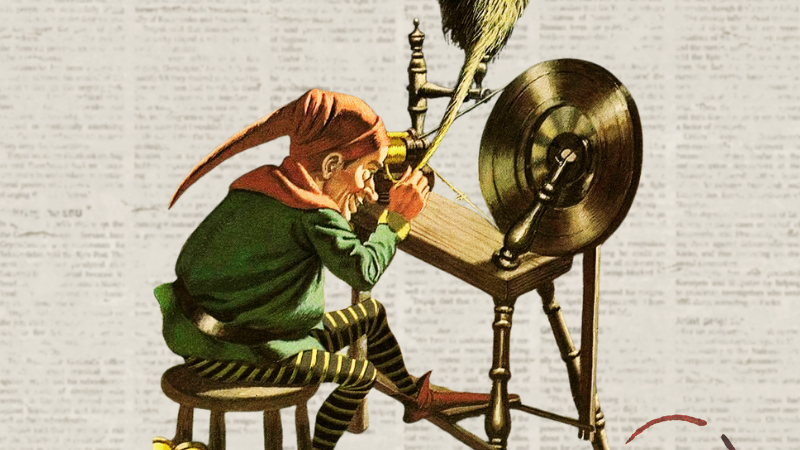
A few years ago, scrolling through social media when I should have been writing, I came across a photo of the Lady Bird edition of Rumpelstiltskin. Struggling to remember the specifics of the story, I googled it. There, in the summary of a childhood book, I found the perfect analogy for my writing life:
A miller brags to a king that his daughter can spin straw into gold. (I pitch a novel.) The King imprisons the miller’s daughter in a room and orders her to prove her magical ability under pain of death. (I attempt to write.) There is no image that captures my experience of drafting a novel better than a woman crying over her inability to spin straw into gold.
The miller’s daughter finds herself in my ideal writing environment: time spent alone without distraction. Her salvation arrives in a strange but recognizable form. Rumpelstiltskin is the villain of the tale. Rereading the story as an adult, I began to question his motives. He haggles a ring and necklace from the miller’s daughter in exchange for his labour, before asking for her unborn child. The jewelry he takes is of little worth to someone who can spin straw into gold, and he doesn’t seem to be in the market for a baby. The only value he attaches to these possessions is that they belong to a young woman who he initially helps and then terrorizes, but why? The woman marries the King and gives birth to her first-born, bringing about the return of the forgotten imp who comes to collect his pay check. Instead of taking the child, Rumpelstiltskin proposes a game: if the Queen can guess his name within three days, she can keep her baby. His desire is human, childlike even: he wants to play.
“There is a muse, but he’s not going to come fluttering down into your writing room and scatter creative fairy-dust all over your typewriter or computer. He lives in the ground. He’s a basement kind of guy,” Stephen King tells us in On Writing: A Memoir of the Craft. Through my own writing practice, I have become acquainted with an amoral imp who only appears when I sit down to write and forces me to evaluate everything I thought I knew. He has what I need: he brings my work to life.
The Brothers Grimm fairytale is a popularisation of a much older myth which spans thousands of years and crops up in cultures across the globe. Ironically, he goes by many names depending on what part of the world he pops up in. His counterparts include Ruidoquedito, meaning “little noise” in South America, and Joadine in Arabic, which roughly translates as, “he who talks too much.”
In all of his different guises, Rumpelstiltskin remains a creature of the unconscious – the ugly, uncomfortable part of ourselves we don’t acknowledge on a day-to-day basis. Given free reign, he would bring about the destruction of a society that thrives off self-preservation. Banished to the shadows, he can seem like a bully with anger management issues. What he craves is connection to a world that overlooks him. It’s only natural that when someone sits in the shadows of their consciousness for long enough, he’ll appear.
I don’t have much to offer Rumpelstiltskin except my undivided attention, so I do what he wants – I play. This is the craft of fiction. I play with words, sentences, paragraphs and dialogue. I give myself permission to do things that I normally wouldn’t in my “real” life. I don’t censor myself. I write down everything that comes to mind without worrying what a reader might make of it, or me. Eventually, through the debris of trial and error, I enter the inner lives of my characters. They appear fuzzy, at first, like pixelated nineties video games, until slowly, I become conscious of thoughts and feelings, day jobs and spouses that don’t belong to me.
Rumpelstiltskin can be dismissed as a fairytale character, or he can stay in the realm of the unnameable as an infinite bundle of energy that serves to connect us to ourselves and others.
Usually, I spend a few glorious minutes, hours, days or weeks at play until something happens that disrupts my writing routine. I fall back into old habits, preferring to think about my work-in-progress from the outside rather than engage with it on a sentence level. It is only then that my inner Rumpelstiltskin begins to heckle me from the back of my brain, furious at me for abandoning him. When I sit back down at the desk, it will take a while to coax him back out of the shadows again.
Writing is a verb, an exercise. I have reached an age where an epidemic of running marathons has broken out amongst my family and friends. People are much more comfortable pushing their physical bodies to their limits, rather than sitting down to stretch their imaginations with pen and paper. “You should stay away from your potential,” Dylan Moran quips in his stand-up show Monster. “It’s like your bank balance, you always have a lot less in it than you think…leave it as a locked door within yourself, and that way, in your mind, the inside of it will always be palatial.” By the same logic, to write anything at all is to go into the locked room of your potential and realise that the roof is leaking, there’s damp in the walls and the furniture is infested with woodworm. If you stay for long enough, a weird little goblin of your own creation will come out to play. He will interrupt your renovation work and wreck all of your carefully made plans, but you have to trust that it’s for the best.
At the end of the fairytale, the Queen vanquishes Rumpelstiltskin by correctly guessing his name. In some versions of the story, he self-destructs and in others, he runs away, never to be seen again. Order is restored to the kingdom through what is known as the Rumpelstiltskin effect, a term used by psychologists to describe the naming of something in order to create an illusion of understanding it. In a world that is fond of labels, it is easy to define chaos in simple terms and pretend to live happily ever after, staying far away from anything that stretches beyond the horizons of our understanding. Rumpelstiltskin can be dismissed as a fairytale character, or he can stay in the realm of the unnameable as an infinite bundle of energy that serves to connect us to ourselves and others. For me, he has become the unlikely midwife of every story I’ll attempt to get down on paper. He can be ignored but he will never go away. I wouldn’t want him to.
__________________________________
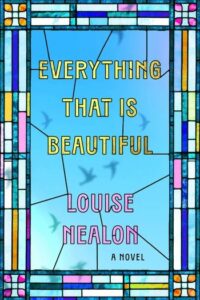
Everything That is Beautiful by Louise Nealon is available from Harper, an imprint of Harper Collins.

Louise Nealon
Louise Nealon is a writer from County Kildare, Ireland. In 2017, she won the Seán Ó Faoláin International Short Story Competition and was the recipient of the Francis Ledwidge Creative Writing Award. She has been published in the Irish Times, Southword, and The Open Ear. Nealon received a degree in English literature from Trinity College Dublin in 2014 and a master’s degree in creative writing from Queen’s University Belfast in 2016. She lives on the dairy farm where she was raised, and SNOWFLAKE is her first novel.