







“The Most Terrific Liar You Ever Saw in Your Life”: Six Books with Unreliable Narrators
Rachel Calnek-Sugin Recommends Susan Choi, Claire Louise Bennett, Olga Tokarczuk, and More
I remember learning about the concept of an unreliable narrator in my ninth grade English class. We were reading Catcher in the Rye, that ultimate coming of age novel that teachers love to use to describe an unreliable narrator, since Holden Caulfield is, famously, “the most terrific liar you ever saw in your life.” Unreliable narrators, we learned, were deceitful or delusional; there was some reason we couldn’t trust their versions of the world. This prompted the same question for me then as it does now: well who is a reliable narrator?
We tend to believe that things are the way the storyteller says they are—but that’s because we’re hearing it from their point of view. And everyone has a point of view. Even the most omniscient, level-headed narrator sees things in their own way. Even nonfiction texts that purport objectivity are often clouded by bias. We know that history is told by the victors. And we’re living in an era where we’re inundated with fake news and AI content. The question of what it means to trust a narrator is essential. Fiction can play with that, can complicate binaries, and can help us think about things like sanity, truth, and what the self is in new ways.
My debut novel, Universe of Grace, dances with the unreliable narrator in an exploration of some of those themes. The novel is written in a very limited third person and Grace is a character with a distinctive voice and an intense subjectivity. But because the perspective is such a close third, a reader can’t be sure whether what’s happening is actually what’s happening in the world of the novel or if it’s just in Grace’s head. Might she really be from another planet? Can her fast food job turn her into a literal robot? Could her plushie cats possibly put on plays and debate philosophy for her and her wife? In a sense, this is a question of genre: the book could be read as magical realism or as realistic fiction where the stranger elements happen inside her head. Either way, the reader is right there alongside Grace asking if it’s her who’s crazy, or if it’s the world. For Grace, magic is possible—even obvious; it’s the regular workings of oppression and exploitation that never seem normal.
What follows is a list of some of my favorite unreliable narrator fiction—by which I mean, novels whose distinctive narration explores themes of trust and subjectivity—in ways that trouble ideas about what’s real, who’s sane, and what gets lost in the telling of the story.
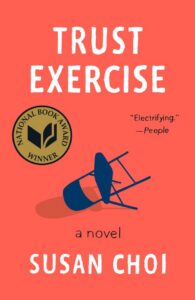
Susan Choi, Trust Exercise
In Susan Choi’s novel, “trust exercise” refers to a set of acting exercises in Mr. Kingsley’s theater class at a competitive performing arts high school in the 1980s. But it also brilliantly describes the experience of reading this book. The first section follows a teenager named Sarah and her infatuation with her classmate, David; at first, Trust Exercise felt like an easy read. Then I got to the second section and everything changed. We skip twelve years and shift perspective to one of Sarah and David’s classmates; this new character re-casts the events from part one, and made me realize that the story I thought I was reading was only a sliver of what was really going on. I felt reoriented, and betrayed, in the best way. And, primarily, indignant with myself. Because I trusted too wholeheartedly in Sarah’s fun, light, gossipy, sexy, simple, self-centered version of the world, and missed the rest—the sinister stuff—even though I, we all, should have been able to see it. I don’t know if I’ve ever so profoundly changed my mind about a book halfway through. It’s really genius.
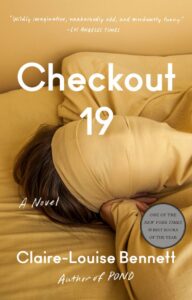
Claire Louise Bennett, Checkout 19
My friend Mia recommended Checkout 19 to me saying she’d never read anything like it. I haven’t either, and it’s such a weird, wandering, voice-driven book that it’s also incredibly hard to describe. Checkout 19 is a novel about reading, or it’s a novel about this unnamed narrator’s coming of age primarily as explored and anchored through her relationships with books and stories—both books that already exist in the world, and also stories written by this narrator, some of which are included in their entirety, and thus become, in a very real way, part of the story of this person’s life. It explores how reading and writing can shape and mediate our lives, relationships, and ways of understanding. It feels like an unreliable narrator novel to me because there is so much slippage between which stories are just stories and which ones are the Real Story. It troubles that distinction in a way that I love. I read Checkout 19 while I was writing Universe of Grace and it was a powerful influence for me in following a voice into the murk of a character’s strange, subjective, internal world. And Claire Louise Bennett’s narrator has such an exciting and delicious voice that I would follow her anywhere.
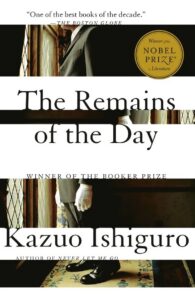
Kazuo Ishiguiro, Remains of the Day
This is one of the most quietly devastating novels I’ve ever read. Remains of the Day features an old-school butler named Stevens in postwar England reflecting on things like dignity and what it takes be a great butler. It’s a slow, meticulous unraveling that rewards a patient reader. Stevens recollects his decades of devoted work for Lord Darlington, who he insists is noble, righteous, above any criticism. As we learn more about Stevens’ former employer, it slowly becomes clear that he was an influential Nazi sympathizer—but our narrator is blinded by continuing to cling to a story that’s falling part, because it made his life feel meaningful and virtuous. Stevens’ commitment to hard work, dignity, and emotional detachment also lead to agonizing relationships with both his father and his potential love interest, Miss Kenton—agonizing for us, I mean; Stevens himself insists on living in an infuriatingly rational register, rather than an emotional one. It’s this self-denial, and attempt at self-discipline, that makes him such a compelling unreliable narrator. One of my mentors, Dan, once told me that a tragedy is a story where the main character realizes too late what could have made their life meaningful. Remains of the Day is a real tragedy by that measure. The last few pages absolutely wrenched me. And they were also a call to be real with myself.

Olga Tokarczuk, Drive Your Plow Over the Bones of the Dead
In a remote, snowy village near the Polish-Czech border, Janina does astrology, translates Blake poetry, and investigates the mysterious deaths of the area’s animals, and of its game hunters. Janina is an atheist, a vegetarian, and a real recluse—she’s a wonderfully eccentric, and also hilarious, narrator. Though she’s an avid astrologer, she tells us: “I’m not a good Astrologer, unfortunately. There’s a flaw in my character that obscures the image of the distribution of the planets. I look at them through my fear, and despite the semblance of cheerfulness that people naively and ingenuously ascribe to me, I see everything as if in a dark mirror, as if through smoked glass.” She’s talking about astrology, but she’s also, in a sense, warning us about her narration—telling us, Don’t trust me, I’m telling all this through a dark mirror. Drive Your Plow Over the Bones of the Dead has some serious plot, and Janina’s unreliability figures prominently in its major twist. This book is a beautiful meditation on sanity, solitude, and which kinds of life we value.
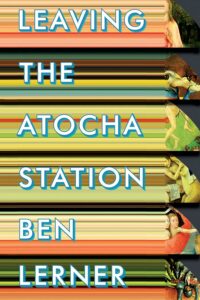
Ben Lerner, Leaving the Atocha Station
I think about this slim little book all the time. It’s about this American 20-something year old named Adam on a creative writing fellowship in Madrid. Mostly the book is about Adam’s anxiety, which primarily concerns his realness; Adam feels like a fraud as a poet and a person. He’s pretty insufferable, and like Holden Caulfield, is a terrific liar, which makes a reader wonder whether we can trust him. Like many of the other books on this list, we find ourselves deeply inside this protagonist’s internal world in a way that sows doubt and distance about what’s happening outside. For Adam, the most potent question is about how he can be real. This comes up in his relationships, in his poetry, even in his witnessing of a bombing. As readers, we inevitably find ourselves asking the same questions. Adam begins the novel with a visit to the museum where he hopes for a “profound experience of art” that he’s never really able to access. Maybe it’s antithetical to the book that reading Leaving the Atocha Station felt like a profound experience of art for me. I was truly moved by this book because as insufferable as Adam is, there is also some small, inexplicable redemption. As fraudulent as he may be, there is also a gorgeous, untarnishable realness that makes the book thrum unexpectedly with hope.
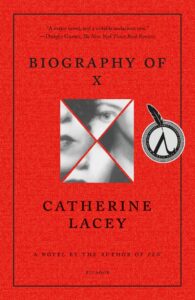
Catherine Lacey, Biography of X
This is a novel that’s a biography (an awesome conceit already) of someone named X, a charismatic, larger-than-life, multidisciplinary artist, in an alternate-history U.S. The biography is written by X’s widow, CM, and it’s CM’s attempt to make sense of X’s life, of their relationship, and to move through her own grief. A grieving widow uncovering all sorts of shocking, wonderful, painful mysteries about her wife’s life is a pretty perfect set-up for an unreliable narrator, and the play of what we can trust and what’s too colored by intense love and hurt is especially potent considering that this biography is CM’s attempt to “set the record straight”—to finally offer a true account of X’s life. But truth is flimsy, fluid, and ultimately expansive in this novel; X is a character who defies the confines of a singular, factual self. “Who can say who I are, how many I are, which I is the most I of my I’s?” X asks. My favorite aspect of CM being an unreliable narrator, though, was actually not in the gaps in how she sees X but in the gaps in how she sees herself. A biography is about its subject, but it’s also, inherently, about its narrator—particularly when its narrator has such an intimate investment. In CM’s focus on and devotion to X—both posthumously and during their relationship—she loses track of herself. But I finished this novel moved most of all by CM’s own power and grace.
__________________________________
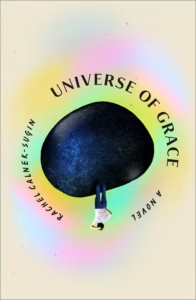
Universe of Grace by Rachel Calnek-Sugin is available from Henry Holt and Co.

Rachel Calnek-Sugin
Born and raised in New York City, Rachel Calnek-Sugin is a writer, social worker, and educator committed to our individual and collective liberation through art-making, community building, and personal transformation. She loves trees, dancing down the streets of Brooklyn, and cooking extravagant meals for her loved ones. She works as a therapist in New York City’s public schools and writes fiction, nonfiction, plays, and the occasional subway-poem. Universe of Grace is her first novel.