






They Tried To Plan an Ideal City.
They Made Something Much Worse
Paul Goldberger Considers the Many Flawed Ways Humans Have Sought to Remedy Urban Malaise
The idea of the ideal city as a perfectly shaped structure seems, somehow, never to lose its allure. A key theme of modern architecture all through the twentieth century was a sequence of attempts to impose pure form on the supposedly disorderly city; even before Le Corbusier and Hilberseimer tried to rationalize the city in the form of their slabs in open space, there was Tony Garnier, the French architect whose 1904 project, the Cité Industrielle, envisioned a city with entirely separate and distinct quadrants for living and working, all planned with utter rigidity. The housing was to consist of identical town houses, stretched out in long, even rows. There was an administrative section but no jails or courthouses: Garnier’s faith in the ability of his design to create a community of peaceful, law-abiding, like-minded citizens was so total that he convinced himself that such things were not going to be necessary in the utopian place he had conceived.
In Italy at the beginning of the twentieth century, the architect Antonio Sant’Elia had a similar faith in the future, although in Sant’Elia’s case it was expressed in Città Nuova, a design for an ideal city inspired by the might and power of the machine, “a radical break with all known models of town planning,” as Esther da Costa Meyer wrote. Sant’Elia envisioned rows of massive buildings, their form inspired as much by science fiction as by modern ships, bridges, and skyscrapers, “an entirely new entity arising ex novo from the ground, without having to compromise with any remains of the past.”
What all these designs share is a desire to substitute geometric purity for urban complexity—or, in simpler terms, to make the mess go away. It is easy enough to understand the appeal of this in the nineteenth century, when the city was increasingly bearing the brunt of the transformation wrought by the Industrial Revolution. For many of its occupants—in some cities one could even say for most of its occupants—the nineteenth-century city was harsh, dirty, dangerous, and woefully unsanitary. Whole families lived in a room or two, and even with the advent of inside plumbing in the mid-nineteenth century, multiple apartments often shared a single toilet. Many tenement apartments overlooked air shafts, and even on the brightest day saw not a ray of sunlight.
The impulse to purge the chaos, to clean the place up, to make it more livable, was natural. In New York it led to the creation of Central Park and numerous other parks, as well as various attempts to set minimum standards for tenement housing, many of which were followed elsewhere. And in England, the environment of the nineteenth-century city led directly to the garden city movement, which encouraged the creation of new, quasi-urban alternatives to the traditional city in which buildings would be carefully balanced with generous amounts of public green space.
Every vision of the ideal city emerges out of the certainty of someone…that some new kind of physical form will be the answer to our social ills.
The theorists of the garden city, most notably Ebenezer Howard, understood that the city was an economic engine and saw how much power it generated, but they also saw it as a kind of malevolent force, denying any kind of civilizing life to all but its richest inhabitants. Like so many critics of the city both before and after them, they were bothered most by the chaos and disorder of the conventional city, which was only made worse, they felt, by the absence of any sense of nature. Howard believed that there could be a place that possessed the economic energy of the city but softened by the presence of nature: What would make it work, he felt, was to reduce the crippling density of the city and spread people out in a careful, ordered manner. He set out his ideas in Garden Cities of Tomorrow, published in 1902, which proved to be vastly influential, in part because Howard had the ability to recognize that design alone would not bring about the utopia he envisioned, and he wanted to combine his radial layout with landowning cooperatives to make property ownership more accessible to members of the working class.
To his credit, he saw not only that a mix of social and economic classes was vital but also that a single design template was not the answer, and while he envisioned each garden city as having a central area with public buildings and a park and residential neighborhoods connected to it by roads like the spokes of a wheel, he anticipated that each version would vary, at least somewhat. Indeed, at Letchworth, the first garden city, built in 1904 on a nearly four-thousand-acre plot thirty-four miles north of London, the configuration of the terrain led to an abandonment of Howard’s layout in favor of a less literally geometric plan. It also turned out that there was not enough capital to underwrite the cooperative landownership that Howard had hoped for, and that none of the housing would be affordable for lower-paid workers. Letchworth, like many of the other garden cities that followed it, would turn out to be more of an improved, slightly more urbane version of a suburb than a reinvention of the city.
We might almost say the same of New Delhi, conceived early in the twentieth century as a new capital that would express the power of the British Empire in India. There are lots of trees and wide avenues and traffic rotaries in the urban design by the architect Edwin Lutyens, but it can only be navigated by car, and the only thing that makes your heart skip a beat is the magnificent architecture of Lutyens’s buildings, not the city itself. At its best, New Delhi can be called stately, but that is being generous. To feel that you are in a real city, you need to go to the old section of Delhi, where chaos is not a liability but the very stock-in-trade. New Delhi is the prim drawing room; old Delhi is the bustling back of house, the flip side of all that gentility. New Delhi was intended to be majestic, but it is, at bottom, more than a little expressionless; in the utter mess of old Delhi, all its crazy parts coming together in spite of themselves, the totality is something that, in its own way, can truly be called resplendent.
I’m intrigued, though, by the allure of the garden city in India for both the British and, after independence in 1947, for the Indians themselves. It’s certainly possible to describe Chandigarh, Le Corbusier’s city in northern India, as an earnest attempt to combine the garden city model with modern architecture. Some of its residential districts, where modern, low-rise housing is arrayed around small parks, are better than their equivalents in Brasília, and Chandigarh has been more amenable to expansion than Brasília.
To give Ebenezer Howard his due, at least he was not entirely in thrall to a fixed and unyielding design, as so many advocates of the ideal city have been throughout history and even more, it would seem, in the late twentieth century, when numerous architects were seduced by the concept of the megastructure, a vast construction on a scale somewhere between a conventional building and a city. The megastructure was its own kind of ideal city, where, as at Arcosanti, all notions of heterogeneity were thrown to the winds, along with conventional streets, in favor of the idea of a single, enormous object within which various functions—living, working, shopping, exercising, learning, being entertained—would be amalgamated. To take one example, Paul Rudolph designed several megastructures for New York City, most notably his project for the Lower Manhattan Expressway, which would have covered the highway with several layers of residential and commercial buildings, effectively creating a linear city that would have appeared to float above the existing city, dominating it and yet at the same time coexisting with it.
Coexistence with the existing city was perhaps the most compelling aspect of Rudolph’s expressway scheme, which otherwise exuded the same air of arrogant, inflexible futurism as Arcosanti, which was conceived as a fully autonomous city of its own. That said, it was visually stunning and had the same magnificent interweaving of complex space and structure that characterized Rudolph’s seductive if often impractical architecture. Rudolph’s visionary projects followed those of Yona Friedman, a Hungarian-born French architectural theorist who also had a fondness for megastructures that might be built over existing cities, although Friedman’s projects in many instances were to be fitted out by residents themselves, which had the virtue of allowing for the very diversity of design and use that most megastructures seemed designed to prevent.
Friedman spoke often of an urbanism that was flexible and responsive to the needs of different times and different people, and despite how sweeping his visionary projects were, he thought of them as offering an alternative to the rigid geometries of earlier modernist visions of the city. But is any sweeping and total scheme for a city as freewheeling as that? Friedman’s ambitious schemes designed to hover over existing cities were never built, and we have no way of knowing whether his civilizing rhetoric would have been accurate or been proven hollow.
Regardless, every vision of the ideal city emerges out of the certainty of someone—architect, theorist, planner, sovereign, or rich patron—that some new kind of physical form will be the answer to our social ills, and perhaps our political and economic ones as well. That is surely what Walt Disney believed when he envisioned adding what he called the Experimental Prototype Community of Tomorrow to the theme park and resort that he was already developing in central Florida, Walt Disney World. Disney’s death in 1966 put an end to this ambition, which in some ways was even more of a fantasy than those Disney was purveying in his Magic Kingdom, since it never got beyond a very conceptual stage. The executives who succeeded Disney quickly abandoned his notion of trying to design an ideal city and built a more conventional theme park beside the Magic Kingdom instead, naming it EPCOT in honor of the thing that it did not at all resemble.
The idea that a new kind of urban form will fix the world is as alive today as it has ever been, and it continues to play out in the form of envisioning new cities, which have a way of being far more attractive to people with great resources than the challenge of improving existing cities. This is very much the case in the United States, where the tech billionaire Marc Lore has proposed Telosa, a city that he wants to build somewhere in the Southwest—there is no actual site yet—and for which he has commissioned a design from the fashionable architect Bjarke Ingels, who recently co-designed the headquarters of Google. Telosa, Lore says, “is not just building a new city—this is a new model for society” that will be governed by what he calls “equitism,” which is presumably a more forgiving form of capitalism. Ingels’s renderings amalgamate every possible architectural and social cliché of the moment, with swooping, curving towers topped by trees, elevated transit systems, apartment buildings drenched in greenery, solar panels, and plenty of landscaped open spaces. It looks like an updated version of Disneyland’s Tomorrowland, a kind of theme park of imaginary architecture that is utterly devoid of tension.
Only slightly more realistic is the as-yet-unnamed city that a group of tech billionaires from Silicon Valley hope to build in Solano County, north of San Francisco, where they have acquired more than fifty thousand acres of agricultural land. The group, which calls itself California Forever, has presented the scheme as a way of addressing the exorbitant housing costs in California, and it is promised as a place that will be open to a diverse population and will include both affordable housing and a reasonable dose of the conventional, walkable urbanism that marks so many successful cities elsewhere.
It is too soon to say more about California Forever’s city as urban design, since at this point it has not gone much beyond the acquisition of land by a dummy shell corporation created to mask the identities of California Forever’s backers and the sponsors’ announced intention to convert this farmland into their notion of an ideal city. The real question the project raises is why a group of billionaires who claim to care about the future of their state would choose to invest in an entirely new project instead of using their resources to improve the cities California already has and, indeed, would choose to build their new city at some distance from the existing metropolitan region known as the Bay Area. The state is in the midst of a homeless crisis and a housing affordability crisis—issues that, certainly in San Francisco and Silicon Valley, are to a large degree of the tech industry’s making.
The real issue with…so many totally planned cities, is that they emerge out of an obsession with a total, singular vision.
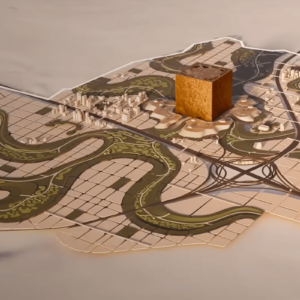
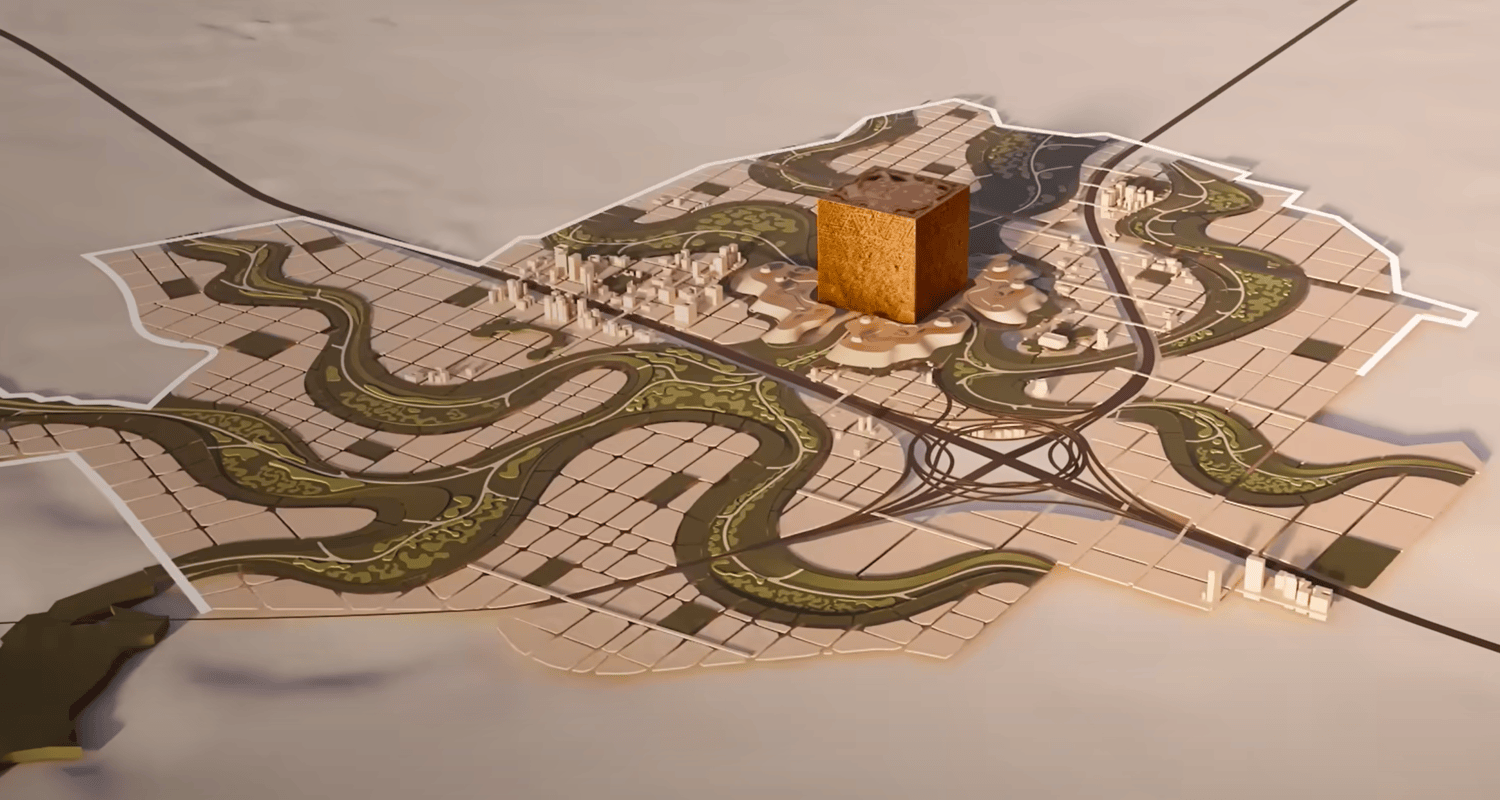
And then there are Saudi Arabia’s attempts to substitute geometric purity for urban complexity: two vast projects for new cities that, despite promises of sustainability and people-centered livability, seem to be driven mainly by a love of gigantism and abstraction. One is a so-called new downtown at the edge of Riyadh, called New Murabba, that a promotional video describes as the place “where wonder meets creation, and our present thinkers create our future dreamers, connecting us all to new moments of joy and delight.”
Despite the talk of lively urban streets, the centerpiece of New Murabba is a cube-shaped structure roughly twelve hundred feet high, called the Mukaab, which is described as an “unparallelled immersive experience” and an “architectural wonder” that according to its sponsors will have twenty times the space of the Empire State Building. Curiously, the Mukaab’s shape resembles that of Islam’s holiest shrine, the Kaaba in Mecca, a stone cube, blown up to gargantuan scale and transformed into the ultimate secular destination. It will contain “premium hospitality, retail, cultural, and tourist attractions, residential and hotel units, commercial spaces, and recreational facilities,” according to the promotional materials for New Murabba. “At the Gateway to the Mukaab, a distinct directional experience transitions visitors from the bustling urban street to a serene pedestrian path.”
For all its audacity, New Murabba pales beside what is perhaps the most bizarre, not to say outrageous, vision of all: the Line, a mirrored, linear structure that, if it is ever built in full, would be 170 kilometers long (roughly 105 miles), 500 meters high, and 200 meters wide—essentially a reflective glass wall across the desert. It is the centerpiece of Neom, an urban development conceived by Mohammed bin Salman, the crown prince of Saudi Arabia, and it makes New Murabba, not to mention Arcosanti, look like a quaint village. Construction has already begun, with sections to be designed by such international celebrity architects as Thom Mayne, the office of the late Zaha Hadid, Rem Koolhaas, and Ben van Berkel, although it is not entirely clear what role there would be for the ideas of these architects, given the predetermined nature of the plan, which calls for parallel mirrored glass structures with open space in between.
The Line is the megastructure to end all megastructures, effectively a single building that pretends to be a city and would stretch across an entire region. Here, urban design has not just put too much faith in the general notion of rigid geometry. With the Line, it has decreed a shape that has absolutely no relationship to the way in which any city in history has ever developed—and neither have its designers even tried to put forth any argument as to why this abstract form, in which pedestrians, mechanized transportation, and support infrastructure would be on different levels, would actually function as a city, beyond claims that it would operate with renewable energy and would produce mounds of data using artificial intelligence.
The images of the Line that have been released seem influenced by video games as much as by any element of real cities, and there is more than a hint of the feeling of the film Blade Runner and other dystopian images of the future. The Line would be a car-free environment in which trains would take residents back and forth along the single axis that would take the place of streets, and its proponents advertise it as a paradise of technological know-how, reduced energy consumption, and adjacency to nature.
Perhaps it will have some of these virtues, but the real issue with the Line, and with New Murabba and so many totally planned cities, is that they emerge out of an obsession with a total, singular vision. They leave no room for anything to evolve beyond the original design, and no opportunity at all for residents to have some say in the nature of the place in which they will be living. Everything is fixed, everything is consistent, and everything is part of a larger whole, even more rigidly so than it was in Lúcio Costa’s design for Brasília. The exterior of the Line is a gargantuan abstraction, within which is hidden what urban life there will be; in this sense the Line is less an advance in urban development than a retreat into the ancient notion of a city whose activities are hidden behind protective walls. In this case the urban life, such as it is, is inside the wall rather than behind it, but that makes it only stranger, and more set apart from the world than an ancient walled city—only an interior life, not an exterior one, and in such a place what does the public realm consist of ? The mirrored exterior wall is, in its way, even less inviting than the ancient city’s stone walls, and it surely has less connection to the realities, both natural and man-made, of the land in which it sits. It is allegedly for people, but it offers little or no opportunity to be shaped by people.
Not surprisingly, the Line has not progressed according to plan. Toward the end of 2025, the Financial Times reported that after an expenditure of some $50 billion, barely anything has been completed, many design issues remained unresolved, and the entire enterprise, if it were ever to be finished, was now estimated to cost roughly $4.5 trillion, an impossible expenditure even for Saudi Arabia. It has been scaled back. “Everyone knows the project won’t work,” a former employee was quoted as saying, and the Financial Times declared the Line “in danger of joining the ranks of the world’s grandest follies.” In the end, the Line is not a city but a conceit, and a conceit is not a place.
______________________________
From The Imperfect City: Design, Serendipity, and the Real Life of Cities by Paul Goldberger. Copyright © 2026 by Paul Goldberger. Published by arrangement with Alfred A Knopf, an imprint of The Knopf Doubleday Group, a division of Penguin Random House LLC..

Paul Goldberger
Paul Goldberger, a contributing editor at Vanity Fair, began his career at The New York Times, where he was awarded the Pulitzer Prize for distinguished criticism for his writing on architecture. Later, and for fifteen years, he was architecture critic for The New Yorker. He is the author of many books, including Building Art: The Life and Work of Frank Gehry, Why Architecture Matters, and most recently, Ballpark: Baseball in the American City. He teaches at the New School and lectures widely around the country on architecture, design, historic preservation, and cities. He lives in New York City.