On Authenticity, Acquisition, and the Secret Lives of Objects
Nicole Cherubini and Natalie Lemle Discuss the Stories That Ancient Artifacts Can Carry
As a sculptor, I love an archive, especially when it is filled with objects that refuse to be silenced. Each piece carries the sediment of its own story. They have witnessed creation, love, use, violence, change, transition, oblivion, aggression, and adoration. Their histories are nearly made invisible through age, and yet they remain glaringly present when we take the time to look. Each object was made by someone, with a precise intention—to embody a necessary purpose, once held in relation to a community.
Now, that function feels distant, almost inaccessible. In our culture of acquisition, the act of making and the meaning it once held are worn down, replaced by possession. Purpose dissolves into who owns it, who displays it, who claims authority over it. The object no longer belongs to its origin or to its own agency, but to the structures that contain it. Making and meaning are stripped away to satisfy ownership; collectors, institutions, and entire nations now justify the value and importance of these objects
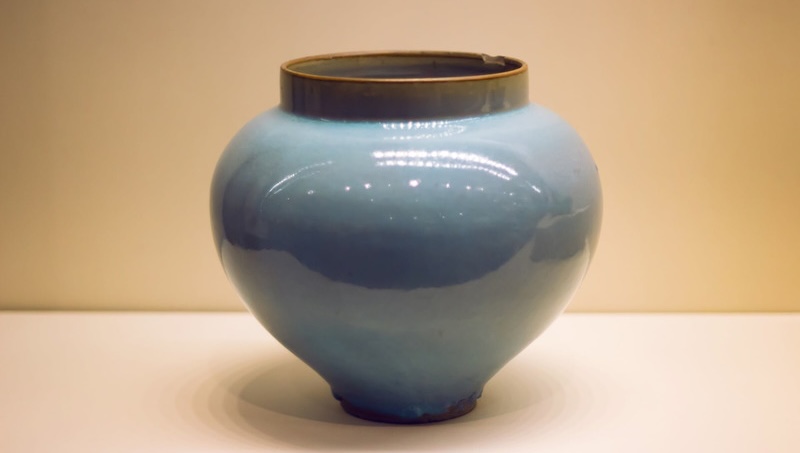
And still, I always return to the archive—more precisely, to one simple elegant form, a pot. I admit, with a kind of awkward awareness, that few things give me more persistent, unreasonable pleasure than thinking about pots. This book, Artifacts, is about a unique and beautiful pot. From this small vulnerability, I begin a conversation with Natalie about her beautiful and provocative book, which follows, among other things, the lifetime of an object.
Lets start towards the end of the book when one of the main characters states, “archaeological authority is a fallacy.” How do you think about historical subjectivity and why is it so needed and present in this story?
*
Natalie Lemle: We all know the saying, history is told by the victors—I knew from the beginning that I wanted to talk about the ways in which the historical record is unstable and biased. But of course as you point out, this is a book about physical things, about artifacts, and the book in many ways is an exploration of how that saying shows up in contemporary archeology.
We’re crafting stories using evidence, and the evidence is subjective, and new information is being discovered all the time. To pretend that any of it is fully resolved is false.
I came to classics and archeology via high school Latin, and language is such an interesting way in, because translation is so subjective. When I translated The Golden Ass by Apuleius as an undergrad—which figures into the plot of Artifacts—I used Robert Graves’s English translation as a point of reference. Since then, Sarah Ruden’s excellent (and much bawdier) new translation has come out. Same Latin, two pretty different books in English.
All of this work is being done by humans. We have our biases, and we want to tell stories. It only makes sense that archeologists would try to fit a site or a find to a predetermined narrative. The same for museums, where new technology can reopen conversations about objects that were once closed. And politics still very much come into play, especially as countries move further to the right. There are both national and individual narratives for an ancient object or work of art.
So: authority, why is it a fallacy in an archeological context? Authority implies conclusion. But we can never fully know. We’re crafting stories using evidence, and the evidence is subjective, and new information is being discovered all the time. To pretend that any of it is fully resolved is false.
I think this is ultimately something fiction does naturally, because it’s inherently so subjective in its reception. Which makes it the ideal medium for a lot of the more academic ideas I’m personally obsessed with.
Nicole Cherubini: I love these notions of fiction and translation. I think this can also be understood through the materiality of an artifact. At the end of the book, you say something so beautiful about the pot, the shard, and the wax in relation to conservation and repair. I think a lot about the life of an object and how it moves through space and time. Clay and glass are archival; once fired, they are with us forever—or what we understand as forever. Yet both can break, rendering them oddly both permanent and fragile. As a maker, these opposing qualities are persistent and present throughout every part of the process.
I often wonder what it would be like if we did not conserve broken artifacts. What if we allowed these works to remain as fragments—sections, parts, shards—and, in this state, attempted to understand them as a new kind of beauty? In this form, we could see the insides, the thickness of the walls, and more of the maker’s hand and decisions. So much that was hidden now completes the whole. Possibly, if we think about these shards differently, we might also rewire the state of our humanity a bit.
NL: This is beautiful, and I totally agree with you. I’m a little bit obsessed with authenticity, and there’s this part of me that yearns to see things (and people!) in their natural, untampered-with state. But I totally understand the human impulse to want to see things in an idealized state, or maybe as they once were. For example, I love all the education around how ancient sculptures were painted. But what’s so great about that initiative is that they’re reproductions of actual sculptures, so you can get an idea of what these ancient things might have originally looked like without actually working on the ancient object itself. Also, beauty is in the eye of the beholder. I remember first seeing those painted sculptures and thinking how garish they were, how much I preferred the minimal marble I was used to seeing. But even that “clean” look is a fallacy (speaking of fallacies!); the marble sculptures were power-washed in the 19th century by well-meaning conservators to look more white, for example.
NC: There are so many references to Venus and her various superpowers throughout the novel: as a goddess of political harmony, love, sexual power, agricultural fertility, seafaring, and military history. And even your connecting Venerdi, Friday, back to her. She is clearly an incredibly important character for insight into the subplot. Can you speak a bit about this, her, and why? I have my guesses, and thoughts, but would love to hear yours first.
NL: When I was first drafting Artifacts, I was set on two things: 1) that I wanted to invent an Augustan-era villa along the Little St Bernard Pass, because I had taken an archeology seminar in undergrad on this region and developed an obsession with it, and 2) that I wanted to somehow integrate the myth of Cupid and Psyche into the villa. Originally I thought the myth would be depicted in mosaics in the style of the late Roman mosaics at the Piazza Armerina in Sicily, because I knew I wanted to explore the villa’s life in late antiquity, but as I developed the story of this fictional villa, I knew I needed a portable object.
I didn’t actually intend to write so much about Venus in the book, but she is an important figure both in the Age of Augustus (the Julio-Claudians are said to have descended from her via Aeneas) and in the myth of Cupid and Psyche (she is Cupid’s mother). And it felt like the story just kept looping back to her. Ultimately, for as much this is a book about archeology, the emotional anchor is really Lena’s unresolved issues with her mother. Venus is the ultimate mother figure, and different incarnations of her in various cultures rule fertility, so it felt even more resonant to have her play an important role.
NC: I’m thinking about the way Venus weaves in and out the story, as almost an antagonist or foil to all of the sinister and malicious greed circling around. She, I guess much like the idea of the broken pot, offers another way of existing and being. Her presence made me think a great deal about bell hooks and Baldwin’s discussions of love and the generative strength, it possesses transformative powers. And then, of course. The layering in of Cupid and Psyche, with Venus as mother, mirrored Lena and her mother.
NL: Yes—it wasn’t something I was conscious of while writing, but one of the things that surfaces by the end of the novel is the idea that love is never perfect, but we do it anyway. Lena goes from having these walls up around her to understanding that it’s okay to rely on other people, that relationships can have all these dimensions to them, not all of them positive, but that doesn’t diminish their value.
NC: We are both Italian-American, and from urban areas. I am older than you, but I am sure we have had some of the same experiences, or maybe better, an understanding of self through this label and this cultural heritage. There were a few moments in the book where this dichotomy felt very present, especially when you write something like, “I came to understand that ancient objects belong only to the past, which will always reclaim you.”
Do you feel like this story in any way relates to this experience? The motherland, the place that is such a part of us, and yet so not? But somehow held in reverence much like these objects? And maybe hold a parallel history of travel and displacement in some odd way?
NL: Oh, definitely. I’m Sicilian on my father’s side and German on my mother’s side, but I’m also completely American. I didn’t go to Italy for the first time until I was 18 years old. And yet I identified with both cultures, especially the Italian side—I wanted to learn the language, and I was lucky that my public high school in the suburbs of Chicago offered it. I didn’t grow up speaking two languages, but Italian seemed to come so naturally to me—and I remember thinking this was because I’m Italian it was always inside of me.
Then when I spent a year in Italy during undergrad at the University of Bologna, I felt so American! Amanda Knox had been arrested the year before, and that was often the first thing that came up in conversation. But I’d been stereotyping Italians, too, in a way—I assumed I’d be welcomed with open arms by any Italian person I met because of my heritage.
NC: And I would feel remiss if I did not bring up the looting of the Isabella Stewart Gardener Museum here—both of us with Boston ties, both having this unique Museum as part of our alternative understanding of display and aesthetics. How, if at all, does this connect into your writing of Artifacts? And, maybe just, how did this shape your thoughts or interests?
To me an object is authentic when you can still feel the maker and the use in it, whether it’s a thousand years old or made yesterday.
NL: When I first learned about the heist, I understood it as this unsolvable mystery. Now we know pretty much conclusively that it was organized crime. With heists in general, I’m less interested in the how and much more interested in the why—and in what happens to these things once they’re underground and can’t be sold.
That’s a lot of what Artifacts is about. A looted object doesn’t just disappear—it has a second life! Very often these things are being used as collateral in deals that have nothing to do with art. And in that way they can keep accumulating history in this underground setting.
And the Gardner itself is a particular kind of museum. Isabella Stewart Gardner set it up so her taste was the organizing principle, and her will required that nothing could be moved. So the empty frames are still on the walls, and that’s another way of storytelling—it’s also probably part of why that particular heist remains so vivid in public consciousness.
NC: The “how” stories are always pretty magnificent though? As an artist, a museum is my church. With all the good and bad involved, it is a place of safety. It is quite a violation when a piece of work gets stolen. Not unlike the journey of the Cupid and Psyche cup! And then there are the questions about where these pieces are and why? I always wonder why someone would want these beautiful works just for themselves, not to share? What does this explain about consumption when it is not conspicuous?
NL: Honestly, that’s a beautiful way to look at it—we have examples of people who are taking things for themselves (as explored, for example, in The Art Thief by Michael Finkel), but the thing I’m more interested in is the underground world of looted antiquities and the idea that these objects have value even though they can’t be sold on the open market.
NC: And finally, you gave a small mention to Fonthill in the book! Henry Mercer has been a great influence to me, and he was also friends with ISG. (His tiles are all over the floors of the Gardener). I would love to know why you chose to include this obscure bit of US art/craft history?
NL: I would actually bring this back to my obsession with authenticity! I visited Fonthill, not as a kid, but as an undergrad as part of a summer internship at the Met Cloisters. I was captivated by the fact that Mercer had trained as an archeologist and wanted to show the way he had both integrated medieval objects and ideas into the house, and how every part of it had been made by hand.
I guess to me an object is authentic when you can still feel the maker and the use in it, whether it’s a thousand years old or made yesterday. That’s closer to how I think about the Cupid and Psyche cup in the book—it’s been broken, repaired, and moved across centuries, an inherently human object.
NC: Yes, I totally get that. I’m always thinking about how we can reimagine and/or reform society—or, perhaps even more importantly, how we arrived at this place, at this particular moment. To me, these archived objects of beauty and humanity seem like a rich theoretical space to explore. They hold an immense amount, all of what was said above and so so much more– as does your book!It was such a pleasure to read, and even more so to have had the privilege of discussing it with you. Thank you, Natalie.
____________________________
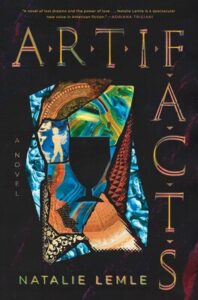
Artifacts by Natalie Lemle is available from Simon & Schuster.
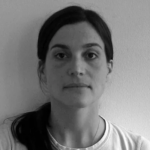
Nicole Cherubini
Nicole Cherubini is an American visual artist and sculptor working primarily in ceramics. She lives and works in New York.