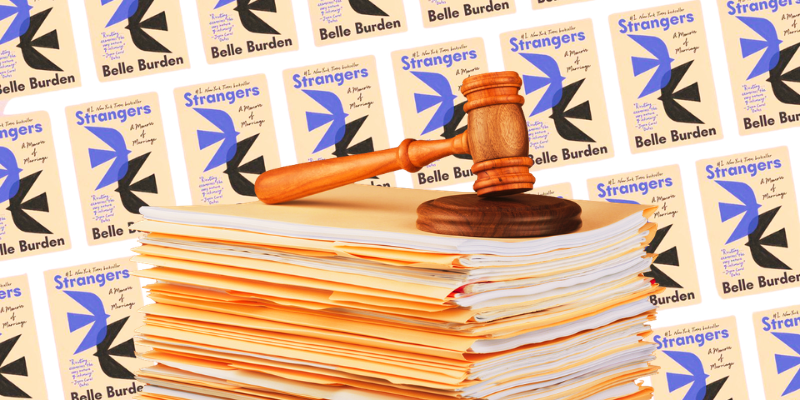
Why the internet is re-litigating Belle Burden’s divorce.
Belle Burden’s memoir Strangers might be the most talked about book of the year. Since its January publication, book clubs have been buzzing with takes on this tell-all memoir, which follows the author’s very public, very gutting divorce from the man she thought she was happily married to. In reviews, the book has been framed like a Wharton tragedy: this is the tale of an innocent woman who lets her guard down and loses it all…
Heralded as a cautionary tale for women who cede financial independence in marriage—or dare to sign a constricting prenup—Strangers has clearly struck a nerve in our tradwife-pilled collective subconscious. So much so that the memoir was recently the subject of a Hollywood bidding war, which Gwyneth Paltrow won.
All well and good—even if the log-line here may remind some of you of this goofy scene from the Sex and the City movie. But this week, the plot thickened. In a probing piece for The New Yorker, journalist Jessica Winter took a hard look at Burden’s financial profile—and incidentally turned up some holes in the narrative that has defined her divorce as tragic for chiefly financial reasons.
“The media response to Burden’s book has portrayed it as offering hard-won lessons in personal finance for all women in heterosexual partnerships,” Winter wrote, citing sympathetic coverage in Real Simple, The Wall Street Journal, and The New York Times. But what actually does losing it all mean to a descendant of scions?
Burden is, in fact, the recipient of profound generational wealth—the socialite Babe Paley was her grandmother, and she’s got empire builders on both sides via the Vanderbilts and the Tilfords.
She doesn’t exactly make a secret of this in her memoir, which was admired for its candor about privilege. But much of the drama and pathos in Strangers hinges on the claim that Burden walks away from her marriage with nothing, having used her own trust income to purchase property that her husband was later able to claim during divorce proceedings.
After procuring court documents “pertaining to Burden’s marriage and divorce…including her prenuptial agreement and her divorce settlement,” Winter found evidence that “undercut the sense that Burden’s long-term financial situation was precarious.” Namely, the fact that Burden is the beneficiary of five family trusts that leave her with millions of dollars on paper.
In one light, this is a real gotcha moment. Especially considering the fact that the “Modern Love” column Strangers was based on “scarcely mentioned money at all,” according to Winter, though the narrative around the book has placed financial independence at the story’s center.
But what’s the internet saying about all this? Honestly, the range of wild takes here has put me in fond mind of the good, old Twitter. My favorite takes tip toward conspiracy. There are those on Bluesky, Threads, and X calling Winter’s story a “hit piece,” commissioned by her ex-husband. Which seems unlikely, to this reader.
In column A, for the reasonable, we’ve got literati like Lisa Lucas expressing shock at the revelations.

In column B, the sanguine chide. To paraphrase critics Hanna Phifer or Christian Lorentzen, why should we surprised—let alone, interested—when rich white people lament estate tax losses?
And in column C, we’ve got the equal opportunity skeptics. Does the fact that Burden is still pretty wealthy really taint this tale of heartbreak?
Late to this discourse but this piece doesn’t change my perception of Strangers at all. She doesn’t pretend not to be very rich and privileged. The emotional impact of the divorce stuff isn’t bc she’ll literally be destitute, it’s bc the guy behaves like a psycho https://t.co/OYjr8mBNeU
— Rosie Gray (@RosieGray) May 25, 2026
Lorentzen and Phifer’s takes mirror mine, generally. But I actually think this discussion has churned up some interesting questions. As Winter notes in her piece, the takeaway isn’t that we’re due an exact accounting of anyone’s finances, especially in a memoir. But why must a woman’s vulnerability, in this case, be framed as financial when it’s not?
Are these the only recognizable stakes, for a certain kind of betrayal? Or isn’t the personal injury enough?
Finally, here’s our own Maris Kreizman, wrapping up the week’s discourse with a neat, sane bow.
TLDR Belle Burden is very rich and has always been very rich despite her ex-husband being a horrible wanker. www.newyorker.com/books/page-t…
— Maris Kreizman (@maris.bsky.social) May 23, 2026 at 8:17 AM

Brittany Allen
Brittany K. Allen is a writer and actor living in Brooklyn.