On the Poetics of Canine Narration
Erik Gleibermann Considers Etna, The Call of the Wild, and More
They tread a landscape existentially threatened by human wreckage yet are drawn to their fellow species, intriguing and strangely self-destructive. They decipher human scents, collaborate with people to survive, protectively sleep at their bedside and sometimes attack. But above all, as the keenly self-aware canines narrate their journeys through a torn world, they stand apart as reflective witnesses of human pathos.
In Paul Yoon’s new novel, Etna, a mixed breed shepherd speaks with a spare, impressionistic calm tinged by nostalgia as he recalls being seized from his idyllic farm life to serve in a global war where he’s conditioned to be a stoic killer. Yet Etna gazes sensitively upon the vulnerable American soldiers who command him. “Maybe every human had their own song they carried with them,” he muses, “like it was another heart, the way the men in my unit sang by themselves, wearing their headphones at night.”
In John Berger’s King: A Street Story (1999) King physically defends a vulnerable, elderly homeless couple stranded in a street encampment but he sustains them even more by patiently listening as they recall their former lives of security. And in George Saunders’ tragicomic short story, “Fox 8” (2013) the enumerated storyteller (qualified to narrate by shared canine ancestry) becomes infatuated with a human family eavesdropping at their doorstep but is achingly disillusioned when hard hat-wearing humans clear-cut his forest home.
I experienced these stories as quintessentially American, tales of male characters bonding on the forbidding frontier. Instead of natural wilderness, though, the contemporary hinterland is man-made desolation. When Etna’s close companion handler Jason is killed after four years in earth-scorching combat, Etna sets out to rediscover his coastal puppyhood home in an unnamed region (Yoon’s details suggest Korea) across a wasteland strewn with refugee camps. To his acute senses, rain tastes like jet fuel and the vapors of detonated explosives pervade a terrain littered with bones and desiccated corpses.
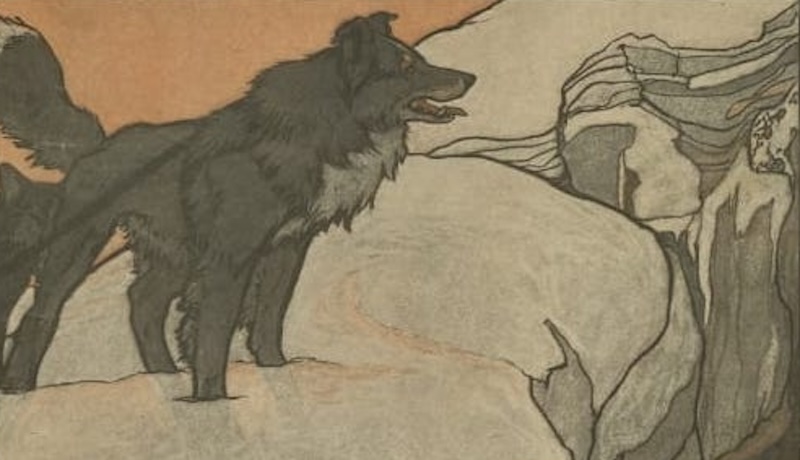
Etna’s modern ancestor is Jack London’s Buck, the canine protagonist in Call of the Wild (1903) who is conscripted to toil as a sled dog in the Alaskan Klondike under a series of vicious abusers until he’s rescued by the soft-hearted gold prospector Jack Thornton. Near the campfire flames Buck grows to adore his master.
Call of the Wild is a field study pitting the civilized against the atavistic. In third person close narration London shows Buck as psychologically split between his easygoing Santa Clara Valley origins and the lupine ancestral drive to prowl that he discovers in the nighttime Alaska forest. London parallels this condition to the delirious fervor he perceives underlying men’s domesticated selves. “This ecstasy, this forgetfulness of living,” London describes, “comes to the artist, caught up and out of himself in a sheet of flame; it comes to the soldier, war-mad on a stricken field.”
While Yoon also portrays a dark view of human society, which inflicts apocalyptic war upon itself, nearly every named human individual is sympathetic, all victims of the offstage political regime that has drafted them. Like Etna, they are sensitive creatures hardened by a severe environment. Jason relates softly to Etna, calling, “like he was gently but firmly pulling on a line of string.” Etna senses Jason’s loneliness. Watching with affection and curiosity as the soldier plays piano in an abandoned house Etna thinks, “maybe he was trying to speak to the piano the way I often tried to speak to him.”
Etna speaks psychically to Soojin, a preternatural dog whisperer, though she’s the one at the story’s outset who abducts him for war and names him after the Sicilian volcano. Ultimately, Etna’s closest bond is with the itinerant medic Hong who nurses his emaciated, shrapnel-scarred body.
Saunders’ “Fox 8” contrasts to Yoon’s and London’s stories as a suburban fable in which the narrator connects with human beings only from afar. Human culture so captivates him that by watching parents read bedtime stories to their children he becomes literate enough to write his own story (he apologizes “for any werds I spel rong.”). He’s moved by the fox-like human “gudnite kiss” to the “pups” and fantasizes about holding the baby and eventually attending college with the child.
But after endearing us to this eager and innocent narrator, Saunders blindsides us. Accompanied by his buddy Fox 7, Fox 8 first investigates the new shopping mall now encroaching on their forest habitat and admires the mysterious rites of human consumerism, observing that “We were sarounded by splender no Fox cud curate.” But when they leave construction workers kill Fox 7 for sport and Fox 8 returns to find his clan den has disappeared. Though another fox clan ultimately adopts him, their care feels like only a temporary reprieve from advancing human nihilism.
The disillusioned yet optimistic narrator composes a final letter as a moral plea to the “Yumans,” asking, “How cud the same type of Animal who made that luv lee Mawl make Fox 7 look the way he looked that time I saw him?”
These canine narrators serve a Greek chorus-like role, participating in an unfolding tragic downfall yet holding a discerning outsider’s role. They testify, interrogate and grieve the blind, self-destructive choices humans fail to question themselves. “Why did the Curator do it so rong,” Fox 8 mourns, “making the groop with the greatest skills the meenest?”
When a story maintains a dog’s viewpoint throughout, it allows readers to remain fully outside human consciousness. Even in the third-person narration of Call of the Wild the dramatis personae of eccentric, infighting dogs overshadows the flat and peripheral human characters until Thornton appears.
In King: A Street Story, which Yoon credits for inspiring Etna, the narrator is in constant dialogue with Vico and Vica, the couple he adopts, while also playing sentinel for the homeless community subsisting beneath the highway overpass littered with home appliances. Over the course of the novel’s 24 hours, he serves as stabilizing interlocutor for the distressed, quarrelsome couple who repeat their stories like characters in a static Samuel Beckett play. “I make people feel that whatever they tell, I’m hearing it for the first time,” he explains, ensuring that through his narrating voice their fragile life stories will be preserved. Like Etna’s, King’s sensory awareness offers him penetrating insight. “Men have seven skins,” he detects curiously. “Water has five, and I can distinguish each with my tongue.” He’s not a spiritual healer but seems to absorb Vico’s and Vica’s pain by receiving their testimony. Fox 8, Etna and King collectively remind me of the superintelligent, compassionate extraterrestrials in science fiction who wish to rescue humans from their self-wounding.
These canine narrators serve a Greek chorus-like role, participating in an unfolding tragic downfall yet holding a discerning outsider’s role.
Though quietly caring and possessing rich inner worlds, both King and Etna are dispassionate narrators. King has been hardened by years on the streets and Etna seems traumatized having endured mass violence, left an isolated refugee after nearly all the humans and dogs in his unit perish. He seems to become emotionally numb. The young dog abducted from peaceful family life forced to sever neck and genital arteries reports his story flatly. “All the men we were with killed other men and sometimes animals, and I killed, and Fuji killed, and the other dogs killed.” Yoon’s style recalls the stricken narrative detachment of the young soldiers in Remarqué’s and Hemingway’s World War I and Tim O’Brien’s Vietnam. Etna’s short declarative sentences, clipped repetitive phrasings and muted tone expose us to the flattening mental toll that aimless, unceasing wars take on their participants.
But Yoon infuses this neutral-tone narration with lively and intelligent dialogues among Etna and other animals (Etna can speak to every species, though Soojin is the only human). These animals debate, banter and consider faith. We encounter a swearing cat, an irascible donkey, two serenading horses and a perched bird fond of Socratic discourse.
By driving Etna’s drifting itinerary with the quest to return home, Yoon invokes the pastoral nostalgia that has characterized the canine tradition’s man-dog battles against the brutal wilderness. London’s Buck remembers his sunny California origins, though the memories fade as feral instinct takes over. King, the urban refugee recalls running carefree in the woods long ago and claims such memories express a universal canine longing. “All dogs dream of forests whether they’ve been in one or not,” he notes. Etna clings to a pre-war Edenic vision of his past to give himself purpose and destination. We hope he reaches his pristine coastline but given the widespread, massive devastation, we fear this refuge may turn out to be a naïve fantasy, or the remnant of primal memory.
Yoon faces the literary challenge of reworking thematic tropes and a narrative device that risk becoming formulaic—the wise animal narrator, the return to innocence, primitive savagery that surfaces in the wild, masculine man-dog intimacy born at the ancestral campfire. Though I sometimes felt Yoon was retreading overly familiar terrain, he marks new territory by creating a fully fleshed protagonist whose distinctively war-distressed inner voice feels nearly human while remaining believably canine. Clearly influenced by Berger, Yoon develops the idea London introduced with only rough-hewn melodrama over a century before, that a precocious enough dog might offer a unique window onto human character. Yoon adds texture to this eccentric dog narrator’s nose to the ground viewpoint that’s domestic and vigilant yet vestigially wild. Etna’s not quite a prophet in a fallen world, but by refracting fragments of their unconscious hopes, fears, impulses and possibilities, he offers humans a singular mirror.

Erik Gleibermann
Erik Gleibermann is a San Francisco–based social justice journalist and memoirist. His writing has appeared in The Atlantic, The Guardian, The New York Times, The Washington Post, Slate, Oprah Daily, The Los Angeles Review of Books, The Black Scholar, The American Scholar, Poets & Writers, Ploughshares, The Kenyon Review, The Georgia Review and World Literature Today, where he is a contributing editor. His memoir-in-progress is Jewfro American.