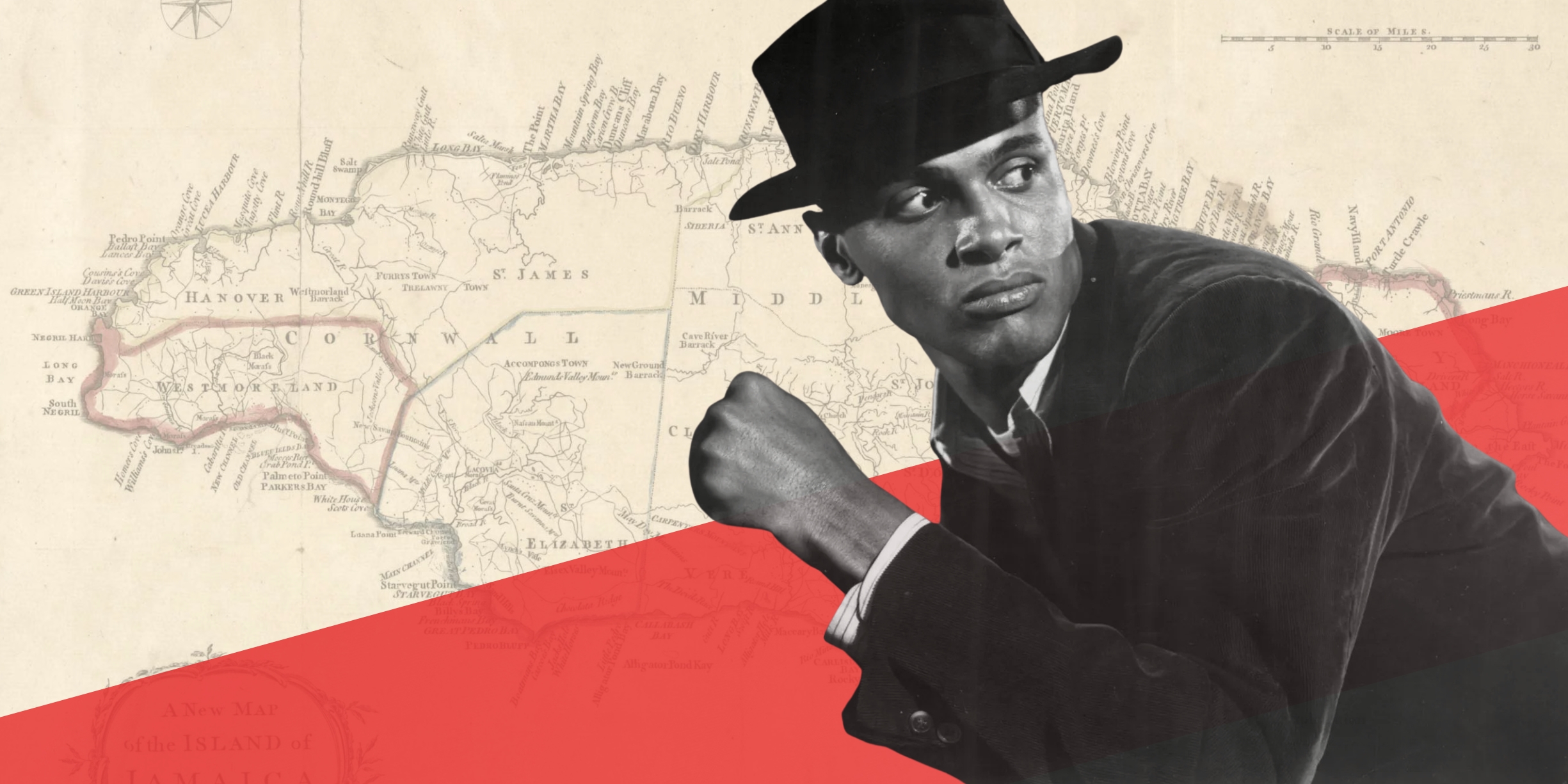
How Harlem and Jamaica Inspired the Music of Harry Belafonte
Joshua Jelly-Schapiro on the Artistic Influence of Black Diasporic Life, From New York to the Caribbean
The cultivation of sweet-tasting foodstuffs has shaped Caribbean history for five hundred years. And in the late 1800s, after slavery’s end in the British islands, sugar was joined by another cash crop for which a market was fast emerging up north. At the 1876 Centennial Exposition in Philadelphia, some inspired mind seized on the idea of selling pieces of brown-speckled yellow fruit from the tropics, wrapped in foil, for a dime. Bananas were a hit. Within a few decades, big Gros Michel bananas—picked green in the Caribbean, and allowed to ripen en route to New Orleans or New York—became the first tropical fruit to be a part of Americans’ daily diet. The silly yellow fruit that became a part of their culture was freighted, from the start, with suggestive meaning.
In 1923, the United States’ most popular song was called “Yes! We Have No Bananas,” a ditty first penned for Broadway that later became a hit for Louis Prima, a son of Italian immigrants in New Orleans who grew up alongside the booming banana trade there. Josephine Baker, also in the twenties, thrilled audiences from Stockholm to San Francisco with her “banana dance,” performed nude save for a skirt of bananas dangling from her waist, suggesting the members of her conquests. A couple of decades later, the United Fruit Company introduced its ubiquitous mascot: a comely singing piece of fruit, Miss Chiquita Banana, who was at least partly modeled on Carmen Miranda, the Brazilian bombshell whose banana-bedecked headdress, in movies like The Gang’s All Here (1943), helped make her a symbol of tropical sex. In the fifties, when Belafonte was a symbol of tropical and other kinds of sex, too, he recorded the most famous banana song of all. But already by his Depression-era boyhood, Americans had made bananas their favorite fruit—we still eat more of them than apples and oranges combined. The banana trade’s leading companies maintained fleets of freighters to ferry fruit north from Central America and the Antilles. In the 1920s and ’30s, the United Fruit Company’s “Great White Fleet” steamed between the U.S. and ports across the Caribbean basin to herald the modern cruise industry: booking passage in its ships’ staterooms was a way for adventuresome Americans to visit the tropics—and for emigrants from the islands to head in the other direction.
His peripatetic youth and time here fed his determination, later on and in the songs he sang, to illuminate what bound Harlem’s tenements to Jamaica’s fields, and the poverty he grew up amidst in both.
It was on one such boat that Millie Love made her way from Jamaica to Manhattan. And it was on another that she deposited her son—in care of his dad after he got into too many fistfights in first grade and had his leg broken by a car on Harlem’s streets—to go home again to the Jamaican village where her mum lived.
*
“I still have the impression of an environment that sang.” That’s how, later on, Harry Belafonte described what he found in Jamaica in 1934. “Nature sang, and the people sang, too.” That may have been so: Belafonte the singer always made his island boyhood—he would now remain in Jamaica, off and on, until his teens—a staple of his onstage patter. His grandmother Jane Love, in whose humble home he stayed during his first island sojourns, offered a form of affection that matched her name and was far less complicated than his troubled mum’s. It also granted him the ease he felt later on, moving between races and classes as an adult: in his memoir, he credits that trait “to the fact that Jane, who was as white and blue-eyed as a person can be, so enveloped me with love.” Since the 1700s, Jamaica’s populace has been dominated by the descendants of African slaves. But the island was also a haven for outcasts and pirates and merchants, from across Europe and the Levant and beyond, who came to the Caribbean to seek their fortunes or to help grow the fortunes of others.
The Love family’s forebears, as evinced by his grandmother’s white skin, belonged to a latter group: the class of impoverished Scots, known as “red legs,” who came to the West Indies as indentured workers or to work as overseers on English-owned plantations. Those owners named the hamlet near Jamaica’s north coast where Jane Love lived Aboukir, after another corner of their empire: the town in Egypt where Horatio Nelson famously bested Napoleon in the Battle of the Nile. Pronounced “Ah-boo-ka” by locals, Aboukir is in the island’s “garden parish” of Saint Ann—a corner of Jamaica best known for being where Columbus alighted in 1494, on a beach called Discovery Bay, and for a pair of native sons who became world-famous later on.
Marcus Garvey was born in Saint Ann Parish in 1887 and grew up there before he left for New York. So did Bob Marley, who was born there in 1945 and later laid to rest in a hamlet a few hilltops from Aboukir, where sandal-wearing tourists now come to hail the reggae superstar’s music and memory. Marley’s own family history, as a mixed-race son of Saint Ann’s hills, resembled Belafonte’s. His mother was a dark-skinned granddaughter of Saint Ann’s enslaved whose peasant kin farmed dasheen and yams. His white father was the ne’er-do-well son of an imperial merchant in Kingston, employed as a surveyor of crown lands in the area. This pair’s son, Robert Nesta Marley, moved to the island’s capital with his mum and grew up alongside a new homegrown record business whose signature rhythms—ska, rocksteady, reggae—made Jamaica famous. After heading to London in the early 1970s, he joined reggae to a rock star’s mien and wrote brilliant songs that would make him the first “Third World Superstar.” Many of those songs evoked the afterlives of the Triangle Trade that formed the Jamaican countryside where he—and Belafonte and Garvey—grew up.
On “Slave Driver,” the second track on Marley’s break-out LP in 1973, he addressed himself to the enforcers of old iniquities (“Slave driver / the table is turned”) and then to his people who were still suffering its legacies, whether back in Jamaica or in the ghettos of northern cities: “Today they say that we are free,” he sang, “only to be chained in poverty.” His worldview, on that record and every one that followed, was deeply shaped by the ideas of Marcus Garvey. If one of Garvey’s legacies was the conception of a Black diaspora, another was a supposed prophecy that helped found the religion—Rastafari—that Marley and many of his cohort embraced to confront history’s scars. (It was Garvey’s urging, “Look to the east, for the crowning of a Black king,” that led Rastafari’s founders to adopt Emperor Haile Selassie of Ethiopia as their savior.) Belafonte, sandwiched between these two sons of Saint Ann, never became a Rasta, but was raised by a Garveyite. And his peripatetic youth and time here fed his determination, later on and in the songs he sang, to illuminate what bound Harlem’s tenements to Jamaica’s fields, and the poverty he grew up amidst in both.
*
When he was nine, Harry made another ill-starred stab at school in Harlem. When that failed, his mother Millie brought Harry and his brother, Dennis, back to Jamaica once more. She looked for but didn’t find work in Kingston, and installed her boys in what became a series of boarding homes, including one owned by some cousins who were far less loving than their grandmother, but who Millie paid to house Harry—poor Dennis, only four years old, was placed elsewhere—while she went back to New York. In Kingston, Harry was no less given to the strict British curricula at the schools he attended—Morris Knibb, Wolmer’s, Half Way Tree—than he was to the lessons on offer at PS 186 on 145th Street. He attributed his struggles learning to read to an injury he’d sustained to his left eye while playing with scissors at his grandmother’s in Aboukir; in fact, he was dyslexic. When decades later he was awarded an honorary doctorate by the University of the West Indies, he joked to Jamaica’s former prime minister, Michael Manley, that he’d attended every school in Kingston. More memorable than his time in any of them were the hours he spent, after dismissal, wandering a town whose jangling streets echoed with song.
Race, like beauty, is in the eye of the beholder. And Harry’s boyhood travels between Jamaica and New York fed his understanding of both.
“Guava jelly, guava cheese…yellow yam, yellow yam, come get your yellow yam,” the higglers cried. He described their songs, and others he heard on Kingston’s streets, in his memoir:
The fishmongers were the best; they had a new song for whatever their catch of the day was. At the wharf, mento bands would sing to the endless stream of tourists disembarking from cruise ships. Even politicians sang to gather crowds before delivering their speeches. A politician named Simpson had an artificial leg made of cork that buffered the stump against the wooden peg. “Cork foot Simpson, the Vagabon’ / If I catch you I chop off the other one” was the verse written and sung by the opposition candidate. Simpson won the contest, and on the night of his victory he responded by singing his victory rebuttal.
Among the instruments those mento bands played, alongside their guitars and shakers, was a wood-and-iron thumb piano that’s known in Jamaica as a rumba box, which closely resembles the instrument, from Central Africa, best known as an mbira.
In Harlem, Harry’s favorite radio show was Amos ’n Andy. His mother, who worshipped Franklin and Eleanor Roosevelt, never missed one of FDR’s fireside chats. In Kingston, Harry’s colonial kin spent evenings glued to a wood-paneled radio tuned to the BBC. Listening to the London Philharmonic play Beethoven, conducted by Sir Thomas Beecham, left an impression. So did the stentorian diction of the BBC’s presenters. Jamaica’s official language and civilizational ideal was the Queen’s English, but the island’s lingua franca was the marvelous variant of that tongue called patois. Its tuneful lilt joined England’s lexicon to African syntax; Jamaicans approach consonants and diphthongs by removing “h” sounds from some English words and adding it to others (“eggs” are “heggs”), while eschewing the “th” sound altogether. It’s the tongue Harry’s Scots Jamaican grandmother used when she cried, as he’d lovingly recall, “Where me ’arry? Where me sweet boy ’arry?”
Years later, Belafonte and his marketers would claim that his biggest hits were songs he’d first learned in Jamaica as a boy. It wasn’t true: his repertoire was largely adopted from tunes he first heard or learned not in Jane Love’s hamlet but in Greenwich Village. But in the hills of Saint Ann, where he spent breaks from school in Kingston, he absorbed the language and sounds that inspired them. And seventy years after he did so, in a rum shop by the dusty soccer field in Aboukir, it didn’t take me long to find one of his maternal cousins, a brown-skinned man who recalled Jane Love’s old home, by a nearby knoll called Old Bethany. When I asked if I could see it, he told me that the place was knocked down after Harry’s uncle Callbeck, the last of the Loves to live there, sold it off to take a job working for Kaiser Aluminum in Saint Ann’s Bay.
Back in New York, I wrote Belafonte a letter about this encounter. He replied warmly and arranged to meet for lunch near his home on the Upper West Side. I brought him a book that I thought he’d enjoy: a first edition of Katherine Dunham’s Journey to Accompong—a landmark portrait of Jamaica’s Maroons that Dunham, the pioneering choreographer of Afro-American dance, penned from fieldwork she conducted there as a PhD student in anthropology in the 1930s. Harry thanked me kindly. And then he reflected, in the gravelly voice for which he became known in old age, on how his Caribbean identity aided his success in Eisenhower’s America. Harry’s white fans, who loved his sunny songs of the West Indies, he agreed, were responding to the same “unthreatening” quality they projected onto his pal Sidney Poitier—and to that imperious pride with which they carried themselves. “People from the Caribbean,” he explained, “did not respond to America’s oppressions in the same way that Black Americans did. We were constantly in a state of rebellion, constantly in a state of thinking way above that which we were given.” He reflected further, over his clams and cranberry juice: “I had no particular crisis with white people. Because I never really saw them as in any way superior. Americans—Black Americans—had crises, because not only were they forced to believe that white people were superior, but in many instances they bought it. And they made peace with it. We didn’t.”
*
“They made peace with it. We didn’t.” Those are fighting words. And words that distill much about why, in the United States, West Indians and U.S.-born Black people, despite being placed in the same category by America’s racial mores, haven’t always gotten along. But race, like beauty, is in the eye of the beholder. And Harry’s boyhood travels between Jamaica and New York fed his understanding of both.
______________________________
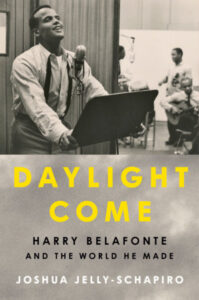
From Daylight Come: Harry Belafonte and the World He Made by Joshua Jelly-Schapiro. Published by Penguin Press, an imprint of Penguin Publishing Group, a division of Penguin Random House, LLC. Copyright © 2026 by Joshua Jelly-Schapiro.

Joshua Jelly-Schapiro
Joshua Jelly-Schapiro is a geographer and writer whose books include Names of New York: Discovering the City’s Past, Present, and Future Through Its Place-Names; Island People: The Caribbean and the World; and, with Rebecca Solnit, Nonstop Metropolis: A New York City Atlas. His work appears regularly in The New York Review of Books, The New Yorker, and The New York Times, among many other publications. Jelly-Schapiro teaches journalism at New York University and is director of publishing at Pioneer Works in Brooklyn, where he hosts the popular Author Talks series and is coeditor in chief of Pioneer Works Broadcast.