Generational Storytelling: Writing For My Grandmother and My Daughter
Margrét Ann Thors on Honoring Her Icelandic Heritage in Her Debut Novel
When my Icelandic grandmother, my amma, was in her early eighties, my mom took her to the doctor for a check-up. By then, Amma was hard of hearing and had Alzheimer’s. She didn’t catch what the doctor said. “He says everything looks good, Margrét,” repeated my mom, nearly shouting. “He says you’re going to live another twenty years!”
Amma was silent for a beat; my mom thought maybe she hadn’t heard or hadn’t understood. But slowly the corners of her eyes creased into a smile. “Did you get it in writing?”
This was Amma: witty, a little mischievous, always seated at the kids’ table. She spent hours playing gas station and hide-and-seek with my brother and me, seeming never to tire of chasing us on the wraparound porch. She watched Saved by the Bell with me after school; Zack Morris reminded her of my dad when he was young. She let me play with her adding machine and Royal Copenhagen porcelain figurines while my brother waged war on the living room floor with green-and-brown plastic army guys. She spoke English to us, except when she muttered Icelandic expletives under her breath, or when she got off the phone with her sister in Reykjavík and was laughing so hard she didn’t know which language was which.
When my postpartum fog began to clear, I wrote with new purpose: I wanted to write a book my daughter could someday hold in her hands, even when we could no longer hold each other.
She died twenty years ago, in her mid-eighties. She didn’t get to see who I’ve become. She didn’t get to meet my daughter.
I began writing Freyja to honor my amma. Dwelling inside this book—set in her home country of Iceland, animated by stories she’d told me as a child—made me feel close to her. I tried to understand Iceland as she had known it: in its poverty, its remoteness, its theatrical weather, its eerie quiet. I tried to inhabit the landscape as I first experienced it as a child: spray from a waterfall making me squint, the lemony zing of sheep sorrel weeds, my brother’s laughter as he peed on a lava field. In Iceland, I find Amma.
There has always been a rhyming between us. My name is her name. My profile is her profile. The island at the edge of the Arctic Circle she left is the island I returned to and now call home.
But the resemblance I feel most sharply is stranger: most of my memories of Amma overlap with her losing hers. On a family trip to the Pacific Northwest, she wandered off in Seattle and we spent several panicked hours searching for her. One summer, I made myself physically sick with worry that she would forget to pick us up from soccer camp. When the Alzheimer’s became very advanced, she stopped speaking altogether.
In recent years, I’ve inherited stacks of old letters Amma wrote from the U.S. to her sisters in Iceland. I hold these lined pages, recognizing her shaky script from so many of my birthday cards and games of tic-tac-toe. I hear the rhythmic brush of her thumb over the steering wheel at red lights; I see the steam from her black coffee at the diner with table-side jukeboxes, where I would belt out Whitney Houston’s “I Will Always Love You” to my brother’s horror and my amma’s delight.
I read these letters and look for patterns, for pieces to the puzzle of who she was before I knew her. She writes a lot about money—how little of it she has. She writes a lot about my dad—what mischief he’s getting into. Thor is going to teach me to drive, she writes in one letter. I’ve already heard from my dad how that story ended: with one exceedingly frustrating afternoon in a local parking lot, after which he gave up.
I have the papers Amma held, the envelopes she sealed, the time capsule of words she wrote. I have glimpses of memories that preceded me, memories she would eventually lose. These remind me of her, but they are not her.
The most fateful night of my protagonist’s life—the night when her childhood best friend disappears on a black-sand beach—leaves her with a distorted recollection of what really happened. My own traumatic experiences taught me how shifty memory can be—how incomplete and vulnerable to self-doubt. But as I wrote, I was also preoccupied with Amma. With the way her mind became unknowable to her.
She held tight to her humor as long as she could, though. At the rehearsal dinner for an Irish-Catholic wedding, she found herself seated next to the priest at the bar. “So, Father,” she famously said in her thick Icelandic accent, “vhat do you think, is He really up there?”
Many years later, shortly after learning I was pregnant, I felt an urge to go to church. On a whim, I sat alone on the end of a pew, palms to my belly. When the music started—an instrumental melody I didn’t recognize—I felt, truly felt, Amma beside me. Tears streamed down my face. She was not a presence; she was present.
Amma was not religious, and yet I was overcome by the sense that she had come to me here, in a church in the country of her birth and burial. The baby would be a girl, I understood at once. And her name would be Thorunn Margrét.
On the fourteen-year anniversary of Amma’s death, I went into labor. My daughter, Thorunn Margrét, was born the following night.
She’s six years old now and talks frequently of death. At bedtime once, she casually asked me, “Mom, when I die, are you going to put me in a glass case like Snow White?”
Usually I measure my responses, but here instinct overtook me. “If everything works the way it’s supposed to, sweetheart, then I’m going to die before you.”
That was a long night.
Amma’s letters preserve her worries about money and my father; my daughter’s toilet paper roll books preserve her six-year-old syntax.
She wants me to confirm that her father will die before I do because he is older (by four months, I should add). She wants a rule that will make the most mysterious of mysteries fit in her small hands. She wants to get that rule in writing.
When I ask what she wants to be when she grows up, she lists vegetarian (veterinarian, she means), then singer, then writer. She ends with, “And I want my mom to live until she’s REALLY old.”
Motherhood changed the direction of my writing. I spent the early, exploratory drafting process trying to conjure the memory of my amma. But when my postpartum fog began to clear, I wrote with new purpose: I wanted to write a book my daughter could someday hold in her hands, even when we could no longer hold each other.
Around her sixth birthday, she began writing “the story of her life.” Once upon a time, I was born, she begins. She cuts open toilet paper rolls and staples small scraps of paper inside; she spells phonetically. Sometimes she leaves these mini-books at our doorstep in hopes that passersby will check them out of her “library.”
Amma’s letters preserve her worries about money and my father; my daughter’s toilet paper roll books preserve her six-year-old syntax. Freyja preserves the Iceland I first knew through Amma’s stories. I ended the acknowledgements section with the words I whisper to my daughter every night: I will never stop loving you.
These marks on paper are something. But in the moments you most need the person you love, these marks are not enough.
A few weeks ago, when my daughter lost her first tooth, she dictated to me a letter for the Tooth Fairy. In the post-script, she wrote: Please leave the soul of the tooth behind with me. For a day and a half, she carried the tooth around like a talisman, reluctant to part with it. Also, she wanted the Tooth Fairy to draw a picture of what she looks like.
My daughter now has several other loose teeth. Next time, she wants to ask the Tooth Fairy to take the soul and leave the tooth. “I just really miss my tooth,” she tells me with a slight lisp, her tongue catching on the gap.
______________________________
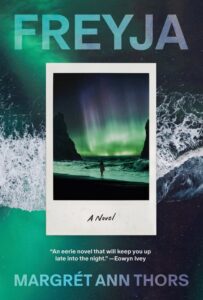
Freyja by Margrét Ann Thors is available from Spiegel & Grau.
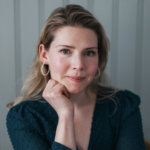
Margrét Ann Thors
Margrét Ann Thors is an Icelandic-American writer based in Reykjavík, Iceland. She received her MFA from Columbia University and teaches graduate and undergraduate courses in the English department at the University of Iceland. Her writing has appeared in Glamour, Creative Nonfiction, Ós Pressan, Storychord, and other outlets. Freyja is her debut novel.