Why, As Writers, Do We Cut the Things We Love?
Kayla Rae Whitaker on the “Animal Data” That Makes Up a Good Story
Here are a few details from past drafts of my latest novel that ended up on the cutting room floor: the family babies, a brother-and-sister duo marooned from their older siblings by an age gap, branch off from their folks, who run a Reagan-era discount chain, to open a survivalist superstore (tagline: “It’s closer than you think!”). Years before, at age nine, the sister monkeys around the periphery of her parents’ high-pressure party, gets drunk, and throws up (okay, I appreciate the wisdom of editing a tanked third grader out of my manuscript); incensed by her brother’s ire, she punches him and cries out that he’s “an old shit-ass bag.” And at one point, there was an entire point-of-view that didn’t make the final edit: that of the matriarch’s love interest, a pretty, practical woman who is also an employee at the family business. An entire voice, psyche, universe: gone.
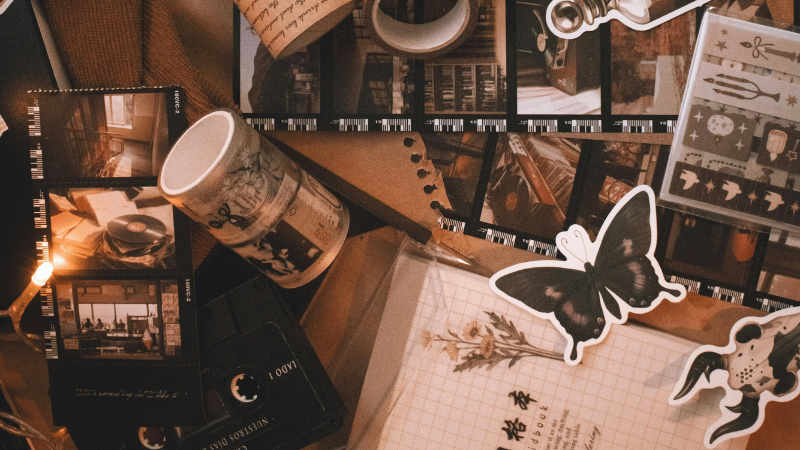
Most of what I end up cutting out of my writing is ephemera—the details and minutia of character and story we write at draft one that forms the narrative’s cobblestone, establishing the early world concretely enough to be paved over later. Ephemera is a bilateral entity for the fiction writer. The most precise definition of ephemera is an object that is meant to be discarded once it has outlived its purpose—paper goods like movie tickets, play handbills, lipstick tubes, rings that green the fingers. Stories are filled with this literal kind of ephemera in the form of what the characters wear, carry, purchase, pocket. But there’s ephemera in the spiritual sense of craft—the spare remarks and objects that constitute the overflow cut for cleaner syntax or word count.
Ephemera is so often illustrative of the inner life of a character, a direct, beating correlative of the contents of their hearts. Show me a character’s junk drawer, and I can tell you precisely how they will damn—or redeem—themselves. Ephemera that stayed in the book: a purple thumbcap that the heroine uses to count cash that later becomes a visual calling card she leaves for her lover.
From the standpoint of productivity, however, ephemera often seems counter to efficiency—to getting a coherent story down on paper and ready for publication as soon as humanly possible.
There’s the youngest, most freewheeling son’s habit of swilling cold coffee while watching The Gong Show. There’s the Cadillac a lavish main character purchases for himself every two years (in white, because “red is a whore’s color”), as well as the Rubic’s Cube the matriarch, dutiful to a fault, cannot help but save from the linen aisle and return to its rightful place. These details tell us who the characters really are and who they’d like to be, about their responsibilities, their ghosts, their desires. And if you look closely enough at both the ephemera you keep and the ephemera you cut, these details are often indicators of longing and impulse—the road signs to significant plot turns that the writer needs to craft a story.
From the standpoint of productivity, however, ephemera often seems counter to efficiency—to getting a coherent story down on paper and ready for publication as soon as humanly possible. Everything in our culture demands an objective and an eventual product. The fact of the matter is this—from a craft perspective, you must write your way through and accept the reality of cuts. It’s the only road to take, and that road isn’t a six-lane interstate. It’s a rural route with hairpin turns. Efficiency has nothing to do with it. Following that road—with as much patience as your faith allows—does.
But ephemera is more than just detail, and it’s more than the bone structure of hidden early drafts; it’s closer to critic John Wood’s concept of “thisness”—the sensory details of a story that are so specific the reader can almost touch them, so immediate and alive they seem to place the reader bodily into an experience. Ephemera forms the bridge where reader and book meet and begin to collaborate.
There are a lot of good reasons for this, but the simplest, most human reason is the most compelling: ephemera is what is left when everything else about a memory or an experience has fallen away. It is our animal data, what our sensory faculties have relayed to us, information filed into the primal “keep yourself alive” Rolodex in our heads that contains everything from “the stove is hot; don’t touch” to the way “Bells of London” began chiming from your grandparents’ old clock, the gauzy turning of the machinery within as a reminder of the passage of time. The most powerful ephemera is consumed unconsciously, only to surface decades later in such a way that it makes the hairs on your forearms bristle.
My learned appreciation for ephemera was a pond fed by two springs: one, a college-era love affair with poetry (and fiction learns a great deal from poetry, which leans on ephemera in the form of intense sensory detail to make the motor run), and two, the kind of mindfulness exercise that extremely anxious people use when they feel themselves begin to spiral. I was all ephemera, all noticing, when I first became sober twenty-one years ago.
Recovery is a sort of second birth. In those first days of sobriety, the part of yourself that has been scabbed over with substances for so long is finally exposed, shivery and unprotected, to life dead sober. Was I drawn to ephemera—details so small they kept me anchored in place at a time when I felt as if I were constantly sinking through the floor—because I was becoming a writer, or because I was a recovering alcoholic, or both? It’s a common trick, reaching for minutia—a sweater sleeve, a desk surface, the pendant on your necklace—to remind yourself that you exist in here, this space, in this moment and this moment only, and not the rabbit hole of panic and despair beckoning to you. Ephemera directs the brain to the tiniest concrete nubs of consciousness, calming the quaking mind and bringing us back to ourselves.
Human beings in 2026 know better than perhaps any other preceding generation the ephemeral nature of memory. We’re at the mercy of so many memory- and faculty-draining influences that it’s incredible we function as well as we do—being forced to multitask all day, every day, at work and home and often with multiple, seductive screens within reach, so much so that at the end of the day, our brains are so tired most of us yearn to lay flat on our backs and give processing responsibilities over to the buzzy little mirror in front of us. We’re losing the ability to spell, to memorize phone numbers. And we’re losing sensory experience: sights, sounds, smells. Our ephemera: the spackle holding our memory and sense of self together.
Your creature data is there, inside, powering you through time.
I’m as guilty of plonking around on my phone as anyone else (though my thirst for ephemera is still evident, notably through my favorite subreddits: r/Grandmaspantry, where people post long-expired sundries found in the cabinets of older relatives—think yellowing boxes of Jello 1-2-3 or Kotex from 1971, complete with a dreaded plastic belt; r/Mudlarking, where people hunt along riverbeds for artifacts, then post their findings, and r/700sandwiches, which—you know what, just do yourself a favor and go plumb those depths yourself), but my ability to go out and locate my own ephemera is waning. If you are hovering over five different things with a 10% investment in each, small sensory input is the first thing lost.
Like any writer, I become frustrated when my writing isn’t blooming as quickly as I’d like. But more galling: my shortened attention span and irresistible urge to gape at every screen I see has loosened that connection with the world I forged so many years ago, when I felt like I was losing everything. In the last drafts of the project—when I finally knew it was going to be a book—I was forced to take a long, hard look at my ephemera habits, and in the final plot decisions, the ephemera that solidified my characters. So back to Wendy, whose perspective was lost to the early drafts, but whose voice still resonated through the final story.
Late in the process, I put my phone in another room. I thought hard. And it came to me. The strokes of the final act were powered by my intimacy with her: from the snack she makes for her daughter every day (ants on a log) to her favorite Fleetwood Mac album (Tusk) to the type of handgun she owned. The first two signal the domestic draw that pulls her lover into her orbit, time and time again; the last, her unwillingness to be cowed when the powers that be come to threaten her—and her influence over the other characters, to resist the bootheel of the bully. In what Wendy kept stowed in a lockbox on a high shelf, I found the final, crucial act of the book.
It’s an expression of self-acceptance to write material you know you’ll cut later, supported by the faith that those details are both intended to be shed and to shepherd the story to its final destination. It’s an expression of self-love to protect your brain autonomy. We are entitled to an inner life that relishes all the lovely sensory garbage we can handle. Ephemera is how you remind yourself that you are a human being—you are not digital, you are not static. Your creature data is there, inside, powering you through time.
__________________________________
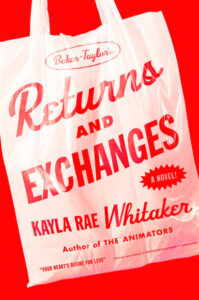
Returns and Exchanges by Kayla Rae Whitaker is available from Random House.

Kayla Rae Whitaker
Kayla Rae Whitaker was born and raised in Kentucky. She is a graduate of the University of Kentucky and of New York University’s MFA program, which she attended as a Jack Kent Cooke Graduate Scholar. She lives in Louisville. The Animators is her first novel.