How This is Your Brain on Music Transformed Neuroscience
Elizabeth Margulis on the Importance of a Seminal Work of Popular Science on the Field of Music Cognition
Twenty years ago, when This Is Your Brain on Music was published, the idea that music could be studied with the tools of biology and neuroscience was a niche one. When it came out, I was junior faculty at Northwestern, working in one of the country’s only departments devoted to this topic (the department of “Music Theory and Cognition”). The field had only formally existed for something like twenty years. A scholarly organization, the Society for Music Perception and Cognition (SMPC), was founded in 1990, and an academic journal, Music Perception, in 1983.
But most of the research being done was carried out by people who had the university equivalent of a day job. They were behavioral scientists who moonlighted as music researchers on the side, or music scholars who tried to sneak empirical methods into musicology conferences. To get grants from agencies like the National Science Foundation, you wouldn’t say you were researching music; you’d call it “complex nonlinguistic auditory processing.”
A book directed toward the general public might seem irrelevant to the progress of an academic field, but it can actually transform it.
This is Your Brain on Music was the beginning of the end for all of that. A book directed toward the general public might seem irrelevant to the progress of an academic field, but it can actually transform it. For one, it reifies the topic: music is a legitimate object of study for neuroscience; there’s an entire book about it. Down the road, that has an impact on funding—since the publication of this book, I’ve been the grateful recipient of two separate NSF grants where I straight-up confessed that I was studying music. For another, it captivates the imaginations of brilliant individuals who might not otherwise have considered a career in this area. The young people who pick up popular science books at the library tend to be deeply curious and self-motivated—qualities that also characterize great researchers.
Although I can’t make a careful case about causality, I can casually observe that since 2006, there has been a flood of immensely talented scholars into the field. It is now several times more likely that if you look at the roster of faculty in a psychology or music department, you’ll find someone working at the intersection of music and mind. A map published by SMPC shows labs with robust programs all over the world. But third, and equally important, a successful book for general audiences ensures that scholars in other fields also learn that the topic exists. This heightened awareness across the academy tends to bring new methods, perspectives, and communities into contact with a field’s ideas, spurring development that never could have happened without this breadth of voices.
In the decades since This is Your Brain on Music suggested enticingly that music is a product of the human brain, new research has upended what seemed like basic assumptions about what music is and how it works. For example, researchers rigged up a situation where 14-month-olds, after being bounced in sync or out of sync with a researcher, witnessed that researcher appear to accidentally drop objects she needed. Toddlers who had previously moved in synchrony with her were significantly more likely to engage in prosocial, helping behaviors: picking up the objects and generously handing them back.
Seen from this perspective, music seems not merely like an activity that builds cognitive skills, but perhaps even more essentially like an activity that builds social connection. Reinforcing this point, babies tested more than half a year after initial exposure reacted selectively to songs only if they’d first heard them sung in person by a parent, rather than by a stranger or a toy. From the earliest stages of life, music isn’t just a sequence of sounds, it’s profoundly social.
Cross-cultural work, a rarity until the elevated profile of music science attracted more involvement from anthropologists, has further advanced our understanding. That consonant intervals (fifths, octaves) sound pleasing had been taken as a given, attributable to biological properties such as the physics of the ear. But recent research found that members of the Tsimane’, a native Amazonian society in Bolivia, rate consonant and dissonant chords as equally pleasurable. Musical delight did not seem to be biologically endowed in quite the direct way people had assumed. Additionally, a study of 39 participant groups in 15 countries showed that people experience the same rhythm differently depending on the culture in which they’ve been immersed. Before any interpretive layer, the basic sonic patterns that people perceive depends on cultural experience. In fact, infants start out being able to process multiple temporal patterns equally well, but specialize across the first year in the patterns common to their culture, losing the ability to process others. But unlike adults, once a baby has lost this capacity, simply listening to music featuring that pattern over the course of a week or two is enough to bring it back. None of this was apparent twenty years ago.
Without the catalyzing force of This is Your Brain on Music, I can’t imagine that I would have been able to find the collaborators or the funding necessary to execute complex cross-cultural studies that rely on new tools in machine learning.
‘Nature versus nurture’ proves to be an inadequate framework for these findings. Evidencing at every level the way culture and biology interact, music gives the lie to this false binary. The dazzling variety of musical practices, across places and across time, surfaces this interplay in sensorily vivid terms, providing a unique opportunity to illuminate the role of history and environment on perceptual experiences that feel quite individual.
My own research in the Princeton Music Cognition Lab peels back the everyday experience of imagining something while listening to music to identify a striking case of this collision between the individual and the collective. When we played people excerpts of music they hadn’t heard before and asked what story they imagined while listening, the task was highly unconstrained: they could have told us anything. But person after person, tested individually in a sound-attenuated booth, produced highly similar descriptions for the same excerpt. One prompted stories of an old cowboy sitting alone on a porch, surveying a ghost town; another prompted stories about a sun rising over a meadow, where tiny creatures awakened and started to frolic. Yet while these stories were highly consistent within culture, they did not convey cross-culturally. Although we tend to neglect the scenes we imagine or remember while listening to music as a failure of attention, they actually reveal a deeper attunement to the web of associations that shapes our reflexive sense of the world. Talking about them provides a way into the points of connection and divergence that shape our relationships. Studying them reveals how our intuitive models of the world are built, and how we might go about changing them.
Without the catalyzing force of This is Your Brain on Music, I can’t imagine that I would have been able to find the collaborators or the funding necessary to execute complex cross-cultural studies that rely on new tools in machine learning. This recognition led directly to my desire to write Transported: The Everyday Magic of Musical Daydreams—an attempt to contribute to the same ecosystem that made my own work possible. My highest hope for Transported is that a curious teenager will happen across it in their local library, and be inspired to continue into the next generation the now increasingly mainstream study of music as a core part of our lives, minds, and societies.
____________________________
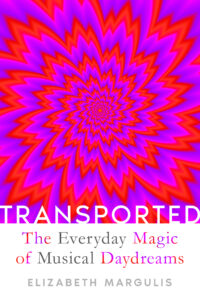
Transported: The Everyday Magic of Musical Daydreams by Elizabeth Margulis is available from Liveright Publishing Corporation, an imprint of W.W. Norton & Company.

Elizabeth Margulis
Elizabeth Margulis is professor of music and director of the Music Cognition Lab at Princeton University. Her book On Repeat: How Music Plays the Mind won the Wallace Berry Award from the Society for Music Theory. She lives in Princeton, New Jersey.