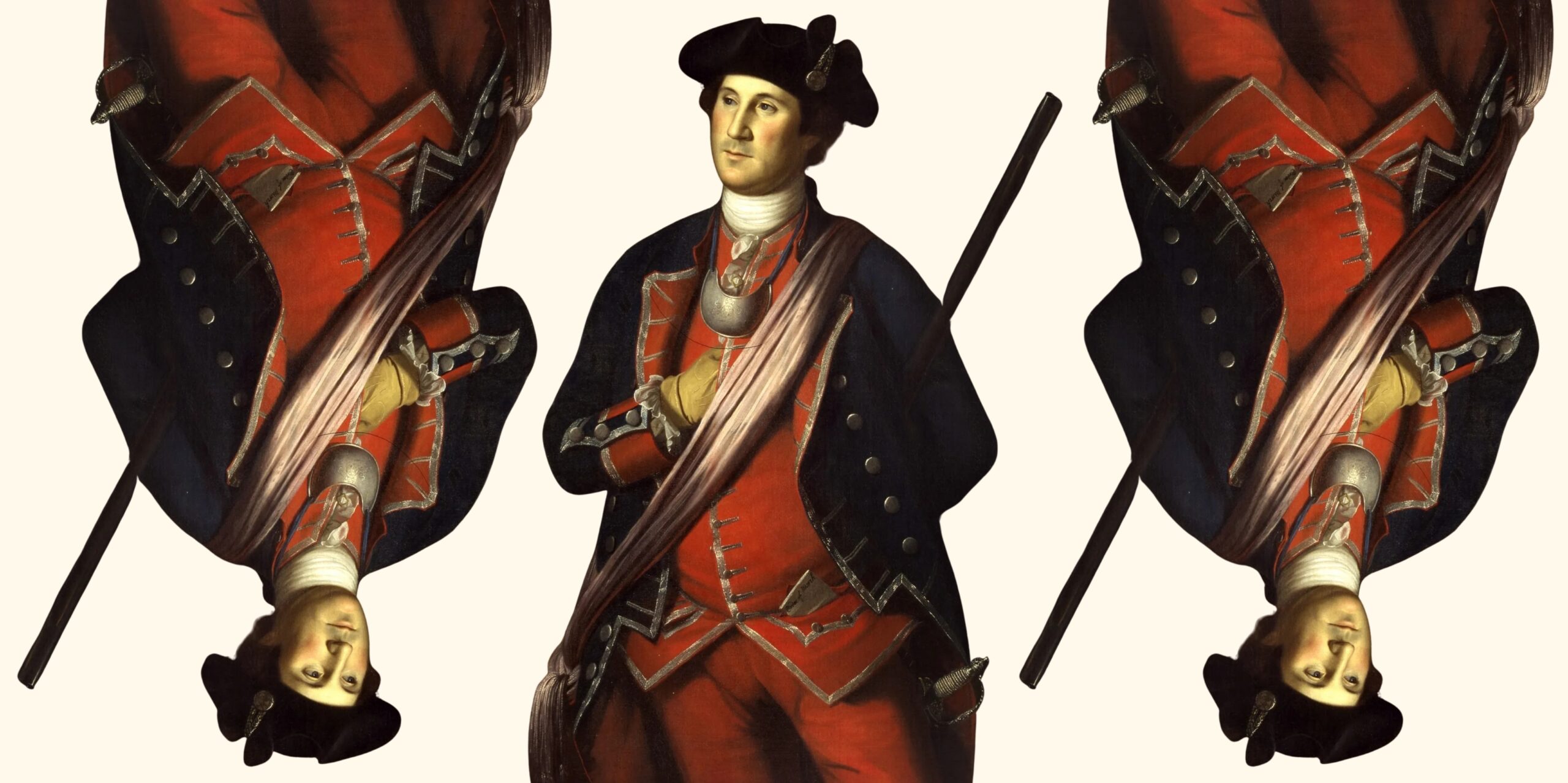
“Faithless and Foolish.” How a Young George Washington Failed Upward Into an Unpaid Internship
H.W. Brands on the Early Career of Our First President
A young man seeking a career requires a role model, or at least benefits from one. George Washington’s father had been a planter and merchant, but Augustine Washington’s early death deprived the boy of direct observation during the years when he was becoming a man. Brother Lawrence Washington’s military service doubtless turned George’s British empires eyes in that direction, yet the temporary nature of Lawrence’s service gave George little more than a taste of what a life at arms entailed. And Lawrence’s early death, following the failure of the Barbados therapy for his tuberculosis, attenuated even that.
Edward Braddock was different. The general revealed the full flowering of a military career in the British empire. Washington’s taste of battle had whetted his appetite for its drama and danger, and his time in command made him think he was good at giving orders and having them obeyed. He wanted more of the soldier’s life, and Braddock showed what more looked like. The British army might be his future.
It would have to be the British army. Washington had hit a wall in the Virginia militia. He’d been promoted to colonel after the death of Joshua Fry, but that simply meant that all the responsibility for the defeat at Fort Necessity fell on his shoulders. He offered the expected excuses: he was outnumbered, supplies ran low, the rain made defense impossible. He overreported the damage his men had done to the French. “The number killed and wounded of the enemy is uncertain,” he wrote, “but by the information given by some Dutch in their service to their countrymen in ours, we learn that it amounted to above three hundred, and we are induced to believe it must be very considerable, by their being busy all night in burying their dead.”
French commander Louis Coulon de Villiers doubtless underreported the French casualties, but his tally of three dead and seventeen wounded was likely closer to the mark. The French were behind cover all day, and of course they won the battle.
Another Iroquois chief thought Washington faithless as well as foolish.
Washington adamantly denied having admitted to assassination. “That we were willfully, or ignorantly, deceived by our interpreter in regard to the word assassination, I do aver, and will to my dying moment; so will every officer that was present,” he said. “The interpreter was a Dutchman, little acquainted with the English tongue, therefore might not advert to the tone and meaning of the word in English; but, whatever his motives were for so doing, certain it is, he called it the death, or the loss, of the Sieur Jumonville. So we received and so we understood it, until, to our great surprise and mortification, we found it otherwise in a literal translation.”
The defeat at first did him little harm. The Virginia house of burgesses voted to thank him and the militia for their service, with the lawmakers attributing the defeat to the failure of the other colonies to come to Virginia’s aid.
The burgesses might have voted differently or they might not have had they heard other assessments of Washington’s performance. Conrad Weiser was a Pennsylvania German who had roamed the frontier for decades, learning the Indian languages and befriending Indian leaders, including some who encountered Washington in Ohio. One in particular told him about dealing with the young Virginian.
Weiser recorded the conversation in his journal. “Tanacharisson, otherwise called the Half King, complained very much of the behaviour of Col. Washington to him (though in a very moderate way, saying the colonel was a good natured man but had no experience), saying that he took upon him to command the Indians as his slaves and would have them every day upon the out scout and attack the enemy by themselves, and that he would by no means take advice from the Indians; that he lay at one place from one full moon to the other and made no fortifications at all but that little thing upon the Meadow, where he thought the French would come up to him in open field; that had he taken the Half King’s advice and made such fortifications as the Half King advised him to make he would certainly have beat the French off; that the French had acted as great cowards, and the English as fools in that engagement.”
Another Iroquois chief thought Washington faithless as well as foolish. This warrior spoke to a council of chiefs called by the British in the aftermath of the Fort Necessity fight. His name wasn’t recorded, but his sentiments were clear. “We now open our minds to you, and desire that you will not be foolhardy and depend too much on your strength as Col. Washington did,” he said. The people the chief represented had counted on the good faith of the British but been disappointed. The disappointment started on Washington’s journey to Fort LeBoeuf the previous year. “Col. Washington, whom we convoyed to the French fort, left us there, came through the woods, and never thought it worth his while to come to Logstown or near us and give us any account of the speeches that passed between him and the French at the fort which he promised to do.”
Washington continued to ignore them in the recent campaign. “Col. Washington never consulted with us nor yet to take our advice,” the Iroquois chief said. He paid for his mistake. “Then happened the battle at the Meadows, before which we gave Col. Washington an account of how strong the French were, and when they were just at hand, he would not believe us.”
Fortunately for Washington, the Indians’ opinions weren’t heard or heeded in Williamsburg.
The ways of the whites puzzled the Indians. “What afterward passed in council between him and the French we never could yet understand. Had it been us, we must have been all killed or taken prisoners without we had run away, for we never council in time of war.”
Washington’s neglect of his Indian allies continued after the battle. “Then Col. Washington carrying all his people down to the great towns and leaving all this thin settled country to be protected by a few strangers, and never in all this time to return back or come with other men, as there are men enough in all this great province. All which gives us more reason to suspect that what the French had told us had some foundation.” The French had said the British were faithless.
Fortunately for Washington, the Indians’ opinions weren’t heard or heeded in Williamsburg. Yet even while the burgesses commended Washington, they broke up his regiment, as part of imperial retrenchment. The parts that remained were commanded by captains. If Washington wanted to stay in the militia, he’d have to accept a demotion. He didn’t and so resigned. He resumed civilian life.
But not for long. When he learned Braddock was coming, with force to accomplish what he had failed to, the twenty three year old former colonel wanted back in. Happily for him, Braddock was looking for locals with knowledge of the country he aimed to conquer. Virginia Governor Robert Dinwiddie gave him Washington’s name. Braddock invited Washington to join his “family,” or personal staff, albeit as a volunteer.
Washington said he was honored by the invitation, especially from an officer of such distinction. He avowed his desire to serve king and country. And he confessed to a selfish motive. “I wish earnestly to attain some knowledge in the military profession,” he wrote to Braddock’s adjutant, Robert Orme.
Washington required time to finish up a few personal matters. Yet he kept in touch with Braddock. “I herewith send you a small map of the back country, which, though imperfect and roughly drawn, for want of proper instruments, may give you a better knowledge of the parts designated, than you have hitherto had an opportunity of acquiring,” he wrote to Orme.
Washington tried to convince himself that an unpaid, uncommissioned post with Braddock was just what he wanted. “The sole motive which invites me to the field,” he wrote to John Robinson, the speaker of the house of burgesses, “is the laudable desire of serving my country, and not the gratification of any ambitious or lucrative plans. This, I flatter myself, will manifestly appear by my going a volunteer, without expectation of reward or prospect of attaining a command, as I am confidently assured it is not in General Braddock’s power to give a commission that I would accept.” Yet one never knew: if Washington did well, Braddock might find a commission he could accept.
Being part of Braddock’s family came with perquisites. The British army would cover most of Washington’s expenses. And proximity to power opened doors most useful to a young man of ambition. “I have had the honour to be introduced to the several governors and of being well received by them all,” he wrote to William Fairfax after Braddock’s conference in Alexandria. Washington thought he’d made a particular impression on Massachusetts governor Shirley, the most intelligent and energetic of the bunch. The admiration was mutual. “I think his every word and action discover in him the gentleman and politician.”
__________________________________
From American Patriarch: The Life of George Washington. Used with the permission of the publisher, Doubleday. Copyright © 2026 by H.W. Brands

H.W. Brands
H. W. BRANDS holds the Jack S. Blanton Sr. Chair in History at the University of Texas at Austin. He has written more than a dozen biographies and histories, including The General vs. the President, a New York Times bestseller, and Our First Civil War, his most recent book. Two of his biographies, The First American and Traitor to His Class, were finalists for the Pulitzer Prize.