







Why Are Women’s Biographies Often Told From a Man’s Point of View?
Sarah Fritz on Writing About Virtuoso Pianist Clara Schumann
Women’s historical fiction and historical romance are currently more popular than ever, but women’s historical nonfiction? Not so much. Despite being a biographer, when choosing books for pleasure, I’m still drawn again and again to fictional retellings of women’s history rather than nonfiction ones. They’re not only more compelling (as all fiction tends to be when plots can be crafted rather than proved by citation), but they also let me engage more of myself on their pages. The fiction gives an immersive experience of women’s viewpoint.
In nonfiction of women’s histories, particularly biography, there is a pesky prominence of men’s point-of-view. The practical reasons for this are numerous, from lack of research availability to the popularity of men’s history to the appeal for men readers and critics’ approval. I’ll argue that this skew in perspective, where men’s perspectives and voices eclipse women’s, is a major reason for its lesser popularity among women readers. But when women’s biographies continue to win Pulitzers while prioritizing the male point-of-view, what incentive is there to do otherwise? Still, despite the fact the I might not be rewarded by prize committees, when writing my own historical nonfiction, I needed women’s voices to be not just a priority, but the priority. Because I wanted to write a book I enjoyed reading, one that left me, and my women readers, feeling centered and not secondary.
Another major obstacle, often confronted by the woman’s biographer, is her own self-perception.
Even though the Bechdel test was not intended for nonfiction application, I decided to try it on my new biography for Pegasus Books: Madame Composer: The Virtuosic Genius of Clara Schumann. Every time I found brief mentions in diaries and letters of Clara’s conversations with fellow women composers, even though these could have easily been cut, I included them. I also played a game with myself—could I write a biography where not a page went by without Clara’s point-of-view? I’m fairly sure I succeeded, though not without considerable effort or without confronting innumerable obstacles.
Luckily, with Clara Schumann, lack of information—the problem which plagues most research about women in history—was a non-issue. Her father, Friedrich Wieck intended her to be a prodigy equal to W.A. Mozart, the Paganini of the Piano, and so kept diaries for her, written from the point-of-view of “his creation.” He notated all her achievements as if they were his own, culminating in her ascent to the imperial title of Court Virtuosa to the Austrian Emperor.
And I’ve thus demonstrated the trap into which all previous biographers of Clara Schumann—of which there were many, including one from Random House in 1940—have fallen: telling the story of her prodigy years from her father’s point-of-view. Writing her childhood from her own perspective, how Clara herself felt, thought, and acted, for the reader to experience her viewpoint, took extra steps. A thousand diary pages turned on their heads. Everything written from her father’s hand, I transcribed through Clara’s eyes.
Another major obstacle, often confronted by the woman’s biographer, is her own self-perception. In the 19th century, a wife’s diary was kept as a record of her husband’s life, especially for a wife of a so-called genius. Clara’s marriage diary praises her husband’s compositions, to the point of adulation, at the expense of her own. Generations of past historians have used her adulation as proof of the husband’s superiority and the wife’s inferiority. Even feminist writers fault her for a lack of belief in herself. But this discrepancy is a mark of its time, not of fact. The biographer of women’s history, in order to separate fact from suppression, must peel back the misogynist traditions of the period.
It’s hard not to feel a kinship with my subject who performed the men’s works more than her own.
This contextual web forces the writer to confront (or obey) our own internalized misogyny every writing day. All too often the author’s bias for the men’s history sneaks into the prose. Past biographers of Clara often betray more admiration for the music of Robert Schumann or Johannes Brahms than of their subject. Madame Composer is the first biography to call Clara Schumann a composer at all—a title which she herself feared it would be arrogance to claim.
During my years building a social media following, I was accused of feminist agenda more times than I can count, for tweeting facts like how many preferred Clara’s virtuosity to Franz Liszt or how Johannes relied on Clara to critique his works. (The love story was not the real scandal.) I felt the pressure to doubly prove each contradiction of the men-centered histories for fear of more accusations. The dissolution of traditional myths causes discomfort; it exposes the patriarchal agenda still lurking among us.
Fear of losing men as readers also shaped my prose, taking care that these theoretical men would not feel cast as the enemy, even as I wrote about the systematic oppression of the most famous woman composer of 19th-century Germany. I highlighted men who played roles of minor heroism, the few who supported Clara’s works, in part, rather than only dwelling on her oppressors. Some men saw her value, though none ever put his reputation on the line for her, as she would countless times for her husband and Johannes.
After rage reading biographies of these two men, where Clara’s compositions were either sidelined or unmentionable, I considered writing a response with their compositions dually neglected. However, my reader’s lens is so dominated by the all-men classical music canon, a list of now-revered composers which Clara shaped over the course of her sixty-year career, her central role in their histories cements her legitimacy. Clara inspired, critiqued, edited, arranged, premiered and performed their works; her shaping of their historic pedestals was impossible to exclude from her story. Even though her pivotal role is often erased or diminished in theirs.
It’s hard not to feel a kinship with my subject who performed the men’s works more than her own. 19th-century critics—who believed women could only be mere copyists and never composers—praised Clara for giving up on her composing, for devoting herself to her husband’s works, as the ideal dutiful wife and widow should. If she’d promoted herself as a composer equal to the men, she would’ve lost their respect. In parallel 21st-century fashion, with its continued expectation of deference to men’s history, so too would my books go unread, or unpublished, if I wrote a woman’s biography uninterrupted by men’s history.
__________________________________
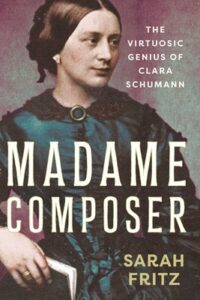
Madame Composer by Sarah Fritz is available from Pegasus Books, distributed by Simon and Schuster.
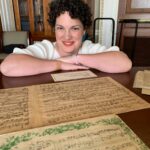
Sarah Fritz
Sarah Fritz is a musicologist, mezzo-soprano, and music historian who’s contributed to the New York Times, given pre-concert talks for the Philadelphia Orchestra, and appears in the PBS documentary, Mozart’s Sister. She runs the Clara Schumann Channel platform, dedicated to educating the public about women composers and performs with the Philadelphia Orchestra’s Symphonic Choir, including an appearance in the choir scene of the movie Maestro. Fritz teaches on the faculty of the Westminster Conservatory in Princeton, New Jersey.