What Tradwife “Influencers” of Centuries Past Share With Their Social Media Contemporaries
Maia Chance on the Age-Old Phenomenon of Toxic Nostalgia For a Nonexistent Past
Once upon a time, before Ballerina Farm and Nara Smith, there were 1800s domestic advice manuals.
In the middle of the 19th century, writers Lydia Maria Child and Catherine Beecher were busy defining what the ideal home—and the ideal woman—should be. The American Frugal Housewife (1829), A Treatise on Domestic Economy (1842), and The American Woman’s Home (1869) offered instructions on everything from bread-baking to furniture to babies, all wrapped up with a submit-to-your-husband bow.
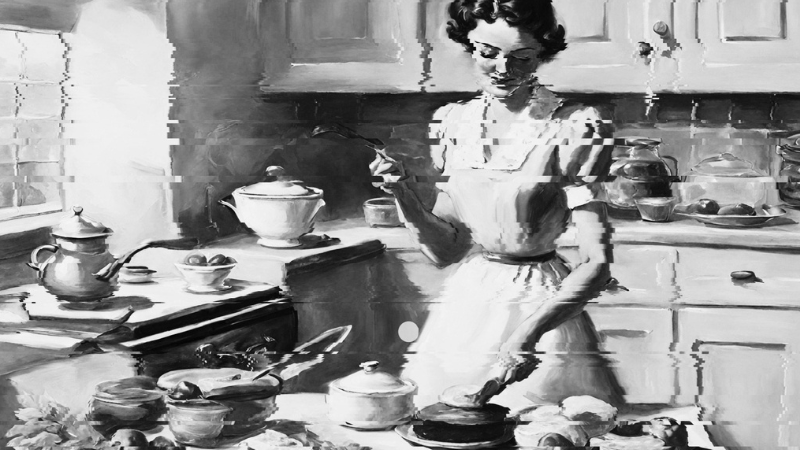
Today’s social media tradwives have resurrected Beecher and Child’s blueprint almost beat for beat. I’m talking about the Little House on the Prairie cosplay kind of tradwife. The ones who say you’re doing homecare and motherhood and marriage all wrong if you aren’t doing it in a floral dress. Who preach getting married and having babies when you’re very young, romanticize homesteading, and extoll scratch cooking—heavy on the sourdough. It’s an aesthetic that runs on pure nostalgia. Things were better in the past, tradwives insist. So let’s go back.
Beecher and Child’s books and today’s tradwives are reacting to the same cultural tension: housekeeping is essential, exhausting, and yet still treated as somehow beneath serious consideration.
But here’s the funny thing: those 1800s domestic advice writers were nostalgic for the housekeeping of the past, too. The problem with “modern girls” Child wrote (in 1829!) is that they’re so busy socializing and learning how to play the piano and indulging in “extravagance” that they have no time “for the formation of quiet, domestic habits.” And Beecher was wistful for a Colonial New England past when wives ran households with a clocklike efficiency. She wishes “that the grandmothers of New-England had written down their experiences for our children; they would have been a mine of maxims and traditions.” Even for Beecher and Child, the good old days were already long gone.
What does it tell us if domestic advice writers nearly two hundred years ago were pining for a past when women were better at, well, being a woman?
It begins to feel like the image of a golden past is really a mirror, showing us what we want, or what we’re afraid of, right now. And it reveals exactly how social media “aesthetics” work: they make problematic ideas seem picturesque. Sepia-tinted nostalgia absolves us of both responsibility and choice: “Look, I didn’t invent the concept of obeying my husband/women doing all the housework/eating unpasteurized dairy…it’s tradition.”
It’s easy to get distracted by the “ancestral diets” and free-range toddlers, but nostalgia isn’t the only thing tying tradwives to their 19th-century predecessors. Beecher and Child’s books and today’s tradwives are reacting to the same cultural tension: housekeeping is essential, exhausting, and yet still treated as somehow beneath serious consideration.
It’s not a secret that our current American culture denigrates the value of housekeeping. It’s treated like an unnecessary “extra,” and yet houses still need to be vacuumed and diapers still have to be changed. And it’s well documented that women—including feminists—are doing the lion’s share of the housework in cis-heterosexual households. Women have to squeeze all that “extra”-yet-still-absolutely-necessary work into the margins of their “real” jobs. It’s exhausting. It’s enraging. And yes, it’s degrading.
Beecher and Child both described housekeeping as “degrading,” not because the work lacked value, but because no one treated it as a serious field. Girls weren’t educated in it. Young women wanted to be good wives but “did not know how.” Beecher insisted housekeeping was in fact scientific—cooking as chemistry, labor as physics. (Beecher was also motivated by her racial biases. She blamed “raw” Irish servants and enslaved Black laborers for household disorder and urged white women to reclaim the work for themselves.)
Tradwives today aren’t wrong when they say that “girlboss” and grind culture belittle domestic labor. Corporate capitalism has no use for scratch-cooked meals and line-hung laundry.
Except that tradwife influencers spend huge amounts of time, and cultivate immense expertise, producing photos, videos, and text. We all know “content creator” is their real job description. But women hustling behind the scenes, doing invisible labor, pretending it’s effortless and aesthetic while Meta and TikTok hold all the ownership…how does that raise the status of actual housework and caregiving?
The fantasy of a perfect past is—just as Beecher and Child show—the real American tradition.
Beecher and Child wanted to elevate the role of the housekeeper, but they tied that elevation to a rigid hierarchy: wives obey, husbands decide. Beecher wrote that when disagreements arise “the husband has the deciding control, and the wife is to obey.” She softened it by insisting that the husband’s “distinctive duty” was one of “self-sacrificing love,” and that boys should be raised to give their mothers and sisters “precedence in all the conveniences and comforts of home life.”
Tradwives have resurrected the female submission part of the blueprint, but not the male self-sacrifice part. But true patriarchy is a two-way street, and twenty-first century men want to reap all the benefits of that system without making any of the sacrifices. As a result, tradwife submission—just like their fetishized dresses—starts to read less like tradition and more like kink.
Trad husbands make occasional appearances online. Their round, boyish faces and empty eyes are startling, and one can’t help thinking that women vowing to “submit” to these fellows surely have their work cut out for them. You come away suspecting that the tradwife’s insistence on “supporting her husband” extends to propping up his very gender identity.
Tradwives’ and trad husbands’ gender, like tradwives’ labor, is first and foremost a performance. Not only that, but this performance is a product, sold by Meta and TikTok. Tradwives are delivering the last shreds of domestic privacy, intimacy, and pleasure directly into the hands of late-stage capitalism. They profess to turn their backs on consumerism, but they’ve made their time, their husbands, their homes, and even their children, into commodities.
It’s all empty. A mirage. A false-fronted building in an Old West ghost town.
We know this, and yet we just can’t look away. Because the fantasy of a perfect past is—just as Beecher and Child show—the real American tradition.
_________________________________

The Ravine by Maia Chance is available from Thomas & Mercer.

Maia Chance
Maia Chance is the national bestselling author of multiple mystery and suspense novels, including her latest domestic thriller (featuring a tradwife), The Ravine, out now. She holds a PhD in English Literature from the University of Washington, focused on 19th-century American domestic ideology and advice literature. She lives on an island in Washington State with her husband, two children, and one naughty dog. Learn more at maiachance.com.