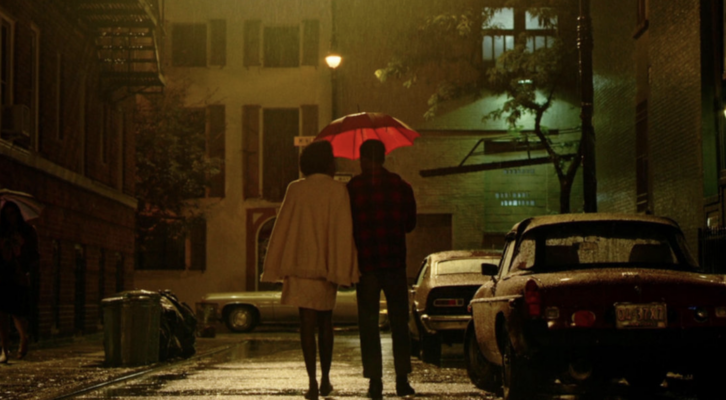
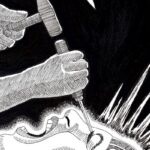
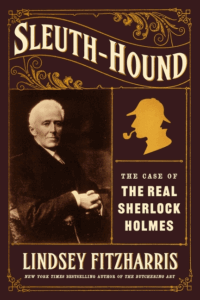
What to read after you see the Bayeux Tapestry.
The Bayeux Tapestry is now on display in England’s British Museum, and the hottest ticket in London right now is a chance to peek at a nearly thousand year old piece of fabric art. Whether you’ve gotten to view the Tapestry, or wish you could jaunt to the UK to see it, I’ve got a few recommendations of books to check out if you’ve got what British doctors call “Bayeux Fever,” which I’m afraid I may have.
But first, a little primer. The Bayeux Tapestry is immense, nearly two feet wide and about as long as a 747. It’s embroidered onto cloth (not woven on a loom so it’s not—pushing up my glasses—technically a tapestry) chronicles the events around the 1066 Norman Conquest of England by William the Conquerer, including the Battle of Hastings when William faced Harold II, the last Anglo-Saxon King of England. William’s half brother commissioned the piece to commemorate the conquest, though it was likely woven by English nuns on the losing side of the war.
The history the Tapestry documents has deep meaning to the English, but the object itself has long been housed in a small museum Bayeux, France. Now, after years of diplomacy, the Tapestry has landed in London, where it’s been such a popular attraction that the museum is having to change how it manages the long lines.
While you’re waiting on those lines, how about something to read?
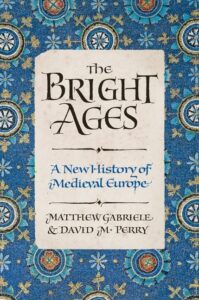
Matthew Gabriele and David M. Perry, The Bright Ages
I’ve recommended this book before and I stand by it: The Bright Ages is an immensely readable history and the sort of curious, engaged history that I love. The Middle Ages is a period freighted with the immense weight of outdated preconceptions. Gabriele and Perry’s book is wide-ranging, taking up a series of topics, figures, and moments for reevaluation, including the Vikings, the Black Death, Charlemagne, and much more.
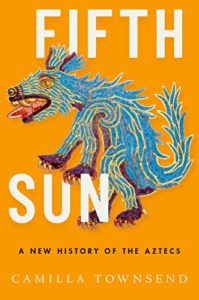
Camilla Townsend, Fifth Sun
The period of the pre-modern, pre-nation-state world didn’t just happen in Europe of course. Many kids in the West learn 1066, the date of the Norman Invasion depicted in Bayeux, but what about 1325, the founding of Tenochtitlan? Fifth Sun is a 2021 history that draws on new scholarship and a breadth of primary sources to present a more up-to-date and broad telling of Aztec history. Townsend is a great writer too, and includes some fictional flourishes to enliven her history.
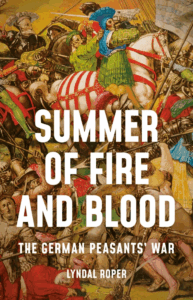
Lyndal Roper, Summer of Fire and Blood
Something you might be missing from the Bayeux Tapestry is the perspective of the commoner. Though in the margins there are depictions of daily life, the Tapestry isn’t revolutionary or counter-authoritarian history. If you’re curious for a ground up look at the time period, Lyndal Roper’s history of The German Peasants’ War is a great one to pick up. The Peasants’ War was a very short-lived, doomed rebellion of lower class folks who took up arms against the church and the aristocracy in 1524-1525. The revolt was brutally put down—it’s likely that a quarter of a million peasants and farmers were killed in retaliation.
Of particular interest is the proto-socialism that emerged amongst the rebels and peasants who fought against their oppressors, and Roper explores this movement that was inspired by radical strains in the Protestant Reformation: “the uprising was one that expressed early ideas of justice, communal decision-making, and resistance to arbitrary power.”
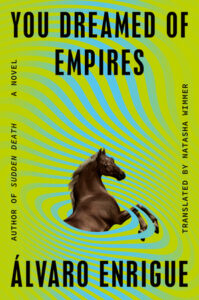
Álvaro Enrigue, You Dreamed of Empires
There’s a small theme of Aztec history in this list, so I had to include this great, Middle Ages-ish historical novel. Empires is surreal and gripping, a novelist’s telling of the disorientation and violence of imperial conquest. Enrique is one of the great writers working today, and the way he explores the cultural exchange that happens at the edge of a sword is essential today when issues of cross-border sovereignty, memory, and justice are more urgent than ever.
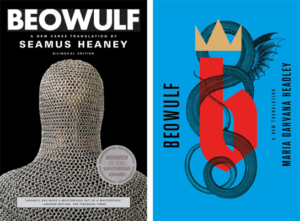
Seamus Heaney, Beowulf & Maria Dahvana Headley, Beowulf
Listen, you don’t have to read two Beowulfs, but if you have any interest in primary sources from the hoary past, both of these translations should be on your radar.
Headley’s translation generated a lot of buzz and backlash for its colloquial approach, especially because she rendered the poem’s first word—the Old English “Hwæt”—as “Bro!” I think Headley’s radically contemporary approach got unfairly tagged as gimmicky. She’s tapping into something interesting about the poem and its place in an ancient society. Long before Marvel cast a long cape shadow across culture, people have been invested in smash-em-up monster and superhero stories, and I like Headley’s impulse to translate context in addition to words.
That being said, you can’t beat Seamus Heaney, one of the great poets of all time bringing to Beowulf his lyricism and attention to the frictional details of everyday life. He writes a beautiful, wholely poem from the Old English. And if you’re keeping score at home, Heaney’s “Hwæt” is “So.”
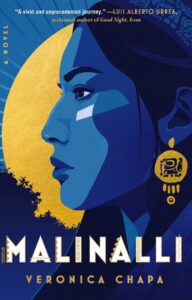
Veronica Chapa, Malinalli
Another fictional, intimate account of the Spanish conquest of the Aztec Empire, Chapa’s novel takes on a controversial figure in Mexican history: the woman who served as translator for Spanish conquistador Hernán Cortés. Though it might not be enough to salvage Malinalli’s reputation (the term “malinchista” in Mexico negatively refers to someone who likes a foreign culture or lifestyle over their own) the book is a sympathetic portrait of someone forced to survive between worlds.
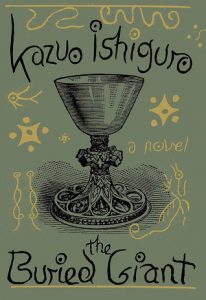
Kazuo Ishiguro, The Buried Giant
Like the Tapestry, this one’s a classic for a reason. A very moving portrait of memory and resilience in a fanatical version of England after King Arthur. This is one of those books I’m always telling myself it’s time to reread, and maybe seeing the Bayeaux Tapestry would kick it to the top of the to-reread stack.
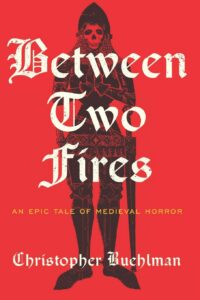
Christopher Buehlman, Between Two Fires
The Tapestry doesn’t shy away from the violence and death of battle, so maybe you’re in the mood for something that dives into the horror. Between Two Fires is a zippy historical monster story, where a bandit ex-knight and a young girl beset by visions have to contend with plague and inhuman monsters. The perfect supernatural read for spooky season.
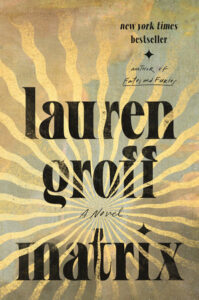
Lauren Groff, Matrix
I know it’s not a common favorite Groff, but I love this book and its break-away utopia of 12th century nuns. Groff’s writing is always transcendent, and her prose is especially on display in Matrix’s passages of holy visions, bodily lust, and political power.
Let the record show that I think anything that Abbess Marie de France wants, she should get.
Updated to correct a dating hiccup: the Tapestry is nearly 1,000 years old, not 100.

James Folta
James Folta is a writer and the managing editor of Points in Case. He co-writes the weekly Newsletter of Humorous Writing. More at www.jamesfolta.com or jfolta@lithub.com.