What Knitting Has Taught Me About Writing
Miranda Shulman on the Similarities Between Her Writing and Knitting Practices
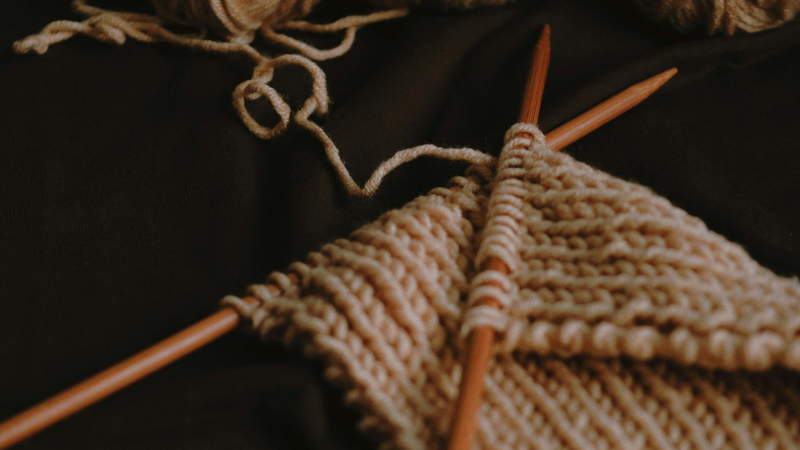
At age five, my mother taught me to knit. That same year, in my kindergarten classroom, I was learning to write. Back then, writing meant slowly dragging my pencil tip around the little hull of a “u,” ensuring it was round, not pointed like a “v,” only to be told it wasn’t quite round enough. And knitting meant clumsily looping a strand of acrylic yarn onto the tip of a bamboo needle, groaning, then handing the project to my mother for help. Eventually, my letters became neater, rounder, more consistent. So did my stitches. Still, it was years before I considered either practice “art.”
These days, I use knitting to unwind (pun intended). I do it while I’m thinking about other things, or as reality television flashes blue light against my bedroom wall, or on the train, or in a movie theater. Writing, on the other hand, is my lifeline—a compulsion, a joy, and sometimes agony. I try to make time to write early in the morning, when I can lose myself in the story, the sentences, before other responsibilities start tugging at the edges of my mind.
I feel strongly that every writer would benefit from a secondary, lighthearted creative pursuit—one they regard as a healthy indulgence, without the intensity of a duty or a calling. I’ve spoken to many writers who are knitters and feel the same way.
Over time, I’ve found myself leaning away from rigidity and control in favor of appreciating whatever I can do on a given day, knowing that each word written and discovery made is valuable and celebratory.
One of my favorite things about knitting is that you don’t have to be, and probably shouldn’t be, precious about the conditions under which you do it. It needn’t require the only chair in the world that’s the right kind of comfortable. It doesn’t have to happen at a particular time of day, or when it’s exactly fifty-nine degrees outside with the wind blowing due east for you to do your best work. And you can do a few stitches here, a few stitches there, no need to carve out hours of time or commit to making six inches of a scarf in a single sitting. The only thing that matters is showing up, doing the work. You make your practice fit within your full life rather than attempting to do the opposite.
At times, I’ve been rigid about how and when I write, and though I definitely do my best work in the morning, I’ve found that being too picky leads me down a path of angry self-talk, which makes me resentful, which turns writing into a chore, which makes it harder to motivate myself to do it. If what I do is never enough, what’s the point of doing anything at all? If my standards for myself are unachievably high, why should I even try? Life doesn’t always allow for dedicated writing time and that’s okay. I have a nine-to-five job on weekdays. But if I apply my approach to knitting, then I can take pride in the little, in-between-life moments spent writing—like when I type a few sentences into my notes-app on the subway or jot some words down at a bar while waiting for friends.
Those in-between-life moments can lead to breakthroughs. Sometimes it takes a new setting and being surrounded by inspiring distractions to answer questions I can’t answer at my desk with my phone silenced and my boyfriend banished (the “ideal” writing conditions). Over time, I’ve found myself leaning away from rigidity and control in favor of appreciating whatever I can do on a given day, knowing that each word written and discovery made is valuable and celebratory. So much about this reminds me of my relationship to knitting—someday, maybe it will work for other things, too (stay tuned for the essay: “What Knitting and Writing Have Taught Me About Exercising”).
Whether you generate a draft in fits and starts wherever you are, or by sticking to a rigorous daily word count, you can’t get too attached to the work itself. When I say that every stitch, every word, is progress, I mean that every stitch, every word, is a valuable learning experience, not that they are permanent. When I’m knitting, I’m often following a complicated pattern translated from Dutch to English. It usually takes a few tries to understand what’s being asked of me, and if I’m knitting in a dark room (like a movie theater or a dimly lit restaurant) I’ll probably make a mistake. Then again, when I’m knitting on my couch at home, I’ll also probably make a mistake. There’s no way to knit a sweater faster than the time it takes to create the right stitches and understand the pattern. You have to make all the mistakes and be okay with re-doing it until it’s right. That’s the process of making. That’s dedication to craft. That’s discovery.
I’ve come to find it healing: the act of spinning past mistakes into beauty.
I am constantly “frogging” my work (unraveling it and starting over). There was a time when I didn’t do this, and ended up with a bunch of holey, crooked scarves, holey, too-tall hats, and nests of holey, half-made sweaters—and I mean “nests” literally as they eventually attracted moth larvae (ew). These were projects I’d worked hard on, so it was difficult to imagine undoing them. At the same time, I had no interest in wearing them.
The infuriating, but also kind of helpful, thing about knitting is that the materials are very expensive: mostly the yarn, but also the needles if you’re buying many pairs. If you want a gorgeous, fair isle wool sweater, chances are it will be cheaper to buy than to make (thrift stores are filled with them). If you don’t restart projects pock-marked by dropped stitches, or poorly fitted because you cut corners, you will end up with a pile of unwearable garments that cost you hundreds of dollars. Despite being very sentimental, eventually I couldn’t justify spending more and more on yarn when I could transform what I had into garments I was proud of, that wouldn’t sit in the corner of my room forever attracting bugs—including some of my very first, decades-old projects. I’ve come to find it healing: the act of spinning past mistakes into beauty.
When it comes to writing, it’s difficult for me to restart a faulty draft not because of sentimentality but time. I always feel like I’m falling behind, like I should’ve had a novel draft finished by now, or sold a second book, or completed this essay or that short story and placed it here or there. Why am I so slow? is the question perpetually dogging me. In reality, it’s awesome if you’re slow. It means you’re careful. It means you care. The wonderful thing about both writing and knitting is that you can improve with time and practice. In writing, there’s a lot of talk about innate talent, and while that’s definitely a factor of success, I am often stunned when I look back at my own work—not by shame, but pride because I’ve learned and improved so much without realizing it was happening.
On a daily basis, when I do the work of slowing down by restarting a chapter that isn’t clicking, or even a whole draft from scratch, or when I feel accomplished as I slide my phone into my pocket after a few minutes of manically typing out a new idea, I’m not thinking to myself, “knitting gave me this tool.” But when I zoom out and consider how my writing practice has evolved over time, it’s clear where I’ve drawn inspiration from. Improvement can be a direct result of a change in mindset.
For me, that’s happened partly out of necessity as my life has grown bigger and busier, and I’m so much better for it, more relaxed, and deeply grateful for the model I’ve absorbed. These days, when I can’t carve out a few hours for dedicated writing, I spend less time feeling like a failure. Above all, I care about quality. Creating something I’m proud of. Publishing a book has helped drive this home, too.
As I write these words, I’m on the precipice of the people in my life and beyond reading my work and perhaps judging it. From this vantage point, I don’t care about how long it took me to get here. The only thing I care about is quality. I feel proud of what I’ve made and will only ever put out work I’m proud of. I hope every book I write from this point on is better than the last, just as every sweater I knit is a little more complicated and impressive than its predecessors.
Beyond what it has taught me about writing, I’m so grateful I’ve had knitting to turn to at the end of a long writing session, when my brain is fried and I want to feel engaged, yet relaxed. It reminds me what art-making can be, the joy and sense of accomplishment it can inspire. I know I will finish my sweater. I know it will be beautiful. I can trust the same will be true of my novel, story, or essay, as long as I’m relaxed, patient, and kind to myself.
__________________________________
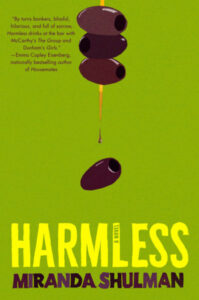
Harmless by Miranda Shulman is available from Dutton, an imprint of Penguin Random House.

Miranda Shulman
Miranda Shulman attended Bard College, where she majored in human rights. Before pursuing a career in publishing, she worked at Planned Parenthood. She grew up in Brooklyn, New York, and still lives there. Harmless is her first novel.