We Should All Be Autodidacts: The Case For Reading the Great Books at Your Own Pace
Naomi Kanakia Argues in Favor of a DIY Literary and Philosophical Education
There’s a set of books that you’ve probably already heard of. These are the ones that’ve been extolled by professors and critics. They’ve been referenced in countless speeches and essays. And in school, your teachers most likely claimed that these books were among the world’s greatest works of literature.
I’m talking about texts like Melville’s Moby-Dick, Austen’s Pride and Prejudice, Tolstoy’s Anna Karenina, Homer’s Iliad and Odyssey, Milton’s Paradise Lost, Dante’s Inferno, Cervantes’s Don Quixote, and about a hundred others—most people have heard of these books, and most people have some preexisting ideas about them. (Collectively, these texts are often referred to as ‘The Great Books.’)
People like me, who love the Great Books, often worry that the general public has a negative impression of these classic texts. We worry that ordinary people think the Great Books are a tool of White supremacy.
And it’s true; that belief does exist, among some readers. But when I talk to people about the Great Books, they usually don’t say, “Oh, those books are racist.” Instead, they quite frequently say something like, “I’ve always meant to read those.”
So why don’t they?
I didn’t need professors. I didn’t need a lot of external guidance. I read these books the same way I read everything else: I sank into the dream of the text, experiencing it with as much immediacy as I could.
If I dig deeper, I find that these titles tend to arouse feelings of shame and inadequacy. The people I talk with, my friends and my peers, are usually very educated. They’re writers, professors, and intellectuals. They’re not just avid readers; they’re also people whose self-worth is tied up with their love for books.
But they’re afraid to approach the Great Books.
Oftentimes that fear is rooted in negative experiences from college or young adulthood. Perhaps you took a class on Henry James, and you were inexpressibly bored by Wings of the Dove. Or you tried to read the Iliad and bounced off the seemingly endless catalogue of various kings with their “long black ships.” Over time you felt increasingly ashamed of your lack of reading, so it became a sore spot, something you no longer wanted to approach. And now it feels too late. Serious reading is for English majors. It’s for people with PhDs. It’s for weighty, self-important, intellectual types.
Nobody can sympathize more than I do with these problems. For one thing, I still feel insecure. I write a newsletter about the Great Books, and about every two weeks some commenter with a PhD will imply that I’m a poor reader. They’ll say I don’t understand the book I’ve read. They’ll say its meaning would be obvious if only I were aware of what F. R. Leavis said about it sixty years ago. Or they’ll say that I’m not reading correctly, that I need to embrace the ambiguity of a particular passage, and that its seeming inscrutability is actually a major part of the effect intended by the work’s author. You’re not supposed to understand.
Sometimes, despite the tone, these comments improve my understanding of the text; other times, they just hurt my feelings.
These kinds of interactions are unavoidable when you read the Great Books. First, many people have spent their lives studying these books. And they have written many monographs about each of them. So any question you might have about a given work—it’s probably already been discussed many times before. And you, as a nonspecialist reader, often have neither the time nor the ability to track down this previous discussion, so you come away feeling as if there’s no possible way for you to understand this tome.
Second, these books carry a strong cultural connotation: If you understand Aristotle, then you’re smart. If you love Proust, then you have taste. If you vibe with T.S. Eliot, then you’re sensitive. And people really want to feel as if they’re smart, tasteful, and sensitive. Many folks not only have a lot of their self-image tied up with the books they love, but oftentimes they also have a lot of cultural and social capital tied up with being a great reader—there are many people, myself included, who’ve translated “being a great reader” into a considerable amount of online clout. And that means there are real stakes to the question of who gets to take credit for truly understanding the Great Books.
Those stakes are the reason I used to feel resentment toward these books. As a teenager in Washington, DC, I loved sci-fi and fantasy novels. I thought Isaac Asimov’s and Robert Heinlein’s works were the height of literature, and I really aspired to write books in that tradition. But I knew that these books had no place in our English class.
I went to a Catholic school that was quite high-minded and austere. We had a Latin motto, Pax in sapientia (Peace through wisdom). We were constantly informed that our purpose was to become genteel and inculcated in Christian virtue. We had to take five years of Latin, where we read Cicero, Catullus, Ovid, and Virgil in the original. In English class, we read Pride and Prejudice and T. S. Eliot.
I never did well in that class. I was bored by these books. There seemed no bridge between them and the sci-fi novels I truly loved. One year, while on vacation with my family in India, my mom found a copy of Gone with the Wind at a used bookstore in Jaipur, and she told me the book was pretty decent; she’d enjoyed it as a teenager, growing up in India. And I devoured that book, reading it in a few days. I was so impressed with myself: here I was actually reading a Pulitzer Prize-winning novel, a work of realistic historical fiction. I came back after the summer ready to tell my English teacher about this great book I’d read, and he said, “Oh, I guess that’s a great example of popular fiction.”
After that, I was like, “Oh well, I guess there’s no pleasing these guys.” This world is full of codes about which books are worthwhile and which aren’t, and there’s no way of figuring out the rules, so why worry about it.
Similarly, in college I took a few English classes, but they all relied on this strange way of reading, close reading, where you put “pressure” on the text and pretended there was some meaning that, to my eyes, didn’t really exist. I couldn’t do it. Every time I wrote a paper, the professor would say, “Why don’t you try doing some close reading?” But that’s exactly what I had thought I was doing.
So I didn’t bother. I majored in economics instead.
Meanwhile, I was writing my sci-fi stories. I had dreams of being a highly acclaimed writer, of having everybody say: “Naomi is doing something truly special. She is truly channeling greatness.” It’s a long story, but when I finally started reading the Great Books, I was out of college, and I read these books in secret, with-out telling anyone. I had internalized a sense of shame, and I felt, instinctively, as if I weren’t the right sort of person. These books were for other people—English major–type people, and if I started talking about the classics, then I’d only make a fool of myself.
Reading on my own, there was no need to engage in close reading. No need to write papers. No need to prove myself to anyone. Instead, I could truly interrogate my own reactions. I could ask, “Am I actually enjoying this?” Some books, I did not enjoy my first time around. I was quite bored by Moby-Dick when I first read the book at age twenty-five. If I’d been forced to write a paper about it, I would’ve failed the assignment. But luckily I didn’t have to. Other books I loved: I absolutely adored Anna Karenina. From the first page, I was enraptured, fully transported into the world of Levin, Anna, and Vronsky. And their struggle, within their world, to lead a good life, to lead a life that has meaning—their struggle between whether to pursue romantic adventure or a staid, bourgeois life—felt very real to me, at age twenty-five. The book spoke directly to me in a way that was unlike anything else I’d ever read.
Over time I taught myself how to read the Great Books. I didn’t need professors. I didn’t need a lot of external guidance. I read these books the same way I read everything else: I sank into the dream of the text, experiencing it with as much immediacy as I could. No papers. No discussions. No need to force myself to slog through a book if I didn’t want to—if something wasn’t for me, I put it down. Sometimes I came back to it five or ten years later, and sometimes I didn’t. Some things I understood well, others I understood poorly, and some things I understood not at all. And that, too, was okay.
This way of reading, which a professor would call “lay reading,” is completely different from how the Great Books normally get taught. And I would argue that lay reading offers a lot of advantages, for the average person, over professionalized reading. In my writing, I generally extol lay reading, which I think is an underappreciated way of engaging with classic literature.
Which isn’t to say there’s no value in professionalized reading. But professionalized reading is for professionals, no? If you’re an English professor or a humanities PhD, then you have a specialized way of reading, just as a race-car driver has a specialized way of driving. But even the race-car driver doesn’t drive 150 miles per hour when they’re taking their kid to school. Similarly, for most people, in most situations, lay reading is much more fruitful than close reading as a way of engaging with texts.
*
However, lay reading is not the way that people have, historically speaking, interfaced with the classics.
Once upon a time, learning the classics was a way to advance in the civil service and the learned professions. For centuries, to get into Harvard, Oxford, or Cambridge, you had to pass a test of proficiency in Latin and Greek. You needed to know these classical languages before you could even enter college.
It was the same in China; the civil-service exam was primarily a test of your ability to interpret the Confucian classics.
In India, classical knowledge was the jealous preserve of the Brahmanic caste. If you weren’t a Brahman, there was no way to learn Sanskrit, no way to even access ancient knowledge.
Luckily, this situation is now in the past. You do not need to know the Great Books in order to enter Harvard, run a corporation, become a professor, write for fancy journals, or really do anything else you might want to do. The only people who truly need to know some subset of the Great Books are humanities majors, humanities PhDs, and humanities professors.
For everyone else, Great Books knowledge is optional; it also doesn’t necessarily carry that much social cachet. Few are the drawing rooms where you will be mocked for your lack of Plato.
And yet the shame remains. It’s an internalized, vestigial shame that, from my perspective, is the greatest barrier these days to people engaging seriously with these books.
It’s a shame exacerbated by the fact that we tend mostly to approach these books in the classroom. Because there’s something about the college environment that really inculcates hierarchy. At the top, you have the professors, who’ve studied these books for a lifetime and get the final say. And at the bottom, you have the students, who are raw clay, intended to be guided and shaped.
I know that seminar-style classroom discussion is meant to overturn this hierarchy, but I never experienced it that way. I always felt as if, in the classroom, I were only being humored. Yes, every-one gets to offer their opinions, but you know that the professor is the true expert, the true arbiter of meaning.
It’s a contradiction we see even in Plato. There is a dialogue, Meno, where Socrates insists that all knowledge is implicit. Everyone knows everything because knowledge flows not from direct experience but from our intuitive understandings. Knowledge is just remembering things that you already know. To demonstrate this, he calls in an untutored slave boy, guides him through Socratic questioning, and gets the boy to derive the Pythagorean theorem. But… the slave boy doesn’t even get a name. If everyone truly knows everything, then why is Socrates privileged over the boy?
Why do we need a teacher at all?
Most people think reading the Great Books is much more difficult than it actually is. And it’s really this perceived difficulty that prevents people from doing it.
Similarly, there is a cottage industry these days where people argue that it’s essential for the average person to be exposed to the Great Books. My own work belongs to this industry. But these defense-of-the-humanities books are usually written by college professors, and they deal explicitly with liberal-arts education. For instance, Roosevelt Montás’s Rescuing Socrates is a defense of Columbia University’s Core Curriculum. Montás closes by saying:
The animating argument of this book is for liberal education as the common education for all—not instead of a more practical education but as its prerequisite. Though I love liberal arts majors and was one myself, I am not advocating for more students to major in the liberal arts, but for liberal education to serve as the foundation for every major. We—by which I mean college faculty and administrators—should eliminate the opportunity costs of liberal education by embedding it in every undergraduate degree.
At its core, Montás’s book is a policy document. It is asking other colleges to increase their Great Books offerings.
But this approach treats “reading the Great Books” as synonymous with “learning about them in college.” And with that message you turn off millions of people who are interested in literature but who worry that it’s too late—that because they didn’t get the right education, the Great Books are forever beyond their reach.
Yes, there are continuing-education classes you can take and online lectures you can listen to. But the message conveyed by a lot of writing on the subject is that learning on your own is distinctly inferior, distinctly secondary. That if you didn’t learn at the feet of a professor, then you’ve missed out.
I think many people feel this way about the Great Books—why should I read them when I can never really possess them? Why read them if my learning will always be seen as inferior and secondary, not just in other people’s eyes but in my own as well?
My viewpoint is that most people are already somewhat curious about the Great Books and have imagined on occasion whether these classic texts might actually be worth reading.
And I’m assuming you’ve already been exposed over the course of your life to a lot of high-minded rhetoric about the power of reading and the power of the liberal arts. I’m sure you already know that reading is good.
Most people understand that reading is good and that reading classic books is even better. But we also understand that the Great Books are not the only good things. My wife has an MD and a PhD and is a professor of immunology who runs a lab dedicated to finding the cure for HIV—I like to joke that she and I have two doctorates between us. She does not do a lot of pleasure reading. It is hard to fault her judgment that finding the cure for HIV is a better use for her time than reading Anna Karenina. Most of us have a lot of things we could be doing, and it’s not unreasonable for a person to believe that reading the Great Books isn’t the best use of their time.
Yes, reading classic literature is a worthwhile pursuit. But exercising, socializing, meditating, traveling, making friends, finding love—these also are pretty good things to do. So where does reading the Great Books fit in? How good is it?
That’s why I harp on lay reading so much. Because most people think reading the Great Books is much more difficult than it actually is. And it’s really this perceived difficulty that prevents people from doing it—not any doubts about the value of the underlying activity.
*
When people ask whether they should read these books, I have two answers. The first is “Why would you not want to read all these old famous books that you’ve heard about all your life?”
The second answer is that the Great Books tend to share one quality. They have a lot of integrity. They tend to be unflinchingly honest about whatever their subject happens to be. And this means that even when they come down on one side of a question, they usually make a fair case for the opposite side.
______________________________
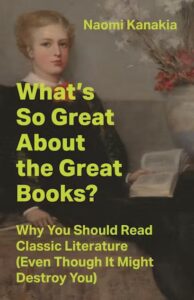
From What’s So Great about the Great Books? Why You Should Read Classic Literature (Even Though It Might Destroy You) by Naomi Kanakia. Copyright © 2026. Available from Princeton University Press.

Naomi Kanakia
Naomi Kanakia is the author of three YA novels (HarperTeen and Little, Brown), literary short stories (Gulf Coast, American Short Fiction), science fiction stories (Analog, Asimov's, F&SF), poetry (Cherry Tree, Storm Cellar), literary criticism (The Chronicle Review, Los Angeles Review of Books), and a self-published cynical guide to the publishing industry. She lives in SF with her wife and daughter.