Marilyn Monroe Was a Voracious Reader, Despite Her Near-Debilitating Imposter Syndrome
Gail Crowther on the Literary Life of a Pop Culture Icon
If someone tells you that you are stupid and dumb enough times, chances are you will start to believe it. If you are someone with no stable and loving family to fall back on, or no partner who believes in you, or no close friends who are in your corner, your self-worth relies entirely on the strength of your self-belief. This can be difficult to sustain, and it is understandable that some form of self-doubt would begin to creep in. Why is impostor syndrome an important point to consider when thinking about the literary life of Marilyn Monroe? The answer is that Marilyn’s reading formed a concerted effort to overcome any inadequacies she perceived in her-self. She strove for progressive self-betterment with an engaged and inquisitive mind. But to fully understand the literary life of Marilyn Monroe, we need to understand why she felt those inadequacies.
Marilyn had no supportive parents to tell her how well she was doing. One husband, Joe DiMaggio, interfered with, and tried to control, her career. Marilyn’s closest friends usually doubled as employees. In other words, she often paid those she was closest to. If anyone was going to believe in and champion Marilyn Monroe, it was going to have to be herself, and she often did a pretty good job of this. Coming from the background that she did, she took on and worked her way up through the Hollywood studio system to become one of the most famous women in the world.
Yet for much of the time she was terrified. Dorothy Parker recognized and empathized with this fear. Ayn Rand noted how incredible it was that Marilyn got as far as she did, faced with the attitudes of the time: “A spectacularly successful star, whose employers kept repeating: ‘Remember, you’re not a star,’ in a determined effort, apparently, not to let her discover her own importance. A brilliantly talented actress, who was told by the alleged authorities, by Hollywood, by the press, that she could not act.” Today, this would be referred to as “impostorization,” the idea that workplaces or institutions have cultures designed to make employees question their own competence or sense of belonging.
He felt that she wasn’t as intelligent as he had previously thought, and—much toMarilyn’s horror—he wrote that in some ways he pitied her.
It could also be seen as a form of gaslighting, making someone perpetually doubt themselves. Even when Marilyn found someone—Arthur Miller—who she thought truly believed in her, this too fell apart. Just months after their marriage Miller and Monroe traveled to England. One day looking for her film script, she happened upon his diary, which had been left open in the sitting room of their English house.
Whether it was left there deliberately or by accident is unknown. Marilyn saw that the entry was about her, and although she never exactly said what she had read and Miller never really spoke of this (his notebook is not available), she did say it indicated that he was in some way disappointed with and doubted their marriage. He felt that she wasn’t as intelligent as he had previously thought, and—much toMarilyn’s horror—he wrote that in some ways he pitied her.
The Strasbergs and Marilyn’s half sister Berniece said Marilyn told them Miller had thought she was some kind of angel but now he guessed he was wrong, and even worse, he was frequently embarrassed by her in front of his intellectual circle. In turn she regarded many of his friends with some resentment, claiming they treated her like “a dull little sex object with no brains and talked to me like a high school principal with a backward student.” People who knew Marilyn felt that she never fully recovered from reading Miller’s words.
What she did write in her diary were some of the saddest words:
I guess I have always been
deeply terrified at to really be someone’s
wife
since I know from life
one cannot love another,
Ever, really.
So, it is easy to establish plenty of examples where other people thought Marilyn was less than, and it would be foolish to think this did not have an impact on her feelings of self-worth. One of her biggest fears was being regarded as a joke, but how devastating it must have been to work so hard, to read so hard, to educate herself and learn, to have a wonderful personal library only for people to claim you never read any of it. But whether this amounted to impostor syndrome requires a little more analysis, both of the condition and what Marilyn had to say.
The name alone is loaded: impostor implying some sort of deceit, a charlatan or a fraud, and syndrome implying a disorder or ailment. But in fact, what the term refers to is a psychological condition in which a person suffers from feelings of self-doubt or fraudulence. They doubt their skills and talents, even when faced with evidence of their success. Their accomplishments feel empty because they fear they will be exposed as a fake, as someone who does not deserve their luck or success. This condition is not pathologized, it does not appear in the Diagnostic and Statistical Manual of Mental Disorders, and it is not a recognized psychiatric disorder, but people who suffer from it have a higher chance of anxiety, depression, sleep disorders, low self-esteem, neuroticism, and perfectionism. If you truly believe you are not good enough, you will screw yourself up trying to prove that you are.
Impostor syndrome is generally regarded as being a product of a person’s childhood or parenting (as Marilyn wrote in her diary, “Everyone’s childhood plays itself out”), but it is also linked to personality traits such as atychiphobia (fear of failure) and any existing mental health conditions. The overall impact is a sense of not belonging.
So far, this describes Marilyn. She lived with generalized terror and anxiety. She suffered terribly from insomnia. She often felt out of place. She was known to be a perfectionist, sometimes demanding take after take when even the director was perfectly happy. Diary notes that exist give us Marilyn’s voice. Written in a small black notebook with the gilded word RECORD on the cover, she reflects on her fear and panic.
On page 135, black-edged and written in pencil, Marilyn worries that if she is given new lines, she won’t be able to learn them or will make mistakes. Then this spirals: “People will either think I’m no good or laugh or belittle me or think I can’t act.” She tries to reason with herself but the fear she will somehow be “found out” is just too strong: “Trying to build myself up with the fact that I have done things right that were even good and have had moments that were excellent but the bad is heavier to carry around and feel have no confidence.”
It sprang from Marilyn’s self-doubt and fear that she was not good enough.
Yet impostor syndrome is usually classed as an unfounded belief of low self-worth. Surely Marilyn regarding herself as a joke and not good enough is not remotely unfounded. Everybody told her this—her studio, her husband, the press. Consequently, she tried so very hard. Truman Capote noted that one of Marilyn’s overriding features was her desire to try and please everyone. Max Lerner of the Los Angeles Times was one of the few journalists who seemed to understand what Marilyn was experiencing.
In 1960, reflecting upon the treatment she had received, he wrote, “She has shown an animal faith in her own life-force, and a long-range sense of purpose which no one and nothing have been able to deflect.” But more than this, Lerner felt Marilyn had something that stood out from the hundreds of other young women who had tried to make it in Hollywood, a holistic approach to what she was trying to achieve, which made her different: “The impressive thing is that this single-purposed drive towards stardom and fame and acclaim co-exists with a tremulous sensitivity, a hoydenish playfulness, an authentic talent, and an evidently genuine pull towards books and ideas and writers.”
Often because Marilyn appeared sweet and genuinely kind, her grit and self-determination were underestimated. And like any talented woman who sometimes refuses to toe the line, she was accused of being “difficult.” In Marilyn’s case, she did cause huge disruptions on set. She was often late. Not because she wasn’t ready but because she felt she wasn’t ready. She would be sick with stage fright, or think her hair and makeup were not perfect, or that she couldn’t remember her lines. All this self-agonizing left the rest of the cast and crew waiting around for hours, their goodwill draining away. Jack Lemmon, who starred alongside Marilyn in Some Like It Hot, understood that this behavior was not malicious or intentional or, quoting him, “temperamental.” It sprang from Marilyn’s self-doubt and fear that she was not good enough.
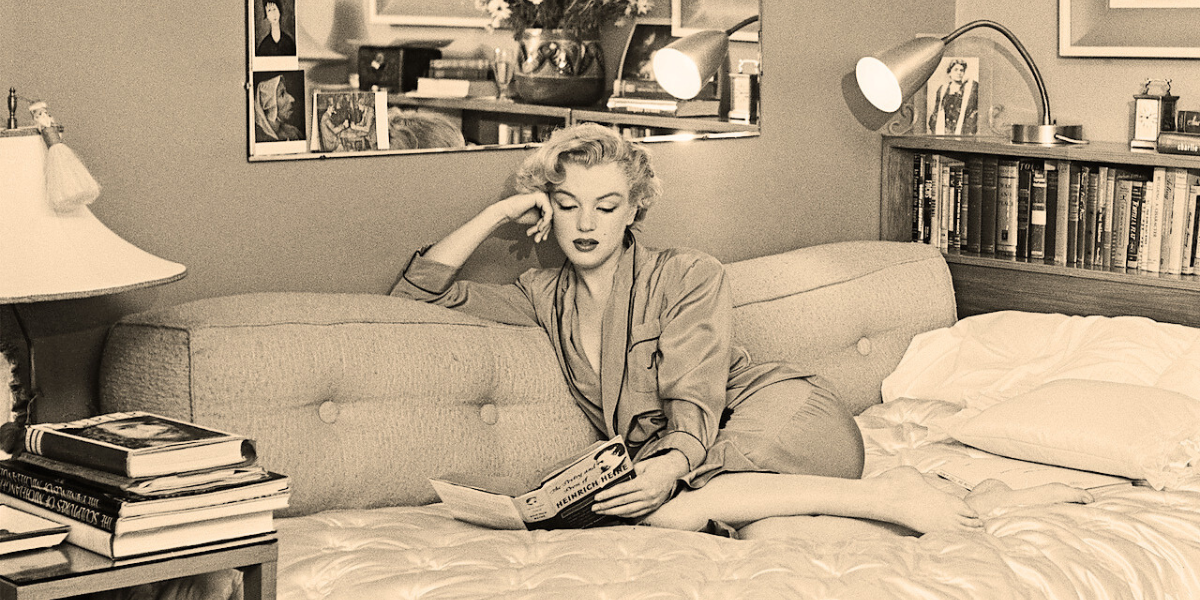
This lack of confidence and social anxiety is reflected by some of the books on Marilyn’s shelves. For example, not only did she have lots of D.H. Lawrence, but she had a book guiding her on how to read him. Her shelves contained books on correct etiquette when entertaining (How to Do It, or, The Lively Art of Entertaining by Elsa Maxwell) and instructional books covering many areas of life, ranging from gardening and raising Siamese cats to keeping turtles. She was always worried about doing something wrong, saying something wrong, and becoming an even greater object of ridicule than she already was. W.J. Weatherby noticed this hesitation and lack of confidence when Marilyn discussed her reading.
She was ashamed to admit some books were beyond her, and she was so used to not being taken seriously that when she spoke about playing Cordelia opposite Michael Chekhov’s King Lear in her acting class, she waited for Weatherby to scoff at her. When he didn’t, she shyly admitted that she wanted to perform more Shakespeare: “She suddenly raced on, her interest in the subject overcoming her embarrassment.” George Sanders, who starred with Marilyn in All About Eve, recalled her reading poetry on set and found her conversation had unexpected depths: “She showed an interest in intellectual subjects which was, to say the least, disconcerting.” But mostly he noticed that she was very unsure of herself: “She was somebody in a play not yet written.”
So, to come full circle, if you are told enough times that you are stupid, then it is always going to be a battle to resist that judgment.
But there was a feeling that whatever Marilyn did, it would never have been enough. She read The Sleeping Prince by Terence Rattigan, bought the film rights, formed her own production company to make the film, and engaged Laurence Olivier as her costar, and still people on set sniggered about her belief that she could act opposite one of the British greats of stage and screen. Olivier himself, tired of her using the Method to get into character, told her to “just look sexy,” a comment that infuriated her so much she began to be obstructive on set. The more she sensed people laughing at her, the more paralyzed she became. Her diary notes list her problems and fears: “nervousness, humanness, blunders, mistakes, and my own thoughts.” It didn’t matter that when the rushes of the film were viewed, Marilyn acted everyone off the screen (the consensus being amazement since she didn’t appear to be doing anything in front of the camera). It didn’t occur to anyone that she actually knew what she was doing.
Some of this came down to snobbery, but some of it was also a result of what Bosley Crowther in The New York Times believed to be a clash of fantasy versus reality: “She was more a symbol than an artist.” She was fashioned into this distinctive female symbol that was transmitted around the world, and this symbol was so strong that it overcame her artistry, her intelligence.
“Marilyn Monroe,” he wrote, “was not generally regarded as an artist submerged in her art.” Yet if this was the popular view, it wasn’t what writers saw in her. Somerset Maugham was delighted at the news that she was to play the part of Sadie Thompson in an adaptation of his short story “Rain” for television. This movie never happened because Lee Strasberg wanted to direct but NBC wouldn’t let him, so, depending on who you believe, he either instructed Marilyn not to take the role or she didn’t want to take it without him.
Saul Bellow was bowled over when he met her. “I have yet to see anything in Marilyn that isn’t genuine,” he wrote. “Surrounded by thousands she conducts herself like a philosopher.” The poet Norman Rosten, who became close to Marilyn, noticed that she needed constant proof she was adored because it denied her inner dread of being unwanted. And many writers who featured on Marilyn’s bookshelves—Garson Kanin, Alvah Bessie, and Lucy Freeman—were so taken with her that they went on to write books about her, or featuring characters based on her, after her death.
So, to come full circle, if you are told enough times that you are stupid, then it is always going to be a battle to resist that judgment. It is a testament to Marilyn’s strength that she fought against this for so long: “I ask myself what I am afraid of. I know I have talent. I know I can act. Well, get on with it, Marilyn. I feel I still try to ingratiate myself with people, try to tell them what they want to hear. That’s fear, too. We should all start to live before we get too old. Fear is stupid. So are regrets.”
__________________________________

Excerpted from Marilyn and Her Books: The Literary Life of Marilyn Monroe by Gail Crowther. Reprinted by permission of Gallery Books, an Imprint of Simon & Schuster, LLC.

Gail Crowther
Gail Crowther is a freelance writer, researcher, and academic. She is the author of The Haunted Reader and Sylvia Plath and the coauthor of Sylvia Plath in Devon: A Year’s Turning and These Ghostly Archives: The Unearthing of Sylvia Plath. Gail divides her time between the North of England with her dog, George, and London. As a feminist vegan she engages with politics concerning gender, power, and animal rights.