On Indigenous Rebellion as a Precursor to the American Revolution
Sarah M.S. Pearsall Discusses the Bloody History of Pontiac‘s War
As her world tilted and disappeared, the last buildings she would have seen were the church, the bakery, the artillery magazine, and a few houses along Rue St. Antoine. She would also have seen the crowd. For an enslaved woman who had probably spent much of her life shrinking into the background, trying to avoid attention—a scold or a slap from a mistress, a master’s unwelcome hand (or worse) in places she did not want it—it must have been disconcerting to be thrust into the spotlight.
There were so many faces turned toward her. There were women like her—some Indigenous and some African-looking sorrowful in their coarse linen shifts, huddling together. Their masters stood nearby, traders in thick mantle coats with handkerchiefs wrapped round their heads, smoking and chatting in French. Red-coated soldiers, stiff and solemn, called out orders in English. The fathers, faces ruddy, prayed in Latin for her soul, black robes flapping in the wind. Mothers with babies on their backs set down their heavy baskets for a bit, soothing their children with soft words in Potawatomi. A few of the little ones chased the chickens wandering around.
No one wanted to stand behind the commanding warriors, draped in blankets and furs, brass hoops in their earlobes, medals and wampum on their strong chests, silver armbands glinting in the light. The feathers on their shaved heads made them even taller, blocking the view. They probably clustered at the back, speaking low in Odawa, glowering at the dogs clothed in red.
Those red-coated officials hanged the woman, but they didn’t bother to record her name. That was British imperial justice in 1763. She had at least one name, probably more, but we don’t know them, and probably never will. She was a daughter, likely a sister-among people for whom siblings mattered a great deal-and perhaps a mother. Yet she lacked the protection of family because her kin ties had already been broken.
She was what they called a “Panis” Indian, which meant, more or less, a slave. Her fellow accused Panis had already made his escape “to the Illinois;’ leaving her to face the scaffold on her own. The two of them had been convicted of murdering their master, John Clapham, whose headless corpse was found floating in the river. Records include none of her words. If she gave a last dying speech, if she cried out loudly or sealed her lips tightly, it all floated away, down the straits. Yet her death helped to provoke a war that helped usher in a revolution.
There was power in unity.
The place where this hanging took place had not one but multiple names. Its Anishinaabe inhabitants called it Bkejwanong. The French had named it for the strait (detroit) below. The British pronounced that silent French tat the end: Detroit. There were many names, and just as many distinct visions of what constituted justice. Why did that death in Bkejwanong, and the murder that preceded it, matter so much? This woman’s choices, and those of other Indigenous people, were interconnected. She and others of this place refused to accept coercion, making defiant bids for autonomy. They were willing to risk death for liberty.
Here is a different kind of murder mystery. What do the killing of a trader, the execution of a woman, and the war that followed have to do with the American Revolution? Solving this puzzle illuminates the central theme here: how and why diverse people forged unity in critical ways, as well as how events west of the thirteen colonies influenced the course of events elsewhere. Wars—and peace—shaped unity, pushing people together—and apart—in a complex choreography. These events in Detroit reveal an increasingly burdensome system of empire and slavery, which caused many to push back against it.
There was power in unity. Indigenous people understood this point; so did the authors of the Declaration of Independence. They called themselves the “United Colonies” and also, of course, the “thirteen united States of America” in the document’s very first line. Indigenous citizens of many distinct nations, too, crafted a relatively expansive vision of unity, one nurtured by kinship, diplomacy, and religion.
Anishinaabe was a designation like “European” that included many nations (such as Ojibwe and Odawa). Anishinaabe emphasis on unity and autonomy became more important as some settlers developed an increasingly narrow vision of solidarity, one excluding Indigenous people and even British and colonial officials. Both trends, stemming from wars in the 1760s, would shape the dynamics of the 1770s in profound and abiding ways.
Killing this woman rattled imperial officials. There is a whiff of anxiety in the letters that Major Henry Gladwin, in charge of the fort, exchanged with General Jeffrey Amherst, his commander, about this execution. The two men knew it hardly reflected glory on crown and country to hang a woman, especially one as powerless and seemingly inconsequential as an enslaved Indigenous woman. The assumption of British men and law in this period was that a woman criminal in a pair was merely an accomplice led astray by the man.
Still, since the man had fled, these officials emphasized the necessity of executing her, even as the whole episode whispered even to them of the dangerous vulnerabilities of their colonial situation. Although “I am always Sorry to Consent to the Sending of any Unhappy Wretch out of this World,” sighed Amherst, her crime was “so very heinous … that nothing less than her Life could Atone.” “This Barbarous Act;’ he advised, had to be punished “in the most Public Manner, as a Terror to others.”
British leaders like Amherst and Gladwin sought to bring terror and subjection to Indigenous people; their actions had exactly the opposite effect. Indigenous individuals did not see justice here: quite the reverse. It wouldn’t be the last time that officials misread the American situation and misfired, consequences recoiling on them with devastating effect. As one observer later framed it, “at the very time we were representing the Indians to ourselves as completely subdued and perfectly obedient to our power, they were busy in planning the destruction, not only of our most insignificant and remote forts, but our most important and central settlements.”
If British officers saw this “Unhappy Wretch” as dispensable, others did not. Her case, within a nexus of other acts of disrespect, provoked the ire of numerous Indigenous Americans, including one of the better-known of the eighteenth century, Pontiac, an Odawa leader who organized resistance against the British. Determined to assert their own vision of justice, Pontiac and others painted themselves for war, picked up their stockpiled arms, and attacked British forts, just two weeks after this hanging.
To many Indigenous people, the British specialized in preventing them from doing what they pleased. In 1764, Anishinaabe men expressed indignation at being stopped by British soldiers from going to their own hunting grounds.21 A speech by an Odawa diplomat reported that the Delaware “told us this Spring, that the English sought to become Masters of all, and would put us to Death.” When Gladwin wrote to Amherst in April 1763, he reported that Indians had been protesting: “They say We mean to make Slaves of them.”
When Pontiac addressed the French in 1763, he complained, “You do not speak to us any more like brothers, but like masters, and you treat us as we treat our slaves.” One British author and veteran of the Seven Years’ War and Pontiac’s War contended, “No people on the face of the earth are fuller of the idea of liberty than the North-American Indians. The very thoughts of that slavery which they were made to expect under the English, was enough to determine them to enter into every proposal the French could offer.”
“Almost dying” does not sound much like “entertainment.”
Indigenous people who were not enslaved resented being treated like slaves (colonists felt the same). In the 1760s, several situations arose involving ordinary people navigating coercive authority that restricted mobility and autonomy. In one telling incident, a group of indigenous women was shot at while traveling by canoe. Even in tense moments of war, a bevy of women usually signaled peaceful intentions. By custom, such women, chatting and paddling their way along the rivers, were to be left alone. The English ignored these unspoken rules. From their position on shore, British soldiers attempted to stop the canoe. In response, the women maneuvered their craft behind some brush, hiding from the soldiers gawping at them from the bank. The officer fired on the canoe, hitting the bow.
Those shots explode with that whiff of anxiety we have already witnessed, as British officers attempted to show their mastery of a situation in the face of their evident lack of it through violence toward women. The women lodged an official complaint that the British officer “had treated the Indians like Slaves.”
Being treated like a slave meant the threat and the reality of coercive violence, and, for women especially, sexual violence. British soldiers exchanged letters from the forts-spaces dominated by men-about Indigenous women, whom they termed “harlots,” assuming easy access to at least some of them. Amherst mentioned one woman at a fort who “had entertained herself so often with the Soldiers that she was almost dying.”
“Almost dying” does not sound much like “entertainment.” Was this Indigenous woman injured by forced sex with multiple soldiers, or by their diseases? Either way, behind Amherst’s disconcertingly neutral observation lies a dire situation.
The reality and threat of sexual violence may help to explain not only the canoe incident, but also the murder of John Clapham. We do not know why he was killed. All we know is that “A Cruel & Inhuman Murder” took place near Detroit in 1762, “Supposed to be Done by Two Panis Slaves … Assisted by some lndians.”
It may be that this woman and man killed Clapham to take his goods and gain a better life. After all, the behavior of the Panis man, who made his escape without the woman, suggests that he was not necessarily the most upstanding character. Yet why would a woman have apparently helped to kill and decapitate a man, an act even the hardened Amherst denounced as “so very heinous”? Then, as now, it was rare for women to commit extreme physical violence. Those few who did so were usually desperate, having endured violence themselves. As one scholar of Indigenous slavery has observed, Panis women working for Europeans were “extremely vulnerable,” routinely “made sexually available to” traders.28 In other words, men like Clapham would have expected more than just the washing of their clothing and the preparation of their food from a Panis woman. The Panis man may have been seeking to protect her. In similar cases, the master had been directing relentless sexual violence against the woman before his death.
A few women carved their rage onto bodies. After the siege of Detroit began, Gladwin sent soldiers to Niagara to obtain provisions. At day-break, a group of hostile Wendats and Potawatomis killed and mutilated several British soldiers. One French observer reported, “Even the Indian women took a hand.”The women-and only the women-did two things in particular. First, “they slashed them with knife-cuts, as we do when we want to lard beef”-a chilling description of women’s brutality in a domestic register. Second, “some of the women mutilated them to the point of emasculation,”or, to translate the French more bluntly, “cut off that which makes a man.” As with the murder of Clapham, this kind of symbolic aggression implies rage against British men as men. These same resentments likely erupted in the murder of Clapham and in the solidarity a great many local people felt with the Panis woman.
So united and powerful were these Indigenous people that some of their enemies started to get desperate, that whiff of anxiety taking on a sickening stench.
Violence against women provoked outrage among Indigenous women—and men. Men like Pontiac do not seem to have used sexual violence as a weapon in war, which is remarkable. So many others around the world did—and, alas, do. These men considered the loss of control that such behavior implied-an animal urge indulged by weak men lacking the courage to fight other men directly-to be shameful. Their war preparation usually curtailed even healthy sex lives, since sex was considered a dangerous distraction. In short, these Anishinaabe men did not generally use sexual violence as part of their grammar of war. They were not entirely high-minded; torture remained part of their arsenal. Yet settler violation of women registered as a strike on an entire nation. Indigenous men grieved but also fumed when women were attacked.
Sexual violence was a factor—though far from the only one—in Pontiac’s resistance. One observer noted that Pontiac “under pretext of some fancied insult” from Gladwin had determined that only “members of his own nation ought to occupy this part of the world.” What was the nature of this “insult”? A British soldier had struck an Indigenous man with his gun when the man attempted to protect his cousin from rape.
Of course, there are other explanations beyond sexual violence for Clapham’s murder and Pontiac’s anger. Still, this murder emerged from a setting where some people endured violence and slavery at the hands of others. The war, too, grew out of resistance to sexual violence, slavery, and coercion.
The heavy hand of British executions, offensive to Indigenous notions of reparative justice, also provoked many. Indigenous justice tended to be performative and community-oriented, “covering” losses and making restitution, not instilling terror. The French had behaved differently than the British under Amherst did; the French had played by Indigenous rules. Captives, gift giving, and diplomacy could help remedy a killing that was seen as an act against a community, not just an individual. During the Seven Years’ War, when two Indigenous men had murdered an allied Frenchman, they had to beg forgiveness in a highly staged ritual. They were brought bound, “naked, smeared with black paint, slave sticks in their hands.”
Then, performing contrition, “they prostrated themselves at the feet” of the French governor. In his scripted response, he “gave them a white shirt, advising them to have hereafter a heart as white as it was.” They could then take their seats with others, “This ceremony having rehabilitated them.”
At times, as there, the French were willing to follow local rules of punishment and rehabilitation; the British were not. Public executions-along with jails and whips, those other symbols of colonial oppression-infuriated Anishinaabe people. As one Frenchman observed, “This is and always will be their excuse for making war.”
In 1763, amid whips, chains, and nooses, there arose “a mountain of marvellous whiteness” and a powerful woman. They appeared in the mystical vision of Neolin, a Lenni Lenape leader, the kind of man whom the French called a conjuror, or medicine man. Neolin’s dreams—linking this world and others, connecting with spirit animals, and full
of symbolism—seemed to forge a path to a better world. In these moments, Neolin became the Wolf, seeking the Master of Life. The Wolf’s journey began with that hill and the mysterious woman “of radi-ant beauty” who told him he had to climb it. No fool, the Wolf “was careful to obey the words of the woman.”
First, he had to bathe himself. Next, he had to ascend. As the Wolf stood facing that massive pile, “perpendicular, pathless, and smooth as ice,” he “questioned this woman how one should go about climbing up.” She gave him no answers, only encouragement. The Wolf figured out how to ascend; a person just had to think, to show courage, and to work for the goal. He reached villages at the top, at which point he looked down and remembered that, thanks to the bath, he was in fact stark naked.
Even visionaries could have a sense of humor. Jokes taught lessons too. The Wolf’s nudity could be read as a metaphor for his acceptance of his powerlessness, his willingness to listen with humility, and his purity. Despite his lack of both clothing and confidence, the Wolf eventually found his way to the Master of Life, who was also inspiring but demanding. The Master assured the Wolf of his love for the Wolf’s people, but he also required reform, warning against drunkenness, fighting, polygamy, and adultery. The Master also urged political changes: “This land where you all dwell I have made for you and not for others.” The Master exhorted the Wolf to “drive off your lands those dogs clothed in red who will do you nothing but harm.”
Pontiac and the people who supported him knew that harm first-hand. Over the nine years of the “Seven Years’ War,” they had lost family members, prospects, and a lot of options. It was hard to keep fighting; the costs of war were high and personal. Still, what man wanted to be a dog, or, even worse, a dog of dogs, forced to live by British rules?
Domesticated, dependent, skulking around, snatching whatever food was left unguarded: Here was the miserable future painted by Neolin if the Wolf’s people accepted this colonial order. Pontiac wanted to be like the Wolf: masterful and fierce, making the British cower and flee. He was not alone in this desire. If Anishinaabe could band together, and obtain enough firearms from their old allies the French, they could vanquish those dogs clothed in red. It is hard not to wonder: Was Pontiac using Neolin’s visions to advance his own ambitions, or did he really believe a different world was possible?
Both, probably; he wanted to ascend the mountain for himself and for his people. After 1763, Pontiac and many others yearned to create a strong community and to assert the independence of Indigenous nations. For some of them, it was a continuation of an old war, what one historian has called “a war for Native autonomy.” Unity was critical to these aims.
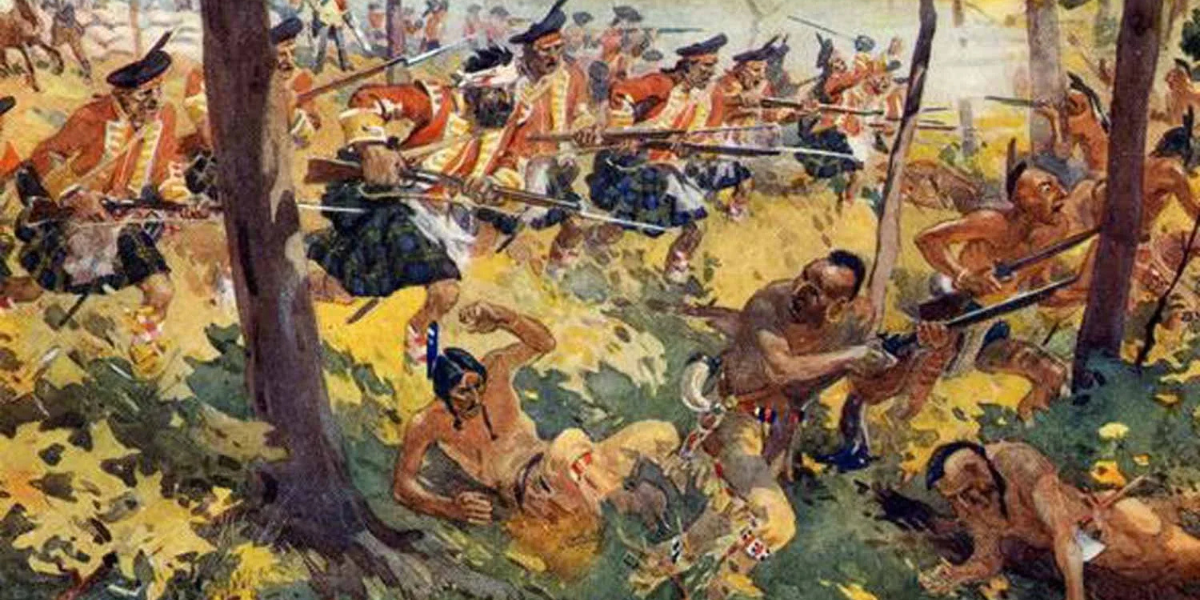
Donning his war belt and raising the hatchet of war aloft, Pontiac “began to chant a war-song against the English.” Many nations joined the chorus, chanting day after day, indicating their assent. People as diverse and dispersed as the Lenni Lenape on the East Coast and the Odawas on the Great Lakes joined the war song. They found unity, despite histories in some cases of direct conflict, especially between the Odawa and the Wendat. Not everyone agreed, including one Catherine, described as an “old woman chief,” who supposedly revealed Pontiac’s plans to attack Fort Detroit, as well as a northern Odawa leader who “threw away” the war hatchet sent by Pontiac—or so he told the British in 1764. Not everyone loved Pontiac. Yet most supported him, month after month, year after year.
The attacks Pontiac led in 1763—most of them successful-showed the hopes that thousands of people had to force the British out of their beloved homelands. As in many wars between Indigenous people and Europeans, such as King Philip’s War in seventeenth-century New England, the British gave this war the name of its primary leader. Yet a name like that minimizes the solidarity of several different nations.
One account claimed that Pontiac was supported by “the Indians, composed of Chippewas, Potawatamies, Hurons (Wyandots), and in fact all the surrounding tribes … to the number of about three thousand.” That number, though possibly unreliable, suggests the strength of this solidarity. Indigenous forces won the Battle of Bloody Run outside Detroit in 1763, and they succeeded in taking numerous British forts in the Ohio Valley and the Great Lakes. However, they were unable to take the three largest forts: Detroit, Niagara, and Pitt.
Still, one British veteran of the Seven Years’ War found it remarkable that this multinational solidarity had endured for so many months. As he phrased it, “It was a thing without precedent, for such a multitude of Indians to keep the field so long.” He attributed this success to Pontiac’s influence and to the ability of Pontiac’s French secretary to secure supplies. The provisioning of warriors suggests, though, the helping hands of Indigenous women, who grew and preserved food. They exhorted their warriors to fight well, to “exert yourselves, and act like Men, and true Brothers.”
Indigenous soldiers captured numerous settlers as the British struggled to subdue this mighty alliance. They usually took women and children captive, and they killed men, sometimes torturing them first. In grave moments, they killed captives, too. In war, no one’s hands stay clean.
So united and powerful were these Indigenous people that some of their enemies started to get desperate, that whiff of anxiety taking on a sickening stench. For the British in North America, the war begun in 1754 had included a series of defeats, a relentless struggle against people who knew the terrain and who linked arms with the French. Men like Amherst likened the British situation in North America to previous campaigns against hardy, clever, and intractable Indigenous people that had taken centuries: the ancient Roman conquest of Britain, or the English conquest of Ireland.
It seemed impossible to make headway. “We must … Use Every Stratagem in our power to Reduce them,” Amherst decreed. The author of an anonymous manual on war found among his papers suggested one strategy: directly kidnapping Indig-enous women and children in order to force their men to stop fighting, a tactic that would not have been countenanced against settler women and children. Colonel Henry Bouquet even suggested to Amherst “to make use of the Spanish Method to hunt them with English Dogs [to] extirpate or remove that Vermin.” Yet it was impractical to bring dogs from England to the Great Lakes, Amherst concluded.
However, British officers did have an even more deadly, if more uncontrollable, weapon at their disposal: smallpox. Amherst and Bouquet both alluded to using smallpox (which could survive for hours on textiles) “to Extirpate this Execrable Race,” as Amherst phrased it. Those who survived smallpox gained a lifelong immunity to it. Therefore, it was dangerous only to those who had never had it: a great many Indigenous people and others too. Still, although this strategy was the most perilous of all, it was the one they chose. When two Lenni Lenape diplomats departed Fort Pitt after discussions, the English gave them two blankets and a handkerchief from “the Small Pox Hospital.”
Settler frustration underlay this biological warfare. To many settlers, including some from Northern Ireland in what is now western Pennsylvania, Pontiac’s War seemed a continuation of a long, hard struggle against “French and Indian” people. After all, the great conflagration of the Seven Years’ War, which killed more than a million people around the world, had also begun in such a spot. It was easy to imagine that Pontiac’s War could inflame tensions elsewhere.
In 1763, one Mohawk youth had planned to attend King’s College (Columbia University) to train as a Christian missionary. His nation had nothing to do with Pontiac’s War. However, he did not go because his friends were concerned that the war would make it difficult for him in New York City “where he can hardly be a Day without hearing his Countrymen … heartily cursed as deserving to be all extirpated … the Boys in the Street will be apt to insult him.”
The killers went back to their farms and families and lived on.
All too many Americans did not distinguish between Indigenous allies and enemies, as at Conestoga, Pennsylvania. In 1763, during Pontiac’s War, a group of peaceful allied Indigenous people took refuge there. In December of that year, a group subsequently called the Paxton Boys murdered six individuals there, setting fire to their homes in the early dawn of a snowy day Another fourteen residents had been away at the time. The murderers followed them to Lancaster, Pennsylvania, and proceeded to kill and mutilate them, too. Of the fourteen, eight were children. Killing children in a shelter marks another attempt at “total extirpation.”
Yet the Paxton killers were not finished, marching on to Philadelphia in January to threaten other allied Indigenous peo-ple there. Although they were halted, no charges were ever filed against them. The killers went back to their farms and families and lived on.
Not everyone shared their vicious vision. A lot of people in Philadelphia and elsewhere denounced them. The lines drawn were not simply between British officials and frontier vigilantes. Those further east-such as Benjamin Franklin-tended to keep steadier heads and hands. Franklin was an established printer and author, an inventor (most famously of the lightning rod and also of bifocals), promoter of education (including founding the school that became the University of Pennsylvania), and civic institutions (including the Library Company of Philadelphia and the American Philosophical Society). He sympathized with Indigenous allies, producing a narrative condemning the Paxton killers.
Franklin, a consummate publicist, included the names of several of the murdered people. There was “John Smith;’ a Cayuga married to a woman named Peggy. There was “Betty, a harmless old Woman; and her Son Peter, a likely young Lad.” There was “Sally, whose Indian Name was Wyanjoy … esteemed by all that knew her.” He concluded: “Unhappy People! To have lived in such Times, and by such Neighbours!” He painted a vivid picture of their tragic end:”they fell on their Knees … in this Posture they all received the Hatchet! Men, Women and little Children-were every one inhumanly murdered!-in cold Blood!” He lamented: “the Guilt will lie on the whole Land, till Jus-tice is done on the Murderers. The Blood of the Innocent will cry to Heaven for Vengeance.” As he concluded,”Cowards can handle Arms … can wound, mangle and murder; but it belongs to brave Men to spare, and to protect.”
Ben Franklin took a lot of heat for his brave defense of indigenous people during the Pennsylvania Assembly elections of 1764. He and members of the pacifist Society of Friends (or Quakers) such as Israel Pemberton who favored accommodation became the subject of political attacks from the kind of individuals who supported the Paxton killers. One satire rendered literal the insult of “Indian lover.”
On the right side of the image, Pemberton, labeled “King Wampum,” is fondling the breast, spilling out of her dress, of the Indigenous woman with whom he is dancing. Her hand lingers between his thighs as she steals his watch fob. Using Quaker forms of address, she says:”Thou hast something lovely in thy Fob I must enjoy it.” He replies with a leer: “Thou hast something lovely in thy countenance I must enjoy thee.” On the other side, a Quaker distributes tomahawks to Indigenous men from a barrel marked IP (Israel Pemberton). Another Quaker at the table frets: “The Paxton spirit grows Stronger and Stronger.” Clutching a bag of money in the center, Ben Franklin declares his desire to win the upcom-ing Assembly election (he did not). War far away affected local politics.
In the meantime, that war drew to an inconclusive close in 1764. Pontiac and his allies had hoped the French would join, supplying more arms and soldiers. The French, still smarting from the Treaty of Paris, did not. Pontiac and others began negotiations with the British, who had replaced the lndian-hating Jeffrey Amherst with the more even-handed Thomas Gage. His willingness to negotiate ended the war, and gift giving and diplomacy eased the situation.
Some have wondered: Did Indigenous Americans belong to a larger Age of Revolutions? Yes—in fact, they helped to launch it.
Still, distrust remained. The Newport Mercy, back in Rhode Island, reported in 1765 that “Pondiac and the chiefs of the other nations” had made peace with the British, but that one of them had “declared, that they had talked friendly to the English, only from their teeth out, but hated them in their hearts.” The British capitulation infuriated many colonists. Men like the Paxton killers envisioned an American landscape stripped of its Indigenous inhabitants, where settlers could live on their land with their wives and children in peace and prosperity. They wanted their sons and daughters to be able to move west without fear to cultivate richer farms, better lives. They blamed accommodationists like Franklin and Pemberton for tragedies in the west.
Pontiac’s War also shaped British responses. They started to change tack. Facing the difficulties of managing and organizing a suddenly enlarged global empire, they did not want to launch any kind of total war against Indigenous people, whom they considered, like the French, simply another set of subject peoples, to be managed and assuaged. The British developed a plan for empire in 1764, to be rolled out over the next few years, which would have centralized authority and regulated trade, land boundaries, and justice in Anglo-Indian interactions.
This “Plan for the future Management of lndian Affairs” was never enacted, and in fact one historian contends that its “utter rejection … may be its greatest historical relevance.” There are several reasons why it failed ever to take effect, but chief among them was that it was a vision of empire-with relatively even-handed treatment of lndigenous nations-unacceptable to colonists. It would also have required further taxes. What happened subsequently proved that taxation, too, could provoke resistance.
Indigenous people like Pontiac wanted to reach that shining mountain of autonomy. The residents in those villages around Detroit worked for a world without controlling British men: their stiff soldiers, their corrupt trading, their debilitating alcohol, their grasping hands. As one English soldier noted of his countrymen: “They impose on the men both in buying and selling, abuse their wives and daughters, and other female relations; and go yet greater lengths, if possible, in every other species of wickedness.” He concluded: “Where is the wonder then, if we so often find the Indians on our backs, without being able to particular-ize the motives of their insurrection?”
An enslaved Panis woman from the pays d’en haut died at Detroit in Her death, like her life, counted. It came out of a world of diversity and accommodation, one which started to look imperiled. After 1763, Indigenous Americans started to feel the heavy hand of British imperial justice in ways that provoked them. What was seen as the injustice of her ignominious end on the gallows was at least one factor of many that propelled a move to war.
Some have wondered: Did Indigenous Americans belong to a larger Age of Revolutions? Yes—in fact, they helped to launch it. This moment shaped profoundly all that was to follow. All kinds of people forged unity out of noble ideals (community, sovereignty, freedom) and also out of less noble ones (racial and other exclusions and fierce anti-British sentiments). In a culture of resistance to encroachments and violence, Indigenous women and men were among the first North Americans to push back hard against the British Empire.They overcame distinctions of culture, language, even histories of conflict to come together to fight for a different world. In refusing to be treated as slaves, they built soli-darities on religion, kinship, and anti-British rhetoric.
A scheme for extermination, shared in different ways by Amherst and the Paxton killers, increasingly united many others in 1763, and beyond. For them, freedom meant the freedom to take Indian land, a land free of Indians. Here is the dark heart of the coming of the American Revolution, one still beating into the new republic, energizing set-tlers to fight, to protest, to kill, and to write declarations. In 1764, the Paxton killers complained in their Declaration and Remonstrance that “the Frontiers of this Province have been repeatedly attacked and ravaged by Skulking parties of the Indians, who have with the most savage Cruelty, murdered Men, Women and Children, without distinction.”
In 1776, the Declaration of Independence condemned King George III for having”endeavoured to bring on the inhabitants of our frontiers, the merciless Indian Savages, whose known rule of warfare, is an undistinguished destruction of all ages, sexes and conditions.”54 Here is the sound of the settlers’ war chant, angry words that sent musket balls flying.
In the wake of the Seven Years’ War, many people in North America, Indigenous and otherwise, envisioned new worlds. Anishinaabe people dreamed of a confederation in the Great Lakes, rising like a white mountain, one that reached back to precolonial days but also looked forward to a modern and united Indigenous people. The supporters of the Paxton killers imagined instead a land cleared of the peoples who had long lived there; they were willing to do almost anything to make that happen. Others, like Franklin, wished for a new kind of empire, one in which justice prevailed.
British officials, too, had plans for a reorganized empire, one that would unite colonies from the Canadian north to the Great Lakes to Caribbean islands. Chests puffed up with victory for a time, but soon new imperial worries bent shoulders and backs. The burdens of war were heavy, and they lingered. There were debts to repay. If the Brit-ish had to protect settlers, then it was reasonable that those colonists should help fund that protection. Or so it seemed to British authorities who started to enact new plans for revenue.
__________________________________
From Freedom Round the Globe. Used with the permission of the publisher, Doubleday. Copyright © 2026 by Sarah M. S. Pearsall

Sarah M. S. Pearsall
Sarah M. S. Pearsall is an award-winning historian with degrees from Yale, Harvard, and Cambridge, where she taught for nearly a decade. She is a professor in, and soon to be Chair of, the Department of History at Johns Hopkins. She wrote this book as both a National Endowment for the Humanities Public Scholar and Distinguished Fellow in the American Revolution at the British Library.