The Helter-Skelter History of the Manson Murders
Claudia Verhoeven on the Convoluted Notions of Time in the Manson Family
“Now is the time for Helter Skelter,” Charles Manson is said to have said, and then the family went out and committed two nights of violence that meant to “shock the world” and “instill fear into the establishment.” But given the paradoxical notions of time that shaped the family’s communal life, it’s remarkable that they knew what he meant at all, not to mention that this unusual temporal pronouncement had for them the force of law. But apparently, they did, it did, and it matters: Distinct notions of time factored into the family’s radicalization and rooted whatever authority Manson had for its members.
What we will call “family time” was no less striated than the space at Spahn’s, and it too was causally connected to the family’s crimes. Like that space, so this time: It is assumed to be stable, straight, and standard, but if we disaggregate and analyze its layers, it becomes plain that it was much more multifaceted than that. But also, uniquely, we can come to see a kind of psychic link in the family between their experience of time and an unusual understanding of terror.
This link ultimately produced in them a state of hyperconscious historicity, something like an intensely sharpened sense of being in time, which animated their will to violently intervene in the historical present for the sake of an exalted future. Such a link however is characteristic of radicalization more generally, and indeed the strange story of Helter Skelter—the official script, certainly, but not only—becomes straightforward as soon as it is read as belonging to the longer history of politico-religious extremism, or terrorism.
In one sense, family time was not atypical for the era. “Have you heard a song that is popular like right today, where, in part, the language of that song is ‘Tomorrow is out of sight and yesterday is gone’?” Manson’s lawyer Irving Kanarek asked the psychiatrist Dr. Joel Hochman, who after repeatedly interviewing the female defendants had testified that they consistently quoted Manson, including a statement that “everything is now, there is no future, no past.”
Hochman had not heard the song (which is by Kris Kristofferson), but he agreed with Kanarek that no, this temporal attitude was “certainly not unique.” Living for today, everyone apparently agreed, was characteristic of a youth culture that was dropping out from a system and society responsible for cutting life short both at home and abroad. But family time went further, because Manson essentially led a sustained assault on “clock time”—first to decelerate it, then to eliminate it altogether.
In most of the television interviews he gave after his conviction, Manson did a little musical routine that we might say, somewhat seriously, performs sociologist Hartmut Rosa’s dystopian theory of social acceleration: Clapping his hands or otherwise creating a beat, Manson said that each time he got out of prison—in the early ’50s, late ’50s, and late ’60s—popular music had sped up. Interviewed by Dr. Joel Fort in preparation for Leslie Van Houten’s 1977 retrial, Manson explained his eventual diagnosis and prescription: “The whole thing is gonna go mad at the pace it’s going. You have to slow it down. That’s what I did. I took the clocks away. I took the TV away.”
In Helter Skelter, Bugliosi argued that Manson had established the temporal regime at Spahn Ranch to isolate the family and “[create] in this timeless land a tight little society of his own.” And Tex Watson did confirm that family time had its roots in Manson’s direct command: “Charlie never allowed calendars or clocks at Spahn—time meant nothing when you lived in an eternal now.” But at least initially there were other reasons too. “Man invented time,” Manson told Gregg Jakob-son. “The clock is the invention and creation of man. It is a concept.” Eventually, Sandra Good later wrote, Manson invented “a new time, a clock face divided by colors.”
A magical mystery tour, Lynette Fromme explained, “is making the best that could possibly be made of every single day and letting yourself be whatever creature you feel like being.”
But in the meantime Spahn’s would be devoid of measured time. “All occasions at the ranch are the same,” said Lynette Fromme, one of many who testified that they wore no watches, had no calendars, and did not pay attention to the days of the week. Even those who did not necessarily “follow” Manson were affected because of this setup. As Danny DeCarlo explained,
Because we never had no clocks or calendars up there, so, hell, I didn’t know what time it was. It got dark, light, dark, and that was it. We never listened to a radio; we had no calendar, so one day went along like the next day. I did not know if it was Monday, Wednesday, or Friday.
The situation was exacerbated whenever the family was in Death Valley: “I can’t pick you no dates,” said Juan Flynn when asked about the when of a certain event. “You don’t have no dates up in the mountains, you know. It is just days and nights, you know.”12 Long-term exposure to this ultimately resulted in the obliteration of modern temporal units: “I’m so screwed up,” Leslie Van Houten told her first lawyer, Marvin Part, when asked about a certain time. “It was the rainy season,” she said, then added that she “can’t tell months, only seasons.”
This antichronism eventually also caused severe memory loss among family members. Said Van Houten’s later lawyer Maxwell Keith about his client, “It is now very difficult for Leslie to remember dates and time, as time meant nothing to her.” Nancy Pitman said in the same vein, “I can’t remember so long ago in such a direct order because, you know, my life, you know, at the ranch, you know, wasn’t filled with time like that.” Linda Kasabian said simply this: “I wish you wouldn’t ask me time because I don’t know time.”
While it is fair to see the family’s refusal to tell time as an effort to set itself apart from “the ones that work from 8:00 to 5:00” and as part of the long history of assaults against “clock time” analyzed by E. P. Thompson and other scholars, of course it also just meant to obfuscate the facts of family crimes and block efforts by lawyers on both sides to make their case. Patricia Krenwinkel’s defense attorney Paul Fitzgerald, for one, expressed serious frustration with the difficulty of pinning down with any kind of exactitude the evidence given by prosecution witnesses:
And when you would ask them over and over again, what day?
Well, we didn’t pay any attention to days. One day merged into the next. Could it have been a Sunday?
Yes, it could have been a Sunday. A Monday? A Tuesday? A Friday? Could it have been August?
Yes, it could have been August. Could it have been July?
Yes, it could have been July.
But again, initially, there were other grounds for doing away with measured time, and its absence was experienced as extraordinarily liberating: The timelessness it created was the backdrop to the constant, conscious “changes” that the family sought to affect with their “magical mystery” tours. A magical mystery tour, Lynette Fromme explained, “is making the best that could possibly be made of every single day and letting yourself be whatever creature you feel like being.”
So Manson might be Riff Raff Rackus, and Steve from LA turns into John Jones from Minneapolis, and Dianne becomes “Snake,” and Susan “Sadie,” and Leslie “Lulu” and “Louella,” and so on. As with the family’s refusal to tell time, magical mystery touring did also have a more tactical purpose for those living on the margins of society. Quoting Manson during his testimony for the prosecution, Brooks Poston said: “Put it on to keep the man from bothering you. Become something else, don’t get stuck in one person; be something else.” Fitzgerald, for the defense, acknowledged the same about this shiftiness: Family members changed their names to avoid police harassment, but he underlined that it was also because “they made a conscious effort to assume a new identity,” and he called their frequent name changes “humorously poetic. “Slippies” was the neoloism Manson coined for this way of being, for the new kinds of beings they were becoming.
“We dressed differently each day,” Atkins told the grand jury. “[We] were each a different person every day of our lives. Three, four, five different people. Changes. Changes. Not backward, not forward. Just changes. Changed faces, changed names, changed clothing, changed expressions. Just live every day for every day.” Wrote Watson several years later:
The Family lived in the present, the moment and its fancies, not questioning where we’d come from, who we’d been. If one day one suddenly changed his or her name (as many of the girls did more than once) and took on a new personality, then you just rode with it.
The Manson family’s real devotion was thus to being in what they called “the now,” though perhaps unsurprisingly it is difficult to come by a dis-tinct definition of this temporal unit. One of Atkins’s statements is exemplary: “Now is now. Now is everything that ever was, ever will be. Right now. It is now.”
“The now” therefore must be approached in a more roundabout way, via duration. Fromme’s reference to “an aesthetic experience” in answer to a question about Manson’s “philosophy of life” indicates that what “the now” is about is a kind of authenticity that enables a heroization of the present. “Each moment is different. You have to live by the circumstances surrounding each moment,” Fromme said.
[Manson] was always happy, always, and it was like—he had no frame of reference. He moved—like if there was a path—he lived for the moment, he moved, like that if there was a path on the road, some-times instead of going over the path—this was in the woods—we would go over the branches and through the undertunnels, and the thickets and things, and things And it’s, what is it, an aesthetic experience Every minute was a different experience. Every minute was something I had never experienced before.
The fact that this description calls forth the spirit of a Situationist dérive should serve as a reminder that in all this there is overlap not just with sixties counterculture broadly speaking, but rather more specifically with its avant-garde, in California groups such as the Diggers. The Diggers were active in San Francisco’s Haight-Ashbury district when Manson arrived there following his 1967 prison release, and he on occasion mentioned them, though only with regard to their “free” events, for example the free food movement.
By the end of the trial though, even some of the defense attorneys accepted Helter Skelter.
Minus the violence—the Diggers were explicitly opposed to armed revolution—the two groups had a great deal in common. Especially relevant with respect to family time is the Diggers’ concept of “life-acting,” which was adopted from their earlier incarnation as the San Francisco Mime Troupe, that is, from a “guerrilla theater” practice that actively sought to tear down the boundaries between art and life. The “life-actor” was someone who “consciously creates the role he or she plays in everyday, offstage life.” It meant a dedication to a “life . . . lived in a consistently improvisational manner.” This had a temporal aspect, necessitating a move away from a “predictable future, into the playful possibilities of existing spontaneously in the perpetual present.”
It is possible, therefore, to underline the strong similarity between the Diggers’ “life-acting” and “perpetual present” and the family’s “play-acting” and “eternal now.” In the family’s case, however, this “presentism” was underwritten and consciously molded by Manson’s very long prison experience, which eventually gave it a very different edge from the Diggers’ time.
Vincent Bugliosi argued—first in court, then in Helter Skelter—that Manson had meant for the murders to incite Helter Skelter. Sometime during the summer of 1969, after months of pronouncing that “Helter Skelter is coming down soon,” Manson grew “impatient” waiting for the race war to erupt spontaneously, and began to advocate voluntarism—“I want to show Blackie how to do it,” he supposedly said—then eventually proclaimed, “Now is the time for Helter Skelter,” and ordered the murders. Clues left at the scenes of the crimes were meant to implicate the Black Panthers—e.g., “PIG” was written “because Black Panthers call white people pigs”—and the hope was that the white community would blame the Black community for the crimes, which would serve as a triggering mechanism for Helter Skelter.
The family would wait out the war in an (as yet undiscovered) underground paradise in Death Valley known to them as “the bottomless pit” (Revelations 9:1) or simply “the hole,” where they would multiply to a biblical 144,000 (Revelations 9:14) and from whence they would eventually emerge to take power from the victorious Blacks and then rule the world.
That narrative—the official Helter Skelter narrative or, as Helter Skelter’s subtitle has it, “the true story of the Manson murders”—has had incredible traction the past half century, only coming to be challenged very recently with the spread of Helter Skepticism. It’s quite extraordinary, because there are few such infamous cases in the modern era that are always only seen from the prosecutorial perspective, and if this had been an early modern case, historians would have been suspicious of the strange story long ago.
But as it was, the dominance of this narrative even came to obscure the fact that when Bugliosi first presented the Helter Skelter theory, it was thought to be entirely unbelievable, not to mention beside the point. A full three months into the Tate-LaBianca trial, to wit, it was still possible for Judge Charles Older to state flatly, “I can’t see any connection between what Mr. Manson believed about blacks and whites in the abstract and motive.”
By the end of the trial though, even some of the defense attorneys accepted Helter Skelter: “To foment black revolution and direct a blow against the establishment,” said Maxwell Keith, “Manson masterminded and directed the seven murders previously described.” Thus, although initially even Bugliosi himself repeatedly stressed that the motive for these “senseless” crimes was “bizarre,” eventually it was the very bizarreness of the motive that made the crimes make sense—but also less serious.
The Manson murders thus became available as synecdoche for the “end of the sixties,” even while they were bracketed as a “bizarre” anachronism from their historical context, thereby containing the threat posed by the element that made the Manson family narrative so cohesive and the Helter Skelter theory so effective: politico-religious voluntarism, or more specifically terrorism and revolutionary millenarianism.
Helter Skelter, in other words, is art. Whether it is also true is another story.
No one characterized the Manson family as “terrorist” or “millenarian” during the trial, but the force of the prosecution’s narrative certainly comes from the fact that it is constructed from elements characteristic of these radical political and religious traditions. Defense lawyer Paul Fitzgerald in fact picked up on the narrative’s political implications: “I try to sort of figure out what this whole Helter Skelter sort of thing would be like. The closest I can come, and it is undoubtedly mundane, is that it’s like Mau Mau terrorism [in British Kenya during the 1950s].” He also however immediately took issue with this: “But the Mau Mau had a message If the whole point of Helter Skelter was to put terror and fear in people and to start a revolution, why not make the message clear?”
This is indeed one of the trickiest things about the family: As soon as one determines that its crimes might actually have been political, elements that fall perversely short of politics conspicuously stick out; but when one decides that the crimes were pathological—or pathologically apocalyptic—political elements stupidly stare one in the face, for example in Keith’s aforementioned summing-up of Manson’s motive: “To foment black revolution and direct a blow against the establishment.”
Timing was of the essence here: The Manson murders were not quite synchronized with the anti-colonial, New Left, and religious “waves” of structurally similar violence, so they were seen as singularly strange rather than what, if anything, they were, namely an index for a more ambiguous, postmodern political violence coming into formation.
But this untimeliness is also why the true story of the Manson murders could continue to fascinate the public and remain available for endless recycling in popular culture. It stitches together the most modern phe-nomena (hippies, hallucinogens, Hollywood, etc.) into a “bizarre” criminal patchwork, but reverberates with sense that derives from much deeper, much older, even immutable human concerns with being in time.
Helter Skelter, in other words, is art. Whether it is also true is another story. But one way to evaluate its history and its resonance, in any case, is to focus on an element that is common to and characteristic of both terrorism and millenarianism, namely a hyperconscious concern with being in and acting on time. This element structures the official Helter Skelter narrative, but no less the lived reality of family time.
__________________________________
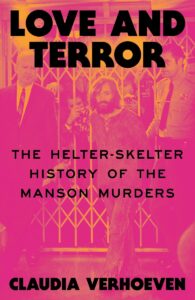
From Love and Terror: The Helter-Skelter History of the Manson Murders. Used with the permission of the publisher, Verso Books. Copyright © 2026 by Claudia Verhoeven

Claudia Verhoeven
Claudia Verhoeven is an associate professor of history at Cornell University. She received a BA in Philosophy from UC Berkeley and a Ph.D. in History from UCLA. She is the author of The Odd Man Karakozov: Imperial Russia, Modernity, and the Birth of Terrorism and the co-editor of The Oxford Handbook of the History of Terrorism. She has been a fellow at the Robert Schuman Center of Advanced Studies at the European University Institute, the Society for the Humanities at Cornell, and the Institute of Advanced Studies in Berlin.