What Erdoğan’s Rule Reveals About the Current State of Western Democracies
Suzy Hansen on the Lasting Effects of Modern Authoritarianism in Turkey
Was the autocracy President Recep Tayyip Erdoğan created over 20 years in Turkey a rejection of liberal democracy, or a response to its failure? The Turkish nation created in 1923 never healed the wounds of a people who lost an empire, and the new nation found itself in an awkward place in the Western international system, integrated into it but stigmatized as not quite modern or Western enough. Its new political class never resolved the country’s bloody history, or reckoned with its minority communities, its Christians, Alevis, Jews, Arabs, and Kurds, and though Turkish nationalism offered one possible sense of identity, it was one both incomplete and oppressive.
The twentieth-century Turkish Republic, the nation-state, had been founded in response to an entirely different world, with entirely different pressures. The twenty-first century’s almost supernatural forces—globalization, technology, migration, climate change—demanded a different kind of country, especially at the end of the American-dominated international order. What were these enormous, inexplicable things happening to us? Tayyip Erdoğan was the leader who responded to the call.
What Turkey’s experience shows is that countries ostensibly democratic have much deeper autocratic or repressive underpinnings than they like to acknowledge.
Erdoğan had been formed by both a Kemalist ideology and an Islamist worldview that grew out of the humiliating loss of a great Islamic empire, and he had recognized the Turkish nation’s lowly place in the shadow of the West. Twentieth-century liberalism didn’t account for how angry people were about the past, how robbed they felt by the ruthless speed of progress, how disconnected were the worldviews of the people who came from the countryside and the people who came from the city. Erdoğan designed his own politics out of one of the world’s great cities of migration, and he alchemized his humiliation into a proud liberal stewardship of the old nation until he began his angry fabrication of a new one. That task had required demolition and repression, imitation and invention.
Erdoğan ravaged the state’s architecture until it became institutionally connected to his person; he persecuted the opposition until most criticism of him ceased; he drew ballast from Islamic concepts and beliefs for a new Turkish identity; he copied and pasted the superficial hallmarks for this technology-driven, patronage economy from other capitalist countries; he somehow used a huge refugee crisis to his political advantage; he responded to crisis after crisis with ruthless agility, relentless propaganda, and, when necessary, utter cruelty; and he manifested a place for himself on the world stage previously impossible for Turkey. Erdoğan’s super-country was as imitative as it was new. The kid from Istanbul’s streets was not an aberration. He borrowed from life to create this Turkey, he borrowed from all of us.
The idea that Turkey became more authoritarian during his reign was the flaw in the conventional narrative about Erdoğan. Autocracy always ran through Turkey’s politics and state structure, from Ottoman times to Atatürk’s one-party rule to the long twentieth century of its military interference. What Turkey’s experience shows is that countries ostensibly democratic have much deeper autocratic or repressive underpinnings than they like to acknowledge. Erdoğan first emerged during the post-Cold War decade of unipolar, American triumph, adopting the language of free markets, liberalism, and human rights, and stretched those politics of optimism into the brief euphoria of the Obama years. But the War on Terror persisted and mutated into nightmares in Iraq and Afghanistan, and then Syria, which unleashed that darkness in the form of terrorist states and a refugee crisis that spread anti-Muslim and anti-migrant hatred to Europe, the United States, and beyond. The surge of authoritarianism followed almost naturally.
Modi, Putin, Duterte, and Erdoğan—all these men—emerged during this period of ferment as well as from the examples of the Bush, then Obama, and then Trump administrations, all of which offered the world their own models of an “imperial presidency.” What was the nation-state in a transnational forever war? The Americans exported violence in the form of counterterrorism and police trainings to as many as eighty-five countries, from Pakistan to Saudi Arabia to Niger to the Philippines, as well as blueprints for dubious legal frameworks to justify their actions. These methods invigorated authoritarians from Xi Jinping to Modi to Erdoğan who expanded broadly defined “anti-terror” laws to persecute their own citizens.
By 2025, the War on Terror had shattered entire nations and economies, displaced some 40 million citizens and directly and indirectly killed over four million. “While the US military can and must end its foreign wars,” the academic Ussama Makdisi, who is of Palestinian and Lebanese descent, wrote in 2021, “native peoples and countries cannot simply ‘end’ the war; they will live in and among its consequences for generations.”
They failed to recognize early that when the charismatic populist authoritarian comes to power, only an entirely new politics or mode of political figure can defeat him.
In this shattered Middle East, Erdoğan has situated Turkey in a “post-western” position, to quote the writer Aslı Aydıntaşbaş. Turkey was now part of NATO but not the European Union, part of the West but not warring with Russia or China. Erdoğan centralized power around himself but also pushed for loosening the country’s borders and extending Turkey’s influence into the region—into Syria, Iraq, Libya, Azerbaijan, and beyond—as a crucial part of Turkey’s new mission and ideology. Turkey shored up this power, its military and mercenaries and economic might and arms sales and technological advances, resembling its long-time ally the United States, as much as Russia, Saudi Arabia, Israel, or Iran.
Erdoğan’s ideological inheritance was rooted in his country’s historical experience, and he drew lessons from each: ideology from the Ottomans, nationalism from the Turks, imperialism from the Americans. He broke all the democratic rules at home. But he obeyed many of the unspoken rules of the avaricious superpowers for whom chauvinism and war-making had become a way of life. And he too perpetrated the kinds of catastrophes we saw on our screens so much in the 2020s: scenes of carnage, annihilation, deprivation, and despair.
What happened to the opposition during these long two decades—at least in Turkey? How had they failed to protest or stop Erdoğan? What did they regret? When I asked this question to all kinds of people—women int he corporate world, leftist Kurdish academics, low-level bureaucrats, liberal journalists—they all said they regretted the same thing. It wasn’t that they wished they protested Erdoğan more. Their answer wasn’t about him at all.
They regretted that in the first years he came to power they had not, as individuals, worked to overthrow the leadership of the main opposition party, the CHP. For a time under Erdoğan, Turks still had functional elections; the opposition could have beaten him. But they failed to recognize early that when the charismatic populist authoritarian comes to power, only an entirely new politics or mode of political figure can defeat him, that the world in effect has been remade by his arrival and that it is incumbent on the opposition to imagine a new politics in response to it. When the Turkish opposition finally found İmamoğlu, they were a decade late. I won’t say “too late” because if living in Turkey taught me anything, it is that no one should count that country out.
By now, Erdoğan’s pursuit of some perceived loss of Turkish dignity has curdled into bitterness and endless retribution. Someday he will lose the love he once inspired in people, and he too will go, leaving behind for his people a painful inheritance. He and his loyalists never made peace with the society or with the world. They never made peace with themselves.
“Calm down, Hüseyin,” Ismail had said at the police station the night of the attack on Al Nour. “You are a child of this neighborhood.”
“Ismail Abi, ya,” Hüseyin had said. “You know what happens when we let them do this to us.”
Ismail knew that dignity came from self-belief first, from within. When he told Hüseyin, “you are a child of this neighborhood,” Ismail was reminding him that he was already its keeper.
__________________________________
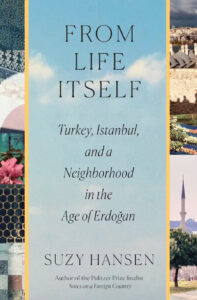
Excerpted from From Life Itself: Turkey, Istanbul, and a Neighborhood in the Age of Erdoğan by Suzy Hansen. Published by Farrar, Straus and Giroux, April 2026. Copyright © 2026 by Suzy Hansen. All rights reserved.

Suzy Hansen
Suzy Hansen lived in Istanbul for more than a decade, where she was a contributing writer for The New York Times Magazine and many other publications. Her first book, Notes on a Foreign Country, was a finalist for the Pulitzer Prize in Nonfiction and the winner of the Overseas Press Club of America’s Cornelius Ryan Award. She has taught writing at Princeton University, New York University, and Bard College.