What Animal Parents Teach Humans About Care
Elizabeth Preston on How Humans Are Born to Care for Others
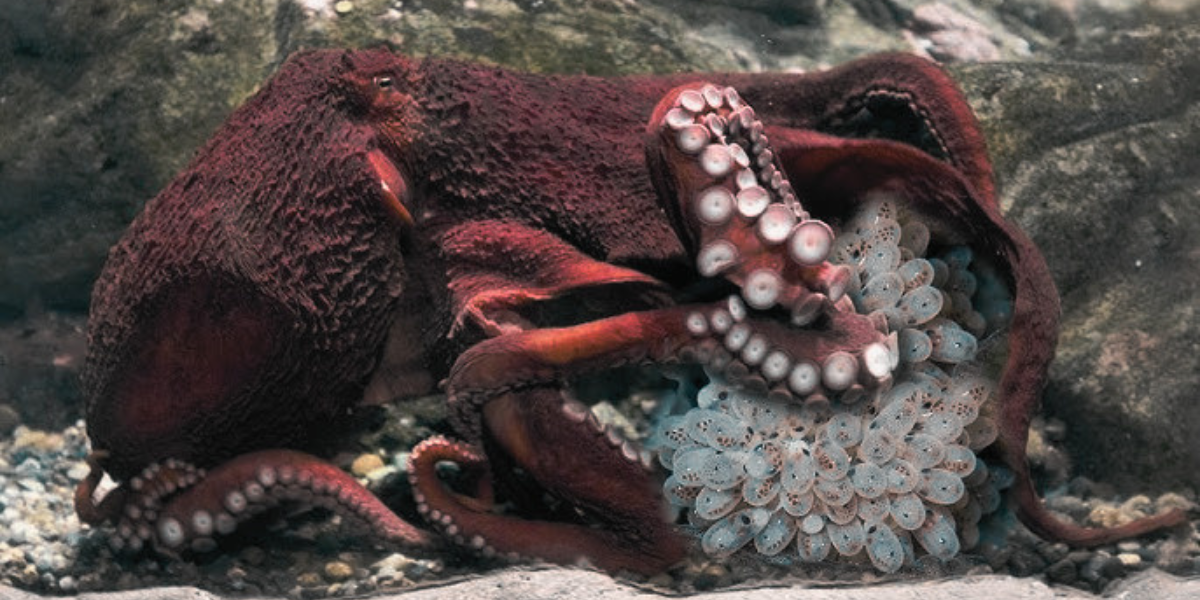
In the spring of 2007, scientists who were using a robotic submarine to explore the deep sea off the California coast spotted a lone purple octopus. They recognized this octopus from her distinctive scars, having seen her just the previous month. Today, she was resting on a nearly vertical rock face, her body curled over more than 150 eggs.
This gave the scientists a rare opportunity to study parental care in a deep-sea octopus species. In general, octopuses and other cephalopods live for only a year, maybe two. After the females mate and lay eggs, they commit themselves entirely to protecting their brood. Coastal octopuses may tuck their eggs into a rocky den; mothers who live in the open ocean simply make a den out of their arms.
The mother stops eating. She cleans the eggs, shoots jets of water across them, and fends off other animals. She wastes away as the eggs grow. As soon as the baby octopuses hatch, the mother dies.
So the team observing the octopus near California knew they were about to witness her death. Over the following months, they periodically sent their submersible back to check on her.
Unfed, she waited 53 months—230 long weeks in the dark—until her work was done.
As they expected, she didn’t seem to be eating anything or budging from her post. Her violet skin paled and slackened; her eyes clouded. She became a nearly white ghost haunting the rock face. And the baby octopuses in their egg cases were a little larger each time the scientists checked. Their eyes slowly grew visible, two dark dots peering out from inside each translucent egg case. Finally, the submersible returned one day to find the eggs empty and all of the octopuses, including the mother, gone.
It was nearly four and a half years after she had laid her brood.
The feat was unprecedented among octopuses. In shallow water, where scientists have had more chances to spy on them, octopus mothers tend their eggs for a few months or less.
It was also unprecedented among animals generally. The longest typical egg incubations, which are among kiwis and some albatross species, last about 11 weeks. Elephant pregnancies last up to 22 months (and I thought I was ready for a cocktail). There are salamanders who carry their developing young inside their bodies for three years or more. They can eat meals, though.
Scientists speculated that a slow metabolism and the frigidity of the water may have combined to keep the octopus mother alive. Unfed, she waited 53 months—230 long weeks in the dark—until her work was done.
It’s tempting to imagine her as a martyr, a paragon of motherly love. But behind every astonishing act of parental care, as well as every clutch of eggs that’s simply tucked under a leaf and left, is cold math.
If she survives, though, her daughters grow up to become her companions and helpers: a tiny community.
Random accidents during cell division create errors in our DNA with a certain frequency. Those mistakes in writing the instructions for life are most often neutral or problematic. But a tiny fraction of the errors cause a mutation that gives an animal an edge in staying alive and reproducing, and can be passed to the next generation.
Depending on countless factors—competition between neighbors, scarcity of mates, predators, luck, the weather—some of those helpful mutations will persist and become more and more common in future generations, evolving into a defining trait of a species. Congratulations! Now you have tusks, say, or a dazzling song.
Researchers can deduce how caretaking evolved by studying animals who care for their young alongside those who don’t. They can also look at species that are closely related to each other but have different parenting styles, or animals that are as flexible in their methods as a human who subscribes to a new
parenting podcast each week. In this way, scientists are revealing the forgotten evolutionary math—like faint equations on an erased chalkboard—that brought all of Earth’s animals to where they are today.
It’s not just a question of which creatures put their energy into raising children to adulthood, or literally kill themselves just to get their eggs hatched, or do no caretaking at all. In some branches of life, the invention of parental care was the first falling domino in a cascade of events that changed the world.
That brings me back to the wasp.
The social life of a paper wasp passes through dramatically different phases. Each female starts her life as part of a bustling hive. The individuals work together in a collective. But after a female mates, she leaves her family and sets off on her own.
The solo insect builds a small nest and lays a few eggs. When those eggs hatch into daughters, she dedicates herself to feeding and caring for them. It’s a strenuous life phase that often kills the mother. If she survives, though, her daughters grow up to become her companions and helpers: a tiny community.
The mother lays more eggs, but now the daughters tend them, and the family grows and grows. It becomes a whole new cooperative hive.
The complex, highly organized colonies of wasps, bees, and ants have made these insects some of the most successful species on Earth. They’re resilient and widespread because every worker does her part to keep the whole community humming, like the components of a machine.
Or like the members of a human society.
Life as a Homo sapiens, not unlike life as a wasp, means relying on coordination with others. That’s true whether you’re part of a small community of foragers in Namibia or a high-rise apartment building in Chicago. We play different roles; we’re not self-sufficient. And the story of how we came to live in these buzzing societies, like the story of the paper wasps, starts with a single parent and child.
In our distant mammalian past, furry mothers fed and cared for their babies alone. Then, at some point in our evolution from ancient ape into modern human, our children probably began staying home to help out after they grew up, like the wasp daughters. The mothers’ mates stuck around, too, and discovered the benefits of fatherhood. Gradually, those families grew into communities.
Ancient humans didn’t simply live near each other and share a fire pit. They pitched in—siblings, dads, grandmothers, neighbors—to jointly care for kids. This shared childcare may have given our species a boost so that we could become the big-brained, brilliant, planet-dominating apes we are today.
Humans are born to care.
Some authors have argued that other factors were the key to making us human. Language, for example. Or learning to make fires and cook our food.
But we wouldn’t have needed language with no one around to talk to. We wouldn’t have had big pieces of meat to char over a flame without other upright primates to help us hunt it (or stand around commenting on our grilling technique). Being together with others is a critical piece of the human story. And what brought us together, ultimately helping to birth human society as we know it, may have been the need to raise our kids.
Today, it can be hard to encounter other members of our species in rush-hour traffic or an internet comments section and imagine that humanity was built on cooperation. Yet this is the message hinted at by the animal caretakers who populate the world, and hidden within our own cells and skulls: Humans are born to care.
I did not feel very much like a member of a big, cooperative ape village when I had my first baby.
My husband had to go back to his office after four weeks of parental leave, and we hadn’t made plans ahead of time for when I would return to my freelance writing and editing work, or what childcare we’d use. I thought maybe I could just . . . write with the baby at home? It’s OK to laugh.
It wasn’t until after we brought our daughter home from the hospital that I realized, too late, how poor our non-plan was. Part of the problem was that the baby was (sorry, honey) a screamer. As a newborn, she screamed with shocking consistency every day between about 5:00 and 8:00 p.m. She also screamed at other, less predictable times throughout the day. She would do me the favor of a thirty-minute nap if I agreed to hold her the whole time.
Caring for her seemed like way more than a one- or two-person job. Yet I could barely put her down for long enough to start a load of laundry, much less research daycare options.
Irrationally (I was tired), I felt like this colicky baby was my own problem to solve. I had fashioned her inside my body, largely out of peanut-butter-and-jelly sandwiches. Now she was reliant on me and my mammalian equipment for food (she found bottles even more offensive than napping). My in-laws lived nearby but I didn’t want to subject them to all the noise and stress. I was afraid to join a new moms’ group and be stuck away from home when a bout of screaming started.
Since those days, I’ve gotten some rest and learned that a human parent, or even a pair of parents, isn’t meant to go it alone. The most natural thing a Homo sapiens with an infant can do is accept help. But the version of me who didn’t know I needed a childcare plan before having a baby, as well as the one who couldn’t accept a hand, were—in a way—different people from who I am now.
That’s because pregnancy and parenthood profoundly restructure your brain, as I’ve since learned from scientists who study both animal and human parents.
In this book, you’ll see that no matter where or how you live, you belong to a family.
During pregnancy, my brain was streamlining itself and priming its circuitry for caretaking. At childbirth, my brain sprouted new receptors for the chemicals that would drive my feelings and reactions. My new brain continued to refine itself as I cared for my infant and responded to her cues (which eventually expanded beyond screams). I’m learning still.
This process isn’t unique to people who give birth. Research shows dads activate the same network of parenting regions in their brains that mothers do. That activation seems to happen from the outside in, as fathers spend time around their infants, rather than from the internal cues of pregnancy. Dads’ brains even experience similar reshaping to the brains of mothers.
These changes suggest that anyone who spends time caring for a baby, regardless of their gender or relationship, can activate the parts of their brain that know how to care. Other research is showing that much of that cerebral caretaking architecture is ancient, and we share it with parents across the animal kingdom. All humans are built for caring—whether we express it by raising our own kids, or being someone’s favorite auntie or uncle, or simply treating our fellow humans tenderly. The tools for care have been woven into our DNA over millions of years.
In this book, you’ll see that no matter where or how you live, you belong to a family. You’ll meet the extended clan of caretakers that includes every human on Earth, as well as other animals of all stripes. This family shares your struggles and concerns, though some members face different challenges, such as preventing their young from being eaten by snakes. Their solutions to these challenges are, at times, astonishing.
You don’t need their advice, though. My hope for you is that this family will give you inspiration and companionship, that they’ll show you we’re not alone. I hope you’ll see that the distinctions we draw between ourselves and other animals, or between different types of humans—the parents versus the childfree, someone else’s kids versus one’s own—actually deny our humanity. Most of all, I hope they’ll teach you that you already know how to care.
We’ll see how we got here by tracing our history in the cells and behaviors of the creatures around us. Their acts of caretaking reflect not just our struggles, but our moments of transcendence. While that purple octopus mom was holding her babies for fifty-three months, she stayed alive four times as long as most cephalopods. That’s the closest her kind comes to immortality.
We’ll watch frogs ferrying tadpoles on their backs, beetles kissing food into the mouths of their larvae, and mongooses teaching pups how to crack an egg. We’ll meet still other animal caretakers whose actions horrify us and reveal uncomfortable truths about ourselves. In the field and in the lab, we’ll meet scientists who are tracking these animals by radio collar, mapping their family trees, sequencing their DNA, and spying on them by drone—often while juggling their own caretaking duties. No matter the sex (females, males, animals that switch when the time is right) and no matter how closely or distantly related to humans (spineless, feathered, a primate cousin, your actual cousin), animals use shared biology and brain circuitry to care for our young.
Scientists are also realizing that those tools for caretaking have helped us, and certain other creatures, not just to raise young but to live together in societies. Parents evolved into families, which became communities. We’ll watch non-parents across species perform critical caring roles, from reptile babysitters to sibling birds and elderly elephants.
And we’ll see that, while we share so much with the other animals, humans are unique in how the elements of caretaking came together in our evolution. We’re the world’s only apes—the hairy, tailless animals that can both make tools and give a thumbs-up about it—that bond to our partners while also relying on our larger families and communities to raise our children. Our cooperation extends beyond caring for young and carries us to places no other life-form can dream of.
We’re also unique among creatures in that we’re not driven merely by math and luck: We can choose how to go forward. We can begin to grasp how the ways we care for children and other humans will reverberate in the bodies of future generations. We can learn to see ourselves as born caretakers on a planet full of animals tending to those who can’t tend themselves, and to see caring not as something specific to parents, but as our birthright.
Like the wasp, we can use paper to dream up a new society.
Alone among animals, though, we can turn a page.
__________________________________
From The Creatures’ Guide to Caring. Used with the permission of the publisher, Viking. Copyright © 2026 by Elizabeth Preston

Elizabeth Preston
Elizabeth Preston is a science journalist who contributes regularly to The New York Times and has written for Science, The Boston Globe, The Atlantic, Orion, Slate, Audubon, Discover, National Geographic and others. She is a winner of the American Association for the Advancement of Science Kavli Science Journalism Gold Award. Preston is also a humor writer whose work has appeared in outlets such as McSweeney’s Internet Tendency, Parents, and Real Simple and was the editor of Muse, a magazine about science and ideas for kids. She lives in Massachusetts.