We’re All Wrong About Men and Feminism
Rosa Campbell on How Men Responded to The Hite Report
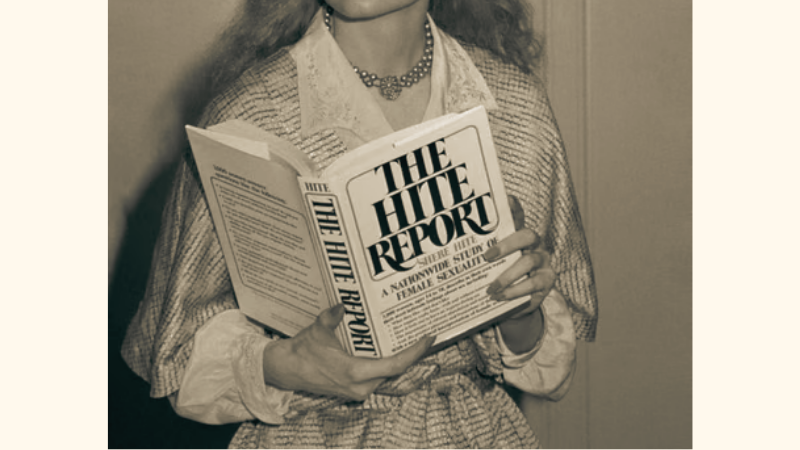
In 1977, a man working on a drilling rig in Alaska, far from his home, sat down and wrote a letter. He’d been working as a “roughneck” handling the drill in freezing Arctic conditions and every day after his shift finished, every spare second he had, he’d been reading. He would wash the oil and mud off, make a coffee, light a cigarette and at the back of the rec room, or lying on his bottom bunk in close quarters with other men, he would turn back to his book, The Hite Report: A National Survey of Women’s Sexuality.
The Hite Report, published in 1976, was written by Shere Hite, Playboy model turned DIY sex researcher. Though it has sold upwards of 50 million copies, the book has now been largely forgotten.
But in 1977, this man was gripped by its revelations. He read that most heterosexual American women were sexually dissatisfied and 70% of women could not orgasm from penetrative penis-in-vagina sex but required clitoral stimulation, but most women didn’t speak up about that. Shere explained why: Women had long been expected to get the most pleasure from sex the way that men had, from penetration. That was because “sex is sexist. A woman’s place in sex, resembles her place in the rest of society.”
So, for sex to be more pleasurable required assertiveness from women and sensitivity from men, but most of required society to be reshaped along feminist lines. The Hite Report was the first feminist book this man had ever read, his entrée to women’s liberation.
Men, many men, seem to hate feminism.
After getting almost to the end of the 500 page tome, he began his letter to Shere:
“My wife gave me your book to read…My first reaction was “What is my wife trying to tell me?” Until reading your book I felt I was a great lover and all-round good guy. With the honesty of various women, I have found my shortcomings… Maybe your book is my wife’s way of communicating with me. At least opening the door.”
In the papers of Shere Hite there are hundreds of letters from male readers, these spill and bulge from the 300 boxes that make up this archive. This correspondence has only been read by Shere and by me. This pile of letters complicates the story that is usually told about men and feminism. The story usually goes that the vast majority of men were not touched by the women’s liberation movement of the 1970s at all, they responded with hostility or stunned silence.
The present seems to corroborate this. Men, many men, seem to hate feminism. Feminism, the men of manosphere suggest to their millions of followers, is a conspiracy so powerful that it has destroyed masculinity and stacked the world against men. Perhaps even more than feminism, many men seem to hate women. The first months of the year have passed in a swirl of revelations about abusive men, reminiscent of the first explosive days of the #MeToo movement. Epstein of course, and Mohamed Al Fayed, the former owner of iconic British department store, Harrods.
But while being wildly wealthy brings entitlement, valorises inequality, offers systemic protection and so encourages abuse, this is not just a rich guy problem. The nice men list, the catalogue of comrades you can count on has lately been torn up too, a fantasy in pieces. Just last month it was reported that Cesar Chavez, the United Farm Workers organiser, raped women and girls, and Noam Chomsky—one of the left’s foremost intellectuals whose most popular book is called Manufacturing Consent—is right there on the Epstein private jet.
The photos show him leaning over his arm rest, clutching his bottle of Voss water, his grandfatherly hair threatening to fall in his eyes that seem to look on admiringly as his cool guy friend Jeff holds court. Noam defended him against “the horrible way” the “vultures” in the press were treating him against the mounting evidence of his crimes of rape and trafficking which, in survivors’ own words, made them want to die. And some of those women are now dead.
In this moment, I feel my conviction that most men I encounter consider women their equals slipping away. Any certainty—my certainty—about most guys being good guys seems naive. This belief that I clung to like a life raft seems to be stone around my neck. You could be forgiven for wondering if the most extreme radical feminist polemics were right. Perhaps, under patriarchy, men can only think of women as ornaments and objects, degraded whores out to seduce and then sabotage, at once stupid bitches too dumb for STEM subjects yet also the cunningest cunts that ever walked this earth.
But against our terrifying misogynistic present, these letters to Shere from male readers flip the script. Men’s responses to The Hite Report show that feminism did reach men, and not just the men you would expect. Most of the men who wrote to Shere were not educated men from big cities, but men working on the line at the Ford plant at Dearborn, Michigan or men employed at strip mall legal firms. There are a few executives writing from corner offices among the taxi dispatchers and sports coaches.
Indicative of her wide reach are a smattering of extraordinary letters from incarcerated men who had learnt about The Hite Report from the porn they read in prison. In these letters they offered intimate biographical accounts of life before jail and their hopes beyond: “I am single, 30 years old . . . I am at the present time in for burgling a dwelling. I’m half American Indian, one quarter French Canadian. When I am free, I travel the rodeo circuit and am on the road all the time unless I’m minding some broken bones, which I have done a few times . . .”
But, in the late 1970s, in this moment before the backlash really took hold, there was a moment of radical opening.
This man agreed with Shere’s perspective on sex: “I hear complaints from dudes like ‘man, all she did was lay there and no action’ and my first thought was that this dude was probably the one who didn’t know what he was doing.” Others wrote to praise the book: “I have been delegated by 7 other prisoners at the Kansas State Industrial Reformatory to write this letter…We say ‘Right on Shere Hite. Right the Hell on.’”
Many male readers of The Hite Report found its feminism profoundly disorienting. They wondered and they worried in their letters to Shere, how could they be men in the wake of this movement? Later, in the 1980s, conservative media, politicians and faith leaders would argue that they could not, that feminism emasculated men, and blamed them for their biological instincts, so to save themselves, they best shun it.
But, in the late 1970s, in this moment before the backlash really took hold, there was a moment of radical opening. Men’s letters to Shere overflow with complex feelings. Many began their letters with a list of the range of emotions that flooded through them as they read: “I felt angry (scapegoated), guilty, understood, hopeful and excited.” The book was particularly painful to read when it seemed to contradict how men saw themselves. “Could it be true that I had been conceited enough to believe I was being a complete sexual partner?”
The power misogyny offered was conditional on them subordinating women and on cruelly ranking men against each other.
Sometimes, men were overwhelmed, and many opened up to the possibility of feminism, doubled down, then opened up again, oscillating wildly between solidarity and oppression. A particularly stark example: “I finished The Hite Report two minutes ago. I saw myself described on its pages so many times by your uncommunicative respondents that…I hope you got some input from a few hairy beasts (adult males to you, you libber!).” Shere slashed through his angry missive with green pen annotating “NO! No!” But then he added a P.S. “All kidding to the side, please accept my deep and awed congratulations.” She decorated this with stars, hearts and ticks.
The Hite Report was sexy and its author was beautiful. This made its feminism a little more palatable. Men’s female partners thrust the book into their hands, and the women’s movement demanded that they take notice. All this took men to the precipice. But the men who jumped and began to change did so because they realised that feminism had riches to offer them too. “Men need the book to become more human themselves,” one correspondent wrote.
Across their letters they discuss how misogyny pressured men to conform to rigid and limiting standards of masculinity to be, “a cross between John Wayne, the Chase Manhattan Bank and Hugh Heffner,” as one reader put it. They wrote of the violence they had endured at the hands of other men, their jostling to reach the unattainable standard of masculinity.
One man recalled sexualised bullying at the hands of his cousin, how years of insults about penis size resulted in sexual dysfunction and stomach ulcers. Another discussed targeting others as “sissies” to avoid the taunts himself. Men told Shere how in sex they acted “as they thought men should act.” They got on top, shut down emotionally and minimised affection. The power misogyny offered was conditional on them subordinating women and on cruelly ranking men against each other. They told Shere that it just didn’t seem worth it anymore.
One man wrote honestly, “I’m frightened because I don’t know how… but your work has set the wheels in motion for a desire to break away from predictable patterns of action and thought.” Another “You are incredible. The only suitable thank you is to try to develop my own support systems for real, humane, vulnerable, aware contact. In an insane society, this is a project of years, not weeks. But the way is clear, my bags are packed.”
The story of The Hite Report shows us how feminism reached men, took them by the hand and led them somewhere new, more interesting and frankly, more pleasurable. Feminism is a movement for the liberation of women, sure, and for everyone else. The invitation it holds out to men to do it differently, in sex and in life, remains open.
__________________________________
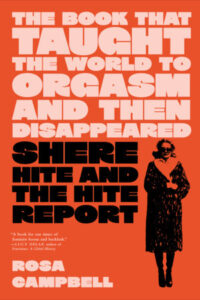
From The Book That Taught the World to Orgasm and Then Disappeared. Used with the permission of the publisher, Melville House. Copyright © 2026 by Rosa Campbell

Rosa Campbell
Rosa Campbell lives in Edinburgh, Scotland, and is a British Academy Postdoctoral Fellow at the University of St Andrews, where she teaches poetry, poetics, and queer and feminist studies. Her first book, Pothos, a lyric essay/memoir about grief and houseplants, was published in 2021 by Broken Sleep Books, and she is the editor of The Miraculous Season: The Selected Poems of V.R. ‘Bunny’ Lang (Carcanet, 2024; forthcoming in North America with NYRB in July 2026). She is currently working on a critical biography of Lang and a book on the poetics of failure.