The Sound of Imminence: Ruth Ozeki in Praise of the Typewriter
How She Discovered Her Favorite Writing Instrument
Spring is the time of year I buy typewriters. It must be the change of season—green shoots pushing up through the thawing earth, bulbs budding and blooming, trees leafing out—which has nothing to do with typewriters, but everything to do with imminence.
I bought the first one in 2023, on April Fool’s Day. The pandemic was only just behind us, we were gearing up for another presidential election, and a few months earlier OpenAI had launched GPT-4. I didn’t know what AI was, but I had a strong premonition that the world was about to change in ways I wasn’t ready for; instead of vernal anticipation, I was filled with dread. I remember saying to a friend, “It’s okay. You all can just go on ahead, but I’ve had enough. I’m going back to the 20th century.”
I was mostly kidding. I like smart phones. I like mRNA vaccines. I didn’t mean to buy the typewriter. I was driving home through Arlington, Massachusetts when I caught sight of a sign above a small storefront that read “Cambridge Typewriter Company.” On a whim, I pulled over. The shop looked closed, but when I tried the door, it opened. A bell tinkled overhead. The interior was dim, but I could see shelves along the walls lined with rows and rows of old typewriters. The owner came out from the back, cleared space on a desk, handed me a stack of paper, and told me to try any machine I liked.
Time stopped then, and I don’t remember what happened, but suddenly it was hours later, and I was standing on the sidewalk holding a 1956 Smith Corona with a double gothic typeface in my arms. 1956 was the year I was born, and this felt propitious, a rebirth of sorts. As I drove the rest of the way home, my mind was flooded with pleasant memories of the typewriters I’d owned and promising thoughts of all the stories I would type on my new (old) Smith Corona.
The typewriters help. They require a more visceral, muscular involvement in the writing process. They remind me to write deliberately, to slow my mind so that my fingers can keep up.
I didn’t get much writing done that week—I was too busy shopping. I bought a second typewriter on eBay, a 1953 Royal Quiet Deluxe with a 10pt pica typeface. The third, a few weeks later, was a maroon and white two-toned 1965 Olympia SG3 with a senatorial font. You can see where this is going.
I keep a process journal, in which I write about writing. My entry for this period reads:
I am not writing. I have spent the last month traveling, giving talks, teaching, and buying vintage typewriters. Why am I doing this? Because I am an obsessive compulsive who has a fetish for old writing implements, but that’s not the only reason. I have faith that these typewriters are going to lead me somewhere. I don’t know where, but I hope somewhere interesting. I feel a character inside me, compelling me to buy vintage typewriters. Who is this character? Who is s/he trying to become?
*
I managed to stop myself from buying any more typewriters and instead set to work on answering the questions the typewriters had sparked.
The following spring, after a hiatus of about a year, I went back to the Cambridge Typewriter Company. By then, I was working on The Typing Lady stories. I wanted to revisit the birthplace of the collection—and, well, it was almost April. I pulled up, parked, and went inside. The bell tinkled, but this time the shelves were empty. The owner, Tom Furrier, was retiring after 45 years, closing up shop, and selling off the last of his stock. Tom Furrier is a legend in the world of typewriter enthusiasts. The only remaining machine was a 1947 Remington Rand Quiet-Riter, which I bought on the spot. Two more stories emerged from that machine.
I’m not saying that the stories were lodged inside the typewriters. Mostly I write on my laptop, but I like using analog writing tools—typewriters, fountain pens—when I get stuck. My writing blocks usually stem from impatience, the old I don’t want to write, I want to have written problem. Computers exacerbate impatience because they’re fast and efficient, so I feel I should be, too. Impatience is a form of laziness, and the cure for impatience is to slow way down. The typewriters help. They require a more visceral, muscular involvement in the writing process. They remind me to write deliberately, to slow my mind so that my fingers can keep up.
I love the way my fingers have to work, forging a letter-by-letter relationship with the page. I love that the keys leave a tangible impression of my words on the paper that I can’t erase completely, even the wrong ones. The record of my thinking is right there in the open, teaching me tolerance for my fumbling, training me not to hide my struggle behind a seamless façade of digital perfection.
You know how annoying it is to have a conversation with a person who jumps in to finish your sentences? I love that my typewriters don’t do that. They don’t make helpful suggestions. They leave me alone to make my mistakes and don’t try to correct my spelling and grammar.
Cradling my new old Hermes, I walked down Sixth Avenue with wings on my heels and stories in my head, buoyed by a feeling of imminence.
I love that I can’t doomscroll or shop. I love the ritual of typing, inserting the paper into the platen, turning the knob until the paper reemerges, centering the carriage. I love the music they make with their movements: the clacks and dings and ratcheting of the rollers and gears. I grew up with typewriters. I remember the sounds of my parents’ typewriters from early childhood and my excitement when I was allowed to type on them. They made me feel like a real writer.
When The Typing Lady and Other Fictions was scheduled for publication, I went to a meeting at my publishing house near Columbus Circle. I decided to walk home to the East Village and happened to pass the Gramercy Typewriter Company—a happy coincidence, since I’d been thinking an electric typewriter, maybe a Smith Corona Coronet, would be a nice addition to my collection. I went in, expecting to see the usual rows of typewriters, but the shelves were empty, except for a single display case. Behind the glass sat a sea-foam green Hermes 3000, a pre-1966 model, instantly recognizable by its bulbous body and soft, swelling curves. Often called the Rolls Royce of typewriters, this Swiss-made machine was loved by writers like Jack Kerouac, Sylvia Plath, Adrienne Rich, John Steinbeck, and Sam Shepard. Enthusiasts love it for its voluptuous beauty and buttery-smooth typing action. The Hermes 3000 had long been my aspirational typewriter, and I’d been haunting websites looking for deals, but ever since Tom Hanks posted about his Hermes, they were in high demand and priced accordingly.
I gazed through the glass of the display case and tried to resist. I asked the sales person about a Smith Corona, hoping they might have one tucked away in back. He shook his head and apologized for their lack of stock. They’d had a sudden surge of sales—maybe Taylor Swift had released a new typing video? They were expecting more in, but for now all they had was the Hermes, sitting there in all its solitary splendor. Would I like to try it? Time stopped then, and I don’t remember what happened. Hours later, I emerged, considerably poorer.
But it was spring! Cradling my new old Hermes, I walked down Sixth Avenue with wings on my heels and stories in my head, buoyed by a feeling of imminence.
____________________________
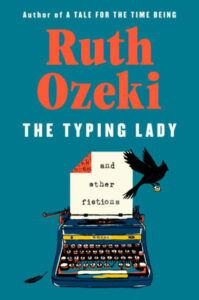
The Typing Lady and Other Fictions by Ruth Ozeki is available from Viking, an imprint of Penguin Publishing Group, a division of Penguin Random House, LLC.

Ruth Ozeki
Ruth Ozeki is a novelist, filmmaker, and Zen Buddhist priest. She is the bestselling author of four novels: The Book of Form and Emptiness, winner of the UK’s 2022 Women’s Prize for Fiction; My Year of Meats; All Over Creation; and A Tale for the Time Being, which won the Los Angeles Times Book Prize and was a finalist for the 2013 Booker Prize and the National Book Critics Circle Award. Her nonfiction work includes a memoir, The Face: A Time Code, and the documentary film Halving the Bones. A longtime Buddhist practitioner, Ruth is affiliated with the Everyday Zen Foundation. She is now professor emerita of English language and literature at Smith College, where she was the Grace Jarcho Ross 1933 Professor of Humanities.