
The Queen of Sales: How Mary Kay Ash Created a Beauty Empire
Mary Lisa Gavenas on the Humble Origins of One of America’s Most Iconic Female Entrepreneurs
Mary Kay was off to a bad start.
She was averaging only $7 a party—and those parties were few and far between. It didn’t look like she would last any longer with Stanley Home Products than she had with the Child Psychology Bookshelf. Or with waterless aluminum cookware. Or with any of the other surefire moneymakers.
The company expected each party to bring in a $20 order. A $7 party meant that Mary Kay’s share of the take was only a couple of dollars. Before expenses. A $7 party was a disaster.
At that rate, each time she tried to sell Stanley, she would have gotten deeper in the hole. Whenever she sent in an order, Mary Kay was supposed to send Stanley another $2 toward the cost of her demonstration case, until the entire $30 was paid off. She had no hope of earning the $35 a week mentioned in that classified ad.
As it was, she wasn’t clearing enough to subsidize the dry mop and split duster she was obligated to give her hostess for throwing the party, finance the silver pastry server she was supposed to provide as an enticing door prize, add lagniappe like a Keytainer or percolator brush, and still make any profit for herself. She wouldn’t have been able to pay cash up front to get a 5 percent discount or place a bulk order to net more commission. She wouldn’t have qualified for the free merchandise earned by surpassing $50 a week in prepaid orders. She wouldn’t have made easy money off reorders either, since she wasn’t getting orders in the first place.
For as long as she lived, Mary Kay would tell and retell the story of her first Stanley rally until it became a kind of hero’s journey.
And because the size and snazziness of the Stanley hostess gift increased in proportion to the amount of product sold at the party, nobody was going out of her way to host a second party for Mrs. J. Ben Rogers. Nobody wanted to go through all the work of rounding up friends and feeding them refreshments if they weren’t going to get anything out of it. Stanley parties were turning out to be like everything else: Stage a few that weren’t successful, and people started to run the other way when they saw you coming.
This had been going on for a couple of weeks when Mary Kay heard about an upcoming Stanley rally and decided to go. Since there was no way her sales record justified the trip, this would be further proof that the little Wagner girl didn’t have any better business sense than her father. Selling Stanley was already like carrying water in a sieve.
Going to the rally would mean upping “L.O.,” salesmen’s slang for money laid out with little likelihood of return. She would have to shell out a $12 fee, travel all the way to Dallas, be away at least two nights, lose any chance of making money for three days, and talk Tillie Bass into minding the kids again. She would be forking over yet more money to Stanley. She would be headed there knowing she wasn’t going to win a thing. She would be a young woman traveling alone to a sales convention and staying with strangers in a hotel, which was no place for a respectable matron who might soon be asking for more typing work from Tabernacle Baptist.
Wild horses couldn’t have kept her away. Wasn’t getting out of a mental rut and having “new thoughts, new visions, new ambitions” the first point in Dale Carnegie’s How to Win Friends and Influence People? Wasn’t Carnegie always on the radio talking about how Aimee Semple McPherson had been a young and impoverished mother of two? Or how Greta Garbo had to leave her salaried job at a hat store to become Hollywood’s “Swedish Bird of Paradise”? The trip to Dallas was just the kind of journey that Carnegie’s titans of industry might take. True, she had demonstrated no aptitude for selling. But Stanley sales literature assured her that didn’t matter. Gumption was what counted.
Instead of staying in the Sixth Ward and reading about moth crystals in The Stanley Standard, she would meet dealers who proved that Stanley could change lives. She would be there when company founder Frank Stanley Beveridge, “the Great Encourager” himself, told everyone: “You can achieve anything you want to achieve. You can achieve any goal that you set for yourself. You just have to keep working toward it.”
As Mary Kay remembered it, she finagled the $12 from a friend after enduring a lecture that those dollars should be used for children’s shoes instead of attending a “wicked convention like men go to.” Then she emptied her Stanley demonstration case, a cheap metal box painted to look like a valise, packed her other dress, and added a pound of cheese and a box of crackers because she didn’t know if the attendance fee included meals. Arriving at the Adolphus, the city’s swankest hotel, she stiffed the bellboy who carried that case to her room. She didn’t have a cent to spare.
*
For as long as she lived, Mary Kay would tell and retell the story of her first Stanley rally until it became a kind of hero’s journey, a pilgrim’s progress that compelled her to leave home, spouse, and children behind as she set forth on her path to redemption.
“Those three days changed my life,” she would say later. By the time she said it, she would be staging Seminar, her own three‑day sales convention, in the same city and following the same format of song, sermon, and ritual that she first experienced in the 1940s.
Even then, the format was nothing new. The length and rhythm of the rally would have been familiar to her Alabama‑ and Tennessee‑born forebears, since camp meetings had been conducted the same way for over a century. For three days, souls would gather from far and wide. Some fleeing toil and craving transcendence, others reaffirming a faith long professed. Convened to hear testimonies of perfection, the congregation would sing. Then the speakers’ exhortations to excellence would build in emotional intensity until women began to weep and the meeting erupted in spontaneous pledges to set new personal bests. At that point, the next crusade would be announced. The difference was that, at Stanley, it was a sales crusade.
“Rally! Rally! Rally!” a Stanley executive explained. “Kept ’em excited. Workin’ toward the goal.”
Four decades after, she would recall more than “a thousand people at that convention,” a description that conveyed its importance to an overawed Mary Kay rather than its actual number of attendees. Even referring to it as a national convention was an exaggeration, since any Stanley get‑together in Dallas would have been a regional rally with, at most, a few hundred salespeople.
Calling it a national convention made for a better allegory, though. As did some other edits she made, creating a story about her first Stanley rally that combined characters and events until it was as long on moral, short on specifics, and easy to remember as a parable. In years to come, she would attend dozens that followed the same format.
With dealers assembled, proceedings started with a sing‑along. By company mandate, all weekly sales meetings kicked off with at least “two appropriate songs” and closed with at least one more. Many branches had a designated song leader, and some had groups practiced enough to pull off harmonies and rounds. At rallies, singing started from the stage, then the audience joined in. That got everybody over their shyness. “They’d get excited, you see. Take people out of themselves,” a Stanley executive explained. “When you sing with a group, you realize you’re not alone.” Set to tunes deeply familiar and conveniently out of copyright, Stanley sang the same old songs with new lyrics.
Everybody did, everywhere from school assemblies to union rallies. Fuller Brush had dozens of songs about selling—which Stanley was able to use by substituting “Stanley” for “Fuller.” To the tune of “I’ve Been Workin’ on the Railroad,” Mary Kay would belt, “I’ve been selling Stanley products, all the livelong day.” To “Jingle Bells,” dealers would sing, “S‑T‑A‑N‑L‑E‑Y, Stanley all the time.” A favorite like “Little Brown Jug” went:
Ha! Ha! Ha! You and me
We’re chuck full of pep and glee.
Ha! Ha! Ha! You and me
Boost the Stanley Com-pa-ny.
Stanley had a songbook full of these, some spirited, some spiritual. The tune of “Tramp, Tramp, Tramp, the Boys Are Marching” could go either way. One version had a chorus boosterish enough for a Rotary meeting:
Sell! Sell! Sell!
For Stanley products
Keep those orders rolling in—rolling in.
And we’ ll show the factory bunch that the sales force has the punch
And the Stanley crowd is bound again to win.
Another version used a chorus that could have come from a tent revival:
Yes, you bet that we can do it.
Cast all alibis away, away, away,
And the purpose firm and true we are out to win and do,
We can do it if we only follow thru.
After that rollicking sing‑along, the rally rotated through recognition of top salespeople, more singing, motivating talks from managers and Mr. Bev, more awards, more praise, and more singing.
Throughout those three days, selling was never addressed in the language of Mammon but in the language of “the Stanley Opportunity.” Mary Kay could have no doubt that selling was an ennobling endeavor, since God Himself seemed to be endorsing it. Assembled dealers were told that success was to be found only by placing trust in Him.
Mr. Bev was not a man given to distinctions between church and state. From the start of Stanley, he encouraged dealers to enlist church organizations in its “club plan,” a precursor to the party plan that allowed organizations hosting Stanley demonstrations to share the profits. As Stanley became successful, he made generous contributions to Catholics, Jews, and Protestants alike. In 1943, he introduced the official Stanley Prayer, his redaction of a prayer written by Mary Soulsby: “O Lord, grant that each one who has to do with me today may be the happier for it. Let it be given me each hour today what I shall say. Help me to enter into the mind of everyone who talks with me.”
Even when the Lord’s name was left out, Stanley speeches sounded like sermons. Stanley dealers were not in cutthroat competition for filthy lucre. They were in competition with themselves, often in ways that made Stanley sound more like a center for personal growth than a Berkshires brush manufacturer. The company motto, “To better your best,” made individual success and company success one and the same. Never was Stanley presented as primarily profit seeking. Mr. Bev would say, “We seek to share through our goodness and helpfulness. Take that out of Stanley, and you’ll have just an ordinary, cold‑blooded business organization.” The Golden Rule was on‑the‑books company policy.
Throughout the rally, almost no mention was made of product: not by Mr. Bev and not by dazzlingly glib national sales manager Albert F. Reggie Regensburger. Mary Kay recalled that one executive disclosed the secrets of success as “Hitch your wagon to a star,” “Get a railroad track to run on,” and “Tell somebody what you are going to do.” Those could have come from Regensburger, but they sounded more like area manager C. B. Eckman, who was notorious for spouting slogans. Copying them carefully, Mary Kay took his catchphrases as commandments.
Here too was the ideal sales incentive. Because even more than she coveted that crown, Mary Kay coveted the bag that came with it.
An upcoming launch might be mentioned, but products were only means to an end. “They know how to sell window cleaner. You’re not going to go into that. That’s old hat,” said a Stanley veteran. “Instead you talk to them about their reason for being in sales. What is their goal? Not just in sales but in life.”
At Stanley, it was never too late. To try harder. To do better. To reinvent yourself and redeem your life. The English folk saying “Failure is the road to success” was a particular favorite. Mr. Bev took Robert Louis Stevenson’s flowery rephrasing, “Let him try as he please, he is still sure of failure; and it is a very old and a very true saying that failure is the only high road to success,” and rephrased it himself as the pithier “Try as hard as you will, you are bound to fail. But failure is the high road to success.” Then attributed it to Stevenson anyway.
There were slogans upon slogans: “Fortify in ’40,” “Get Things Done in ’41.” Linking one snappy saying to the next, Mr. Bev could go on for hours, a technique perfected with “talk cards”: a fistful of file cards with scribbled cues to proverbs, poetry, allegories, and song lyrics, which he reshuffled before each speaking engagement, thus guaranteeing that Stanley dealers heard the same message over and over but never the same way twice.
Mr. Bev knew his audience. Ralph Waldo Emerson, long‑winded champion of self‑reliance, was edited into easy‑to‑remember epigrams; thirty‑one words from Emerson’s 1841 essay “Compensation” redacted to a pithy “Every act rewards itself.” Henry Wadsworth Longfellow, champion of morality over materialism, was granted authorship of the motto outside Stanley headquarters—“There is an honor in business that is the fine gold of it; that reckons with every man justly; that loves light; that regards kindness and fairness more highly than goods or prices or profits”—although the only Longfellow associated with that sentence was Walker-Longfellow, a Boston advertising agency that used the sentence in a 1914 pamphlet. No matter. Mr. Bev stamped it on stationery and everything else he could, while the misattribution passed into business history.
Charles Dickens, Sir Francis Bacon, and Abraham Lincoln were all fair game. As was poet Robert William Service, whose “Song of the Wage Slave” included the verse “I’ve done their desire for daily hire / and I die like a dog in a ditch.”
An active Rotarian and pillar of the Westfield community who decorated his office with plaques reminding him to do more good more often, Mr. Bev was an early adopter of associates as a euphemism for workers and thought employer/employee sounded too much like master/ servant. He spoke with a nonroyal we because he considered himself one of the Stanley workforce, whom he described as “ordinary people with extraordinary ambitions and talents” and thought of as family.
He was the perfect father figure: dependable, genial, the same age that Mary Kay’s own father would have been. So supportive and evenhanded that his sales force played off his initials to nickname him “Fair and Square Beveridge.” He looked the part too: stout, bald, thick glasses. In one‑on‑one conversations, he focused on faces with the concentration of a man who was deaf as a doorpost.
He was also, in contrast to the deceased Alexander Edward Wagner, lavish with prizes. During the Dallas rally, Mary Kay watched scores of salespeople parade to the podium to receive recognition for selling the same products from the same demonstration case that was upstairs holding her cheese and crackers. Sitting in the back of the audience, she gawked as a tall, slim brunette named Laveda O’Brien, a housewife from Corpus Christi, was crowned Queen of Sales with an actual crown. Then she watched as Queen Laveda was applauded by other Stanley sellers and presented with an alligator handbag.
That was too much. Seeing that Queen of Sales onstage, she said, “I decided on the spot that next year I would be Queen.” Here were goodness and greatness and glory to be had.
Here too was the ideal sales incentive. Because even more than she coveted that crown, Mary Kay coveted the bag that came with it. “An alligator bag at that point was as far out of my reach as anything could be,” she remembered. That was what movie stars had.
On the spot, Mary Kay began applying the advice in her notes. Deciding that this would be a way to “hitch your wagon to a star,” she marched up to the winner and congratulated her, flattering the Queen of Sales into reenacting a “dem,” as dealers called demonstrations, in her hotel room. If she could observe, she might be able to figure out what she had been doing wrong.
Apparently plenty. O’Brien, who would spend over a decade as a Stanley branch manager, was more than happy to show how things should be done. In the end, Mary Kay took nineteen pages of notes, interrupting with so many questions that the session took three hours, and writing down every bit of queenly patter with the intention of reciting it like a script when she got home to Houston. This would be her “railroad track to run on.”
Two down, one to go. Eager to put “Tell somebody what you are going to do” into practice too, Mary Kay marched up to Mr. Bev and gushed, “Next year I am going to be the Queen.”
Gallant as ever, Mr. Bev stared at her and replied, “You know, somehow I think you will.”
__________________________________
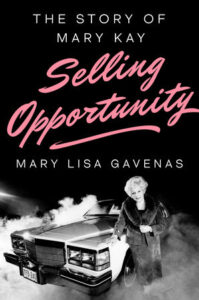
From Selling Opportunity: The Story of Mary Kay by Mary Lisa Gavenas. Copyright © 2026. Available from Viking, an imprint of Penguin Publishing Group, a division of Penguin Random House, LLC.

Mary Lisa Gavenas
Mary Lisa Gavenas, author of Color Stories: Behind the Scenes of America’s Billion-Dollar Beauty Industry, was named a Fellow at the Leon Levy Center for Biography and has been cited as an expert commentator on the beauty business and female entrepreneurship (CBS, NBC, CNN, BBC-4). A former senior editor at Glamour, InStyle, and Mirabella, and columnist for Elle, she has contributed to The New York Times Magazine, Fast Company, and other national outlets.