The Annotated Nightstand: What Mark Haber is Reading Now, and Next
Featuring Laura Vazquez, Eduardo Halfon, Ian Bostridge, and More
Mark Haber’s Ada begins largely how it ends (no spoilers): Gerard Desacroux IV, the impish, recently-made-ruler of a small fiefdom in a region—Saxony or Bavaria, he doesn’t know—paces endlessly (“the only solution to the dilemma of being alive”) while he awaits an imminent arrival. Is it the uprising of the peasants on his land, lead to extremis by Desacroux throwing them into needless and inevitably deadly battles against his neighbor? The Hapsburg Inspector General, the equivalent of the food inspector darkening the doorway of a scummy restaurant? Or Ada, the focus of Desacroux’s ardor and obsession after a rapturous night five years prior?
Though the slim volume takes place over the course of several hours, Desacroux, pacing in his “Great Room,” between paeans to Ada and his father, and hurled abuse at his servants, gives us the rough outline of his entire life. It is a Modernist move, to be sure, but Ada is more aligned with Tristram Shandy, Monty Python, even Roberto Benigni in Jim Jarmusch’s Night on Earth. Butlers are kicked in the shins and told their children are ugly; a patriarch’s idiotic military decisions are venerated for their spirit; blood spilling out of a servant’s wound is more an issue for the rug. In short, Ada is an absurd romp.
Desacroux encountered the beautiful Ada on the streets of Paris, a locale in which he lived under the pretense of academic study, but instead drank, smoked opium, and frequented brothels with abandon. “I was lecherous, despicable, a libertine single-minded in his appetites, who longed for something more palpable than the physical world could offer,” he explains, “until the moment I observed Ada, a ray of God, a celestial light, and was given a taste of the infinite.” Unfortunately for Desacroux, Ada, in the years since, though a mere servant herself, has managed to marry the heir to the paisley fortune (“filthy paisley money,” Desacroux whines). A duel with the husband is the only solution Desacroux, decides—or some time fondling himself in the nearby sword closet.
Haber does the thing so many of us strive for: he makes something near-impossible look easy. In Ada, he dedicates his pages to someone who is baldly terrible and does shitty things to vulnerable people. There are no paragraph breaks in the book—its mode is stream-of-consciousness. While the page trim is relatively small, sentences often spill over to the next page. Semicolons reign. All of this, in less nimble hands, would buckle very quickly. Yet Ada is an absolute delight, hilariously satirical and brilliantly made. And, while I don’t want to linger too long on this for fear of breaking its spell, it’s refreshing to read about a spoiled brat with far too much power that pins him down for what he is: a joke. If you are searching for something brief, sharp, historical, and hysterical, look no further—and it might even fit in your back pocket.
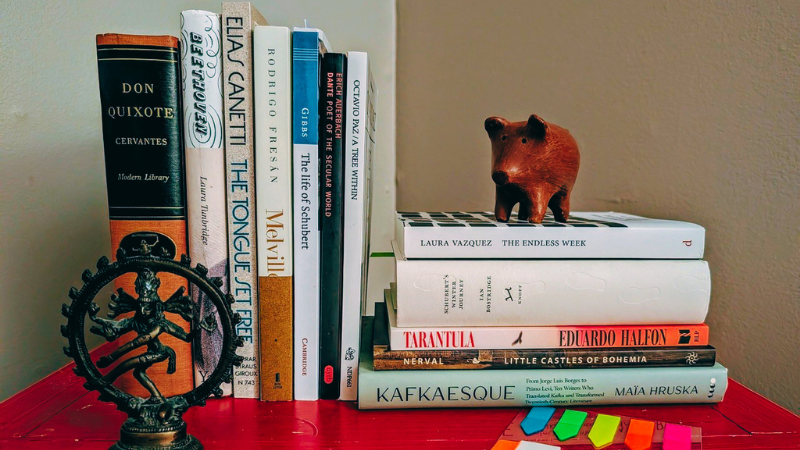
Haber gives us his annotations to his to-read pile (gold star for so much literature in translation!), as well as some trinkets. He writes: “I love to read in bed. Like many, the nightstand is a kind of way station, the book having moved from the bookstore (or another room) closer to my most cherished space. Naturally, I tend towards fiction, so my nightstand has lots of novels and collections, but I love poetry and literary biographies. I also enjoy hybrid genre books. Sometimes I just want to read the introduction to a classic, like Middlemarch or Dom Casmurro; I’m a sucker for a good introduction.
Items on my nightstand:
In my bookselling days we were lucky enough to host the incredible writer Isabel Zapata. She brought this little piglet from Mexico as a gift. I’m not sure why, but I just love it and always keep it around, usually on my nightstand.
I lived in Los Angeles in my twenties and this was a Vishnu statue I bought at a little shop in West LA. I can’t remember exactly where.
*
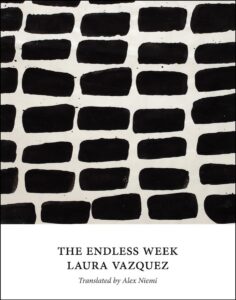
The Endless Week, Laura Vazquez (tr. Alex Niemi)
INCREDIBLE. I want to send a copy to everyone in the world who loves fiction because their brains would be rearranged. It shouldn’t work. It works. Why does it work?
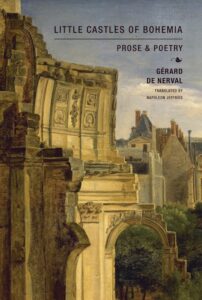
Little Castles of Bohemia, Gerard de Nerval (tr. Napoleon Jeffries)
Any independent bookstore worth their salt carries books from Wakefield Press. Their books are weird and beautifully eccentric, and often highlight obscure and experimental writers from the 18th and 19th century.
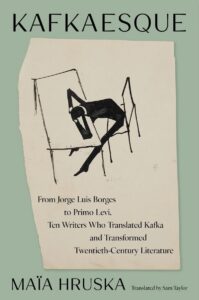
Kafkaesque, Maïa Hruska (tr. Sam Taylor)
An exceptional book about Kafka’s first translators and how his work was eventually introduced to American readers during the Cold War. Beautifully written and engaging. Kafka always reminds me that literature is not the place for seeking literal knowledge, but a sanctuary and an endless reservoir of mystery and wonder.
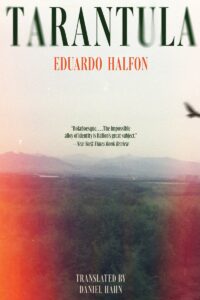
Tarantula, Eduardo Halfon (tr. Daniel Hahn)
I’ve read every one of Halfon’s books translated into English. His novels largely deal with identity, history, and the diaspora of European Jews to Latin America (specifically Guatemala). Understated and always singular, his books dance seamlessly between memoir, fiction, and history.
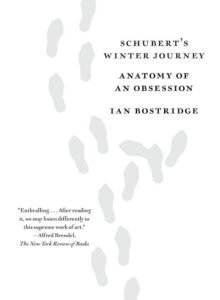
Schubert’s Winter Journey: Anatomy of an Obsession, Ian Bostridge
This is a lovely book about opera, music, 19th-century Vienna, and the psychology of genius. I’m reading it for pleasure, but also research. I’ve become fascinated with harmony and melody and imagination (in my mind three words for the same thing). I’m working on a novel about the creative act, the euphoria and the ecstasy it brings, how it seemingly comes out of nowhere, but also how it lives beside us in the drudgery of the everyday.
Diana Arterian
Diana Arterian is the author of the recent poetry collection Agrippina the Younger (Northwestern UP, 2025), which received the 2026 William Carlos Williams Award from the Poetry Society of America. She is also editor and co-translator of Smoke Drifts (World Poetry Books, 2025), a collection of Nadia Anjuman's poetry. A Poetry Editor at Noemi Press, Diana has received fellowships from the Banff Centre, Millay Arts, and Yaddo. She writes “The Annotated Nightstand” column at Lit Hub and lives in Los Angeles.