Robert Moor on Rethinking Environmentalism, Tree by Tree
In Conversation with Christian Barter and Jennifer Maritza McCauley on Fiction/Non/Fiction
Nonfiction writer Robert Moor joins co-hosts Christian Barter and Jennifer Maritza McCauley to talk about his new book, In Trees, and the power of “tree thinking,” a concept developed by the evolutionary biologist Robert J. O’Hara. Moor explains how this form of thought emphasizes branching, growth, and pruning, as opposed to hierarchical ordering, and shows how these principles can be identified in the work of writers like Tolstoy and Wordsworth. He explores the role the giant sequoia played in founding modern conservatism and takes listeners on a tour of his own experiences in the trees from Papua New Guinea to Vancouver, Canada, where he participated in a tree sit with activists protesting an oil pipeline. He discusses the ethics of climate activism and how tree thinking might help us re-imagine the environmental movement for a new age. He reads from In Trees.
To hear the full episode, subscribe through iTunes, Google Play, Stitcher, Spotify, or your favorite podcast app (include the forward slashes when searching). You can also listen by streaming from the player below. Check out video versions of our interviews on the Fiction/Non/Fiction Instagram account, the Fiction/Non/Fiction YouTube Channel, and our show website: https://www.fnfpodcast.net/ This podcast is produced by Whitney Terrell.
In Trees by Robert Moor | Moon Palace Books • On Trails by Robert Moor | Moon Palace Books
Others
The Baron in the Trees by Italo Calvino • “The Trouble with Wilderness” by William Cronon • On the Origin of Species by Charles Darwin • Nature by Ralph Waldo Emerson • How to Blow Up a Pipeline by Andreas Malm • Walden by Henry David Thoreau • Fiction/Non/Fiction Season 9, Episode 56: Matthew Wolfe on the Secret History of Radical Environmentalism
EXCERPT FROM A CONVERSATION WITH ROBERT MOOR
Christian Barter: You have the book divided into tree-related concepts. The chapters are named after branching, pruning, gnarling, rooting, and so on. Your chapter on branching is an especially literary one, and I found it especially thought-provoking. You make a comparison between two writers to demonstrate the difference between narrowing and branching, Wordsworth and Tolstoy. Would you tell us about this comparison and why you chose these two particular writers to make it?
Robert Moor: Yeah. To back up a little bit, the chapter begins when I go to try to climb a tree near my house here where I live, and it is something I’d done as a kid, as you say. I imagine most people do, and then interestingly enough, most people stop for some reason. This tends to be a trend across cultures, and I was sitting there reading actually a book called The Baron in the Trees by Italo Calvino, which you guys have probably read, and thinking about why did I stop climbing trees? You know, it’s a story of a boy who climbs up into a tree and never comes back down, spends his whole life up there.
So I went to climb this tree, and almost right away was seized by this feeling of vertigo, this feeling of cautiousness. You know, it wasn’t just a fear of heights. It was a fear of like, why am I doing something so stupid? I’d lost that kind of wild tree climber’s spirit, and I was feeling that that cautiousness, that narrowness, was kind of infecting other parts of my life, including my writing. I was taking fewer risks. I was sort of falling into a rut that had been carved out. As you know you enter your your 30s and 40s you start to sort of narrow towards the things you’re you’re good at and the things that you are encouraged to do and so I started looking into the neuroscience of this and it some turns out this is actually a fundamental way the brain grows you start out maximally branchy when you are a baby around I believe, the age of two. You have the most neural connections you’ll ever have, and then the rest of your life is spent pruning away those neural connections.
So I became kind of obsessed with the question of staying branchy. This is something that that neuroscientists encourage us to do to to go make sure you’re you’re doing things that are outside of your comfort zone, so that you retain enough of those stray neural connections that you can stay flexible, and you don’t just kind of get winnowed away by by life. And so, going back to your question, this is something that you see very clearly in the life of William Wordsworth. He’s a brilliant poet, of course. He was one of the founders of the English Romantic movement, and really one of the progenitors of the sort of reverence for nature that that many of us have currently.
We are inheritors of his way of seeing the world, but as he got older and as he found success in his life, and as he suffered some personal tragedies, his world and his mind just got narrower and narrower. That’s actually a phrase that I believe Emerson used when he met him. [Wordworth] struck him as a very narrow person, and there are critics who say that if Wordsworth had died at the age of 30, all but one or two of his best poems would still have been written because he really was just on a downward slide from that point. That’s obviously something most of us want to avoid, both the creative narrowness and and the sort of moral narrowness. You know, he lost a lot of the progressive radicalism of his youth, and he became, as many of us do, more and more and more cautious.
So you might assume that this is just a universal thing that we become narrower as we age, and to some degree, it’s true. It’s an unavoidable part of our basic neurology. However, when you look around at other writers, what you find is that some people resist this narrowness. Some people actually become more branchy as they age, or at least they retain enough of that youthful branchiness to really flower into a kind of genius, and that is what I see in the life and the writing of Leo Tolstoy. Tolstoy had this immense interest in life, in all realms of life, including you know gymnastics. Apparently, he taught himself to play tennis in his 70s, and he was swimming in the icy sea, and once got into a fight with a bear and was left with a scar across his face . . . I think the key aspect was he had a really deep regard for and care for other people, especially the powerless, which in Russia at that time would have been the serfs. He said that devotion to helping others was what kind of broke him out of that narrow frame of mind and kept him in a broader, more engaged way of seeing and being in the world.
Jennifer Maritza McCauley: So you also write about how throughout history, trees have been connected to the more spiritual and the more mystical and the more religious ideas and feelings. We were talking a little bit about sequoia trees a little bit earlier. These feelings of awe inspired by sequoia trees led to a material change in environmental policy. Could you just tell us a little bit about sequoias and how their entrance into the public consciousness helped birth the American environmental movement?
RM: Yeah, that’s right. What you see when you sift back through this history, as I did, and and you look at the regard for for trees, if you use trees as a kind of lens for for the environment as a whole, which is a really easy thing to do, I think, because for a lot of us, trees embody the health of the environment. Cutting down a tree is this ultimate symbol of the desecration of the environment, but that wasn’t always the case. I mean, we didn’t always have this very particular reverence for trees that a lot of us have today.
You can [trace that reverence] to people like Wordsworth and people in the German Romantic movement, like Goethe, and then you see how it goes through Emerson and Thoreau and Muir, and it starts to trickle out into the American public, and people start to to raise their voices in saying that trees are really kind of a temple of nature. They help create these sacralized spaces, which it is a desecration to cut down. But the problem was they were up against the forces of capitalism, right? Trees were worth a lot of money. It was really hard to make the argument to the public that you shouldn’t cut them down. And this is true up until the westward expansion in the United States reaches the giant sequoias. The giant sequoias were so unusual; they were so huge and awe-inspiring. [But] their timber was so not valuable. They tended to fall, and their wood would splinter, which made it not great for lumber–as opposed to the coastal redwoods, which are their close cousins. That was very useful timber. They used it for oil pipes and you know railroad ties and all these various things.
Sequoias weren’t like that. So once the environmental movement encounters giant sequoias, suddenly they can use those trees to break the logic of of industrial capitalism, and in fact, there’s a California senator named John Conness who was proposing setting aside the Mariposa [Grove of Giant Sequoias] in what’s now Yosemite National Park, and the other senators are saying to him, There’s no precedent for this. Why would we just set aside a bunch of trees just to stand there and do nothing? And he said, there is no precedent, and there can be no precedent, for there are no other trees on Earth like them, and so from the giant sequoias, I argue, really grows the American conservation movement as a whole.
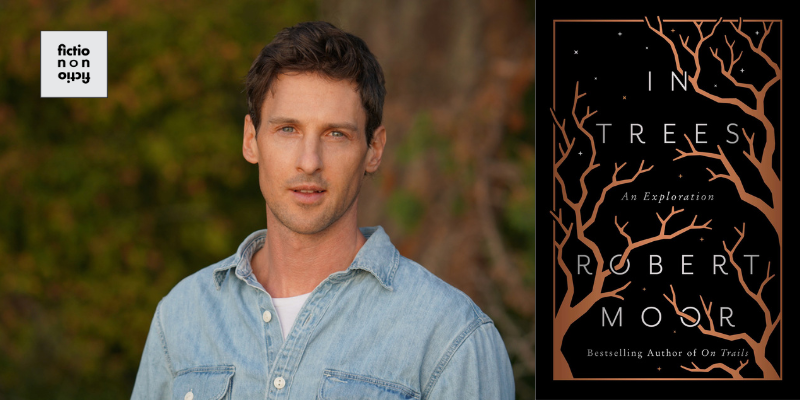
Transcribed by Otter.ai. Condensed and edited by Whitney Terrell. Photograph of Robert Moor by Remi Morawski.

Fiction Non Fiction
Hosted by Whitney Terrell and V.V. Ganeshananthan, Fiction/Non/Fiction interprets current events through the lens of literature, and features conversations with writers of all stripes, from novelists and poets to journalists and essayists.