Matthew Wolfe on the Secret History of Radical Environmentalism
In Conversation with Whitney Terrell and V.V. Ganeshananthan on Fiction/Non/Fiction
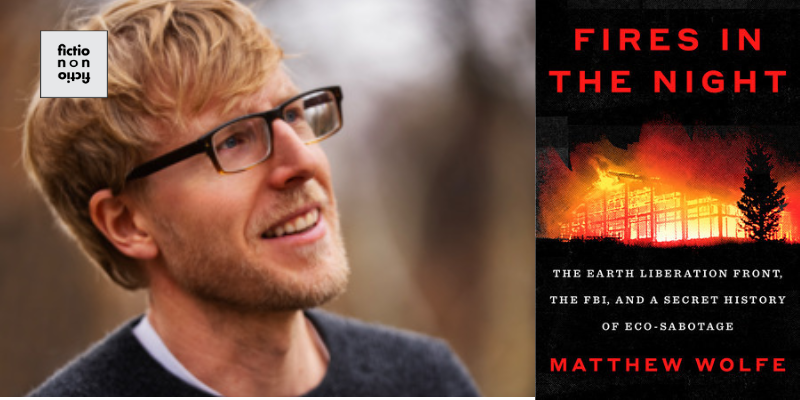
Journalist Matthew Wolfe joins co-hosts Whitney Terrell and V.V. Ganeshananthan to discuss his new book Fires in the Night: The Earth Liberation Front, the FBI, and a Secret History of Eco-Sabotage. Wolfe talks about the history of environmental activism, including its rarely discussed bipartisan past, and explains how industry made climate change a Democratic and progressive issue. He reflects on the impact of the Earth Liberation Front, which originated in England and developed another home in Oregon. He also unpacks their three guiding principles, including preventing harm to people, and considers law enforcement’s reaction to the radical group’s arson tactics. Wolfe analyzes the post-9/11 shift in environmental activism and the significance of the term “eco-terrorism,” which moved from describing harm done to the environment to those taking radical actions in the planet’s defense. He reads from Fires in the Night.
To hear the full episode, subscribe through iTunes, Google Play, Stitcher, Spotify, or your favorite podcast app (include the forward slashes when searching). You can also listen by streaming from the player below. Check out video versions of our interviews on the Fiction/Non/Fiction Instagram account, the Fiction/Non/Fiction YouTube Channel, and our show website: https://www.fnfpodcast.net/ This podcast is produced by V.V. Ganeshananthan and Whitney Terrell.
Fires in the Night: The Earth Liberation Front, the FBI, and a Secret History of Eco-Sabotage
Others
Silent Spring by Rachel Carson
EXCERPT FROM A CONVERSATION WITH MATTHEW WOLFE
Whitney Terrell: They became known as eco-terrorists, and I want to talk about how they were known that way. But first, I want you to just outline the principles of ELF, because I think people would be interested to know whether that complies with what people consider terrorism to be.
Matthew Wolfe: So the whole philosophy with the ELF was they were a kind of unofficial tax on industry. It was actually in some ways a very capitalist mindset, in the sense of saying “The only way that we’re going to reform industry is if at some point they realize it’s going to cost them money to destroy the planet. So, by setting fires, by physically destroying things, we’re going to make it literally more expensive for them to do business.” The ELF had three principles, and the first one was economic sabotage. The whole goal was to inflict the maximum amount of financial damage on those who profit from the destruction of the natural world. The second principle was public education, which was trying to call attention to these atrocities that were being visited on the planet. Fire is spectacular and gets a lot of attention, so it’s a pretty good way of doing that.
And then the other goal was to harm property, but not people. The ELF was very much against killing or even injuring anybody, so they’d go to great lengths when they burned down buildings to make sure that nobody was in them, to make sure that the fire wasn’t going to spread to other structures, or that somebody wasn’t going to get hurt because of something they did. Vail seemed an opportunity to do all of that: causing significant damage to an entity that they saw as responsible for destroying nature; given the amount of media attention that it received, it invariably led to some discussion of why the arson had happened, and caused people to think to some degree about the issues at stake; and third, they were very careful about making sure that nobody got hurt.
At one point, when Avalon was running through the fire, there was one structure he was going to burn, a kind of outhouse or bathroom that was sitting off by itself. He opened the door, and he actually found a hunter sleeping in this heated bathroom, because he’d gotten cold in his tent. So Avalon closed the door and did not burn that structure, and was very careful about not hurting anybody. It’s not foolproof. Arson is a very dangerous tool of political change, but the ELF throughout their career never physically hurt anybody, and there were no fatalities to their fire. So in that sense I think Vail was a good example of the three principles that they’d laid out as the structuring elements of what they did.
WT: I think that’s important to say, because when people call someone a terrorist, normally what terrorists do is kill people. That’s the primary method of terrorism, you’ll hear in the news.
MW: Eco-terrorism is a funny word. It was a term that came out in the early 80s, and was initially used mostly to describe harm visited on the environment. The first President Bush described Sadam Hussein setting the oil fields on fire as an act of eco-terrorism. But then, at some point, the term got contorted to actually refer to people who were using sabotage or vandalism in defense of the environment. A lot of this came back to a guy named Ron Arnold. Ron Arnold was a member of the Sierra Club in the 1970s, and he got completely disaffected with environmentalism for obscure reasons. I think that he saw the Sierra Club as too radical. So he went the entire opposite direction, and he became a lobbyist for industry. He was initially working for the timber industry, and then he expanded and had one of those nebulous right-wing think tanks that sort of puts out junk science as a way of trying to push back against environmental regulation. He also did a lot to popularize the term “eco-terrorism,” and he expanded its definition to mean not just situations where somebody was killed, or violence in the way that we sometimes think about terrorism, but to refer to acts that destroyed property. They all sort of fell under this big semantic umbrella of eco-terrorism.
In doing that, it did a couple things. It delegitimized radical activists who used sabotage or used vandalism as a way of pushing back against corporate power. If you call somebody a terrorist, not only does it draw law enforcement attention, it also means that, in the realm of discourse, you don’t really have to listen to them. Nobody has to care what a terrorist thinks. So, using the term eco-terrorism, which got adopted by the media and politicians, was a really clever lexical thing to do to try and delegitimize a group of people who were doing stuff you didn’t like and and want to stop.
V.V. Ganeshananthan: It also seems like a move to equate or blur harm to people and the destruction of property. I’m from Minneapolis, and in the wake of the George Floyd uprisings, you would hear a lot of discourse about the protection of property, and very little about the protection of people. It’s interesting to think about how this particular term and the use of the rhetoric of terror makes that possible. Also, as you’re talking, I’m thinking about all of the other activist groups that I’ve studied where they didn’t succeed in not harming anyone, like say the Weather Underground. It’s a really interesting comparison. And, of course, the Weather Underground has had this long afterlife. There’s a whole set of books about it. What is the afterlife of this group of activists? What happened to them? What were their fates? The 2018 arrest of one of them, opens the book, but what were the different paths that their lives took?
MW: So the group continued until about September 11th, but at that point the group was kind of falling apart. They had been active in the United States for about five years. They’d set a number of fires. In their spare time, they’d also engage in animal liberations where they’d free horses or dogs from laboratories or slaughter houses. There had been some hope that it would create a number of other groups, or that there would be ELF cells across the country, and they’d all start setting fires, and really putting some kind of pressure on industry. That absolutely didn’t happen. The ELF remained sort of on its own. It was not part of some larger social movement that gave it mainstream support.
So, by 2001, the group was really struggling. And then 9/11 happened, and at that point, whatever appetite the United States had had for people running around, burning down buildings as a tool for political change just vanished. It became a situation where all of the elves understood that what they were doing was not going to be appreciated. It was also a moment when federal law enforcement, which at that point decade had a number of different functions, turned almost entirely towards counter terrorism. The whole FBI was basically reorganized to become a counterterrorism organization. That meant that anybody who’s doing anything that could be called terrorism, including eco terrorists, however inappropriate the term, was going to be a target. So, the ELF at that point basically shut down. There were still a few sporadic actions by various people who claimed arsons in the name of the ELF, but it basically, in the next few years, disappeared.
The FBI was still very interested in the ELF, maybe more so, given that there was this new priority within the bureau about catching anybody who could be called a terrorist. So the FBI stayed on them, and eventually there were a number of arrests. At the end of 2005-2006, a whole host of elves got arrested and were sent to prison. A number of elves, knowing that these arrests were in the offing, just fled the country. About a half dozen of them became fugitives, and the FBI spent a number of years up till now still trying to catch them. One activist, Joseph Dibby, was caught while he was moving through Cuba. He was switching planes in Havana back in 2018. The FBI picked him up and had the Cuban authorities detain him and flew him back for trial. I think all the elves have been caught, except for Josephine Overaker, who was involved in that first Ranger station fire. The FBI still considers her one of their, one of their most wanted fugitives, but everybody else was taken back to court to answer for their crimes.
Transcribed by Otter.ai. Condensed and edited by Rebecca Kilroy. Photo of Matthew Wolfe by Nathan Fitch.

Fiction Non Fiction
Hosted by Whitney Terrell and V.V. Ganeshananthan, Fiction/Non/Fiction interprets current events through the lens of literature, and features conversations with writers of all stripes, from novelists and poets to journalists and essayists.