
Mother Tongues: How Family History Plays a Part in Language and Translation
Chenxin Jiang: “Which is my mother tongue and which an other tongue?”
My family moved eight times before I turned eleven. The biggest of those moves took place when I was three, when my parents moved us from Singapore to Hong Kong. We spoke English at home, but growing up there, I began Cantonese, the language that now feels the most intimate for me and yet one that’s always also felt foreign because of where I learned it: at school. Some of my earliest memories are of feeling like an observer in every situation, because my lack of Cantonese kept me from being fully part of it. Ever since I can remember, I’ve played the game of reading something that appears in both languages–the back of a cereal box, a subway ad, a book–and trying to figure out which came first, the English or the Chinese.
On Singapore’s subway, called the MRT, announcements are sometimes made in as many as four languages; on Hong Kong’s subway, called the MTR, announcements are made in three. Perhaps it’s no great surprise that having grown up in these cities, I eventually became a literary translator working multilingually from German and Italian, languages I learned as a teenager, as well as from Cantonese and Mandarin Chinese. What attracts me about translation is that the words you choose have their starting point in someone else’s wholly different set of words, thus enabling the illusion that translation is a self-effacing act: it’s writing (an act of revealing) behind which you can tell yourself that it’s possible to disappear (an act of concealing).
A few months ago, I published my first poetry translation, a collection called for now I am sitting here growing transparent by the Hong Kong writer Yau Ching. In the book, I describe her poems as “self-translating,” since they originate in the linguistically hybrid city of Hong Kong, which counts English and Chinese—encompassing both Mandarin and Cantonese—as its official languages. I write, “To translate Yau Ching’s poems into English is to bring them into a space that they already uneasily inhabit.” Here’s what I’m not saying out loud: if Yau Ching’s poems are indeed self-translating, then I, the translator, won’t have to draw attention to my translating them. I’ll get to sit there growing transparent instead.
Which is my mother tongue and which an other tongue?
When my siblings and I were little, my parents spoke English to all of us but Mandarin to each other. Mandarin has always been part of my inner language—it’s how books in standard written Chinese by Mandarin speakers sound in my head—but I never had occasion to speak it out loud until I was 25 and moved to Shanghai for a job. In her essay “Mother’s Tongue,” writer and translator Jennifer Shyue distinguishes between the unexamined notion of the mother tongue and what she calls a mother’s tongue: Mandarin, the language her mother speaks.
She writes: “I grew up with a non-English language as a mother’s tongue and home language.” (The exact inverse of my own experience: I grew up with English as a home language, an islet in a lagoon of Cantonese.) Which of these languages is my mother tongue: Cantonese, the language that was all around me, or Mandarin, my parents’ preferred language, or English, a third or fourth language for them but the one they spoke to me? Which is my mother tongue and which an other tongue?
My grandparents lived in Singapore and Malaysia, a part of the world that has existed between languages and in translation for the entirety of its modern history; they all spoke some combination of Malay, Hokkien, Hakka, Teochew, Mandarin, Cantonese, and Japanese. I’ve spent most of my life working with languages, and I still speak fewer languages than they did. To complicate things: my parents both grew up speaking Hokkien, but they met in college, where they spoke Mandarin to each other because it was the language in which they’d done all their schooling. When I’d grown up, in turn, my mother confided that she’d spoken English to us because it was expedient: she’d wanted to make sure that if we ever moved back to Singapore, we’d be fluent in the language of the city’s school system. Did it come naturally? Did it feel right? Those were not questions she asked.
These days, I have preschool-aged children: since we live in the United States, I mostly speak English to them, but occasionally I sprinkle in a little Mandarin because it’s useful to have a private language and because I’d like them to learn it. It’s not my mother tongue—even though, to use Shyue’s distinction, it’s certainly my mother’s tongue—but it’s expedient. The notion of a mother tongue assumes that language functions as a common thread in families, tying parent to child. My experience of being an immigrant twice over—first from my family’s move to Hong Kong and then from my move to the US for college—is that the common thread between my parents’ version of parenting as an immigrant and my own version of it is the privileging of the expedient over the thing that merely feels right.
In wanting to grow transparent, wanting to disappear, I am of course enacting an unsubtle echo of the way in which Yau Ching’s and my variety of East Asianness is coded as transparency in the United States. As Cathy Park Hong writes in Minor Feelings, “Asians are next in line to disappear. We are reputed to be so accomplished, and so law-abiding, we will disappear into this country’s amnesiac fog.” Wanting to disappear also echoes the trope that the perfect translation is unobtrusive, imperceptible, that it shouldn’t announce its being a translation at all—that the translator themselves should be transparent.
There’s no way to acquire a language without time, circumstance, and happenstance.
The funny thing about all this talk of being Asian and therefore perceived as transparent, or being a translator and therefore required to be transparent, is that in Yau Ching’s words 愈坐愈透明, the words we chose for the title, for now I am sitting here growing transparent, it is the speaker of the poem who insists on her own transparency, a transparency that has not been imposed on her:
the world is big and for now I am
sitting here growing transparent
Whether applied to Asian Americans or to literary translators, transparency is framed as an inherent quality, an immutable aspect of a person’s identity—but in Yau Ching’s poem, transparency is a process, a way of being in the here and now over and against the vastness of the world. The poem from which these words are drawn is called “Spacetime” 時空, and one of its opening lines reads: “The English word longing has length in it.” Yau Ching puns on the long vowel in the Cantonese word 長, mirrored in my translation by the long vowel in the word “longing.” This is one of the poems that, to my mind, demonstrate the self-translating quality of Yau Ching’s work, its easy fluency with both of Hong Kong’s official languages.
But while the text of the poem juxtaposes English and Chinese, it’s silent on the specifically Cantonese element in Yau Ching’s Chinese—even when Yau Ching’s words rely on Cantonese rhyme or use Cantonese constructions, Cantonese is never once mentioned. Let’s not get too deep into the weeds about Cantonese; suffice it to say that the prestige variant of Chinese is Mandarin, the variant that my parents did speak, just not to me.
With some 80 million speakers, Cantonese is no endangered language, but it exists primarily in its spoken form, with a vocabulary and grammar different from that of standard written Chinese. Never throughout imperial and modern Chinese history has it been politically convenient to designate Cantonese and Mandarin as separate languages: this is why Hong Kong has only two official languages, not three. This is also why Cantonese is not and will never be expedient, why it’s the underdog, why it’s the thing that is transparent rather than the thing that takes up space.
There’s nothing expedient about Cantonese; there’s nothing expedient about the practice of literary translation. The pay and working conditions are dire. Many excellent books are originally written in English, and yet every day starry-eyed translators add a handful more to the shelves. There’s no way to acquire a language without time, circumstance, and happenstance: whether mother tongue or other tongue, the languages I translate expose a part of my individual and familial history.
So every day that I translate, I find myself sitting at my desk growing less transparent, writing—in spite of myself—words that reveal more than they conceal. I’ve been translating for years now, and I’m only slowly getting used to this element of the practice. There’s no such thing as an expedient literary translation. But every day I’m hoping to get lucky—I’m hoping to find a translation that feels right.
__________________________________
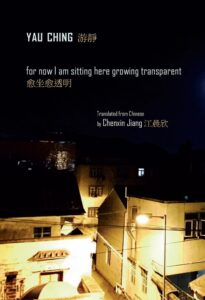
for now I am sitting here growing transparent: Poems by Yau Ching is available from Zephyr Press, translated by Chenxin Jiang.

Chenxin Jiang
Chenxin Jiang translates from Italian, German, and Chinese. Her translation of for now I am sitting here growing transparent by Yau Ching was a finalist for the 2026 PEN Award for Poetry in Translation, and includes a poem that won a Words Without Borders/Academy of American Poets contest. Other translations include Tears of Salt by Pietro Bartolo and Lidia Tilotta, shortlisted for the Italian Prose in Translation Award, Volatile Texts: Us Two by Zsuzsanna Gahse, and the PEN/Heim-winning The Cowshed: Memories of the Chinese Cultural Revolution by Ji Xianlin. Chenxin was born in Singapore and grew up in Hong Kong. She is the president of the American Literary Translators Association.