Jump Into the Ball Pit: Emily Rapp Black on the Creative Power of Play
Writing for the Sake of Creating and Thinking Because It Feels Good
This first appeared in Lit Hub’s Craft of Writing newsletter—sign up here.
One summer in Brooklyn I made an outline for my first book. I was told I must do this, or my ideas would be unorganized, my plot would do no plotting or propelling, and my arrow of story would fly and just keep flying, never hitting any mark. Readers would be disappointed. This prospect made me sad, so I got to work.
Two long and sweaty months later, I’d made about 100 different timelines in Sharpie on construction paper which I’d spread out on the floor. Each time I tried to make an outline that was clean and full of straight lines and correct, I’d get an idea and start making little notes to myself over and under the clean and straight lines. Every timeline eventually resembled the illuminated Biblical manuscripts I once studied in Divinity School; the most interesting and salacious stories were found in the marginalia, where monks depicted themselves in various compromised scenarios and sometimes robe-free. I wanted my mind to think in an organized way, to track the right path forward, to start and begin at the perfect places. I wanted to do it right, but I couldn’t do it at all. And, more significantly, I didn’t want to do it anymore because I’d lost the love of the project. I was housesitting in Williamsburg for a musician, who told me I could play the instruments if I didn’t ruin them, so when I arrived at this stage, I made a bunch of noise on the drums. I felt better.
I picked up all my failed outlines, preparing to trash them or burn them in some dramatic ritual fire in the kitchen sink, but then I looked through the notes. Those made sense, or a kind of sense, because they were leading me somewhere, like a personalized museum docent taking me to the paintings and sculptures they knew I’d like best. I was talking to myself in a voice that I recognized—mine. Sure, the ideas weren’t cohesive, but they were connected, I just wasn’t sure why or how. And now I was curious, and the love of the project returned one hundred fold.
I never made an outline again.
The guiding image of my process was not an outline, but the ball pit found at indoor playgrounds, beloved by children and feared by adults who carry hand sanitizer just for such activities. When a kid sees a ball pit, they don’t think that is a viral infection waiting to happen, or when and how do the foam balls get washed, if ever? No. They see a pit of possibilities and in they gleefully go, connected to joy but disconnected from outcome. It’s just a ball pit. You can see it in their faces: Let’s see what happens. No fear of water that’s too hot or too cold or full of sharks, no worries if there’s someone already in there or if it’s empty, just a bright and cheery willingness to mess around.
I invite you to enter the ball pit of your imagination, where colorful spheres of foam are being tossed up into the air at random, chaotically, in no recognizable pattern or sequence, but somehow, they are connected. Pop. Pop. Pop.
Your ideas—which are yoked to your memory—can be fun to access in just this way, even if you are writing difficult, even harrowing, stories. You can jump into a project anywhere, and move a paragraph or an idea anyplace, because your imagination is there to back up the shards and pieces of memory that you are trying to shape into a piece that will make a reader laugh, or think about something in a new way, or decide to stay in the world for another day. Writing is that epic, and that playful at the same time.
Any imaginative exercise lacks certainty by its nature. It may not move in an orderly fashion, and that can also work in your favor, because memories—those curated from your own lived experienced or those you have conjured up for a fictional character—aren’t easily ordered. At all. But everything you’ve ever said or done or experienced or lost or gained is within you, and the way to get access to it is to jump straight in and let your mind do what it’s built to do: make connections, access memory, experience joy in creation.
But then what is memory exactly? Is it a muscle? A bank? An unreliable narrator? Can you find it if you chase it? If you tug on it, will it give way?
It is all those things. It does all those things. But you, the writer, need to be willing to play, make mistakes, jump up and down and trust that you’re safe, and stop overthinking why you had this idea at this moment and why you put it in a particular place. It’s a word, you can always move it. There’s no way to get it wrong, and there’s no way to get it right.
I invite you to enter the ball pit of your imagination, where colorful spheres of foam are being tossed up into the air at random, chaotically, in no recognizable pattern or sequence, but somehow, they are connected. Pop. Pop. Pop. Everything is connected, of a piece. Everything matters. Nothing is lost.
Once I landed on this image for my process, everything changed. I wrote ideas on sticky notes that I layered all over the walls. I cut chapters and essays and stories into pieces and then threw them around to see if I could find a different ending or a more resonant beginning that I knew I could trust. Why? Because I was making decisions from a joyful place instead of a fearful one, and I was following my sense of innate curiosity, which is also a gift we are given without having to work for it. I made a giant mess, and what emerged was beautiful and strange to me. I was euphoric and productive, without an outline in sight.
Once I stopped trying to organize my thoughts in any strident way, my ball pit became a happy and generative place. I’m having a blast in there, and I don’t care what happens; I’m playing for the sake of play, writing for the sake of creating, thinking because it feels good. Nobody would understand my weird lists or my wacky documents or my ridiculous first drafts, but I do, because I am living alongside them, evolving with the text, which is itself a living thing.
Find an image of creative freedom that works for you and enter that space when you write. It’s yours, it’s pure, it’s safe, it’s playful, and it will shift everything about how you work and how you feel while you’re working and this will, I promise, change your work in the most exciting and satisfying way.
____________________________________________
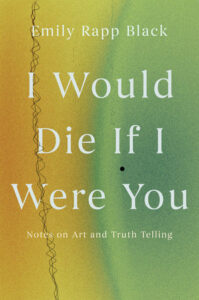
I Would Die If I Were You by Emily Rapp Black is available via Counterpoint Press.

Emily Rapp Black
Emily Rapp Black is the author of the New York Times bestseller book Poster Child, The Still Point of the Turning World, Sanctuary, and Frida Kahlo and My Left Leg. A former Fulbright scholar, Guggenheim Fellow, and graduate of Harvard Divinity School, she is Professor of Creative Writing at University of California-Riverside, where she also teaches in the School of Medicine.