In Defense of Pet Portraiture as a Worthy Art Form
Morgan Day on the Practice of Artistic Tradition
A professor once assigned me to select and watch over a small plot of land in the city. I was to take weekly notes on its changes, so as to understand the site’s history and record the details of its evolution. To make it easy on myself, I chose the small, gated garden of a church across the street from my apartment building. I could have watched it from my kitchen table on the seventh floor, but I followed instructions and sat on the stone bench of the garden every day.
There I surveyed the dried leaves in the empty fountain and counted the dwindling flowers on a bush. The class met once per week, and we each gave an update on our plot: dirty gum flattened on asphalt, the introduction of a blue bottle cap, the gradual undressing of a tree.
The assignment was an exercise in attention; we were to pay closer notice of the subtle transformations endlessly taking place. The corresponding reading assignments were about how matter is not passive nor a blank slate. Everything, both animate and inanimate, has its own creative agency, making and evolving its own narrative, one that can be interpreted through its distinct way of “telling.” We were instructed to uncover the stories of these more-than-human realms and find the links to our unitary existence. There were two ways of doing so: through reading narrative texts and interpreting matter itself as a “text.”
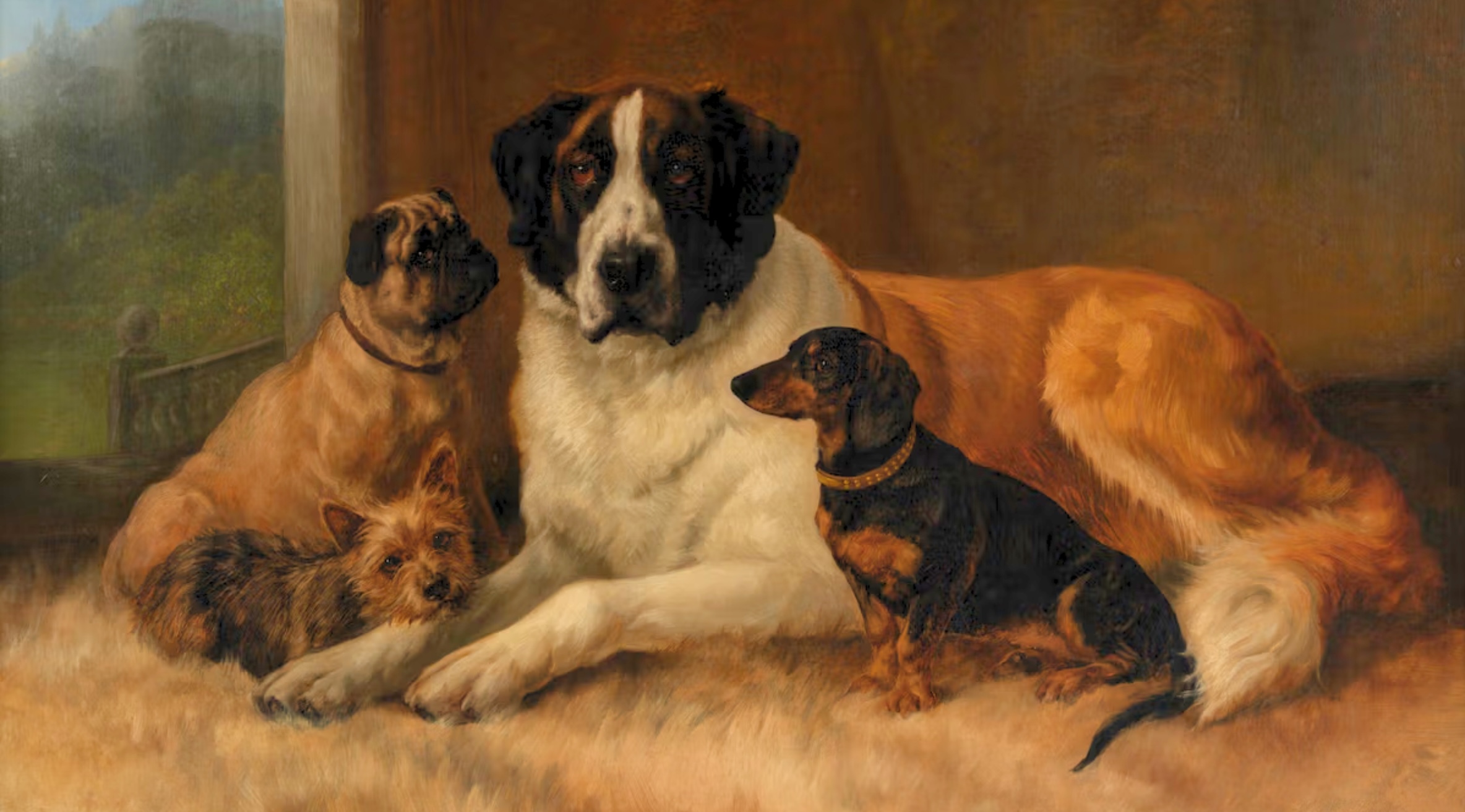
The tradition of pet portraiture is often overlooked as a low art, kitschy and thoughtless.
The boundaries of my chosen site grew beyond the church garden. I noticed a plant gradually yellowing on my walk to class, and the spinning accumulation of trash on a windy day. When I went home, I saw my French Bulldogs, too, with a renewed lens. They became part of a larger system, and it seemed that their little world could be studied, in ways—like perception, symbiosis, the role of the inanimate, meaning, concepts of time and intelligence—as a scaled down version of our expansive one.
In The Companion Species Manifesto, writer and theorist Donna Haraway considers what could happen when we take dog-human relationships seriously. She hopes that “even the dog phobic—or just those with their minds on higher things—will find arguments and stories that matter to the worlds we might yet live in.” Dogs become more than a sidekick or theme, but a creature to be thinking with. To communicate with other species, Haraway says that we must hone alertness and politeness toward them. To craft a more dedicated alertness to another species, I can’t think of a more exacting methodology than pet portraiture. Not supervision or caretaking, but the serious observation and rendering of another species.
The tradition of pet portraiture is often overlooked as a low art, kitschy and thoughtless. It was historically an acceptable way for women to enter the art world. They were more likely to find patrons for their work if they painted dogs or infants. Today, there are ceramic dog soap dispensers at HomeGoods, mass produced prints of cats in royal outfits and suits, and made-to-order watercolor pet portraits on Etsy. An article in the Guardian on pet portraiture opens with: “Want to make your pet look a bit stupid?” The writer reflects on Renaissance artists who painted other species as they were. About contemporary portraits: “you are better off taking inspiration from actual Renaissance portraits of animals to photograph or draw your own.”
I agree with that last part. I’m less curious about the artistic tradition, even the existing work, than the practice. What occurs when an activity has us deeply consider the life of another species: at their scales, in their spaces, with their specific interactions and chosen routines? At the time of the assignment, I had already been engaging in a daily account of my French Bulldogs’ existences. Hundreds of photos and videos of them eating, sleeping, playing, and thinking were claiming more and more space on my phone.
There are echoes of the practice in more contemplative pet tributes, like Henri de Toulouse-Lautrec’s “Touc, Seated on a Table” (ca. 1879-1881). The painting is of his family’s beloved French Bulldog, made when he was a teenager. Touc might look to be snarling, but his softly pulled back ears are a sign of affection in the breed. His position on the table is subtly alert. He won’t relax onto his haunches, as if he’s ready to enact another common behavior in French Bulldogs: lunging at your face as if to bite, only to lick your nose. Often referenced in discussions of pet portraiture is Keith Thomas’ Man and the Natural World, specifically his commentary that pets were an “emblem of mischievous irreverence.” Touc, too, has a devil-may-care attitude that disrupts human conventions and perhaps our notions of art, too.
Pet portraiture is inherently a form of entanglement, one that combines human perception and interpretation, through words and material, with the life of a pet.
The painting of Touc reminds me of the artist Francis Bacon’s statement that he believes in a “deeply ordered chaos.” Contrary to the painting’s title, a split second of disordered life is being captured in Touc, blurry around the paws, an uncanny gaze rendered through lopsided eyes. That might be why the table is relegated to an oversimplified surface for Touc to perch. The background is flat and washed out. We get the essence of a creature who is loved but remains, in some ways, unreachable. The painting is an attempt to seize the nature of the regenerative animal. Materiality becomes the tool to do so. And most importantly, attention; the artist’s acute awareness of Touc’s way of being.
In Marlen Haushofer’s 1963 novel The Wall, translated by Shaun Whiteside, an invisible barrier emerges around the property of a rural house. The narrator is trapped inside the barrier and isolated from the rest of the world. The lives of the creatures, domesticated and not, are recounted in the narrator’s report that is the novel. The literary barrier, like the novel form, creates a frame within which interspecies relations can be studied. And like the assignment from my professor, it seems that a frame might be necessary for our engagement with other species and things—canvas, page, site boundary. Otherwise, the task of capturing the world becomes too overwhelming, the resultant work too reductive, like the first photograph of the Earth taken from outer space.
Pet portraiture is inherently a form of entanglement, one that combines human perception and interpretation, through words and material, with the life of a pet. It operates as an expression or continuation of Stacy Alaimo’s concept of transcorporeality, examined in her book, Bodily Natures: “the human is always intermeshed with the more-than-human world.” This perspective emphasizes how inseparable we are from our environments. Our skin is not a rigid barrier, but a porous surface that allows what’s outside to come in, and vice versa. We’re all in a continuous process of renewal, affected by the things within, and those interacting with, our surroundings.
Maybe conscious awareness of this entanglement is a learned skill. The domestic realm can be one of many entry points. In Joy Williams’ essay collection Ill Nature, she writes: “And the word environment. Such a bloodless word. A flat-footed word with a shrunken heart.” Practicing pet portraiture offers a more organic way for most of us to expand our perception, to be less flat-footed and shrunken-hearted.
__________________________________
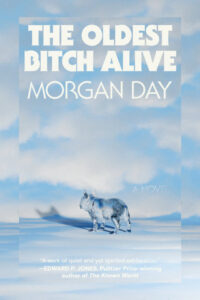
The Oldest Bitch Alive by Morgan Day is available from Astra House.

Morgan Day
Morgan Day is a fiction and architecture writer. Her short fiction has appeared in Ecotone, Gulf Coast, The Southampton Review, Worms Magazine, and elsewhere. The Oldest Bitch Alive is her first novel.