Polly Barton on Ryunosuke Akutagawa’s Hell of Solitude
“The question then is, what does matter? What do we have when we do not have a story?”
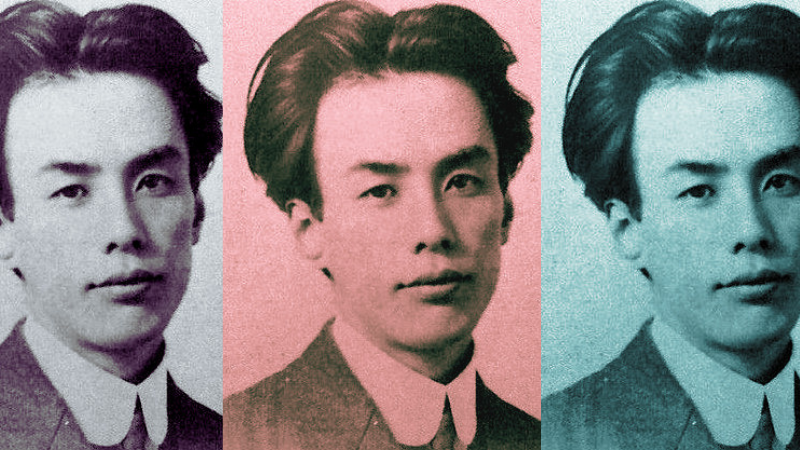
In principle it should be straightforward enough to write an essay about the work of Ryūnosuke Akutagawa. Here is a writer who can absorb virtually any decisive, sweeping statement about his significance in the literary canon that you care to throw at him, and then look back at you, ready for more: it is hard to understate Akutagawa’s importance in the world of Japanese literature; you would be hard-pressed to find a Japanese story writer who had not been influenced, obliquely or directly, by the work of Akutagawa; here is a writer who, almost a hundred years after his death, still manages to evoke almost universal reverence and adoration among Japanese readers, etc. In the time it took me to write this essay, I translated two texts—a philosophical treatise and an interview with a visual artist—and both of them referenced Akutagawa.
Yet the same cannot be said for Akutagawa’s reputation outside of Japan (or Japanophile circles). Since first being approached about writing this foreword I have been mentioning Akutagawa’s name to people with no particular Japanese connection, both in and outside the book world, and have been surprised by the near-total lack of recognition with which I am met.
To date, the most my interlocutors have been able to offer spontaneously is the award named after him, the Akutagawa Prize—Japan’s highest literary accolade given annually, which, since the boom in Japanese literature, acquisitions editors and agents have taken to watching hawk-eyed. I drag the subject back to the man himself and proffer a few tidbits of information, hoping to trigger some recognition: writing in the early twentieth century; protégé of Natsume Sōseki and literary inspiration to Osamu Dazai; died by suicide at the age of 35 in 1927; was extremely prolific during the decade or so he was writing; known as the father of the Japanese short story… Still my interlocutors nod and shake, faces blank.
As with all the most masterful compilations, one senses here an organising principle that is at once definite and diffuse, a kind of atmospheric coherence that evades easy explication.
It is usually only when I mention that he wrote “Rashōmon,” the story upon which the Akira Kurosawa film was based (for simplicity’s sake neglecting to mention that while the film’s framing and title originated from “Rashōmon,” the characters and plot actually derive from a different Akutagawa short story, “In a Grove”) that people’s ears prick up.
“Oh yes,” they say, “I know Rashōmon. I didn’t know it was a short story, though.” This makes me think about which of the Japanese “masters”—which of the “masters” of any culture—gain visibility in other countries. The forces—market or otherwise—that drive such currents. And maybe if this were a different collection—if this were a definitive compendium of the essential Akutagawa stories bringing together such classics as “Rashōmon,” “The Nose” and “Yam Gruel”—then I would elaborate on this point as well as the historical facts about Akutagawa. Yet Hell of Solitude is not that collection.
Instead, what awaits you is something more subtle: a compendium of poems interwoven with assorted lesser-known stories and pieces of writing compiled by Ryan Choi, a veteran translator of Akutagawa’s works. As with all the most masterful compilations, one senses here an organising principle that is at once definite and diffuse, a kind of atmospheric coherence that evades easy explication.
Since it falls to me to attempt some kind of analysis, though, I would say the prose pieces that intervene between the short, spare, crystalline poems seem to be treating the narrative form with a healthy serving of scepticism—regarding it askance, as if with a cocked eyebrow. Notably, several of the stories take the form of lists or catalogues: there is “Bad Omens,” which provides a dated list of bad omens that have taken place in the narrator’s—ostensibly the author’s—life; “The Zoo,” an inventory of associative animal descriptions; and “Seashells,” a collection of at least superficially unconnected tales and observations, each with its own subtitle.
The two stories “He I” and “He II” are divided into parts, essentially describing two friendships in chronological order, with a notable reluctance to embrace standard narrative tropes: “He was a young man from Ireland. There’s no need to mention his name.” Even the more traditionally “story-like” stories share an arch or ambivalent relationship with the traditional practice of story-telling.
One of Akutagawa’s groundbreaking innovations was to take traditional stories from antiquity and breathe new life into them—”Rashōmon,” in fact, being a prime example—and in this collection we see him turning to the folktale of “The Battle of the Crab and the Monkey.”
Instead of retelling the story, however, Akutagawa sets himself the task of penning the sequel: the story opens: “In the end, the monkey was held to account for the crime of stealing the crab’s rice balls.” We then have the disclaimer: “There is no need to repeat this part of the tale since everybody knows it already. Instead, I will focus on what the tale omits: the fate of the crab and his allies after they brutally murdered the monkey.”
The question then is, what does matter? What do we have when we do not have a story?
This is a prime example of a quintessentially Akutagawan storytelling move that even today remains thrilling in its offhand, dispassionate boldness. Indeed, it takes on an added thrill in this context of translation, where very few anglophone readers will in fact know the tale already. Yet I would argue that not only does the idea that there is no need for reiterating all that came prior still hold in such a context—the reader has been told there is a hugely rich backstory and that’s really all the information they need here—but also that there is a wider lesson to draw from this, namely of the virtues of plunging straight in and not thinking too much about what one is supposed to know.
The same lesson applies to those for whom this collection constitutes their first exposure to Akutagawa. In a sense, Hell of Solitude could be compared to a compendium of demos and deep cuts—and yet if that is the case, it is not the kind with appeal only to the Akutagawa aficionado. Rather, the collection provides a perfect jumping-off point not only because the works collected here are glorious and do not read as ‘minor’ but also because they do important work in crystallising a scepticism toward narrative that rewards tracing through other, better-known works.
Mulling over the attitude to narrative showcased in this collection, I keep coming back to a dispute that Akutagawa had in the final year of his life with Jun’ichirō. Tanizaki about whether plot was the most important aspect in fiction. This culminated in an essay that Akutagawa published in the literary journal Kaizō in praise of writers of “unstorylike stories,” which he held to be the purest kind of fiction. It seems to me in this collection we have not just a compendium of “un-storylike stories” but the comprehensive exposition of an unstorylike stance towards story and storytelling. Together these pieces present an argument, in a sense, about how little a well-structured plot in the conventional sense matters.
The question then is, what does matter? What do we have when we do not have a story?
In his unstorylike-story-essay, Akutagawa repeatedly mentions the painter Paul Cézanne in conjunction with a painterly analogy he draws between plot, or “story,” and artistic finesse: sure, to make a good artwork one needs a compositional sketch, he argues, but it’s the vitality with which the canvas is painted that really stuns the viewer. The handful of Cézanne works that have made it over to Japan, he notes, serve as proof of this. He then writes: “I’m interested in stories that are like these paintings.”
In the final piece in Hell of Solitude, “Art and Other Matters,” we find another reference to Cézanne, where Akutagawa writes of “that indomitable resolve of […] an artist who would spill countless buckets of sweat if just to seize upon some inner law essential to conjuring aesthetic feeling.”
Researching Cézanne’s work online, I stumbled upon a Guardian review of his recent retrospective at the Tate Modern, one of whose walls was emblazoned with the painter’s famous declaration: “With an apple, I shall astonish Paris.” The reviewer is unconvinced by this statement, as by Cezanne’s project in general. There’s only one possible response to this, she writes, and that’s: “OK mate. Nobody has ever been astonished by an apple.”
Usually, I would skim over this performance of cool-kid flippancy with a similarly disaffected eye roll, but after steeping myself in Akutagawa I have a different sort of reaction. What strikes me in that moment is not just that “astonishing with an apple” seems to perfectly summarise Akutagawa’s project: the creation of moments where the clamour falls away and we are taken over by pure feeling. It’s rather that this analogy is also the perfect illustration of why both the unstorylike story and the still-life constitute the perfect vehicle for delivering this form of artistic experience.
What is astonishing about the apple-astonishment is, of course, that an apple is not usually an astonishing sight. This is not the version of artistic endeavour where the artist features as flamboyant magician pulling off a smoke and mirrors show, summoning a grand, sweeping narrative, to inspire otherworldly wonderment in their audience. The amazement is not in the objects that this art represents.
We should talk, too, about solitude. About the hell of it, certainly, but also about the quality—the “aesthetic feeling” of it—which strikes me as another thread binding this.
Rather, in this iteration of art, the magic lies in presenting something that distils human consciousness, offering an intensity of sensation through which it, perversely, miraculously, becomes one with our own lives. If it is beauty and wonderment that is seizing us in that moment, it is a beauty and a wonderment which doesn’t begin and end on the canvas, or the page, but rather originates with and returns to our lives and our perceptions outside of it. The humbler the subject, the less “immersive” the narrative, the better.
The truly astonishing thing, which one feels the unstorylike stories making up Hell of Solitude whispering to us, is that we see apples, or animals, or the intricacies of human relationships as commonplace, and do not find them astonishing. What is astonishing is that we are alive, in this world, with other people thinking and feeling similar things to us, and sometimes we come close to forgetting that. But sometimes, when a crack opens in our desensitisation in the form of a painting or a story, we can remember, and it’s possible that that experience will open us, more, to the apples and the animals around us.
We should talk, too, about solitude. About the hell of it, certainly, but also about the quality—the “aesthetic feeling” of it—which strikes me as another thread binding this
collection together. The idea that now, in 2026, in our age of total digital interconnection, we are more lonely than ever, has become almost so much of a truism that it’s hard to know how we might even begin to assess its truth. One way of investigating its veracity might be to try and compare our solitude, its hellishness, with the one that Akutagawa describes.
Indeed Akutagawa himself is engaged in a similar endeavour in the titular story—which, incidentally, is one of the most “storylike stories” in the collection, although even this begins with a gesture that both highlights and destabilises the unthinking suspension of disbelief implicit in storytelling: “This is a story that I heard from my mother… I don’t know if it’s fact or fiction.”
After describing the goings-on involving his great-uncle and a monk, Akutagawa writes:
To someone like me, who spends most of his days cooped up in his study and has little interest in the art or literature of the Edo period, the world of my great-uncle Tsutō and Zenchō the monk seems entirely removed from the one I inhabit. It is only through this concept of a “hell of solitude” that I can begin to sympathise with these men of the floating world, because after all, I recognise that, in some sense, I too am suffering in a hell of solitude.
In other words, the hell of solitude—as a factor, a feeling—unites us across the generations, whether we live in an age of temples and monks, of studies and stories, or of myriad screens, and regardless of our interest in history. A resigned, desolate feeling that Akutagawa returns to again and again throughout the works in this collection: the agonising futility of the waiting we find in “Windows,” the tranquil ripples of sadness shimmering through the poems.
I find myself thinking about a hierarchy of loneliness among forms of writing, wondering if the kinds of writing in this collection are not exactly the “lonelier” kinds, the forms that let the loneliness shine through. Perhaps this is the point: people are drawn to the storylike story because it is less lonely. We search out the good yarn and it comforts us, so that we don’t have to think too much, or feel too much, of ourselves. Yet there is another kind of thrill, albeit a more self-conscious one, that comes from not losing oneself in the story entirely from feeling the charge of the shared consciousness that passes between you and the author, and the other people in the world, or with the world itself. As Akutagawa writes in “He I”:
But we spoke nothing of these feelings. Instead, he ran his fingers along the slatted bamboo fence that bordered one side of the sidewalk. “When you do this really fast,” he said, “your fingers vibrate in a funny way, like there’s an electric current running through them.”
Perhaps what we have, when we are given less of a story than might be expected, when we have an unstorylike story or a desolate poem, is more of ourselves. We have things as they are, our selves as they are, and life as it is, and sometimes that is hell. Nevertheless, Akutagawa shows us that sharing that hell with others can be electric.
__________________________________
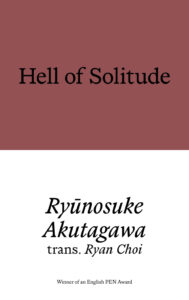
From Hell of Solitude. Used with the permission of the publisher, Prototype. Translation copyright © 2026 by Ryan Choi. Forward by Polly Barton, copyright © 2026 by Polly Barton.

Polly Barton
Polly Barton is a literary translator and writer. Her translations from Japanese to English include Butter by Asako Yuzuki, The Woman Dies and Where the Wild Ladies Are by Aoko Matsuda, and There’s No Such Thing as an Easy Job by Kikuko Tsumura. Her English-language translation of Hunchback by Saou Ichikawa was longlisted for the International Booker Prize 2025. Barton has written the books Fifty Sounds and Porn: An Oral History, both published by Fitzcarraldo Editions, and her debut novel What am I, a Deer? comes out in 2026.