On the Systematic Annihilation of Gaza’s Educational Future
Taqwa Ahmed Alwawi Confronts the Devastation Wrought Upon Her Generation of Young Palestinians
As a student writing from inside Gaza amid an ongoing catastrophe extending into 2026, I am witnessing how genocide is systematically annihilating not only lives but also the very future of education for an entire generation. What is happening here is not collateral damage or an unintended humanitarian crisis. It is a deliberate and comprehensive assault on knowledge, mobility, and the educational infrastructure in Gaza—a process that UN experts have identified as scholasticide.
Scholasticide refers to the systematic destruction of a population’s educational system: its institutions, its educators, its students, and the conditions required for learning. In Gaza, this phenomenon is not an accident. Education has historically been the primary means of perseverance, dignity, and social mobility for Palestinians living under decades of occupation and blockade. Today, that tool is being deliberately demolished.
This crisis goes far beyond the physical destruction of buildings. It represents the intentional targeting of intellectual leadership, cultural memory, and generational continuity. An entire generation of Palestinian youth has been pushed into academic paralysis by design.
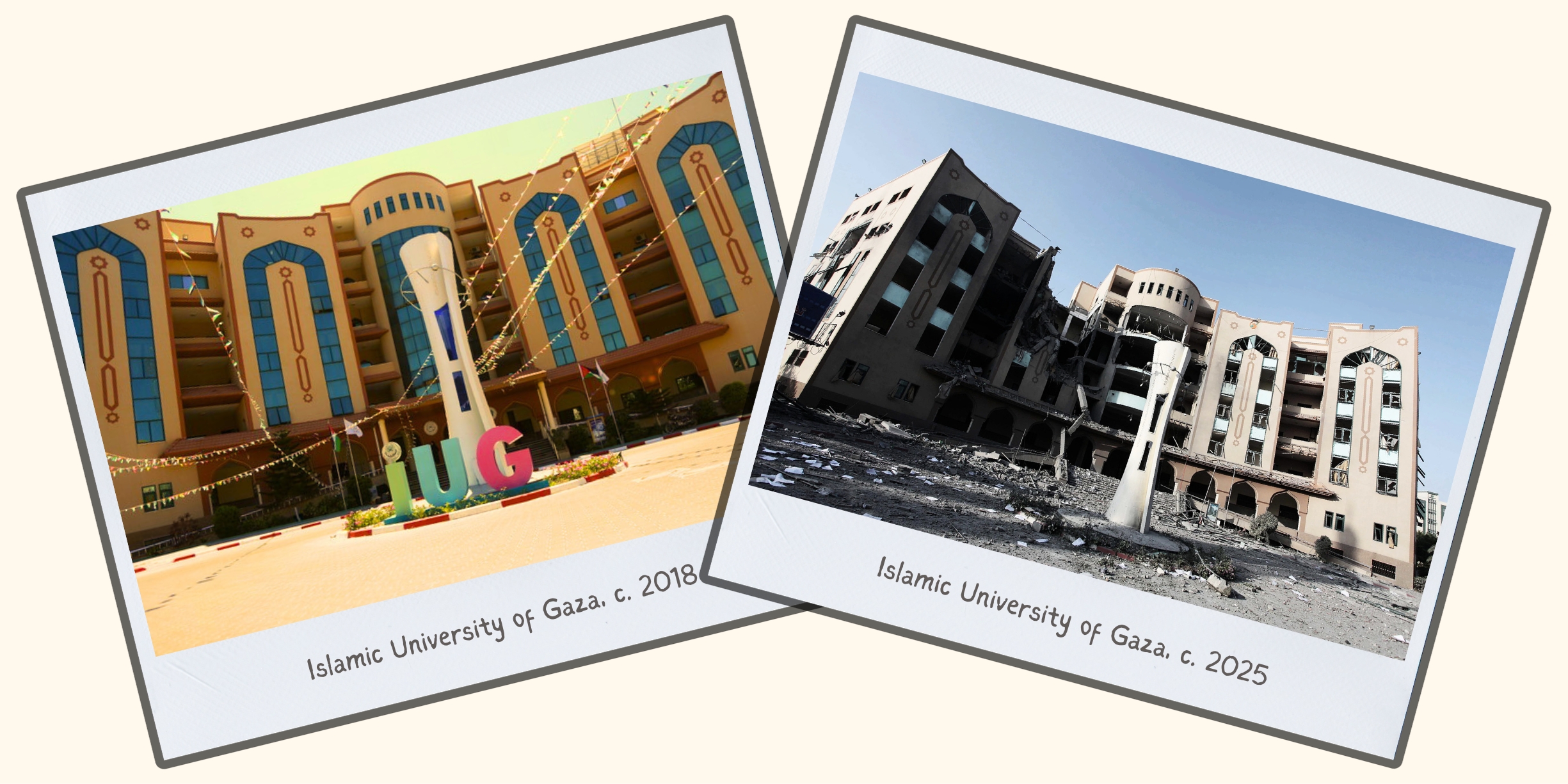
The scale of destruction inflicted on Gaza’s educational sector is unprecedented in modern history. According to the Palestinian Ministry of Higher Education and UNOSAT, all twelve universities in the Gaza Strip had been either partially or completely destroyed by May 2024. Institutions such as the Islamic University of Gaza and Al-Azhar University were not merely classrooms; they were centers of scientific research, medical training, innovation, and cultural life.
The destruction of Gaza’s universities followed a clear and escalating timeline. On October 9, 2023, the Islamic University’s main library was destroyed. Days later, both IUG and Al-Azhar University were bombed. In the months that followed, universities and academic landmarks across Gaza—including Al-Aqsa University, Gaza University, and Israa University—were systematically targeted, culminating in the demolition of Israa University in January 2024. This chronology reflects the sustained and calculated targeting of Gaza’s higher educational sector rather than a series of isolated incidents.
The digital divide has become a digital wall, further isolating Gazan scholars from the world.
The razing of these campuses blocked the academic trajectories of more than 90,000 university students, effectively impeding their higher education for the foreseeable future. Beyond universities, approximately 80 percent of primary and secondary schools and 60 percent of all other educational facilities, including 13 public libraries, have been rendered inoperable. In total, around 715,000 students have been cut off from formal education.
A core component of scholasticide is the targeting of the educators themselves. The Euro-Med Human Rights Monitor has documented the killing of over 100 prominent academics, researchers, and professors, including university presidents, leading physicists, and internationally recognized scientists such as Dr. Sufyan Tayeh.
The loss of a professor is not a single death; it is the loss of decades of accumulated knowledge, mentorship, and institutional memory. Without these intellectual leaders, rebuilding Gaza’s education system becomes a Herculean task. Behind these statistics lies an overwhelming human and societal toll.
In the first six months of the genocide alone, more than 5,479 students, 261 teachers, and 100 university professors were killed, with numbers continuing to rise. This massive loss of life, combined with the near-total destruction of educational buildings, has created an environment where survival takes precedence over education. Seventeen higher education institutions have been destroyed, with laboratories and libraries burned, and reconstruction costs estimated at $300 million. Over 88,600 students lost at least one full academic year. Thousands of academic staff remain unpaid, arrested, or traumatized, and widespread displacement—both inside and outside Gaza—has severely disrupted academic life.
Learning now occurs—if at all—in shattered classrooms, overcrowded shelters, or tents. Books, desks, electricity, and internet access have become luxuries. Studying under these conditions has become a grueling act of endurance.
Proposals for “online learning” as a solution are deeply detached from reality. Gaza’s electrical grid has been systematically destroyed, and fiber-optic networks repeatedly cut. Students cannot access Zoom or Google Classroom without electricity, devices, or internet connectivity. The digital divide has become a digital wall, further isolating Gazan scholars from the world. For students, this means that when electricity or internet access is cut, attending online classes, submitting assignments, or even communicating with professors abroad becomes impossible, leaving them disconnected from their education and academic opportunities.
If the international community remains silent while Gaza’s brightest minds are killed by bombs or immobilized by borders, it becomes complicit in the destruction of the future of an entire people.
Under the Fourth Geneva Convention, an occupying power is legally obligated to facilitate the functioning of institutions dedicated to the education of children and youth. The systematic targeting of universities and the denial of student movement constitute violations of the International Covenant on Economic, Social and Cultural Rights (ICESCR).
Before the International Court of Justice (ICJ), the destruction of educational institutions has been presented as evidence of intent to destroy the social fabric of the Palestinian people—an essential element in the legal definition of genocide.
Independent assessments, including the 2024 Swiss Peace report Resilience in the Rubble, document the systematic nature of this destruction and outline the urgent needs of Gaza’s higher education sector. These findings reinforce the conclusion that what is unfolding is not incidental damage, but a deliberate assault on education as a means of survival and continuity.
For many students in Gaza, winning prestigious international scholarships—such as Chevening (UK), Fulbright (USA), or DAAD (Germany)—once represented a rare escape from the confines of siege. These scholarships were “golden tickets” to dignity, safety, and academic continuity.
Since October 2023, however, these opportunities have turned into sources of profound trauma. International scholarships are strictly time-bound, governed by rigid academic calendars and visa deadlines. For hundreds of students, these deadlines passed while they remained trapped under bombardment—unable to attend embassy interviews, provide biometric data, or even reach border crossings.
By May 2024, over 555 students who had secured international scholarships lost them entirely. Most scholarship recipients remain trapped in Gaza, watching their futures collapse as enrollment deadlines pass. UN agencies now describe this condition as the emergence of a “lost generation.”
On Thursday, January 15, 2026, dozens of Palestinian students in Gaza who had received scholarships to study abroad organized a protest demanding the opening of crossings to allow them to continue their university studies. The protest was hosted by the Solidarity Centre, affiliated with the Palestinian Journalists’ Syndicate in Khan Younis, Southern Gaza, giving the students a platform to voice their concerns. Some have been waiting for 2 to 3 years to pursue higher education, despite being accepted at universities abroad.
The UN documented cases of Palestinians returning to Gaza through the crossing being humiliated and mistreated by Israeli forces, tied up, beaten, denied medical care, and even kept from using toilets.
Around 1,500 students from Gaza received admission to universities in countries such as Pakistan, Turkey, France, and Egypt. However, these scholarships are at risk of being cancelled because they cannot reach their universities due to Israel’s ongoing closure of crossings. One student spoke about the cancelation of his scholarship after he failed to arrive on campus by a set date, which the university later reconsidered but told him to travel immediately to avoid losing it. Another student said his university gave him a five-month deadline to enroll or his scholarship would be revoked.
Many months after a ceasefire began on October 10, 2025, Israel still keeps tight control over the Rafah crossing, blocking Palestinians from leaving Gaza, a clear violation of the US-brokered deal that was supposed to make it easier for civilians to move. For a brief moment in early February 2026, the crossing opened.
On February 2, the first group of sick people, just 23 patients, were allowed to leave over 48 hours. But on February 4, Israel closed it again. A third group of patients, who had already prepared everything for their medical trips, was stopped. That left more than 18,500 sick and wounded people trapped, with no way out. Then things got worse. On February 28, 2026, as fighting erupted between Israel and Iran, with the US and Israel launching strikes on Tehran, Israel shut down all Gaza crossings, including Rafah.
Starting March 1, they announced the closure would last “until further notice,” calling it a “necessary security measure” because of the war with Iran. Local officials in Gaza called it “collective punishment” against more than two million civilians. This new closure came less than a month after the crossing had finally reopened for the first time in over two years. The growing regional conflict has made everything worse. Human rights groups have warned that Israel is using the war with Iran as cover to tighten its grip on Gaza.
Meanwhile, daily abuses against civilians keep mounting.
The UN has documented cases of Palestinians returning to Gaza through the crossing being humiliated and mistreated by Israeli forces, tied up, beaten, denied medical care, and even kept from using toilets. Along the border, fishermen and farmers near the fence are still being shot at. Since the ceasefire began in October, at least 574 Palestinians have been killed and thousands more wounded in ongoing violations, making life even harder and crushing any hope of rebuilding.
The closure of the crossings sparked panic across Gaza. People rushed to buy whatever food they could find before supplies ran out, and prices shot up overnight. Aid groups warned that food stocks would only last a few more days. Scattered airstrikes have also continued. On March 7, a strike in Khan Younis killed a father and his daughter. The World Health Organization says about 18,000 people are still waiting to be evacuated for medical treatment, and only half of Gaza’s hospitals are even partly functioning.
Nazih Helles, a man with a spinal injury who was waiting to travel for treatment with his wife, who has cancer, said: “I almost broke down when I learned Israel had closed the crossings again... This was not the time for another war. The people of Gaza are always the ones who pay the heaviest price.” This painful reality shows the suffering of an entire generation, afraid of losing their future as the blockade and violations continue. The past six months have made one thing clear: the ceasefire was fragile from the start, and civilians are always the ones caught in the middle when political and military tensions flare up again.
“Watching the deadline pass was devastating,” he recalls. “It was a moment of complete helplessness. My dream slipped away—not because of something I did wrong, but because of a reality forced upon me.”
During the January 15 protest, students held banners highlighting their ongoing suffering under the travel restrictions, which have deprived them of access to studies abroad, caused psychological distress, and created fear of losing scholarships or facing dismissal from their universities. Years of hard work are at risk due to their inability to leave Gaza. Many had received partial or full scholarships, but Israeli restrictions in implementing the humanitarian provisions of the ceasefire have turned their academic dreams into a prolonged wait in uncertainty.
Being stranded not only disrupts their studies but also threatens their professional futures, as they live under harsh humanitarian conditions, repeated displacement, lack of essential services, and difficulty meeting daily needs, with no viable educational alternatives.
“Watching the deadline pass was devastating. It was a moment of complete helplessness. My dream slipped away—not because of something I did wrong, but because of a reality forced upon me.”
Lujain Shuqoura, a stranded medical student, was selected to read the protest statement, highlighting the urgent need to prioritise students once the crossing reopens or to establish alternative mechanisms to allow their departure if the closure persists. She noted that some students have been unable to study for up to two years, a clear violation of their right to education caused by Israel’s continued control of the Rafah crossing despite the ceasefire protocol guaranteeing civilian movement. Omar Saad Al-Din, also a medical student at Alexandria University, has been enrolled since 2023 but has been unable to attend due to the blockade and closure of crossings, preventing him from completing his program. Moreover, the practical aspect of his medical training makes online learning impossible.
This protest comes amid growing fears that hundreds of Palestinian students stranded in Gaza may lose another entire academic year. They remain hopeful that their demands will be heard before their academic dreams turn into irreparable loss.
Momen, 22, a web engineering student currently living in Al-Nuseirat refugee camp in central Gaza, was accepted into a fully funded scholarship at King Saud University in Saudi Arabia—an opportunity he describes as “the beginning of a new life.”
He received the acceptance before the start of the academic year, and for him, it represented far more than a university seat. “That acceptance meant a real chance to build my academic future,” Momen says. “It was a dream I had worked toward for years, despite all the difficult conditions I was living under.”
The scholarship deadline expired on September 15, while Momen remained trapped inside Gaza. “Watching the deadline pass was devastating,” he recalls. “It was a moment of complete helplessness. My dream slipped away—not because of something I did wrong, but because of a reality forced upon me.”
The loss has had a profound impact on both his psychological well-being and future plans. “It affected everything—how I see my future, how I plan, how I cope,” he says. “But it didn’t break my belief that education is my only path to survival and self-worth.”
The psychological impact of thwarted potential is a long-term trauma that will haunt Gaza for decades.
His message to the world is simple and urgent: “We are not asking for the impossible. We are asking for our basic right to education and to life. Don’t let geography and siege become the reasons our dreams are buried.”
The most immediate barrier facing students is lack of physical mobility. Since the closure of the Rafah Crossing in May 2024, Gaza has become a sealed cage. Even prior to full closure, exit lists were arbitrary and often required exorbitant “coordination fees” paid to private companies—sometimes exceeding $10,000 per person.
For students who have lost their homes and family income, this financial barrier is as insurmountable as military checkpoints. Organizations such as Gisha (Legal Center for Freedom of Movement) have documented how students are routinely excluded from evacuation lists reserved for medical cases, leaving them in a condition best described as “digital imprisonment.”
The destruction of civil infrastructure has produced a bureaucratic nightmare. When homes and government buildings are bombed, students lose passports, birth certificates, and academic transcripts. Without these documents, universities cannot process admissions and embassies cannot issue visas.
Student displacement has become a defining feature of the educational crisis. Approximately 10 percent of students are now outside Gaza, while the majority are internally displaced—55 percent in southern Gaza and 35 percent in the north. This fragmentation has disrupted enrollment, attendance, and assessment, making sustained learning nearly impossible.
The Palestinian Ministry of Education offices in Gaza City—home to central graduation databases—have been heavily targeted, making it nearly impossible for students to prove their qualifications to the international community. Bureaucracy, here, becomes another weapon of exclusion.
The psychological impact of thwarted potential is a long-term trauma that will haunt Gaza for decades. When a student earns admission to a world-class university like Oxford or Harvard, only to be forced into life in a tent searching for clean water instead of attending lectures, the resulting despair is profound.
The crisis facing Gaza’s students is a litmus test for global human rights. Scholarships without safe passage are hollow gestures. Every revoked scholarship and every missed flight is a victory for the policy of scholasticide.
If the international community remains silent while Gaza’s brightest minds are killed by bombs or immobilized by borders, it becomes complicit in the destruction of the future of an entire people. Safeguarding the educational future of young people in Gaza requires more than aid—it requires educational corridors, guaranteed mobility, flexible visa regimes, and sustained investment in rebuilding educational institutions in Gaza. This last can be done by supporting the efforts of the Emergency Committee of Universities in Gaza, which is accepting funds via Taawon.
This is not an abstract policy debate. Our lives, our futures, and the future of Gaza itself are at risk. It is time for the world to act.
Taqwa Ahmed Alwawi
Taqwa Ahmed Alwawi is a Palestinian writer, poet, and editor based in Gaza. Born in 2006, she studied English Literature at the Islamic University of Gaza. Through her writing, she works to preserve her community’s memory and amplify Gaza’s voice, sharing stories that are often left untold. Her work has appeared on more than 30 international platforms. She is also an editor at Baladi Magazine. Her Portfolio.