







How Do You Write Through Grief?
"How do you fit ghosts into paragraphs? How do you turn your weeping into a scene?"
The ode and the elegy are often thought—at first glance—to be separate modes of poetry that belong to different emotional experiences. Historically, the elegy is supposed to move through lamentation, to celebration, to consolation, though the last stage is—understandably—the hardest for many. There’s no disentangling the complex feelings. Loss doesn’t mean that the complexities of love disappear when a person is gone. Sadness can still belong in a kiss. Praise can also belong to death.
*
My mother was alive when I started writing poems about her as though she were dead. It was the only way I could imagine writing about her all. Since she never read my poems, I was already safe. But somehow beginning from a place that believed she was dead, the words arrived with all the suddenness and joy of a gift.
But I did not write any nonfiction about her until the week between her death and her funeral. It was clear and coherent paragraphs that understood the bewildering rage, despair, relief, pain, shock, and premature acceptance that spun through me. It was fragments. It was messy. It was incomplete.
*
When I started writing essays, I didn’t know how to shape them. Much like grief itself, it felt too large and unwieldy to manage. How do you fit ghosts into paragraphs? How do you turn your weeping into a scene? But poetry taught me so many ways to approach nonfiction, and I first returned to a common touchstone in Adrienne Rich who said for: “was part of the strategy—like asbestos gloves—that let me pick up what I couldn’t touch barehanded”.
The amorphous lines in my journal needed a container, and one of the first ones I chose was the poetic form of the ghazal. In the ghazal, each stanza is composed of two lines which all end in the same word (the radif). In my essay ghazals, I adapted the poetic form so that each small section was two sentences long and ended in the same word. I decided that each ghazal would be an ode and an elegy to different body parts, praising and lamenting as I catalogued the body. I tried a prose crown of sonnets, lyrical braids, backwards movements in time, and classic elegiac couplets. Not all the forms I tried were successful, but some did become a way to see and hold onto grief.
*
Throughout history people have sought all sorts of forms for their grief. They have cut locks of hair and crafted them into flowers for hair wreaths. They have created wax death masks to hold on to the lost person’s final expression. Once photography was invented, they have taken post-mortem photographs to keep a record of the beloved so that—should the memories fade—their face could still be looked upon.
Form—whether poetic, essayistic or mixed media—has given me the space and shapes to contend with all the wounds that time hasn’t healed on their own.
Even the Greeks who gave us the ode and the elegy saw grieving as a public act, one that should be loud and physical. A mourner could even hire professional grievers, or moirologists, so they could have a proxy for that feral feeling in their chest. One thing that made a moirologist good at their grieving was the kind of flexible emotional strength it requires to be broken by loss and to carry on singing and crying from the depth of one’s lungs, from the very center of their bones. If you can’t form the feeling yourself, you can buy a mirror for your heart and watch a hired mourner throw themself on the body of your loved one, cry all the tears that should be yours.
*
Grief appears and disappears like ghosts themselves. But stitching and writing and traveling and making grief an embodied practice, I found ways to reshape my mother’s memory. In those forms I could see both the hard and even horrible parts—and also to remember her at her very best.
I am not sure I am any good at grief. But I know that through the act of grieving I hybridized forms and sometimes created my own, both in language and in hospice blankets I crocheted for the hospital. I found form in embroidering a sugar skull on her funeral photo and in comparing her last words to famous last words in history. I found form in the pilgrimage to places that let me grieve, from haunted houses and haunted object museums, to chasing my last dream of her to the continent of her birth.
All of it worked in some way but none of it worked in any complete way. I have never moved into that third stage of the elegy where I am fully consoled. And yet, I still have come closer to my lamentations. I have come closer to my praise. Form—whether poetic, essayistic or mixed media—has given me the space and shapes to contend with all the wounds that time hasn’t healed on their own.
_______________________________
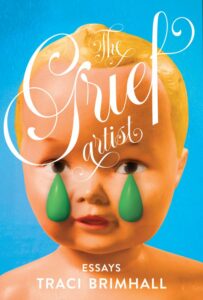
The Grief Artist by Traci Brimhall is available from Sarabande Books.

Traci Brimhall
Traci Brimhall is the author of five collections of poetry: Love Prodigal (Copper Canyon, 2024); Come the Slumberless to the Land of Nod (Copper Canyon Press, 2020); Saudade (Copper Canyon Press, 2017); Our Lady of the Ruins (W.W. Norton, 2012), selected by Carolyn Forché for the 2011 Barnard Women Poets Prize; and Rookery (Southern Illinois University Press, 2010), selected by Michelle Boisseau for the 2009 Crab Orchard Series in Poetry First Book Award and finalist for the ForeWord Book of the Year Award. Her work has appeared in The New Yorker, New England Review, Ploughshares, Orion, Brevity, The New Republic and New York Times Magazine. She has also received the Just Desserts Short Fiction Prize from Passages North (selected by Roxane Gay), the Annie Dillard Award for Creative Nonfiction from Bellingham Review (selected by Sue William Silverman), the Jane Geske Award for poetry from Prairie Schooner (selected by Kwame Dawes), the Cecil Hemley Award from the Poetry Society of America (selected by Sally Wen Mao), and a Pushcart Prize.
In 2025, she was Poet-in-Residence at the Guggenheim Museum in New York. In 2023, she received an Artist-in-Residence position through the National Parks Service at Bighorn Canyon. She also serves as the Poet Laureate for the state of Kansas (2023-2026).