An Exile’s Guide to Losing a Country
Ece Temelkuran on the Slow Creep of Authoritarianism
Nation of Strangers is the conclusion of a decade-long odyssey.
My ten-year saga began in 2016 when I wrote a book called Turkey: The Insane and the Melancholy. Before the book, I’d enjoyed a successful career in my native Turkey for more than twenty years, working as a novelist, essayist, and journalist, with a regular column and, at one point, my own show on national television. Though
I’d previously spent some fragmented years abroad when my journalism got me into hot water, this time I could feel the walls were closing in on people like me – that is to say, critics of Erdoğan’s regime. So, when my Western publishers asked me to write about why my country was so “crazy,” I did. But I went further. I also wrote about how their countries were in danger of becoming insane sooner than they might think.
Not only had I begun to witness the erosion of democracy in Western nations just as it had once started in Turkey, but since my people were reduced to victims in their eyes, it was a matter of pride to tell the West: “You, too, will fail to save your country from fascism when your turn comes. You, too, will have to ask yourselves how your countries have become insane.” This marked the beginning of my odyssey, which many have called exile.
In November of that year, after threats to my life became too regular to ignore, after my name had been smeared by supporters of the regime and I’d lost my job for speaking out, I eventually had to leave Turkey for good. The only dignified way to exist in the wake of this exile was to adopt English as my new language, write a book about contemporary fascism, and prove to the Western world that they were on the same path. For I knew that fascism was a global phenomenon.
In the end, you lose your country even if you are living in it.
How to Lose a Country: The 7 Steps from Democracy to Fascism emerged from the sentiment that if the West understood what was heading towards them, then global resistance would be possible. The initial subtitle didn’t include the F-word, as none of my European editors found it palatable, but thanks to what we have since witnessed in the political landscape, particularly Trump’s return to power, it has been reinstated.
In that book, I sifted through the cacophony surrounding our global political mess to identify the machinations of a country’s slide into fascism. I laid out the logic of this new political agenda – seven global patterns, repeated and recognisable in several cases from India to the US. It begins with a movement that divides society into two: the “real people” versus the “corrupt elite,” and with a leader who insists they alone embody the “real” people.
The next step is the dissolution of truth and the prioritisation of loyalty above decency. Then shame is dismantled. The leader breaks the long-standing political and moral consensus with unprecedented relentlessness. The longer they remain in power, the boundaries of what is acceptable begin to stretch. What once felt unthinkable or despicable gradually becomes normal. As the institutions that hold democracy together are quietly hollowed out and the very definition of democracy is rewritten as being simply majority rule, universal values – human dignity and the rule of law – are replaced with a fierce nationalism, a proud victimhood, and a rewriting of history.
Cruelty and ruthlessness are deemed just, not only in the highest echelons of politics but also trickling down to daily life. The circle of who counts as “us” grows smaller, while millions of fellow citizens are recast as permanent suspects. People are forced to behave as the regime’s model citizens unless they are brave enough to become the “enemy of the people.” Eventually, when power gathers in one person and institutions exist only as decoration, elections as ritual, what remains may look like democracy from a distance, but inside it has already rotted away. In the end, you lose your country even if you are living in it.
A few years after the book was published, the world found itself where I had predicted it would be. Trump bulldozing all that was left of free and democratic America. The UK witnessing the fascist-racist wave that she had been so proud of defeating in World War II. And across Europa, the founding values of respect for human dignity, freedom, equality before the law, and democracy being attacked by the very leaders who had been voted into power. Turkey is undoubtedly one of the pioneers in this field, but others have been steadily following in its footsteps, making many feel as though a carpet has been pulled from under them.
The book was critically praised and translated into several languages, but the political elite – both in active politics and out of it – were more interested in maintaining the status quo: organising panels, conferences, and yet more conferences in the gilded rooms of exhausted political institutions. The theme: how to save democracy.
Except for the brave few, too many were uninterested in the connection between cut-throat capitalism and the erosion of democracy. Only a handful of people could see how fascism had been embedded in neoliberalism, both historically and ideologically. Additionally, there was the ever-present phenomenon of Western exceptionalism.
Many wanted to believe that if only we could get rid of certain leaders, things would soon return to normal. They refused to acknowledge the depth of the political malaise.
Yet I could not have known that within that exhaustion, that sense of homelessness, lay the answer.
Meanwhile, ordinary people and those working on the ground to stop the dark current were wiser. At least they were asking for hope, for the new, knowing that there was no going back to business as usual. Each time I discussed how they would lose their country, audiences were genuinely – sometimes with tears and trembling voices – seeking a way out. Through protest and grassroots movements, away from conventional politics, they were preparing to resist in unprecedented ways. It was the people and their tireless work that inspired me to write a follow-up in 2021, Together: Changes for a Better Now.
After travelling around the world to discuss How to Lose a Country, I noticed that what had been lost wasn’t hope but faith. Our faith in ourselves, in togetherness, and in democracy had steadily depleted over the last four decades, kick-started by the famous neoliberal motto of the 1980s: ‘There is no alternative.” What we needed in order to resist the coming wave of fascism, I came to realise, was not only a political transformation but, more importantly, a moral transformation. First and foremost, we needed to overcome the cynicism that had been imposed on us, turning us into numb and helpless creatures.
So, in Together, I outlined ten values that people worldwide could and should rally around to oppose fascism. I proposed a progressive politics of emotion for fighting against those leaders and their movements that are masters of mobilising fear, hate and destructive pride. Among other things, I wrote about choosing dignity over pride and attention over anger, and how to transform the shipwrecks of political institutions into living reefs that support real, meaningful democracy.
The passionate readers of Together were those on the ground, doing the grassroots work alongside their peers. Others (and there are still too many) believed in the quick fixes of election cycles to protect them from fascism and dismissed the necessity of a moral transformation.
Meanwhile, in 2023, at a time when I was exhausted from the seeming futility of constantly writing and talking about it, fascism and the decline of democracy became popular topics in the mainstream media. With all the escalating insanity around the world that I had witnessed, I caved in. The sense of being out of place in these times, of being “unhomed” by these dark times, weighed heavily on me. I felt homeless in an existential way.
Yet I could not have known that within that exhaustion, that sense of homelessness, lay the answer. The word home was the conclusion of a decade-long political sentence. I didn’t know then that there were many like me – strangers who were about to collapse into despair, unhomed in this world. It was all of those strangers who would give me the faith to write again, for and to them.
And that’s when I remembered that telephone call with my mother from ten years ago.
“Mom, I am not coming back home.”
Looking back, it wasn’t all the dramatic political events that changed everything, but a minuscule whisper. It was a one-minute phone call; half of it was silence. But that’s all it took for me, in the autumn of 2016, to become homeless.
I despise telling this story. Talking about my homelessness, especially the reasons behind it, makes me cringe – politically, morally and emotionally. Even before I begin, the fear of appearing as yet another whining exile demanding recognition already fractures my dignity. I had to leave my country to escape fascism to be able to write, think and simply be. The imprisonment of people like me – that is to say, critics of the regime – had already become a daily occurrence in Turkey, and I had grown weary of reading very detailed rape and death threats made against me.
But more than anything, I left home because fascism is a funny thing. It makes you constantly think about pyjamas. The footmen of such regimes always come knocking on your door at around four in the morning. They not only imprison you, but also shame you based on your choice of nightwear. So, on the night of 6 November 2016, in Zagreb, the city where I had one friend and owned a tiny apartment, when I went to bed for the first time in years without worrying about how my nightclothes would appear to the police, I decided not to go back.
You become that child again, suddenly locked out, left in the cold, alone with the beasts.
The initial plan had been to stay there for a few days just to catch my breath, and that’s why I had with me only one pair of trousers, two shirts, and not a single idea about what to do next. But surviving in absolute uncertainty, turning from somebody to nobody at the age of forty-three, and starting everything from scratch in another language, seemed an affordable price to pay compared to being paralysed with fear or having to be brave all the time. Thus, the call to my mom.
Mom and I already had some practice with such calls. The first time was in 2011, when I lost my job as a columnist. I had written something against the dictator, his people got furious, my paper got scared, and I had to stay where I was at that moment, in Tunisia. My lawyer strongly advised me to take a long holiday, which eventually lasted a year. All of which I had to explain to my terrified mother. The second time was in 2013. The regime mouthpieces believed that I was behind a massive plot to bring down the government and that I had organised an uprising. Due to such bombastic allegations, I stayed in London and Greece for a few months. Mom still needed to hear the reasons then.
But in 2016, it was the first time I didn’t have to convince her. This time, she just stammered in a well- calibrated, serious voice, “Right. It is dangerous. Right? Right! Stay there. Don’t come back.”
Then, silence on both sides.
When the voice imprinted in your memory as the one that always calls you back home falls silent, you experience a very specific ache – an orphaning, if you will. You become that child again, suddenly locked out, left in the cold, alone with the beasts. The heart, with its every beat, pumps out a mourning substance that floods the brain. It becomes impossible to survive.
And that is precisely why, as soon as I hung up the phone in the autumn of 2016, I made a decision. I put my heart in the freezer; I envisioned the organ in the fridge. It was to be dealt with later. To keep going, I transformed myself into an unfeeling, tenacious creature, a survival automaton. My motto was simple: “Zero self-mercy! Zero vulnerability!” There was no time for sentimentality. I developed a disgust for any kind of fragility and soldiered on, doing whatever needed to be done. All that I’d built back home was gone, and now, at this later age, it needed to be rebuilt again, this time in the strange language of English and in a foreign land.
I wasn’t permitted to be human until my life could be deemed a success. But once you lose your home, success – like the word later – becomes ambiguous and infinite, always beyond reach. Without a home, you lose your command over time, and your worth becomes a matter of debate, decided either by the settled-down folk in the new land or some imagined, higher moral authority back in the old one. Life becomes a countdown without an end.
To fill the void of the heart, I produced ideas non-stop, writing and talking frantically about politics. Years passed as I kept touring the world, warning people that fascism was approaching and that they, too, would lose their homes.
After six years of talking about the logic, mechanisms and rationale of politics, I turned myself from that nobody who arrived on the shores of a foreign land into somebody: that Turkish writer who speaks about fascism.
Some people listened to my words as intended – as a glimpse into their future. Yet some preferred to focus on my exiledom. They enjoyed the ‘intellectual damsel-in-distress running away from the barbarians, taking refuge in the arms of the civilised people of the world’ narrative too much – or perhaps believing their own home was a safe haven soothed them and allowed them to feel secure.
When I was finally supposed to be content, after writing two books and receiving some awards, I found myself doing nothing except repeating a phrase: “I am not tired, not much tired, but just exhausted.” Admitting I’d finally arrived at that later was unbearable, so I did what I knew best. I kept going, sustaining myself in survival mode.
Until, finally, my body gave up.
One summer evening in 2022, in Hamburg, a woman is lying on a stretcher in an old-school doctor’s examination room. The sense of I abandons the body, leaving me as a she whom I barely know. And this she is watching the IV drops entering her vein. The arm is mine, I guess, and that woman should be me. Yet, thanks to the disassociation that every survivor goes through, I watch her like a too-feeble-to-empathise-for minor character in a movie.
The doctor says, “Your body is giving up. This is home-sickness, meine Liebe. Now is the time to stop and take care of your heart.”
Loathing the vulnerability of the body, embarrassed by this meek quitter, I whisper, “What a mess! What a mess!” As life drips back into my veins, I gradually re-enter my body, only to think bitterly, So that bloody organ has to defrost now, ah? That probably rotten piece of flesh. Who knows what kind of despicable state it is in.
This was me in the summer of 2022. After six years of my homelessness, I was compelled to acknowledge my broken self. It was finally time to stop and think about home and all that had been lost.
__________________________________
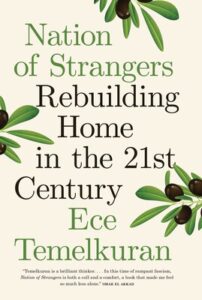
From Nation of Strangers. Used with the permission of the publisher, Scribner. Copyright © 2026 by Ece Temelkuran

Ece Temelkuran
Ece Temelkuran is a Turkish novelist and political commentator whose journalism has appeared in the Guardian, New York Times, New Statesman, Frankfurter Allgemeine, and Der Spiegel. She won the Edinburgh International Book Festival First Book award for her novel Women Who Blow on Knots, and the Ambassador of New Europe Award. She has been twice recognized as Turkey's most-read political columnist, and twice rated as one of the ten most influential people in social media (with three million Twitter followers). She currently lives in Zagreb, Croatia.