The Man Who Killed the Last Eastern Elk in America—And Was Proud of It
Andrew Moore on “The Seneca Bear Hunter” Jim Jacobs and the End of the Wild, Rugged East Coast
It’s difficult to say with certainty when the last eastern elk was killed, but most accounts agree that Jim Jacobs pulled the trigger.
Known as “The Seneca Bear Hunter,” Jacobs had killed hundreds of deer and bear in his lifetime. A Seneca Indian, Jacobs was born on the Corn-planter Tract in Warren County, Pennsylvania, around 1795. Over the years, his hunting exploits had grown into legend, and with a body covered in scars from battling bears, he’d become a local folk hero not unlike Daniel Boone or Davy Crockett. His hunting territory ranged for hundreds of miles, from the Allegheny River in southwest New York to the West Branch of the Susquehanna River in Pennsylvania, all of which he covered entirely on foot. He was tall and strong, and even into his eighties he was described as “erect as a pine and as strong and active as a buck.”
Killing bears made Jacobs his name, but killing elk made good supper. Elk were once an abundant source of food in the Alleghenies, both for the Seneca and for the settlers streaming in. One year, as work crews poured into the forest to build a new rail line, Jacobs fed the men elk steaks and “kept the surveyors, axmen and chain-carriers supplied with plenty of it all summer long.” Pennsylvania, and much of the rest of the East, had been elk country for thousands of years.
But by the 1860s, the elk were scarce. In fact, Pennsylvanians began to wonder if they weren’t extinct in the state, as they hadn’t been seen for more than twenty years.
All of it—the trees, the wildlife, the assemblage of diversity in both life and death through which Jacobs stalked in 1867—all of it was in a last gasp for existence.
Then, in September 1867, while setting traps in the wilds of the Sinnemahoning Valley, a hunter heard the unmistakable bugle of a bull elk.
In earlier times, autumn bugling would attract a harem of suitors, when more than a dozen cows would congregate to feed and mate. An elk’s bugle is a singular sound, beginning with the high notes of a brass horn and finishing with a low roar. The call fills the landscape and seems to come from all directions at once. The author David Petersen wrote that if you’ve never heard an elk’s bugle, “you’d think it was some tortured soul from hell, howling in anguish and pain.” Today, an elk’s bugle is most often associated with the high Rocky Mountains, but that haunting sound also belongs to the valleys and hilltops of the eastern United States.
News of the bugle spread quickly and sent local hunters into a frenzy, scouring the forest for one last chance for glory. Perhaps a few were content with the chase alone, a chance to relive the thrill of hunting days gone by when large game was common. The youngest among them may have never even seen a living elk. A few hunters may have been desperate for meat and hide. Whatever their motivations, these hunting parties would not succeed, and the elk would elude its would-be killers for a little while longer.
But Jim Jacobs was on its trail, and Jim Jacobs was a slayer of big game.
That lone elk was accustomed to staying on the move. Elk, deer, and buffalo had migrated to and from mineral licks throughout North America for millennia. Commonly known as “salt licks,” these naturally occurring mineral deposits provided lapping tongues the sodium, calcium, zinc, iron, and other elements necessary for bone and muscle growth. Throughout the eastern United States, one can still find places named for them, including French Lick, Indiana; Big Bone Lick, Kentucky; and Buffalo Lick, West Virginia. These locations had attracted herds of mammals for thousands of years, and their migrations created trampled-earth game trails that would be used and expanded by Native American travelers. In some cases, the trails would become modern American highways.
Rutted migration routes, carved by the constant pounding of animal hooves, littered northern Pennsylvania. A report from 1896 described those regular paths as “runways through the woods” that “invariably led to salt licks.” The animals’ predictable movements made the elk relatively easy targets. Hunters often lit blazing fires, which disoriented and frightened the elk, and as many animals as possible were killed. “Hundreds of elk were killed annually at the licks or while traveling to and from them, along their well-marked runways.”
That licking instinct may have led Jacobs’s elk to an area known as Flag Swamp, a one-acre wetland filled with blue flag irises and shrubby willow trees. Early surveyors recorded it as an old salt pond. Today, extensive drainage makes it difficult to know exactly where Flag Swamp was, but sources have placed it north of Boone Mountain, in Elk County. The elk may have come there to feed on marsh grasses, for its minerals, or perhaps for a sense of safety.
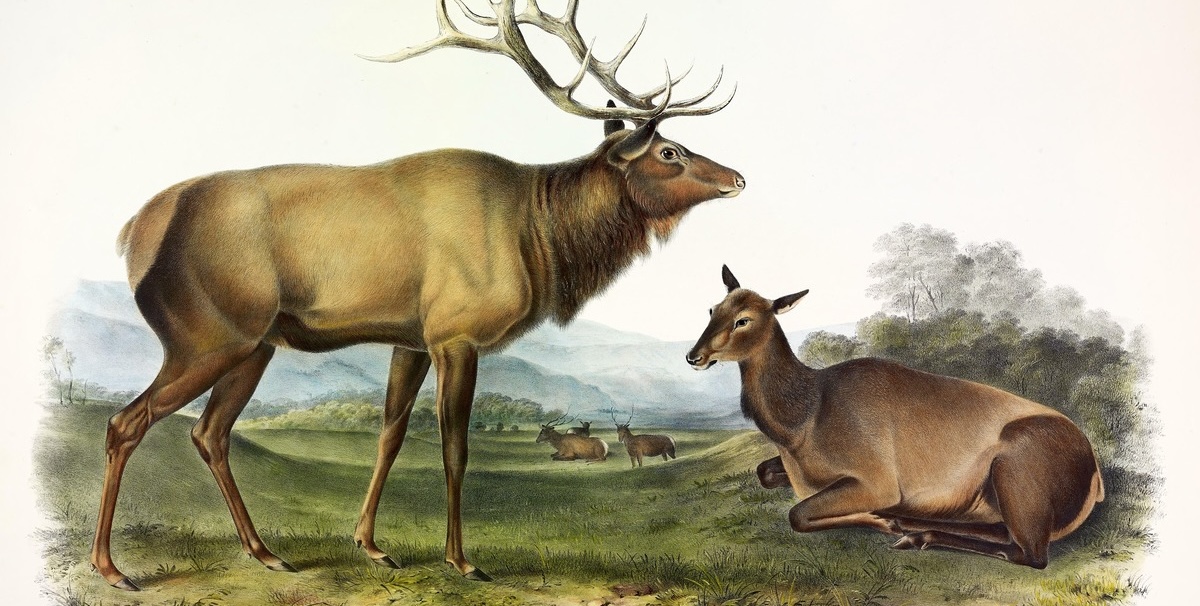
It was there that Jim Jacobs first spotted his bull. The man and the bull may have watched each other from across the marsh—elk are not quick to flee and will stare at pursuers for some time before deciding that it’s best to run. Or Jacobs might have simply picked up the animal’s trail there, following the baying of his dogs. Regardless, the elk got the lead on Jacobs—though less nimble than deer, elk can run up to thirty miles an hour. Encumbered by antlers up to four feet tall and forty pounds in weight, a bull raises its immense jaws, antlers tilted toward his spine, and races through the woods until reaching safer ground. To trail the elk, Jacobs would have listened for its crashing through the understory: twigs and leaves crushing under hoof, low-hanging branches snapping from the collision with antlers and the elk’s five-foot-tall frame. He would have scanned the ground for fresh hoofprints, alternating teardrop-shaped indentations, three to four inches wide. But as the hunt wore on, as its energy was depleted, the elk would have needed to stop and eat. Jacobs would have looked for signs of browse, the torn twigs and leaves left behind when an elk pulls at its food. If he had gotten too near, the elk might have betrayed its position with a warning call, described as a “squeal mingled with a hoarse bark,” emitted like an alarm at the approach of danger.
Jacobs continued trailing the elk—looking for signs of browse and prints and always listening for the faintest sound—for the next four days and forty miles.
In his younger years, Jacobs would have hunted in ancient forests, now known only to our imaginations—old-growth stands of hemlock, pine, oak, and chestnut, with trees standing more than a hundred feet tall and nearly four hundred years old. Here and there, fire, wind, and flood would have broken the forest into a mosaic of old and new, grass and forest, shrubs and sentinels. Jacobs, with his long rifle and pack of dogs, was not the only predator in the Alleghenies—wolves and mountain lions still lurked in the forest. The water, too, was wild—the Allegheny and its tributaries had yet to be dammed, and Flag Swamp was noted as one of the last hideouts for beavers in the state. In fact, the marsh through which he trekked, and the steep, rugged terrain that surrounded it, had slowed the approach of railroads and posed challenges for the earliest timber harvests—unlike the piedmont and coastal plains, those Allegheny Mountains frustrated the initial waves of extraction. But all of it—the trees, the wildlife, the assemblage of diversity in both life and death through which Jacobs stalked in 1867—all of it was in a last gasp for existence.
Jacobs lived at a period of dramatic ecological change, and old-growth forests were fewer and farther between. Settlements and farmsteads spread across the state, and each year the timbermen marched deeper into the woods. Lumber was in high demand for fueling iron furnaces and providing timber framing for local coal mines and for shipbuilding. The first American oil well was dug nearby, in Titusville, Pennsylvania, in 1859, and by the time Jacobs was hunting the last elk, an extraction bonanza was well under way. Industrialization was nigh.
Four days into Jacobs’s chase, it began to snow, and Jacobs finally brought the bull elk to bay on a large boulder. Hunters of the region referred to the boulders as “elk rocks,” as the animals were known to mount them and turn to fight their pursuers by stomping them with their forefeet. The largest eastern elk would have weighed up to a thousand pounds, and a stomp or kick from that powerful animal was fatal; the skulls of dogs and wolves would be crushed. Jacobs found his elk atop one such rock, defending itself and attempting to stomp his dogs to death. For several hours, he tried to capture it alive—it was, after all, the last of its kind—but the elk would not be subdued, so Jacobs shot it in the heart.
According to one report, the bull was “too old and tough for food.” Another source claimed that the animal had been taken back to the Cornplanter Reservation, “where the event was celebrated with great rejoicing.” However it was commemorated, it was now over—both the hunt and the eastern elk.
Jacobs’s elk, “the lone bull of the Sinnemahoning,” had been alone for most of its life. Because elk are social animals, forming large herds and seasonal harems, the bull must have had a sense of its solitude. And if no other elk were present to form bonds with for mating or kinship, it must have struggled. Instead, it had gone about its days and years alone, climbing the remote ridges of the Alleghenies and feeding in the rich floodplains below; it remained on alert for predators and listened endlessly for the sounds of other elk. To the very end it sought companionship: When the bull was discovered by hunters that day in the Sinnemahoning Valley, they first heard its bugle, a vain attempt to communicate with another elk that simply did not exist.
People of this era thought the supply of game in America was inexhaustible. That the forests went on forever. Perhaps this was true for a time—we can read these kinds of statements in the explorers’ own journals—and perhaps it seemed that way when the first colonists came ashore. But by the late 1800s, hunters were aware of their deeds, aware that the animals they shot were often the last of their kind. They found triumph in being the skilled woodsmen who shot the last elk, bear, wolf, or bison.
John Decker, “one of the greatest hunters Pennsylvania has ever produced,” also claimed to have killed the last elk, ten years after Jim Jacobs, in 1877 (although most agree that his was an escapee from captivity). “I have killed more game than anyone else around here, and that is saying a lot, as this was a great country for hunters,” he said. “When I was a boy there were panthers on the ridges and the wolves howled nearly every night.” Although men such as Decker were often quick to claim their kills, they were reluctant to admit that the killing was the reason the animals were no longer abundant. As he himself said, “It is too bad that game is so scarce these days, but I lay it to the forest fires, which give the wild creatures no peace.” Decker understood the disappearance of wolves and even passenger pigeons in similar terms: “I have not seen or heard of a wolf in these parts in forty years, and my opinion is that they left here when lumbering opened up on a big scale All of a sudden they left the [mountains of Pennsylvania]; that’s what makes me think they were not killed off by the hunters. About the same time the wild pigeons, which used to darken the sun with their flights, left here, never to return. I don’t believe they were exterminated, either.”
Decker was not alone, nor would he be the last to struggle with that sense of responsibility. The truth was that the animals hadn’t gone anywhere—they hadn’t “left” or “withdrawn” or “fled” to virgin county—they were in fact all dead. They had been hunted out of existence—shot for personal sustenance, shot for sale as food by market hunters, shot for their hides. Their habitat had collapsed, too, and entire ecosystems had been altered to the point that they failed to properly function. But habitat became inconsequential when the animals ceased to exist.
That the elk (Cervus canadensis) was so quickly and so thoroughly extirpated from the American East was no small feat. It’s estimated that there may have been as many as 10 million elk in North America at the time of European settlement. (By comparison, 30 million whitetail deer roam the continent today.) They were once the most widespread member of the deer family in all of North America; their historic range extended from the Pacific Ocean to the Atlantic coastal plains, and from northern Mexico to central Canada. East of the Ohio River, elk lived throughout the Appalachian Mountains from South Carolina to New York and were reported to have been most abundant in the mountainous areas of the Cumberland and Allegheny Plateaus.
Technically, they hadn’t always been there. The species originated in Asia, during the Oligocene period, around 25 million years ago. That proto-elk spread throughout Europe and into North Africa, becoming those continents’ red deer. Then, around 15,000 years ago, during a period of global cooling, the emergence of the Bering Land Bridge allowed elk to cross from eastern Siberia into westernmost Alaska, and eventually, into the rest of its historic North American range. A great many mammals joined them at various times over the millennia, including steppe bison (the ancestors of American bison), woolly mammoths, and American lions. Evidence suggests that elk were also joined in their migration, at roughly the exact same time, by North America’s first humans.
Those humans had been killing elk for a very long time and may have even followed the elk and bison onto the continent. As they ventured farther south, they would have found an incredible bestiary, at once a land of milk and honey—imagine the amount of meat on an eight-ton American mastodon or a giant ground sloth or giant turtle—and a land of abject terror—imagine the claws, teeth, and power of saber-toothed tigers, dire wolves, and a short-faced bear that weighed up to two thousand pounds.
A few theories help explain why none of the above animals exist today, including climate change and disease, but much evidence points to the bipedal new arrivals: spear-wielding and atlatl-thrusting humans. According to this theory, those now-extinct megafauna—the giant ground sloths and the giant beavers, the mastodons and mammoths, and even the lions and dire wolves—were relatively quickly hunted to extinction.
But the suite of large animals that remained in North America when Europeans arrived in the sixteenth century—the elk, bison, deer, panthers, wolves, beavers, bears, and so on—had survived the changing climate, and had survived the assaults of the migrating humans, and they were flourishing. For a few species, that condition was not entirely in spite of but because of Native Americans, who set fire to the landscape to clear brush, to stimulate new and vigorous growth, and to improve the ease of movement and hunting. These fire regimes supported the humans dependent on meat, the mammals dependent on early-successional browse and grass, and the plants dependent on fire and light.
After Native people killed elk, bison, and deer, they turned their bones and skins into tools and textiles. In the Ohio Valley, elk antlers were fashioned into hoes and chisels; and at one village site north of Portsmouth, Ohio, archaeologists have discovered elk ulnas that were worked into pointed awls six to eight inches long that were likely used to open freshwater mussels. Elk and bear tooth pendants were also common items of ornamentation, and important community members were buried with those adornments. But most useful was the animals’ flesh. For thousands of years, elk would have accounted for the second largest amount of meat in the diets of many eastern peoples, after the ubiquitous whitetail deer. Not only were the animals present in the East; for thousands of years they sustained human life and were integral to Indigenous material and spiritual culture.
Although they were great and skilled hunters, Native Americans in the East rarely killed all of the elk or all of the deer in an entire watershed. The systematic extirpation of those animals would not occur until the global demand for hides increased and the weapons to shoot their sources spread over the continent. The purpose and the extent of hunting were radically altered by the arrival of European guns and markets—the killing of wild animals became an occupation with commercial ends, for both whites and Indians; and wild hides and wild meat became the goods of an insatiable marketplace. That commodification of wildlife would lead to the downfall of nearly every large mammal in North America.
The railroads had drained Flag Swamp, had brought the lumbermen deeper into the Alleghenies than ever before, and they had killed Jim Jacobs.
By the late 1800s, as Jim Jacobs was serving elk steaks to railroad workers in the Allegheny Mountains, wild meat was also being sold in nearly every urban market from Detroit to Baltimore and from St. Louis to New York City. Taverns and inns served all manner of wild game: elk steaks, fresh venison, oysters, grouse, quail, woodcock, crabs, plover, snipe, duck, rabbits, squirrel, and every kind of fish. Thousands of passenger pigeons were shot in the countryside and taken to urban markets by the wagonload. All game was fair game, and eating wild things was both luxurious and banal—throughout the country the consumption of wild animals was entirely typical. In early America, practically everyone consumed the meat of wild animals. As the Jim Jacobses and John Deckers were shooting the last elk of Pennsylvania, their western counterparts were doing their part to exterminate the species continent-wide. Wherever elk lingered, “tusk hunters” shot the biggest elk for their canine teeth, known as “ivories,” to be sold to members of the Benevolent and Protective Order of Elks. Consumption could not go on like that. A herd of elk, like old-growth hemlock, has biological limits.
European arrivals to early America harvested the forests as quickly as the animals within. Shortly after Jim Jacobs downed his elk, Flag Swamp was drained and leveled for a new rail line. In a few short decades every forest in Pennsylvania—and nearly the entirety of eastern North America—would be clear-cut and transformed into a wasteland of stumps. In place of the ancient forest was a shorn land besieged by uncontrollable wildfires, prone to land-slides and erosion. Passing trains dumped coal, and sparks from tracks ignited fires that raged across the land. They were not the fires of Indigenous hunters clearing the understory of brush; they were due to the carelessness of Industrial Age people burning too hot and too much. The dried-out humus, which in some forests had been six feet thick, was burned off to bedrock. Without a forest to absorb the rain, water rushed off the land. In Pennsylvania, “No effort has been made to preserve or renew the forests of the Allegheny valley,” one observer noted in 1904, “[and] the streams have shrunk to mere creeks or dry beds of sand and gravel in summer…[the watershed] is now a waste for briars and brush.” A US Geological Survey report from that same year concluded that “there are few places in the east where the natural beauties of mountain scenery and the natural resources of timber lands have been destroyed to the extent that has taken place in northern Pennsylvania.” Joseph Rothrock, who would become the state’s first forester, even called the region the “Pennsylvania Desert.” Where once had stood a dense canopy of three-hundred-year-old trees, forest cover spanning thousands of miles, gave way to charred stumps and bare earth—a landscape of wanton destruction. The despoilers had given no thought to the future, and disregarded the past, as they gathered every resource in the present.
Jim Jacobs, the last great long hunter of the eastern mountains, was killed there, too. In 1880, while walking to visit relatives in New York, Jacobs was struck and killed by a train near Bradford, Pennsylvania. He was ninety years old. The railroads had drained Flag Swamp, had brought the lumbermen deeper into the Alleghenies than ever before, and they had killed Jim Jacobs.
Over the next several decades, a roll call of Pennsylvania’s native animals would be extirpated, including mountain lions, wolves, wolverines, badgers, pine marten, and fisher cats; whitetail deer were nearly wiped out of the state, as were black bears and turkeys. River otters, once ubiquitous, were gone from much of the East; and beavers were eliminated from all 29 million acres of Pennsylvania. By the turn of the twentieth century, no elk remained east of the Mississippi, nor on the Great Plains, and Merriam’s elk, a subspecies of Arizona, joined the eastern elk in extinction in 1906. The animals were now found only in the high Rocky Mountains and in scatterings along the Pacific Coast.
As the American experiment marched on, we found other things to eat—elk and whitetail became unnecessary because we had pigs and cows—and we didn’t mourn for long the passing of big animals in the East. While a few of the old hunters were wistful about the memory of the large mammals, others saw extirpation as necessary progress. The big game and the big trees, the wild lands and the wild lives—they had to give way. They were among our national sacrifices.
Theodore Roosevelt was among the wistful. Ten years after the Sinnemahoning elk was killed by Jim Jacobs and decades before he would become president, he was on a hunt in the Dakota Badlands and couldn’t find elk there either. Back home in New York, along with the anthropologist and naturalist George Bird Grinnell, he formed the Boone and Crockett Club and kick-started a conservation movement to right the wrongs of their pioneer forefathers. Roosevelt and his club promoted the “fair chase” of game species, worked to outlaw the market hunters that were driving remnant populations to extinction, and helped lay the foundations for the North American Model of Wildlife Conservation.
That sportsmen’s movement, driven by the men who loved to hunt big animals, took hold in the Alleghenies too. In 1913, the Pennsylvania Game Commission arranged to have fifty elk wrangled out of Yellowstone National Park, hauled back to Pennsylvania by rail, and turned loose. Most of these animals died, and two years later they tried again with a hundred animals. In 1915, Michigan sportsmen did the same, starting with just seven elk. Some of the elk were shot by farmers, some were shot for food, and others died of disease. But enough remained on the landscape so that these two populations would persist for decades to come. The animals would remain a novelty throughout the twentieth century, rarely seen backwoods curiosities, but they were on the ground. It was enough to demonstrate that they had been there before and perhaps could be there again.
__________________________________
Excerpted from The Beasts of the East: The Fall and Rise of America’s Eastern Wilderness by Andrew Moore. Copyright © 2026 by Andrew Moore. Reprinted by permission of Mariner Books, an imprint of HarperCollins Publishers. All rights reserved.

Andrew Moore
Andrew Moore is the author of Pawpaw: In Search of America’s Forgotten Fruit, which was a James Beard Foundation Award nominee in Writing & Literature. His work has appeared in the Washington Post, Pittsburgh Post-Gazette, and The Daily Yonder. He lives in Pittsburgh.