To Know a Person Entirely: Re-Discovering My Grandfather Through Fiction
Sofia Montrone: “Where else does writing come from, if not the desire to peer through the keyhole of someone else’s mind?”
There is something I need to tell you about my grandfather: his name was Ben. He smoked Virginia Slims. He drove a big, low Cadillac with a beer between his knees. He was a lawyer. He helped license a line of guitar-shaped Beatles pins. Later, he worked at a RadioShack. As it turned out, he was too honest to be a lawyer. It was all the lying—he couldn’t live with himself.
So much of writing comes down to just this—arranging details until, like a constellation, they form the shape of a living thing. If I have done my job, you may already be able to draw the lines.
What else? He loved to sail. Friends would give him their sailboats and he would take them out to the Bahamas in the middle of the night, savoring the black muscle of the water beneath him, the wide-open sky above. He was a drinker. He drank until he couldn’t feel straight, so that all of his emotions sloshed sideways and trickled away. Drank so much that he slept through the daylit parts of the weekend, when he might have brought his daughter (my mother) to the beach or the pool, or merely sat across from her at the breakfast table, taking the time to top off her diminishing glass of orange juice.
So much of writing comes down to just this—arranging details until, like a constellation, they form the shape of a living thing. If I have done my job, you may already be able to draw the lines.
My grandfather died in the garage of his childhood home on August 6th, 1984, exactly one year and one week after the death of his wife. The discrepancy (the week) was, perhaps, the length of time needed for him to procure the gun with which he took his own life, although it may also be because August 5th was his daughter’s 23rd birthday and he did not want to spoil her day.
There, I’ve told you now.
*
Before I was a writer with characters of my own, I was imagining Ben. There was something fundamentally literary about this endeavor; where else does writing come from, if not the desire to peer through the keyhole of someone else’s mind? Here was a person whom I had never known and so could never remember, and whose life had, despite this, determined the shape of my own. I was prepared to take any insight, however small. I wanted to hear about the foods he liked and the jazz music he listened to. I wanted to hear him—the words he used, the depth of his voice. But my deepest, most ghoulish questions, no investigation could answer. No one, perhaps not even Ben himself, could make sense of the final days of his life. Time had closed over the explanations for his death and locked them away.
Fiction offered me more freedom and more closure. In my fiction, my grandfather was no longer an inscrutable ghost, but a character with definable flaws, who did things in an order that, despite whatever twists and subversions, resolved into meaning. Writing was the natural continuation of how I had already come to understand him, which was no different than the way I understood a character in a book—as a series of well-curated sound bites, behaviors, and anecdotes, each selected to point toward his ultimate fate. His avatars invariably smoked Virginia Slims, drove recklessly, and had children who could sense, in their prescient childlike way, that he was hurtling toward some unreachable place. No matter the content of these stories, their hidden subject seemed to be the unavoidable and imminent loss of these men. As pieces of writing, they were dour and sentimental, which is to say: pretty bad. I had been trying to get a hold on his death, rather than on his life, and ultimately produced works that had nothing to say about either.
*
When I discovered Ben’s letters, the man who had once been my instrument was suddenly able to talk to me in his own voice. I was twenty-two when I read the letters for the first time, three years older than Ben had been when he’d written them. The letters are from his time with the US Army in Korea, where, because he was an avowed pacifist, he spent his days in the barrack kitchens, peeling potatoes. He was a bright but listless boy, that much is clear. Like many nineteen year olds, he seems to be a great expert on almost everything. With adolescent authority, he condemns the chilly, slate mountains of Korea, and the US Army, which he accuses of being a bloated, incompetent, machine. He misses his sisters. After the youngest, his favorite, fails to respond to a previous letter, he quips: “What’s the matter with Phyllis? Doesn’t she know how to write anymore? Or is she too busy with boys?”
“I try not to make any plans,” he writes to his parents. “You never can tell what is going to happen next around here anyway. In the States you can plan a little, but things here are still unsettled.” He makes plans regardless. He can’t help it. To his father he writes about his intention to attend college in Mexico. To his mother he writes about Japan, where he has heard rumors that there are orange trees. “I have to see it before I will believe it,” he says. “If so, that is just the place for me.” It seemed impossible that a person so eager to see the world would one day leave it of his own volition. That beloved Phyllis would be the one to discover him in the garage where they had conspired as children, where she had once canoodled with boys and forgotten to respond to his letters.
Of course, these letters had nothing to do with all that. He had not written about Japan’s groves of orange trees as some kind of Valhalla. His futile dreams of Mexico were not a metaphor for a life frustrated by unresolved dreams. They weren’t a metaphor at all. He was simply a boy, trying, like all of us, to reckon with the enormous and unwritten future stretching out before him.
I have taken comfort in the belief that, no matter how much we attempt to reveal other people with our art, the only hearts we lay bare at the end of the day are our own.
I put aside the novel I had planned to write and began another. As in my earlier stories, there was a father made in Ben’s image, but this time, it was his life, not his death that captivated me. This “Ben” still drove with a beer between his knees, but he also told jokes, played with his children, and flirted with his wife. He loved offal and ate whole fish still embedded with their glassy eyes. He danced at parties. I have never written anything with more conviction and vigor than those the early pages of Nymph. It was as if I had opened the stable gate, and the story I’d been trying to straddle my whole life came charging out.
Over the course of the next three years, the novel would stumble and slow, as novels are bound to do. The more deeply I committed myself to telling the story of this fictional father, the more I worried that I had replaced Ben, not only on the page, but in my own imagination. I could no longer remember if he had really loved to eat liver, or if I had only believed that he had, because, at some point, I had written it into a story, and my memory of the sentence had replaced my memory of his real life. I called my mother constantly, asking her to retell the same stories about her childhood. Then I would forget, and call her again. In reading my book, would she recognize her father or would he appear strange and misshapen, like a person in a dream? I feared that she would think I had exploited her memories of him. That, in attempting to imagine the person he was, I had missed him entirely.
Perhaps all writers who draw from life (and I have yet to meet a writer who doesn’t fall into this category) feel some version of this fear. If there is a way of resolving these anxieties, I haven’t found it, but I have taken comfort in the belief that, no matter how much we attempt to reveal other people with our art, the only hearts we lay bare at the end of the day are our own. If I have not quite written a book about Ben, I know that I have, at the very least, managed to write a book about the people who loved him, and the ways they love and remember him still.
*
A few weeks ago, I was on the phone with my mother and the conversation turned, as it sometimes does, to Ben.
“What I really remember are his hands,” she told me.
“What about them?”
“They were really square and pale and they were bleeding all the time.”
“Bleeding?”
“You know how I am,” she said, her tone light. “The skin just tears so easily. He had all these cuts on them. And his fingers were yellow, from smoking.”
I traced a long gash my cat had left on my own hand earlier that day, my heart high in my throat.
“Are you thinking of how you’re going to put that in your next book?” My mother laughed.
I thought of my novel, on the cusp of publication, and how I had described the father’s hands—broad, with dark hair on the backs. I had written about them gripping his daughter’s shoulders, smoothing a newspaper shut, stiffened by bandages. I hadn’t known about the yellow fingertips. For a moment, I felt that same fear again—the fear that I had missed the heart of the matter. Then came the relief—that there was some part of Ben’s story I had not yet wrangled and rearranged. That his body, in life or death, was still his body, and I had written some other person entirely. That I had not used him up and never would. That I had not reached him, that I still could.
“Yeah,” I said truthfully. “I am.”
__________________________________
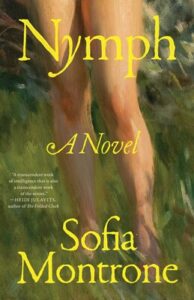
Nymph by Sofia Montrone is available from Avid Reader Press, an imprint of Simon & Schuster.

Sofia Montrone
Sofia Montrone is as an adjunct assistant professor in Columbia’s undergraduate writing program, and formerly served as editor-in-chief of The Columbia Review and the director of Columbia Artist/Teachers. Her short fiction and criticism have appeared in The Columbia Review, Quarto, and Adroit. She holds an MFA from Columbia University. Nymph is her first novel.