A Woman in the World: Colm Tóibín on the Short Fiction of Mary Lavin
“She had spent her life describing others and finding strategies to create versions of herself on the page; it was not easy to categorize her.”
Like Myra in her story “A Memory,” Mary Lavin lived in a mews house behind Fitzwilliam Square in Dublin. She also had a house on a bend of the river Boyne in County Meath, north of Dublin, a place inhabited by some other characters in her fiction. When I came to Dublin as a student in 1972, Mary Lavin was a familiar presence in the city. I watched her as she moved with a sort of stateliness in the Reading Room of the National Library, or as she sat in a small café known as the Country Shop, or as she drank coffee in Bewley’s in Grafton Street. She was usually alone. She wore black. Her hair was parted in the middle and pulled untidily into a bun at the back. Her gaze was kind and sad and oddly distracted, but it had a funny strength as well. She had spent her life describing others and finding strategies to create versions of herself on the page; it was not easy to categorize her.
Although Lavin’s stories were mostly set in Dublin or in County Meath, they did not deal in predictable local color. And although they were mainly set in the 1940s and 1950s, they have not dated. But neither are they timeless. They belong fiercely to their own moment and emerge from a vision that is exact and precise, deceptively gentle, and then sharp and direct.
Lavin removes the props by which we might read her women easily; she refuses to allow us to come to know them by an obvious set of signals or tensions.
I have no clear memory of how I knew that Mary Lavin was a widow with children at a young age, but I might have read it in The Irish Times. I was interested in the word “widow” and I would have paid real attention to a writer, or anyone at all indeed, who was a widow, since my mother was one. Or it may have been when we studied a story by Mary Lavin in secondary school called “The Widow’s Son.”
I had read a good deal of Lavin’s work by the time I first saw her in the city. Some of her stories dealt directly with how grief becomes sorrow, how much silence there was around grief in Irish culture—how, in particular, a woman who lost her husband might feel the loss as a palpable absence and then set about concealing her feelings. One of these stories is “In the Middle of the Fields.” Its first sentence makes clear that her heroine is alone in an isolated rural place. The next sentence reads: “And yet she was less lonely for him here in Meath than elsewhere.”
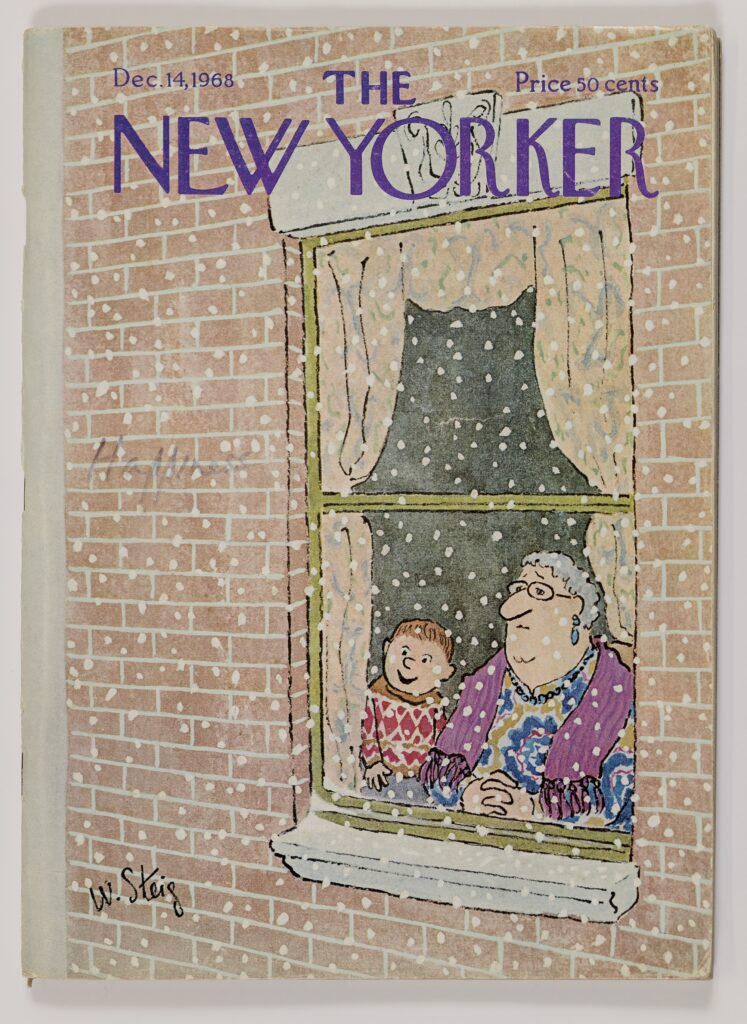 Original issue of The New Yorker that “Happiness” appeared in. Credit: UCD Special Collections.
The loss Lavin is portraying here is complex, or it comes in a complex guise. People think the protagonist wants to talk about her dead husband, or be reminded of what she has lost. “They thought she hugged tight every memory she had of him. What did they know about memory?” She rather hopes for a time when she had “forgotten him for a minute.” It is clear that her grief does not have to be named as “grief,” or brought out for inspection. It is private and untrustworthy and not stable.
In Lavin’s stories a newly widowed woman has to remake the rules for herself, including the most ordinary rules of behavior. Her characters’ behavior could become irrational and hard to explain; they often did the very opposite of what they intended. Being unmoored by loss affects their every thought—even when they are not thinking about loss—and their every action.
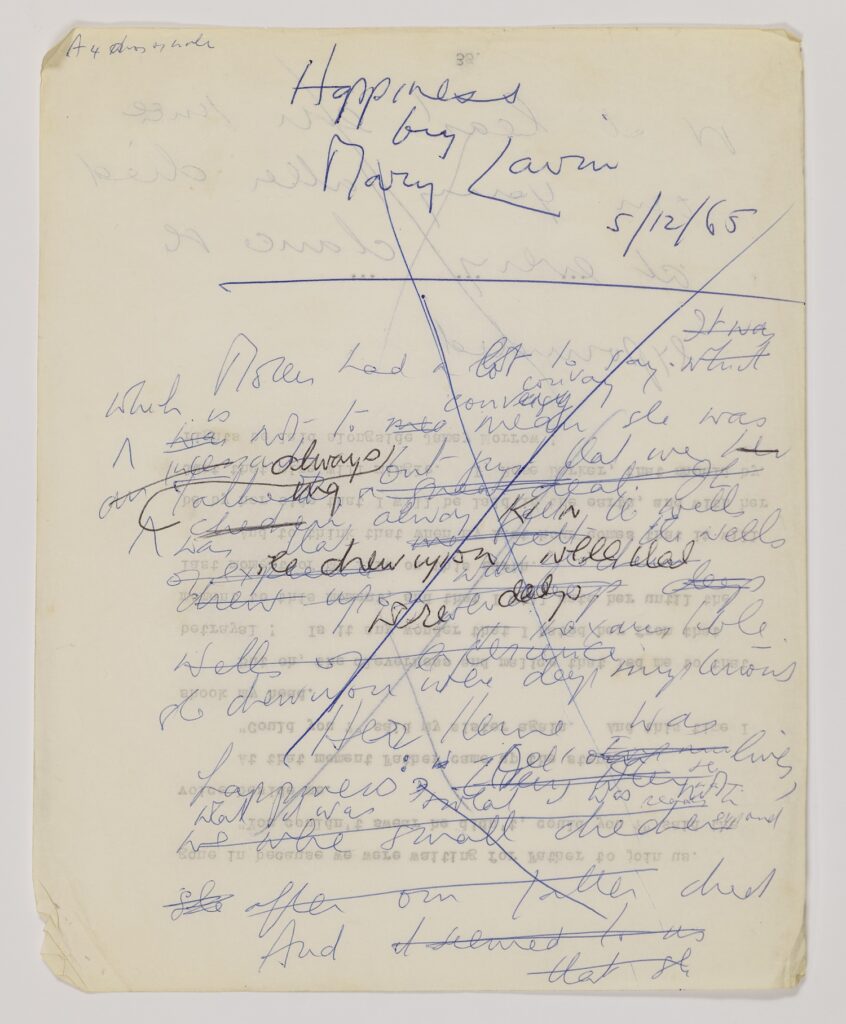 Original manuscript of “Happiness.” Credit: UCD Special Collections.
In 1981, when an edition of her Selected Stories came out in paperback, I went to her house in County Meath and interviewed Mary Lavin for a magazine. The house was modern and beautiful. The long living room was, I remember, on two levels and the walls were filled with paintings. Her conversation was rambling and fascinating. She had a way of starting something and then letting it lead her elsewhere, but part of her mind never left the point to which she would eventually return. “What was I saying?” she would ask. But she would know what she was saying. She told me that she often wrote a story in bed and then worked on many, many drafts. And, when I asked her how would she decide to write one story if she had several in her mind, she told me that she had a contract with the New Yorker magazine, but they only paid for the stories they used, and thus each time she began a new story, she chose to write the one they were least likely to take. And sometimes, she said, she was right and sometimes she was wrong. But she would not have written merely to please them, or for the money.
Rereading the stories now, it is clear that they include a great sense of mystery and wisdom and a use of voice and tone which seems effortless. Part of their power comes from what has been left out. Mary Lavin was more interested in a character she had invented in all its strangeness and individuality than she was in wider society; she was more interested in families than politics; she was more interested in the drama around the solitary figure than large questions of identity. It is the clarity of these interests and her refusal as an artist to be diverted from them that make her work seem now undated, make her stories have the still and severe presence of a painting by Morandi or William Scott. Her stories chart the aura around small hidden dramas and provincial lives. She, from her own reading of Russian and French literature, knew that such limits had created a great tradition, the stories of Tolstoy or Turgenev, for example, or the best work of Flaubert.
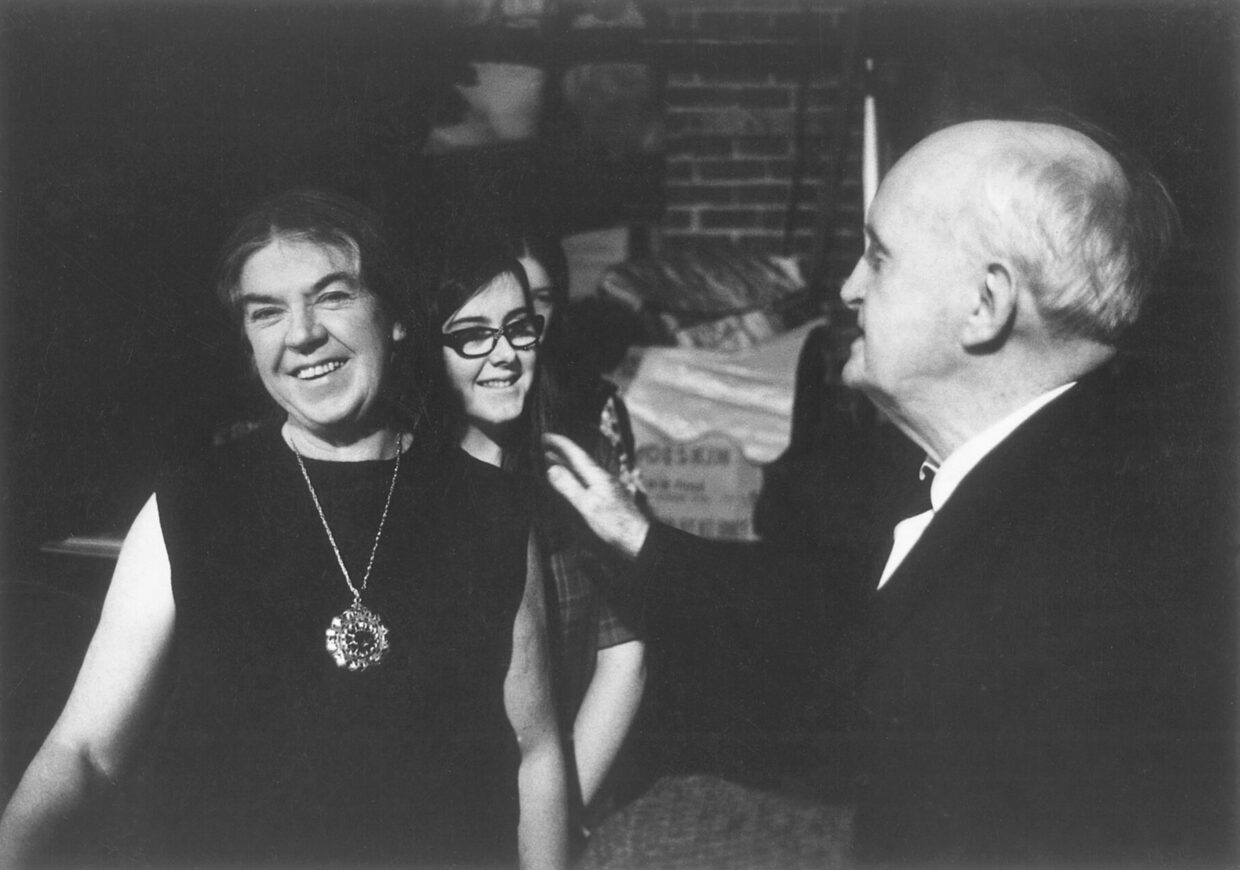 Mary Lavin and daughter Caroline with Padraic Colum, New York Poetry Centre, 1967. Credit: The Literary Estate of Mary Lavin.
Mary Lavin removes the props by which we might read her women easily; she refuses to allow us to come to know them by an obvious set of signals or tensions. They live in a twilight time. Their desires are numerous and ambiguous and require a great deal of detail to describe. And because Mary Lavin is working with the short story rather than the novel, what happens in her fiction must have the noise of delicacy and then a fierce or piercing after-effect. She is not prepared to be simple about this, but she is capable of distracting the reader from this by a set of strategies which suggest simplicity of approach.
Lavin’s women protagonists who are not widows are often placed under pressure so that they appear different from those around them—more sensitive, more guarded, more intelligent, more concerned with strangeness or interested in excitement. Gloria in “Trastevere” and Meg in “The Yellow Beret” offer the stories a drama around fragility. In “A Story with a Pattern,” Ursula’s intellectual curiosity is seen not only as unusual, but an impediment to happiness, a disruptive force. In “The Haymaking,” Fanny’s lack of knowledge of the countryside makes her seem an eccentric and nervous figure against the solidity and unthinking masculinity of Christopher, her farmer husband.
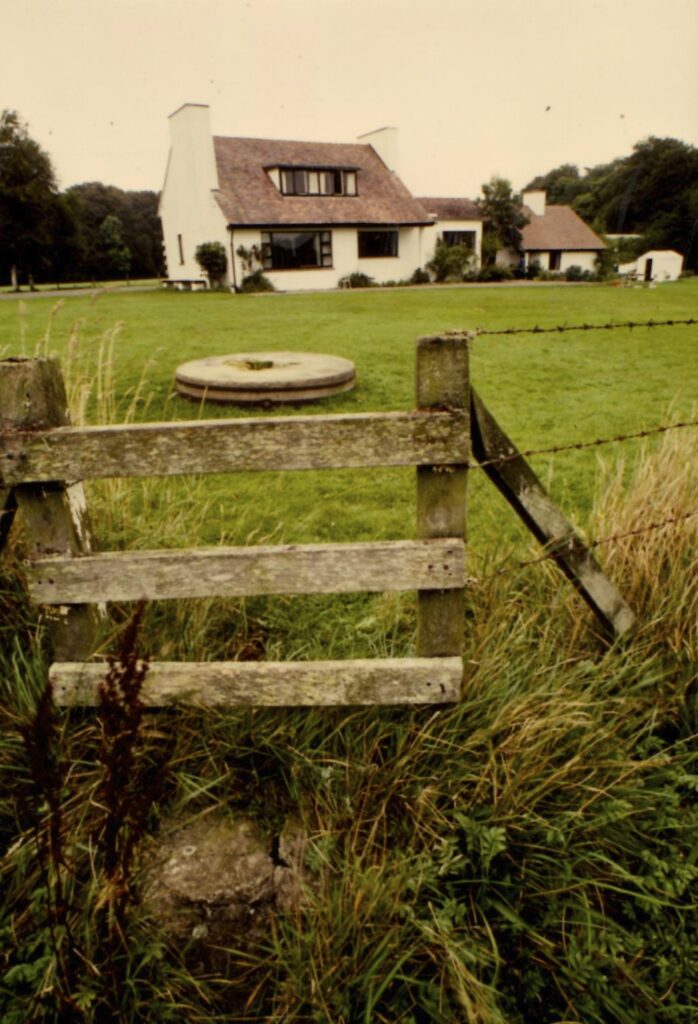 Mary Lavin’s home in Bective, County Meath. Credit: The Literary Estate of Mary Lavin.
In the story “In a Café,” the dead husband is given the same name as the husband in “In the Middle of the Fields”—Richard. Once more he does not appear, but he hovers over everything, or his loss does. Mary, the protagonist, arrives early at a café off Grafton Street in Dublin. She is to meet another widow, a younger woman, Maudie. As Mary waits, what she has lost does not come to her simply: “It happened so often. In her mind she would see a part of him, his hand, his arm, his foot perhaps, in the finely worked leather shoes he always wore, and from it, frantically, she would try and build up the whole man.”
Mary Lavin has a particular skill in making the casual moment or the random detail pull in energy towards itself, remain true and modest but manage to send out signals.
There are paintings on the wall of the café, and they have been done by an artist who comes and sits at a nearby table. She notices his hands first. Then there are a number of awkward connections and disconnections between Mary and Maudie and the artist, who is foreign. Lavin makes this awkwardness stand for a great deal, for the idea that in a time of grief nothing is free from tension, least of all the most ordinary encounter, the most casual moment. In any case, Mary Lavin has a particular skill in making the casual moment or the random detail pull in energy towards itself, remain true and modest but manage to send out signals.
The signals here, as in “In the Middle of the Fields” and “The Cuckoo Spit,” are sexual and they are, by necessity, deeply confused. The artist gives Mary the address of his studio, which is very close, and when Maudie departs, Mary has an urge to visit him. It is clear that when she was married she would never have done such a thing. Once more then, Lavin explores a moment of pure instability in the poetics of solitude. This moment will come in many guises. It will be impulsive and surprising. It will offer a hint of what love is, but also will come like a parody of a love lost. And this time it will bring in its wake something that was not available before—an image of the lost husband which is complete. In Mary’s mind now, the mind that could not see Richard in full before, he comes “towards her tall, handsome, and with his curious air of apartness from those around him. He had his hat in his hand, down by his side, as on a summer’s day he might trail a hand in water from the side of a boat.”
That last image is visually satisfying; it suggests a position for the hand which is casual, languid, relaxed, but it also does other work: the boat is moving, the hand is in water, thus the image is also, by suggestion, the image of someone quietly moving, in this case moving away further into death, further away from her, as he seems to be moving closer.
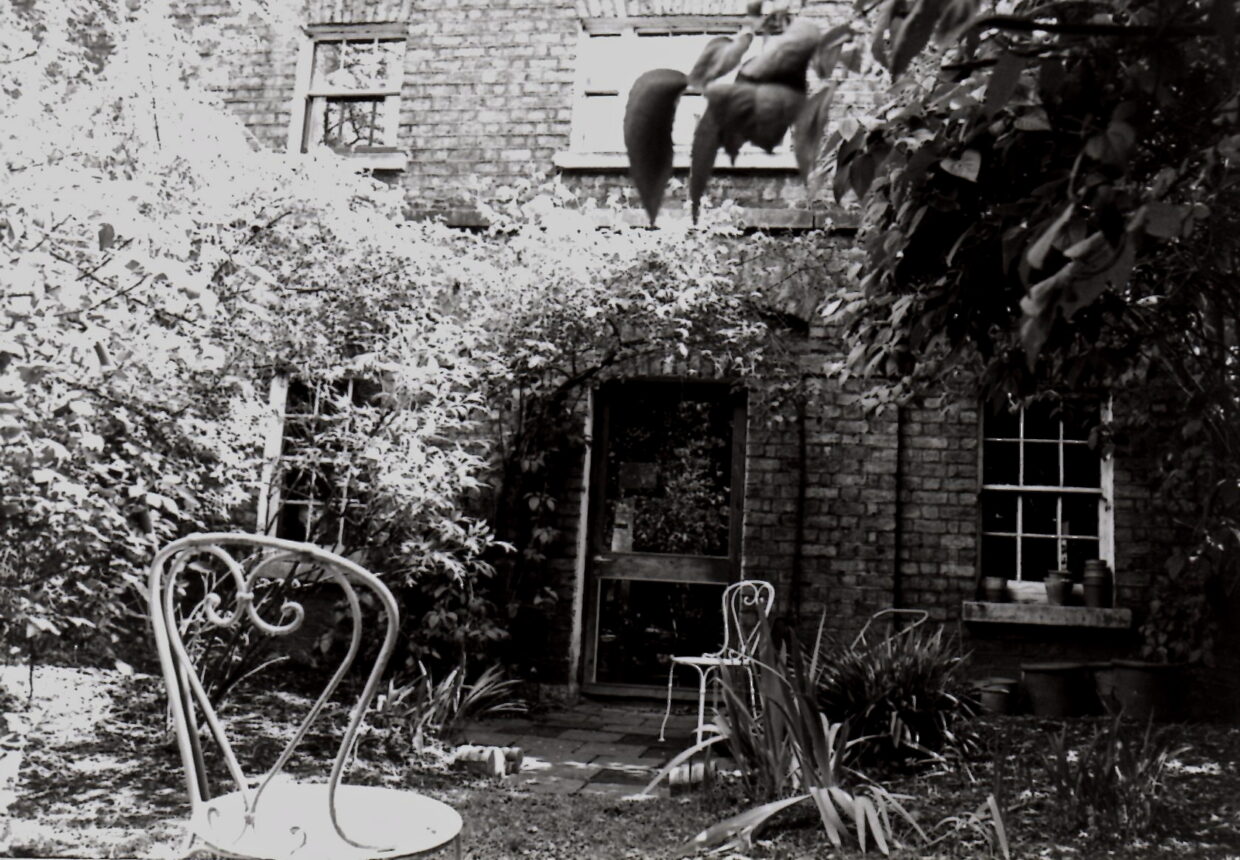 Mary Lavin’s home in the mews, Lad Lane, Dublin. Credit: The Literary Estate of Mary Lavin.
I remember asking Mary Lavin about her story “Happiness” in that house near the Boyne in the summer of 1981. I was aware of course that, like the mother in the story, she had three daughters, since I knew Caroline Walsh, her youngest. And I must have recognized Father Hugh in the story, since someone very like him was coming in and out of the actual room, hoping that the interview would soon end. He—Michael Scott—too had been a priest and he was now her husband.
I must have asked her about “using” autobiographical material in fiction. And she turned her wise and calm gaze about me and smiled. And I remember what she said clearly. She said: “And I predicted my own death in that story. I used my own death.”
In “Happiness” Lavin found a voice which was close to her actual voice, and it was close too to her daughter Caroline’s. The daughter in the story recounts her mother’s vagaries and whims, the way she spoke, the way her daughters and her friend the priest had watched over her as a young widow. The story sets out to lull the reader into trusting that the voice speaks of matters which are odd and gentle, almost eccentric. And then the voice takes on an undertow which is unforgettable in its precision. It moves from the domestic to a set of images which are disturbing, sharp, and ruthlessly set out.
I remember Mary Lavin that day more than forty years ago, gaze unflinching as the style in the story, voice deep and strong, an aura around her of what it means to have faced things, to have fearlessly created an image close to the image of the woman’s head as she sank into death. The mother’s head in the story “Happiness” could equally have been Mary Lavin’s words which “sank so deep into the pillow it seemed that it would have been dented had it been a pillow of stone.”
__________________________________
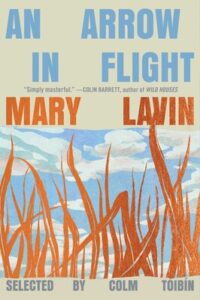
Excerpted from Colm Tóibín’s introduction to An Arrow in Flight by Mary Lavin. Introduction Copyright © 2026 by Colm Tóibín. Copyright © 2026 by The Literary Estate of Mary Lavin. Reprinted by permission of Scribner, an Imprint of Simon & Schuster, LLC.

Colm Tóibín
Colm Tóibín is the author of nine novels, including The Blackwater Lightship; The Master, winner of the Los Angeles Times Book Prize; Brooklyn, winner of the Costa Book Award; The Testament of Mary; and Nora Webster, as well as two story collections. He is the Irene and Sidney B. Silverman Professor of the Humanities at Columbia University. Three times shortlisted for the Man Booker Prize, Tóibín lives in Dublin and New York.