A Pawnshop of the Mind: In Praise of Object-Based Writing
Emily Rapp Black Offers Some Advice to Help Craft Your Next Story or Essay
“What we call the beginning is often the end
And to make an end is to make a beginning.
The end is where we start from.”
–TS Eliot, from “A Little Gidding” from The Four Quartets
*Article continues after advertisement
Franca owned a pawnshop in a small town in Nebraska where Railroad Street intersects the loneliest stretch of windy I-80. She had an accent I couldn’t place and never asked or learned about, hair dyed a purplish red, a love for lace-trimmed floral dresses with puffy sleeves, and for a time she was my only friend after I wandered into her shop one day in 1990 looking like the sad teenager I was. Most people I knew referred to Franca as “odd” (code for “bad and wrong”) because she wasn’t married (imagine!), didn’t seem to give a shit that she wasn’t (what?!), and owned her own store (the nerve!), which was a fantastic, ridiculous mess. I loved hanging out with her in her chaotic, overstuffed store.
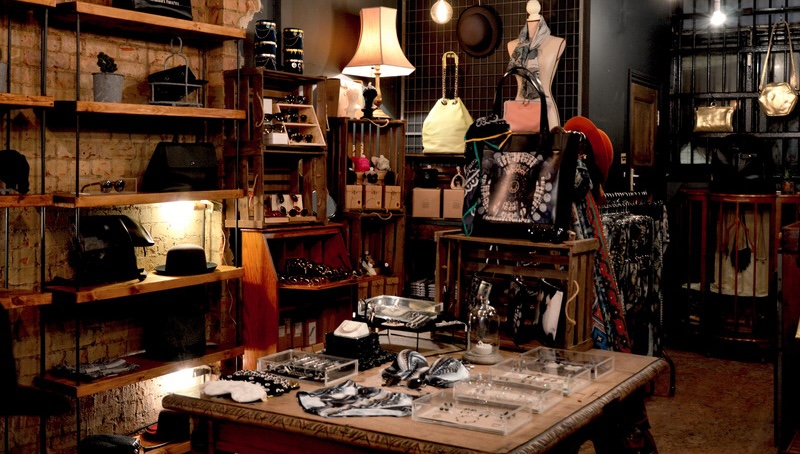
Franca’s shop was full of abandoned diamond rings (I thought of her when I pawned my first engagement ring at a shop in an Austin strip mall and used the money to get my first tattoo); piles of Black Hills gold, which was popular at the time; chains of various metals in various states of rust; taxidermic birds and squirrels and other small creatures arranged on top of glass cases full of turquoise jewelry; Union Pacific Railroad work wear from across the decades; and so many cross necklaces, thanks to that poster of Madonna from her first album in the 1980s, and the fact that most people in this small Nebraska town were some brand of Christian.
I learned from Franca—perhaps more than any other person—that objects have power, and nothing needs to be discarded entirely; we touch, recreate, touch again, recreate, replenish, replicate. And this has a practical application as well: It’s never too late to start again, with an essay, a book, your mind, a person, your life, you. Not to make yourself better—that’s not the business of living—but to live more happily, more creatively, and with more freedom and joy.
Stories—told through objects—can reframe how we see the world and shift our attention in ways that help us find clarity while also making us less miserable.
Franca was adamant that this was a pawnshop, not a thrift store, and she liked to talk while she was putting on lipstick, always a dark plum shade, which she did every few minutes. “People bring in what they don’t like to get money to buy something they like better. Maybe they trade. Maybe they don’t. Maybe they come back the next day.” Perhaps she was proud of this circular exchange, which was not just about selling things, but attaching old objects to new owners, continuing the story, tethering an object to the world by changing its owner and its story, over and over again. Or maybe it just set her mind at ease, that she would never be without inventory.
Franca also taught me the power of remaking things: silver spoons bent into funky bracelets, rusted chains polished and fashioned into belts with old locks dangling from the ends, a single suspender from the 1920s transformed into a glittery headband. She used other people’s unwanted objects and gave them new meaning, and she gave some of them to me. I had a piece of steel hammered into a textured cross on a heavy chain; a spoon with an engraved E that I wrapped around my upper arm like some kind of snake; and a beaded rock necklace that my older brother gave to me for my birthday from Franca’s rock collection, which was literally a pile of rocks, some plastic packets of stale-looking rock candy, and then a few necklaces she’d made herself.
Stories—told through objects—can reframe how we see the world and shift our attention in ways that help us find clarity while also making us less miserable. It’s a win-win. I walked around weighted down by the creations Franca made for me as if she’d fashioned for me a shield against sadness, which she kind of did. She helped me put myself together, as the saying goes, and it was through her that I found my love of creative expression through fashion, which, in a world where I was the only girl with a body like mine, was a form of preemptive protection. If my outfit was bizarre enough, fewer people would ask me about my leg. This strategy was so effective that it was almost too easy.
What Franca did best in her store was curate a world where everything had a place and all of it mattered. She made displays of spectacular things that immediately caught our eyes, as if we were inside her mind the minute she saw that brooch or that bangle. I now understand that Franca was one of my first and best writing teachers. One of the writer’s jobs is, of course, to make a world of words, images, scenes, photographs—a unique artistic world that acts as the container for the story or the meaning. Each one of us is Franca curating a pawnshop of the mind.
Remaking the world is also a big part of the writer’s job. How we see things changes how we understand and enter the story, and objects are a great place to start as an illustration. If you show me a pen, I won’t care too much about it. I might snatch it and start making a to-do list. I might steal it if it’s a Sharpie. But if you tell me that the pen is the one you used to sign your divorce papers, or your mother’s death certificate, it’s the saddest pen in the world. Now that object is tethered to a story, and now you can follow that story as it unfolds in your mind and memory. If you tell me this pen belonged to your father and he never wrote a letter without it and you miss him, it’s a sad and happy pen showing that grief is the price you pay for loving your dad. If you tell me the pen was a fancy gift from a partner and needs special ink and shows how much this person really understands and appreciates you, it’s such a happy pen it might even make Kafka smile.
You might have a fancy Birkin bag or shoes that cost someone’s monthly salary, but would you trade it for the cheap blue-and-pink newborn hat that went on your kid’s head minutes after they were born, the same kind of hat you could find at probably every hospital in the world that is worth maybe one dollar? Would you rather have your crystal glass collection or the weird Polaroid of your favorite person, with a wine stain covering part of their face? Think about it. Examine your objects carefully. If you can remake an object’s narrative trajectory, it’s easy to move on to more complicated tasks.
Like crafting! Or, in this case, cutting things up with scissors and tossing them around. This is the easiest and most enjoyable craft you’ll ever do. In fact, it’s not really a craft at all, because I find crafts annoying and mystifying. This is an exercise in making a mess and having fun, and then cleaning it up and making meaning, and then doing that all again three times.
I mean this literally: Print the essay or story or chapter. Cut it up into its individual paragraphs and then put these pieces of paper in a pile. Put your hands in the pile and start shuffling as if you were a hotshot dealer in Vegas, and now toss the pieces up like you were making pizza dough and see how they land. Have fun with the paper and with the mixed metaphors. Start moving these pieces around to see if it’s possible to arrange the story in a different way as they’ve fallen on the surface, by chance or fate or whatever. They fell that way; see if there’s a new beginning in there you might try as your opening gesture.
And now you’re having fun, and there’s no way you’re white-knuckling your computer keyboard or clenching your butthole when you are throwing paper in the air. Tension will make you tense, not creative, but exploring what you don’t yet know but might soon is fun and will make you curious. You are now a detective assigned to your own story and you have caught the case. You are a private investigator of your own life and it’s Friday night and you’re laughing out loud. Do this twice more. In between rounds, you can take a screenshot of your new arrangement or tape it together and put it in an envelope and print the material again for the next two rounds. You will feel silly. You might feel annoyed, you might laugh, you might weep. That is the point. And you will discover something new about your story, I assure you. You might also have some fun.
And it’s supposed to be fun. Creating things is supposed to be playful, driven by curiosity (How about this for the opening line? What if I make this line? What I thought was the end is a better beginning) and practiced over and over, knowing that stories are living things, and even if they are “finished” and published, they will evolve because new people will be reading them. It’s a constant game of what-if without the worry and stress we usually associate with those words. So much about writing is about chance or luck: what you happen to see or experience or hear, your mood, your level of physical comfort or discomfort, the time of day, the time you have in a day. Work with that element of chance because learning to enjoy embracing—working with it—is fun and fun isn’t logical, and logic isn’t always your ally in that initial stage of creation.
Overthinking doesn’t get you where you need to be, and most thinking is overthinking. Playfulness, however, is much more fluid and open, always accessible, and it’s going to help you find that metaphor or write that dialogue because when you’re having fun, you can’t help but relax and stop overthinking. If there’s one thing this exercise helps you do, it’s to understand how much fun you are to be around when you’re not so serious about whatever it is you’re doing. This is one step toward becoming a more intuitive writer, which is hard to teach but easy to practice if you’re willing. All memory is stored by neurons in a circuit that records; we are, quite literally, wired to remember, which means we’re already telling another story, which means we’re also wired to rewrite.
When we’re playful, we are free to investigate the intersection between imagination and intuition without self-consciousness. Kids do this instinctively; during the pandemic, my daughter, Charlie, then five years old, got off her Zoom school screen and started looking wildly around the room, picking stuff up and setting it down. I heard water running in the bathtub. When I asked her what she was doing, she said, “I’m looking for something that might work as a floating device.” Find a flotation device was, in fact, the assignment, and she didn’t think it was weird at all to search the entire house, because who knows? Her search reflected her belief in the power of curiosity. She also learned the hard way that cats don’t float, or at least ours didn’t, and that they are terrified of water.
Trust me: I hate crafting and craft parties and anything you fold or cut or paint or poke with a special tool or paste on top of something else. But I love this exercise. In it, I find what I like to call the Joy Index, or an access to happiness while in the middle stages or “middle feelings” of a project, which often feel like a slog. This index or fine line of feeling is different from the high of an idea or the completion of something, and different from the low mood of feeling utterly stuck. It’s the frequency of emotional regulation within the artistic process. Instead of dwelling in doubt, cut up paper and throw it around. Story is a kind of systems chaos anyway, so we might as well work with it instead of against it.
You’re doing it for the sake of doing it because it brings you joy and taps into the beginner’s mind, the unselfconscious but awake and open mind, where everything is possible, and nothing is forbidden.
There is power and potential and so much joy to be found in a mess. The walls of Franca’s store were lined with unlabeled bins and drawers full of bits and bobs that looked like the world’s most disorganized hardware store. But if you said, I need a turquoise necklace pendant that’s exactly two inches long, or Do you have a neon-green paper clip that will hold twenty pieces of construction paper? she’d rifle in one of those drawers and find it in five seconds. A woeful mess to most onlookers, which was part of its beauty and charm. Franca knew exactly where everything was; that’s how well she knew her world, and she didn’t believe that it needed to be perfectly organized to make sense or for the perfect treasure for the right person at the right time to be found. The whole store was like a giant magic hat.
This system of thinking as applied to your writing is also portable. While I don’t recommend doing this exercise with scissors and paper on a plane, you can also use the Sticky Note Layer Cake strategy when you’re on the road or just in the mood for a different kind of chaos crafting that involves no actual crafting skill whatsoever. When I’m working on a book, whenever I have an idea, I scribble it on a sticky note and trap it on my board with a magnet. I add the notes at random, one on top of the other, and at some point, I peel them off, one by one, and start looking at what I have.
This system is relatively new for me, but its origin story is an accident. I was visiting my friend Emily in London when her kids were babies, and I went to the nanny’s upstairs room to ask her a question about how to change a cloth diaper, which was new to me at the time. I knocked, opened the door, and didn’t find Renata, but saw stuck to the wardrobe lines of sticky notes—British phrases translated into Czech and vice versa—the edges of which were moving in the wind through the open window. That image stayed with me, the tactile nature and utility of it, the focus and dedication it represented, and the Sticky Note Layer Cake system was born.
A few years ago, on a flight from Los Angeles to New York City, I pulled out my layer cake of notes and started unpeeling them and placing them on my seat back. My friend Margaret was sitting next to me and thought I’d lost my mind. “What is that?” she asked, looking worried. “It’s an outline for a book,” I said. She was so flabbergasted that she took pictures of it, shaking her head. I organized what I had, typed it all up in a big-ass document, and then threw all the sticky notes away with my snack box. “Wait, aren’t you tossing out something important?” Margaret asked. “I don’t need the sticky notes anymore,” I told her, and she, the maker of the most complicated spreadsheets that give me hives and make perfect sense to her and that she displays on multiple computer monitors at the same time, laughed and so did I. It’s fun to have friends whose brains work differently.
Later I cut up this same document and tossed it up in the air three times and found the opening (for now) of a new project. I might finish that project, I might not. It might get published or it might not. When you’re joyfully engaged in the process, it doesn’t matter that much (unless you’re on a deadline, and it works for projects under time pressures too). You’re doing it for the sake of doing it because it brings you joy and taps into the beginner’s mind, the unselfconscious but awake and open mind, where everything is possible, and nothing is forbidden. It’s a literary Eden. Who says no to that?
____________________________
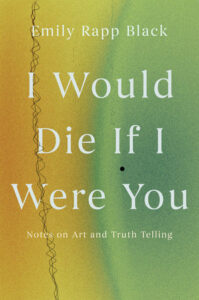
Excerpted from I Would Die If I Were You: Notes on Art and Truth-Telling by Emily Rapp Black. Copyright © 2026 by Emily Rapp Black. Reprinted by permission of Counterpoint Press.

Emily Rapp Black
Emily Rapp Black is the author of the New York Times bestseller book Poster Child, The Still Point of the Turning World, Sanctuary, and Frida Kahlo and My Left Leg. A former Fulbright scholar, Guggenheim Fellow, and graduate of Harvard Divinity School, she is Professor of Creative Writing at University of California-Riverside, where she also teaches in the School of Medicine.