When the Librarians Fought the Archivists Over Who Gets the Declaration of Independence
Michael Auslin on the Final Battle to Control the Declaration of Independence
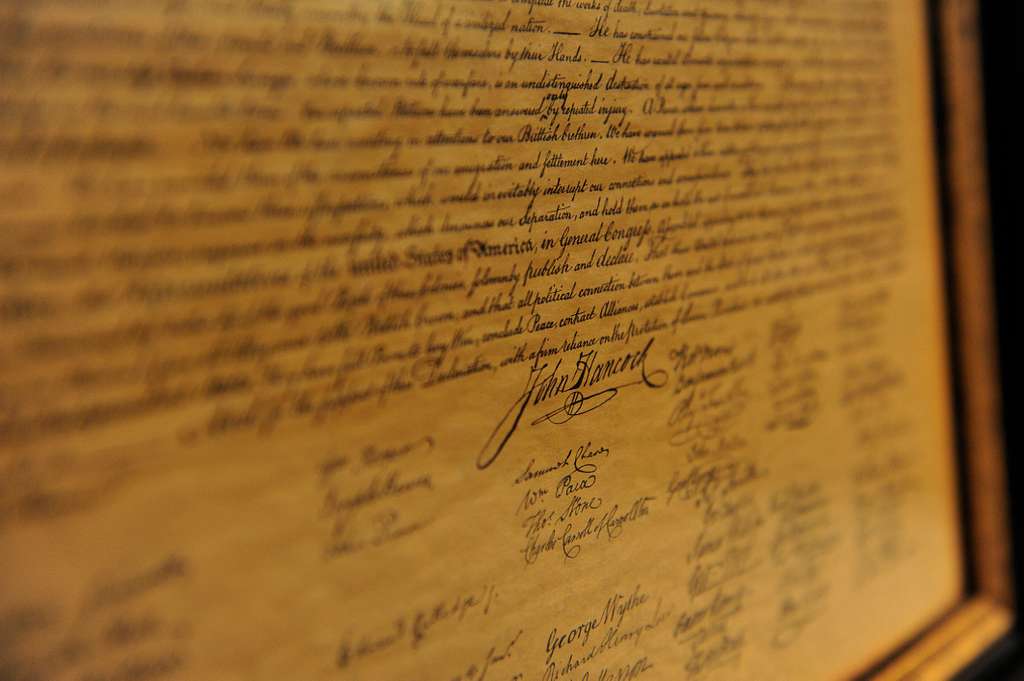
In the summer of 1951, a month after the Declaration celebrated its 175th anniversary, an unmarked panel truck pulled into the basement of the Library of Congress. Once loaded, it drove to the Maryland campus of the National Bureau of Standards, the government’s primary scientific facility. There the Declaration of Independence and Constitution were placed in the care of Gordon M. Kline, chief of the Plastics Section. Kline and his team had one focus: to create the most technologically sophisticated cases that science could envision to preserve these delicate parchments for posterity.
Kline’s mission had started before World War II. In 1940 Archibald MacLeish had charged the National Bureau of Standards with determining the best way to conserve the Declaration and Constitution. The war pulled the Bureau away from these efforts, but once peace returned, Kline and his scientists had gone back to work.
Past efforts at protecting the Declaration paled in comparison to the full power of modern science brought to bear for the first time to preserve the timeworn parchment.
By 1951, Kline’s team had run years of tests. They had examined different sealing materials and analyzed a range of inert gases. They had explored optimal humidity levels: too much and the document would lose strength, too little and it would become brittle. They had experimented with different types of glass, created new paper backing, and designed special sensors so that the environment surrounding the document could be constantly monitored. At last, they were ready, and the Declaration was taken out of the shrine in the Library of Congress to be delivered to the scientists.
In a carefully cleaned laboratory room whose air quality was monitored, the aged scroll was removed from the glass case into which George Stout and Evelyn Ehrlich had placed it at Fort Knox and carefully separated it from its rag board backing. Gingerly, the parchment was laid on a new moisture-absorbing cellulose backing custom-made in the Bureau’s own experimental paper mill and then covered with a thin plate of tempered glass held by brass brackets. This inner cradle was enclosed between thicker, quarter-inch panes of Thermopane glass specially made by the Libbey Owens Ford Glass Company. The case was hermetically sealed with a metal border and lead. When completed, the new enclosure weighed seventy pounds.
After being tested for airtightness, helium was pumped into the glass enclosure through thin tubes inserted into the lead lining, to protect the document from corrosive oxygen and parasites. The humidity was calibrated at 25 to 35 percent, and an ingenious leak detector and platinum wire sensor were designed to measure humidity and temperature levels. Past efforts at protecting the Declaration paled in comparison to the full power of modern science brought to bear for the first time to preserve the timeworn parchment. A similar treatment was given to the Constitution.
On September 17, Constitution Day, the newly encased Declaration and Constitution were brought back to the shrine at the Library of Congress. President Truman and Chief Justice Fred Vinson participated in the ceremonies to reinstall the documents in their viewing cases. The marble altar was now fronted by specially designed laminated glass with a filter of yellow-orange acetate film produced by the Eastman Kodak Corporation, designed to block light radiation. Yet as impressive as the scientific efforts were, Librarian of Congress Luther Evans went to some length to remind his audience that science was secondary to the documents’ philosophy.
“Only the most deluded,” he intoned, “could attach more importance to their physical well-being than to the preservation of the principles for which they stand.” The new technology and impressive ceremony seemed to make clear that the Declaration had returned to its permanent home.
A month or so after the engrossed Declaration was returned to the Library of Congress, two men huddled over a table in the dining room of the exclusive Cosmos Club, then located across Lafayette Square from the White House. Luther Evans hosted Wayne Grover, the Archivist of the United States, in a bid to settle one of the strangest, and longest-simmering, custody disputes in government history.
The dispute’s origins could be traced back to 1926, when Congress had passed a “Public Buildings Act” that included plans for an official ar-hives. Up to then, the untold millions of official government documents had lain in various locations, from the Library of Congress and State Department to local government offices, the Patent Office, and private collections. To begin the process of recording, collecting, and preserving these documents was a gargantuan undertaking. Above all, it needed a headquarters.
Now in peacetime and with a new set of actors, the time had come to bury the hatchet and settle the issue between once and for all.
Plans for the building continued through the Great Depression, and in 1930, Herbert Hoover’s Secretary of the Treasury, Andrew Mellon, settled on both site and architect. The National Archives were to be the symbolic center of the new Federal Triangle reshaping Washington’s center. The site, wedged between Constitution and Pennsylvania Avenues at the midpoint of the National Mall, was halfway between the U.S. Capitol and the White House. Mellon commissioned John Russell Pope, who a decade later would design the Jefferson Memorial, for the task. Pope created a striking neoclassical plan for the building. Its 118-foot pediments would be the largest in Washington and its seventy-two Corinthian columns were each over 53 feet high and weighed 95 tons. The sliding bronze doors, at 38 feet, were the largest in the world.
On February 20, 1933, a bitterly cold winter day, President Hoover had laid the cornerstone of the new archives. In his speech, Hoover paid homage to Pope’s design, calling the building a “temple of our history.” More significantly, he indicated that this temple would also be a treasure house, informing the assembled dignitaries that “there will be aggregated here the most sacred documents of our history, the originals of the Declaration of Independence and of the Constitution of the United States.”
There was just one problem with Hoover’s announcement. Washington’s other Herbert, then-Librarian of Congress Herbert Putnam, refused to surrender the engrossed Declaration. As had happened when the Patent Office and the State Department had briefly tussled over control of the Declaration back in the 1870s, the question of custody was a thorny one. As another Librarian of Congress later noted, “A threat had been proclaimed. The period of uncertainty had begun.” Putnam considered the transfer from the State Department to the Library to be the final one, referring to Congress’s 1922 appropriation for a “permanent repository.”
It would take another act of Congress, Putnam believed, for him to give it up. Facing such an obstacle, neither Hoover nor his successor, Franklin D. Roosevelt, pushed the issue. Putnam’s successor, Archibald MacLeish, was more sympathetic to a transfer, but had been forced by World War II to focus on protecting the Declaration. Now in peacetime and with a new set of actors, the time had come to bury the hatchet and settle the issue between once and for all.
A stout, avuncular Texan with a ribald sense of humor, Luther Evans took over the Library of Congress from MacLeish in 1945, when he was only forty-three years old. A committed New Dealer, he had directed the Historical Records Survey of the Works Progress Administration in the 1930s, making him more of an archivist than librarian. Within a few years of succeeding MacLeish, he had come to believe that a new era required a new approach to the Declaration.
A political scientist with a PhD from Stanford University on the topic of international diplomacy, Evans told Grover over lunch that he was concerned about the security of the founding documents in view of the “international situation,” a guarded reference to the danger of atomic warfare. From an archival standpoint, Evans also worried about the long-term effects of keeping the Declaration housed against an exterior wall, where temperature fluctuations were more extreme. Evans considered it unseemly that the great Rotunda of the National Archives remained empty more than a decade after its completion. In short, he was ready to give up the Declaration. But he knew he would need political cover to hand over the scroll.
Wayne Grover, at thirty-nine, was only the third Archivist of the United States and had been one of its first staffers when the National Archives had opened in 1935. Known for his genial wit, Grover had joined the Office of Strategic Services during World War II before returning to head the Archives in 1948.
In his quest to gain custody of the scroll, Grover felt he had the weight of presidential support behind him. Hoover, Roosevelt, and Truman had all three indicated that they believed the Declaration should be relocated to the National Archives, and the new Federal Records Act of 1950 seemed to give Grover authority to request any document for the National Archives. After so many years of acrimony and uncertainty, Grover and Evans settled the issue amicably over lunch at the Cosmos Club. If Congress agreed, the issue of custody would be decided once and for all.
With President Truman’s support, on April 30, 1952, Evans was unanimously directed by Congress’s Joint Committee on the Library to transfer the Declaration and Constitution to Grover. It was a bitter blow to many at the Library of Congress who had so conscientiously guarded and cared for the founding documents. David C. Mearns, Chief of the Manuscripts Division, expressed the feelings of many in an article entitled “Forever Is Twenty-Eight Years”: “From the time they came to the Library in 1921 the well-being of the Declaration and the Constitution has ever been of paramount concern to us . . . To have been host to these imperishable records even for a few decades has been an extraordinary privilege.”
At 11 a.m. on December 13, 1952, the shrine in the Library of Congress was opened one last time. Library officials turned the Declaration and Constitution over to the commanding general of the U.S. Air Force Headquarters Command. In the winter morning sunshine, two tanks and an armored personnel carrier moved slowly down Constitution Avenue, accompanied by troops carrying submachine guns, while soldiers, sailors, airmen, and marines lined the street. The Declaration and each page of the Constitution had been packed in cases and ceremoniously carried down the steps of the Library between a cordon of eighty-eight uniformed servicewomen, and each case placed in a Marine Corps personnel carrier.
Escorted by a color guard and motorcycle squadron, the impressive procession moved slowly toward the National Archives Building, crowds lining the streets to watch. There, surrounded by armed soldiers, the founding documents were reverentially carried up the thirty-nine steps, passing through another cordon of servicewomen. The procession continued under the portico of the neoclassical building and through the bronze doors.
Inside, the Declaration was carried through twelve-foot-high bronze gates, topped by spearpoints and eagles, into the magnificent Rotunda. Under the seventy-five-foot dome, Archivist Wayne Grover took formal custody of the Declaration. No more honor was paid to presidents on their inauguration than to the founding charters on that morning.
For those in the Rotunda that December day, and for tens of millions of visitors over the next half century, the overwhelming power of the Declaration as symbol and relic was manifest.
Two days later, the Declaration and Constitution were formally enshrined, joining the Bill of Rights at last in the space built so long ago to house them. Appropriately enough, December 15 was Bill of Rights Day. At 10:15 a.m., in front of a crowd of dignitaries including the President and Chief Justice, Grover and Evans together drew back a large curtain to reveal the new shrine.
Three leaves of the Constitution and the single sheet of the Bill of Rights lay horizontally in a marble and bronze casement elevated three feet off the floor. On the wall behind was the shrine’s central altar, bronze doors open on either side. The altar was flanked by two twelve-foot-high columns of green marble topped by Corinthian capitals supporting a larger, curved pediment, next to which were two oversize American flags set into floor stands. Above the altar the names of the three documents had been chiseled into a large gray marble panel and then gilded. On either side, two massive marble columns soared twenty feet up, topped by huge stone eagles. High up on the curving walls to either side were large murals painted in the 1930s by the artist Barry Faulkner portraying Thomas Jefferson handing the Declaration to John Hancock and the ratification of the Constitution.
At the center of it all, perfectly aligned with the flags, columns, architraves, and pediments, was the engrossed Declaration in its altar, surmounted by a bronze eagle. The flawless symmetry automatically drew one’s eyes toward the faded scroll, safe in its helium-filled, hermetically sealed casement. For those in the Rotunda that December day, and for tens of millions of visitors over the next half century, the overwhelming power of the Declaration as symbol and relic was manifest.
Perhaps the setting was too majestic. To many, the Declaration appeared like a secular version of the Ten Commandments, an almost religious testament from the Founding Fathers to the People. President Truman, aware of the danger of mindless veneration, warned in his dedicatory remarks that the Declaration and Constitution should not become “idols whose worship would be a grim mockery of the true faith.”
To others, who may have dismissed the shrine as anti-republican or antithetical to the spirit of democracy, Truman admonished that American freedom would be lost “if the time ever comes when these documents are regarded not as the supreme expression of our profound belief, but merely as curiosities in glass cases.” Despite its grandeur, Truman went on, the new setting was designed to deepen visitors’ attachment to the democratic ideal and “our faith in human liberty.”
While visitors in the Rotunda lifted their eyes up to the Declaration, some also looked down, aware that twenty feet below them lay a massive concrete and steel vault. Built by the Mosler Safe Company in Ohio, the vault’s doors opened upward, activated by two massive counterweights that swung down at the press of a button. In just forty seconds, the inner cases could be carried down on a scissors-jack platform into the fifty-ton vault, where the reinforced doors would shut tight, protecting the priceless parchments from atomic attack.
Every night, the Declaration and its companion documents were to be lowered into the vault for safekeeping, “as safe from destruction as anything that the wit of modern man could devise,” Truman noted at the enshrinement ceremony. In a world living in the shadow of the mushroom cloud, the vault was a grim reminder that after nearly two hundred years, the American experiment needed to be defended.
The vault was necessary now that Soviet spies had stolen plans for the atomic bomb. The open society Truman praised was also vulnerable to organized penetration by communist agents who sought to use the very freedoms celebrated in the Rotunda to undermine the United States. This led to a bitter and partisan struggle over the right balance between protecting civil liberties, respecting individual beliefs, and defending the U.S. government and other areas of civil society from subversive communist penetration. FBI investigations had uncovered the presence of communist sympathizers, spies, and fellow travelers among civil servants but also hounded innocent people whose politics were left of center. What would become known as the “Red Scare,” and the subsequent blacklisting of academics, artists, entertainers, and others, raised difficult questions about the “profound belief” in liberty Truman had alluded to.
Most Americans, however, were not touched by the shadow of great power games or the political and legal struggles playing out on Capitol Hill. Year after year, they continued to pour into the National Archives. “We do not know much of what is in the minds of Americans as they file past the altar,” acknowledged the Christian Science Monitor in 1953. Yet their presence, day after day in never-ending lines, seemed proof that the enshrined scroll was the most powerfully symbolic document in the world.
One comes away from the altar, noted a correspondent for The New York Times, “with an increased faith that this nation, having hoped so much and achieved so much, having endured so much, cannot, in Lincoln’s own words, perish from the earth.” The magnetic pull of the engrossed parchment in its new altar in the National Archives sent a powerful message that American exceptionalism, American identity, and the Nation’s purpose were centered on Jefferson’s inspiring promise of liberty, both achieved and achievable.
__________________________________
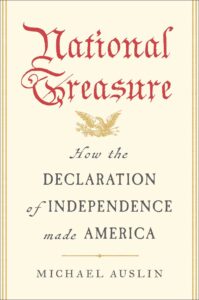
From National Treasure: How the Declaration of Independence Made America by Michael Auslin. Copyright © 2026. Reprinted by permission of Avid Reader Press, an Imprint of Simon & Schuster, Inc.

Michael Auslin
Michael Auslin is the Payson J. Treat Distinguished Research Fellow at Stanford University’s Hoover Institution. Prior to that, he was an associate professor of history at Yale. He wrote National Treasure as a Distinguished Visiting Scholar at the Library of Congress’s John W. Kluge Center and an American Heritage Partners Fellow at the Society of the Cincinnati’s American Revolution Institute. He writes a Substack, The Patowmack Packet, on Washington, DC, past and present, and lives in Virginia.