Shakespeare and Reality Televison Really Aren’t That Different
Samantha Allen’s Reality TV Twist on A Midsummer Night’s Dream
When the first massively popular reality TV shows hit the air in the early 2000s, I remember thinking in my naïveté: Surely this is just a passing fad. I was entering my teens and, like so many closeted queer youth before me, was beginning to form an intense fixation on media. Predicting that Survivor and The Bachelor would only last a few seasons became my way of establishing myself as a sophisticated observer of the landscape. To whom, you might ask? Mostly to the adults who came over for dinner. God, I must have been an obnoxious child. Or maybe I was just gay. But I was so smart, I thought. An assessor of trends. An expert on entertainment.
Of course I was dead wrong.
A quarter of a century later, and reality TV is thriving while all but the buzziest scripted shows die on the vine. We can watch yachties fight and fuck in a half-dozen different oceans on Below Deck and its sundry spinoffs. We can watch housewives of the Mormon and non-Mormon varieties flaunt their wealth. We can watch people cheat on each other in all sorts of warm locales, from Puerto Vallarta to Fiji and beyond. By now, most people know why reality TV makes more economic sense: It’s generally cheap to produce, the contestants aren’t unionized, and we all keep coming back for the kind of drama you just can’t write.
By the end of it, when the language no longer sounded archaic because we had been acclimatized to it, I realized that we were essentially just playing lovable idiots.
I came around to it, too, despite my initial resistance. I fell in love with The Bachelor so deeply that I based my entire first novel Patricia Wants to Cuddle around it. And I binge-watched so much Survivor that I can still hear Parvati Shallow’s voice convincing me to vote out her enemies when I close my eyes. And it’s no wonder I changed my mind because reality TV is, at its very core, a Shakespearean enterprise.
No, Love Island contestants aren’t exactly producing dialogue comparable to The Bard of Avon’s work. I would make a case, though, that Heather Gay’s “Receipts! Proof! Timeline! Screenshots!” speech has a certain rhythm to it reminiscent of iambic pentameter. But there’s a reason why reality TV already seems like it might stick around for as long as Anne Hathaway’s husband has: It is about messy people being messy to each other in ways that are broadly relatable. Because Shakespeare knew how to artfully string words together, and because he is often a young reader’s first exposure to Early Modern English, many sixth-graders falsely assume at first that he was a fancy man who wrote for fancy people. But then you realize what made his plays so popular with people from every background.
Around the same time I was sounding a premature death knell for reality television, I was cast as Demetrius in my middle school’s production of A Midsummer Night’s Dream. (This was pre-gender transition, and the fact that I was the only “boy” in my class who could read Shakespeare without sounding like there were marbles in my mouth should have been a major clue that something was going on with me, but that’s besides the point.) We rehearsed so much that “Helena” and I were able to recite our entire abridged version of the play start to finish backstage whenever we weren’t treading the boards ourselves. By the end of it, when the language no longer sounded archaic because we had been acclimatized to it, I realized that we were essentially just playing lovable idiots.
The core foursome in A Midsummer Night’s Dream are not, as many experts on the play have observed, very well-drawn. They have one or two traits at most. Let’s not forget that Helena’s whole deal is that she’s tall. No way would my editor let me get away with that. The joy of Shakespeare’s best-loved comedy isn’t its characterization, it’s in all of the antics: the eavesdropping, the meddling, all the forced pairings and un-pairings. The Athenian co-eds are not doofuses — that’s Nick Bottom’s job — but they aren’t especially interesting, either. And yet we care about them anyway, because they are still undeniably human: Will Lysander and Hermia end up together? We simply have to know!
Twenty-five years later, I’ve more than accepted that reality TV is here to stay.
The principals of Midsummer bear more than a passing resemblance to the reality TV casts of the 21st century. At this point, I have watched hundreds of women compete for the affections of dead-eyed former football players stuffed into suits. They are all, I am sure, interesting people with fully fledged feelings, thoughts, and desires. But the versions of them we get to know on TV are reduced to mnemonic devices: There was that one girl who wore a shark costume that she thought was a dolphin costume. There was that girl who kept saying “winning!” Like she was Charlie Sheen. One lady’s fun fact was that she loved ketchup chips. We don’t want to get to know these people, not really. We just want to see what happens when they are put in Situations™.
Shakespeare’s comedies especially understand the joy of watching people get trapped in schemes and plots well beyond their control. People overhear the worst possible information at the worst possible moment. Women disguise themselves as boys at the drop — or perhaps the addition — of a hat. Fairies and gods and shipwrecks all conspire to put our players in the most exigent but also the most amusing circumstances. Even the nobles get humbled.
These plays all scratch the same exact itch of, say, watching Bachelorette hunks get hooked up to a lie detector or watching Mike White whine about the lack of fine cuisine on Survivor. It’s some light torture with heightened stakes and everyone generally turns out fine in the end. So many classic teen comedies draw inspiration from plays like Twelfth Night and The Taming of the Shrew because they’re pleasing templates that allow you to move stock characters around on a checkers board without much of consequence happening at all.
Twenty-five years later, I’ve more than accepted that reality TV is here to stay. I’ve traded The Bachelor and Survivor for Selling Sunset and The Ultimatum. And as an author, my reluctant media obsession and my brief foray into stage acting as an 11-year-old have finally combined into Puck, a romantic-comedy that reimagines the famous fairy at the center of Midsummer as the nonbinary producer of a show called Homewreckers who must reconfigure their friends Zander, Mia, Lena, and Damon into their preferred configuration at a destination wedding in the Appalachians.
After I started writing this novel, it seemed the most natural thing in the world to reimagine Puck as someone who might work on a show like Temptation Island. Who else would Robin Goodfellow be in the present day than a queer person who likes to stick their nose into other people’s business? Indeed, there’s no magic flower juice required to make the marriage of Shakespeare and reality television work: It’s a natural match made across the centuries. After all, no one loves drama more than the Bard—unless it’s a girl settling onto her couch with a glass of red.
__________________________________
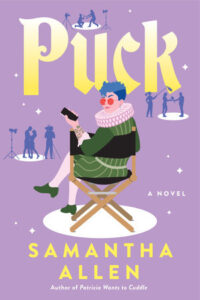
Puck by Samantha Allen is available from Zando, an imprint of Penguin Random House.

Samantha Allen
Samantha Allen is the author of Patricia Wants to Cuddle (Zando, 2022) and the Lambda Literary Award finalist Real Queer America: LGBT Stories from Red States. She is a GLAAD Award–winning journalist whose writing has been published by The New York Times, Rolling Stone, CNN, and more. She lives with her wife and hairless cats in Seattle.