What Co-Writing a Book on Shakespeare Taught Us About Marriage and Parenthood
Charles O’Malley and Scott W. Stern on Balancing the Demands of Publishing and Family
There was, last fall, a lot pulling us to see the movie Hamnet—the Shakespearean subject matter, the caliber of the actors, the breathless reviews—but, as the parents of still-relatively newborn twins, we were dreading it. It’s hardly a spoiler to mention that the plot of Hamnet centers on the death of one of William Shakespeare’s twins. The scene was genuinely awful to watch, but the movie—a story of plague, passion, period costumes, and an unwashed man in a tunic skipping town to cure writer’s block—ended up thrilling us; the portrayal of two creative minds working together (and apart) was, oddly, familiar.
For the past five years, we worked together on a shared project: we were co-writing a nonfiction book about Margaret of Anjou, a character who appears in four of Shakespeare’s plays. More a Gertrude than an Ophelia (but, in truth, unlike either), Margaret was the French-born queen of England during the Wars of the Roses, leading armies and stabbing rivals and cheating on her kingly husband. She speaks more lines than any other female character in Shakespeare (more than Macbeth or King Lear, in fact, though fewer of course than Hamlet) and is the only one of his characters whose entire life, from youth to old age, is depicted onstage.
Despite all this, she remains little-known by most modern playgoers and was for centuries routinely cut from her one popular play, Richard III. (Her other three, Henry VI, Parts 1, 2, and 3, are far less frequently produced.) The juxtaposition between the richness of her character and the poverty of her depiction motivated us to spend the better part of a decade delving into the period of young Shakespeare’s life depicted, most recently, in Hamnet.
The act of co-writing a book became inseparable from the state of marriage itself: the compromises, the rethinking of assumptions, the necessity of time together and apart.
Neither of us had ever collaborated on an undertaking of this size before, much less with a spouse. We decided to embark on this project in a fit of apparent post-plague optimism, on our first vacation since the pandemic began. It was the summer of 2021, those heady days just after we received punishing injections care of Johnson & Johnson, and Charlie mentioned to Scott, almost casually, that he would, in fact, like to collaborate on “the Margaret book.”
She was a character Charlie had been thinking seriously about since graduate school. He almost wrote his dissertation on her, and when he chose not to do so, Scott (we had just started dating) encouraged him to devote to her a whole book. Charlie demurred, repeatedly, and Scott—who was finishing up his most recent nonfiction book and in the market for a new project—proposed that we co-write it. The tale of Margaret could be a marriage of backgrounds: Charlie would receive his doctorate in drama that year, while Scott had written two nonfiction books on the history of gender and violence. Eventually, Charlie said yes. Our wedding, incidentally, was two months later.
Newly wed, newly bound in shared literary enterprise, we did what so many writers—including William Shakespeare—have done over the centuries: we moved. In our case, to a small, sunny, glorified studio apartment in San Diego. There, during evenings and weekends and other breaks from our day-jobs, we started to research and outline.
The experience was markedly distinct from, say, that of young Will and Agnes as depicted in Hamnet. We did not live a hundred bump-and-brigand-marked miles apart; instead, we shared a tiny home with an unsettling absence of doors. We took inspiration not from our personal tragedies but rather from the imaginary burdens of others, as memorialized by a man who’s been dead for over four centuries. We settled quickly into a routine: Scott worked on the couch, Charlie at the table. We accumulated research materials, exploiting several different universities’ interlibrary loan services, including a remarkable willingness to mail books (a vestige of the early COVID era). We refined our idea, settled on a structure. Eventually, we divvied up each chapter into various chunks and began to write.
The coming years represented a learning experience as much as they were a period of productivity. We realized, for instance, that Scott liked editing, while Charlie was far more amenable to actually being edited. We drafted independently and then revised and rewrote each other’s work, seeking to smooth two distinct styles into one authorly voice. In the meantime, we moved again, this time to Oakland. The chapters came together. We started new jobs. We bought a house. We sold the book proposal. We finally found a title.
Then, suddenly, another long-running spousal project bore some fruit: the surrogacy agency with which we’d been working since our time in San Diego let us know that we would soon be the fathers of two boys. We were, like Shakespeare, going to have twins!
What had been a fairly languorous approach to writing took on an urgency: We had a deadline, imposed not by contract but by biology. We finished the first drafts of our last chapters just weeks after hearing the news; we sent our editor a full manuscript in the throes of the second trimester; we received preliminary edits just days after receiving various neonatal test results; we spent that spring of 2024 furiously revising, the clock ticking down as a late summertime due date loomed.
Now, there is hard, physical proof of our years of collaboration—not a third child, as some have joked, but not not some kind of offspring.
In the end, we missed our deadline, a fact due less to our planning than to the unplanned exigency of a hectic, preterm delivery (all worked out fine!). We therefore spent the first months of parenthood squeezing edits and rewrites into the interstices of two babies’ sleep schedules. Luckily, newborns sleep a lot.
Today, the boys are almost two years old. They sleep less. We will be shlepping them along for our book tour, a whirlwind of which they will retain no memories. The daunting task of planning a book-talk is leavened by the more quotidian obligations to identify playgrounds by every bookstore and locate babysitters to hold down the hotel room while we’re off hocking copies.
To friends and strangers alike, our unusual authorly posture—two spouses, both with academic backgrounds but neither presently working in academia, teaming up to write a trade book on a literary subject—is a source of bemusement. Our decision to do so, and our process, and how did you stay married through the whole thing, often inspires more questions than does the book itself.
To be candid, our process was not terribly dramatic—there were no big fights, no couples counseling—other than the drama of racing to complete the project (or, at least, most of it) before the kids were born. Instead, the act of co-writing a book became inseparable from the state of marriage itself: the compromises, the rethinking of assumptions, the necessity of time together and apart.
It seems unlikely we’ll ever do anything quite like this again. We’ve both begun new, independent writing projects. But the first years of our marriage will forever remain “the Margaret years.” Memories of those early, exhausting days of fatherhood cannot be extricated from the challenges of rewriting a particularly thorny vignette. And now, there is hard, physical proof of our years of collaboration—not a third child, as some have joked, but not not some kind of offspring.
____________________________
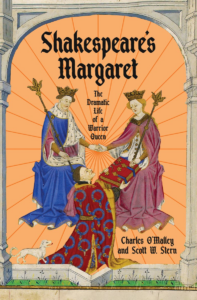
Shakespeare’s Margaret The Dramatic Life of a Warrior Queen by Charles O’Malley and Scott W. Stern is available from W.W. Norton & Company.

Charles O’Malley and Scott W. Stern
Charles O’Malley holds a doctorate in dramaturgy and dramatic criticism from the Yale School of Drama and has worked at theatres across the United States. He is the editor of Toward a Just Pedagogy of Performance.