







Five Essential Books for Understanding the History of the U.S. Supreme Court
Rachel A. Shelden on the Political History of the Court
Today’s Supreme Court is widely thought of as the final authority on the U.S. Constitution. But in its first 100 years, the Court played a very different role in American society. Early Americans rejected judicial supremacy; instead, they insisted that the people retained that ultimate power to say what the Constitution is and what it means. Throughout these early years, Americans actively and self-consciously participated in a wide-ranging conversation about the contours of their Constitution through popular politics. Elected officials debated constitutional issues in Congress, state legislatures, and local assemblies. Political parties made constitutional interpretation the centerpiece of their platforms and campaign strategies. Newspapers featured articles and op-eds about constitutional problems. And average Americans wrote, talked, toasted, and demonstrated about their constitutional views.
How did the Supreme Court fit into a political culture in which the people retained the final word on the Constitution? That is the question I set out to answer in my book, The Political Supreme Court: A Forgotten History. What I found was that the justices were fully integrated into the political world because the Supreme Court was designed and operated as a political institution. Members of the Court served in a political capacity by acting as judicial representatives. Nineteenth-century justices were required to “ride circuit”—meaning they served concurrently as judges in the nation’s circuit courts, creating a balance of regional interests when the Court met in the capital. Both on circuit and in Washington, justices represented the ideas, norms, and practices of their assigned region. In representing their circuits, justices participated in debates over constitutional meaning both in and out of the courtroom. Members of the Court wrote for newspapers, discussed and drafted policy for congressmen, presidents, governors, and state legislators. They participated in partisan campaigns, and even ran for elected office from the bench.
This political activity was obscured by later generations. At the turn of the twentieth century, proponents of a powerful Supreme Court retold the story of the early justices as apolitical constitutional authorities and that mythology only grew over the course of the next 100 years. Today, much of our constitutional world is organized around judicial supremacy, making the history of the political Supreme Court harder to see. But these five books provide a way in. They show it is impossible to understand the Court without understanding the ideas, practices, and politics of the broader constitutional world in which it has operated.
Larry D. Kramer, The People Themselves: Popular Constitutionalism and Judicial Review
The People Themselves is the best starting point for learning about the limited constitutional role of the Supreme Court in early America. As Larry Kramer argues, in the early years of the nation, it was not the justices who created constitutional meaning, but rather the ordinary citizens who implemented constitutional government. It was up to “the people themselves” to make sense of their Constitution by working with, through, and in response to elected officials. Popular politics was the venue of choice because, unlike today, early Americans did not think about the Constitution as a legal document. The idea that courts—and especially the Supreme Court—could review constitutionality developed slowly over the course of the nineteenth century, and always in conversation with popular constitutionalism.
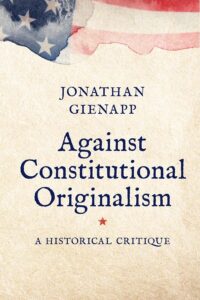
Jonathan Gienapp, Against Constitutional Originalism: A Historical Critique
Anyone with a passing interest in the Supreme Court’s decisions knows that a majority of the justices are self-professed “originalists”— that they evaluate the Constitution based on the original meaning of the Constitution. These justices draw on the constitutional past in order to make modern-day decisions. Unfortunately, their history is not very good. As Jonathan Gienapp’s shows in his devastating critique, originalists have created a past that is only compatible with assumptions they make in the present. What makes Gienapp’s book particularly effective is that he takes originalism seriously in order to dismantle it. Modern-day originalism has many forms; both constitutional theorists and the justices themselves understand and apply originalism in different ways. Among many other strands, some focus on the intent of the founders, while others consider what the public meaning of the constitution would have been at the time of ratification. Against Constitutional Originalism is a primer on each of these approaches and their failings.
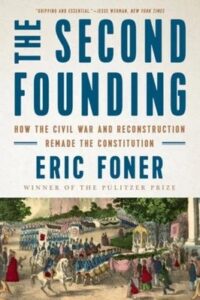
Eric Foner, The Second Creation: How the Civil War and Reconstruction Remade the Constitution
The founding era looms large in originalist theories of constitutionalism. But it is really the second founding—the Reconstruction era—that has formed the basis of much of our modern constitutional order. These were the years when Congress drafted and the people ratified the Thirteenth Amendment abolishing slavery, the Fourteenth Amendment establishing birthright citizenship and extending equal protection of the laws, and the Fifteenth Amendment granting Black male suffrage. Eric Foner’s short and readable book recounts how Congress drafted these amendments and, in the years that followed, the ways that the Supreme Court undermined them. The Second Creation also tells the story of how the Court’s modern jurisprudence became infused with a large catalogue of racist scholarship produced by Reconstruction’s critics at the turn of the twentieth century. Even though historians have thoroughly revised and debunked this older scholarship, it looms large in Supreme Court precedent.
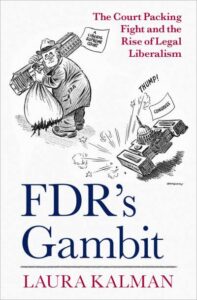
Laura Kalman, FDR’s Gambit: The Court Packing Fight and the Rise of Legal Liberalism
Opponents of Supreme Court expansion invariably use President Franklin Roosevelt’s plan to add up to six additional justices in 1937 as a cautionary tale. The standard story is that FDR engaged in a prideful effort to shift the Court’s jurisprudence by adding members; the plan failed when the bill was shut down by a public unwilling to accept what they referred to as “court packing.” This failure, so the story goes, thoroughly embarrassed the president. Kalman’s book is an important corrective to the mythology around FDR’s plan. She shows that his effort to reform the Court was not a failure. Instead, FDR’s shrewd “gambit” came very close to passing and ultimately struck fear in the minds of the justices. In addition to a lively retelling of the political maneuvering that led to real success, FDR’s Gambit explores how the narrative of failure developed over the course of the twentieth century. Kalman reminds us that politics always has an influence on judicial decision-making in one way or another.
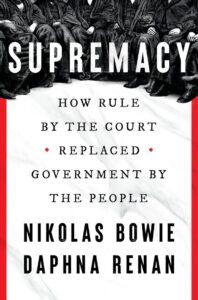
Nikolas Bowie and Daphna Renan, Supremacy: How Rule By the Court Replaced Government By the People
So, if the Constitution used to belong to the people, how did we get where we are now, with a Supreme Court that exercises final authority? Supremacy tells that story. The primary vehicle for change, according to Nikolas Bowie and Daphna Renan, was judicial review of congressional legislation—or “horizontal review.” Although the Supreme Court had long practiced “vertical review”—review of state laws and decisions—justices were loath to invalidate federal statutes in the eighteenth and nineteenth centuries. But in the past 150 years, members of the Supreme Court brazenly seized constitutional power by increasingly engaging in horizontal review. In the years after Reconstruction it was white Southern reactionaries and their northern allies who helped facilitate this move toward horizontal review. But in the twentieth century, liberals abandoned the distinction between horizontal and vertical review—with serious consequences for democratic constitutionalism.
__________________________________
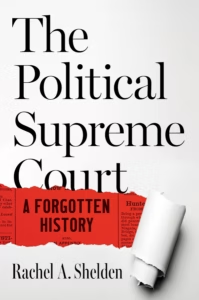
The Political Supreme Court: A Forgotten History by Rachel A. Shelden is available W. Hodding Carter III Books.

Rachel A. Shelden
Rachel A. Shelden is associate professor of history and director of the George and Ann Richards Civil War Era Center at Penn State University. She is the author of The Political Supreme Court: A Forgotten History.