The Artist’s Room Is Not a Neutral Space
Demetris Papadimitropoulos on Imogen Crimp’s Give Me Everything You’ve Got and the Danger of Being Invited Inside
At the BFI, Ruby has barely finished showing her film before the tax is levied: which parts are real? The interviewer wants origins, autobiography, the little certificate of suffering audiences sometimes seem to require before they trust invention. Ruby thinks of Hitchcock putting a light inside Cary Grant’s glass of milk so that it glows. “Film’s an illusion,” she says. She says, too, “I invent things.” A perfectly good answer. Doomed.
The ritual is familiar enough to seem harmless. At readings, Q&As, profiles, and festival interviews, the question recurs: where the story came from, which character is secretly the maker, what was lived, what was borrowed, what was survived. Often this passes for intimacy. Sometimes it is intimacy. But the question has other manners too. It asks the artist to open the suitcase. Show us the wound. Declare the source. Tell us what you paid for this. A made thing is admired, then frisked for biography.
Imogen Crimp’s Give Me Everything You’ve Got takes that small public shakedown and builds a house around it. Ruby, a young filmmaker, is invited to the country home of Ellen, the celebrated feminist director she idolizes. Ellen offers what every young artist knows how to desire before knowing whether it is safe to want: attention, proximity, a desk, a view, a room in which to become serious. The offer is generous. That is the trouble. The danger begins before mentorship has separated itself from help.
Ruby’s longing for Ellen is embarrassing because it is so legible. Ellen is not merely successful; she is formative. Ruby found her films when she was young and learning to be angry. Ellen’s work taught Ruby something about how to look, which is to say something about how to be. To be noticed by such a person is not only to be professionally blessed. It is to have the self that art helped assemble acknowledged by one of its original makers. Ruby blushes when she sees Ellen in the audience. She imagines, with an awful inward brightness, Ellen saying she is proud.
This is where Crimp is merciful. She does not mock the wish. She knows that wanting to be chosen by power is not simply vanity with a better haircut. For a young artist, being chosen can alter the material facts. It can mean the fellowship, the introduction, the recommendation, the money, the confidence to keep going. It can mean the room. Ambition here is never cleanly separate from need.
Ellen’s invitation is almost maternal in its completeness. She books the train, sends a cab, waits outside the house. The house itself has the force of an institution pretending to be a home: red brick, roses, sash windows, grounds, stairs, rooms whose purposes are not immediately obvious. Ruby, who tutors rich children for money, knows enough to read the grammar. Excess becomes invisible to the people who inherit it. A room no one needs is not emptiness; it is class made spatial.
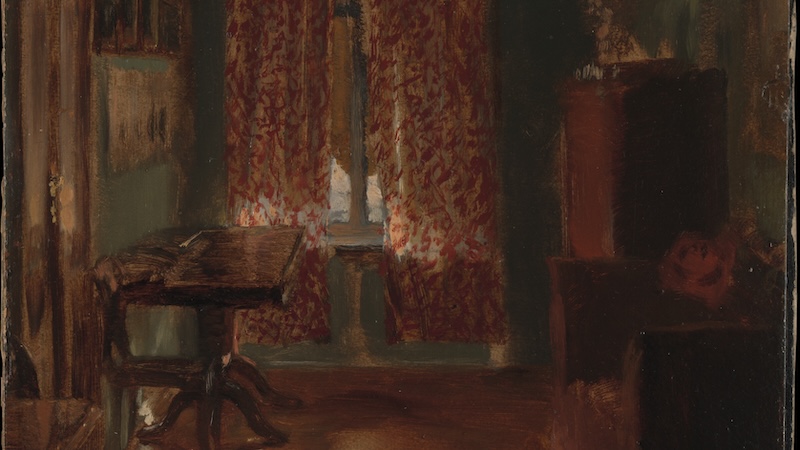
Then comes Ruby’s bedroom, the object at the center of the spell. Wooden floors, a woven rug, terra-cotta walls, a fireplace arranged with candles, a desk before an open window. Towels folded at the end of the bed. Blue flowers on the mantelpiece. Ruby thinks, “this room is mine,” and the sentence is lovely, foolish, and entirely understandable. The room is hers in the way a loan can be yours: intimately, temporarily, and with consequences arriving later in smaller print.
Virginia Woolf is not optional here, though she needn’t be allowed to take the best chair. A Room of One’s Own: the old Woolfian bargain of money, privacy, and time, the material dignity without which genius becomes another cruel joke played on the poor. Crimp does not sneer at that inheritance. Her novel is too serious about art, and too alert to precarity’s humiliations, to pretend that rooms do not matter. Ruby needs quiet. She needs money. She needs protection from rent, interruption, freelance panic, and the exhausting comic labor of appearing fine. The twist is not that the room is false. The twist is that this room comes from someone else’s house, someone else’s taste, someone else’s desire to supervise what Ruby might become.
For a young artist, being chosen can alter the material facts. It can mean the fellowship, the introduction, the recommendation, the money, the confidence to keep going. It can mean the room. Ambition here is never cleanly separate from need.
The country house is beautiful because it has learned how to make power look like atmosphere. Books, rugs, art, wine, garden, pool, trees, cows beyond the fence: the place gives Ruby the calm of having arrived somewhere already sanctioned. Even her hostess gift, some carefully selected chutneys from a market near her old flat, becomes a tiny class injury. Is it too cheap? Too eager? Too obviously the gift of someone trying to seem casually cultured? It is funny because it is exact. Ruby has entered a world in which every object is also an exam.
The gothic earns its keep here. Not thunder, not cobwebs, not a door that slams itself for union reasons. The trap is tasteful. A woman carries your bag upstairs. A mentor asks intelligent questions. Wine appears. The garden keeps blooming through the heat. Exploitation, in Crimp’s novel, has excellent taste.
At first, Lara seems like a disturbance in Ruby’s fantasy of private election. She is Ellen’s daughter, which is to say she is already inside the arrangement Ruby has only just entered. Ruby has seen her before as a child in one of Ellen’s films. In the bathroom assigned to Ruby, a still from that film looks back at her: Lara, young and hard-eyed, already captured by her mother’s camera, already made available under the protection of art. Ruby expected a child, someone sweet and easily placed. Instead there is a young woman with a dismissive smile, and the authority of someone who belongs to the house because she cannot be evicted from its history.
With Lara in the room, mentorship stops looking like a ladder with wisdom descending. It becomes erotic, maternal, competitive, theatrical. Ellen displays intimacy with Lara in front of Ruby; Lara withholds and then offers attention; Ruby watches with envy, desire, and the alertness of a guest who cannot tell whether she is being welcomed or appraised. She wants Ellen’s approval, Ellen’s attention, perhaps Ellen’s body. More dangerously, she wants to know what it would feel like to be the person Ellen always takes in.
Being taken in, Crimp keeps reminding us, is not the same as being saved. It may only mean entering the circulation system.
The same logic has already appeared in Ellen’s workshop for women in film, where authority gathers under the name of confession. Ellen asks the participants to describe the moment they knew they were female. The prompt makes the room tense, eager, mutually supportive and quietly competitive. Each woman wants to honor the others, but each also wants to say the thing that will matter most to Ellen. Tell the truth, but make it useful. Make it painful, but not messy. Make it personal, but in the correct shape.
Ruby’s own film resists that shape. She is developing a story in which pregnancy and abortion do not become the moral climax, the secret wound, the revelation that explains everything. She wants the experience to be ordinary, consequential without being converted into monument. Ellen pushes back. Producers, too, want what they recognize as a “female story.” Ruby understands the trap with painful clarity: once abortion enters the frame, everything can be made to orbit it. A woman’s story, in that economy, becomes legible when it has been given a wound large enough to organize the lighting.
This is the point at which the novel refuses an easier righteousness. It would be convenient to say: confession bad, invention good; the self must be protected from the world’s vulgar little questions. Crimp refuses that comfort. Power dynamics matter. Trauma shapes art. Bodies and histories do not politely wait outside the studio until the artist grants them entrance. Confession has also been a way for artists to seize authority from systems that preferred them silent, decorative, or safely explained. What Crimp worries over is the difference between confession as freedom and confession as toll. Who decides what an experience means? Who decides when it is available? How much must be handed over before the work is considered serious?
Ruby’s insistence on invention is not a denial of life. It is an attempt to retain authority over transformation. She wants the right to use experience without being used up by its explanation.
Inside Ellen’s house, that argument becomes domestic. Ruby is not only invited to write. She is gradually recruited into the household’s emotional weather. Ellen frames Lara as lonely, difficult, in need of company. Ruby’s residency starts to resemble an assignment. Later, the tasks become almost comic in their plainness: Lara’s personal statement, the lawn, the ordinary maintenance of other people’s lives. This is one of Crimp’s most elegant cruelties. The gothic apparatus does not abolish chores. It reveals them.
What Crimp worries over is the difference between confession as freedom and confession as toll. Who decides what an experience means? Who decides when it is available? How much must be handed over before the work is considered serious?
One of the novel’s sharpest scenes comes when Ellen calls and Ruby, hearing urgency in her voice, runs automatically through the house to find better signal. She hates the eagerness in herself before Ellen even asks. Could Ruby help get Lara working? Could she mow the lawn? The lawn looks fine. That is not the point. The point is the adjustment, tiny and complete. The young artist who arrived for solitude and serious work has become caretaker of someone else’s daughter, someone else’s property, someone else’s peace of mind. The room has not been revoked. Its terms have simply become visible.
Elsewhere, Ruby finds herself wearing Ellen’s gloves and holding Ellen’s scissors by the rosebush. The image is almost too neat, which is part of its pleasure: the protégé dressed in the mentor’s implements, placed gently inside another woman’s labor, standing among flowers that have already been trained where to grow. This is how the invitation revises itself. Not with a contract. With something placed in your hands.
Ellen would be easier to dismiss if she were merely monstrous. Instead, she is perceptive, charismatic, often funny. She sees power where others might sentimentalize talent. She knows how artistic seriousness is distributed, how women are asked to defend their authority, how mediocrity protects itself. She can help Ruby because she understands the system. She can harm Ruby for the same reason. The good mentor and the dangerous mentor are not opposites here; they share a wall.
Crimp gives that wall a passage. In Ruby’s bedroom, what appears to be a cupboard door opens onto a hidden spiral servants’ staircase descending into darkness: an old route of labor, service, and access built into the architecture of privacy. Soon after, Ruby opens her bedroom door and finds Ellen standing there, listening to see whether she is asleep. The room has a desk, flowers, a window, a bed. It also has routes through which other people’s needs can arrive. Privacy, here, has a service entrance.
The house knows more than its guest. It knows how people move unseen. It knows the difference between the formal staircase and the servants’ one. It knows what beauty can cover. It knows how easily gratitude can be mistaken for consent. Ruby has been given a room, yes, but the room is connected to old systems of labor. This is not a subtle symbol, perhaps, but houses rarely are. They are blunt instruments made habitable by curtains.
Through it all, Crimp allows the fantasy to remain desirable. The reader is not asked to sneer at Ruby for wanting Ellen’s attention. Only someone very comfortable, or very dishonest, would pretend the fantasy has no appeal. To be summoned by the artist whose work formed you; to be told your mind matters; to be removed from ordinary life and installed in a beautiful room; to have your own seriousness reflected back at you by a person with the power to make that reflection durable—this is not nothing. It is one of art’s oldest narcotics. Recognition can feel like shelter before it feels like surveillance.
Nor is Crimp asking us to seal art away from life. The problem is not transformation. The problem is compulsory availability: the economy the novel keeps sketching, one that rewards certain transformations most readily when they resemble confession; the mentorship that calls extraction encouragement; the hospitality that offers a desk while placing a bill beneath the blotter. Art can use life without requiring the artist to remain permanently available to anyone who admires the finished work.
The title begins, by then, to sound less like encouragement than command. “Give me everything you’ve got”: the mentor’s challenge, the audience’s request, the appetite the novel finds in artistic seriousness itself, the house’s hidden invoice. The old fantasy of the artist’s room survives the novel, but it does not leave unchanged. Crimp asks what the fantasy can forget: who owns the room, who opens the door, who has been there before, who is allowed to leave, and what kind of self must be placed on the desk before work can begin. The room Ruby wants is real. So are the flowers, the towels, the view, the thrill of being chosen. The mistake is thinking the key is the same thing as ownership.

Demetris Papadimitropoulos
Demetris Papadimitropoulos is a Manhattan based writer and former book publicist who worked for more than a decade at one of the big 5. His criticism and essays focus on literature, queer culture, memory, archives, and the politics of how stories are preserved, revised, and recognized.